
This story, “Magnolia Gobbler,” appeared in the April 1973 issue of Outdoor Life.
I had not laid eyes on a Magnolia State gobbler and was beginning to fear that this fact might go down as history. I understood how Jason must have felt in his quest for the golden fleece — only even that search might not have been as frustrating as trying to corner a bearded patriarch of the forest lights and shadows.
We were hunting in some of Mississippi’s best — and yet little-known — wild-turkey range.
You would never guess by studying a map that the Homochitto National Forest, sprawling some 200,000 acres across seven southwestern counties, would be so starkly rugged and isolated. I found heavily timbered ridges and valleys that might have fit unobtrusively into some of the mountainous terrain of my own state of Georgia. Most of the land is accessible over U.S. Forest Service roads. The Homochitto River flows through the heart of the region, and clear spring-fed creeks grace almost every valley. Two or three decades ago, wild-gobbler hunting in Mississippi was almost finished. The flocks, like those of most Southern States, were confined to a few desolate swamps and other wilderness where, somehow they managed to survive. Helped by stocking, by feed-patch planting, by protection and creation of management areas, and by game programs in national forests and on other large public tracts, the wild turkey has spread over much of the state. More than two-thirds of Mississippi’s counties hold seasons, and hunters took an estimated 9,103 birds last year.
Franklin County, where the bulk of the Homochitto lies, has been among the dozen counties of the state with the largest gobbler kills.
“It would be much larger,” Bruce Brady assured me, “if this national forest were hunted as heavily as those where the most birds are taken each spring.” I had to agree. I had observed that the swamps, flats, and rolling hills along the river showed abundant sign where the big birds had scratched for bugs, worms, and acorns and had cropped tender grass.
Mississippi being one of the states where I’d never matched wits with a wise old tom, I didn’t need any wattle-twisting when Brady invited me to hunt in the second of 1971’s two spring seasons, which extended from March 27 to April 11 and April 17-25. This year’s season runs from March 24 to April 23. Mississippi game officials predict another record season because of last spring’s excellent hatch. They estimate the total flock at 85,000. The limit is one tom a day and two for the season.
Brady, who is OUTDOOR LIFE’S new Southeastern field editor, lives in Brookhaven, Mississippi. One of his first loves is the wild gobbler.
We met by starlight that late-April morning two years ago in the concrete yard of my motel. With Brady was Dr. Jim Stribling, Ed Norwood, and George Pullen, all of Brookhaven. Norwood is associated with the Union Oil Company, and Pullen is a trouble-shooter with Mississippi Power and Light. Under the motel’s floodlights, everyone brought out a jug of coffee, and Norwood set two large paper sacks on the hood of his truck.
“Smells good,” I said. “What is it?”
“Your breakfast,” Norwood explained. “You can either eat it here or after the morning hunt.”
“This guy,” Brady put in, “spends half the night frying country sausage, making biscuits, and putting them together as sandwiches. It’s a sort of ritual, and you’ll never have a better breakfast.”
The national-forest boundary lay only a few miles from town. Where the road forked, Stribling, Brady, and I went in one direction, and Norwood and Pullen in another.
Related: The Best Turkey Calls, Tested and Reviewed
“We’ll meet you back here with a couple of gobblers around midmorning,” they called.
After a pair of miles we parked on a wide shoulder. Gray tints were streaking the eastern sky when we separated, Stribling climbing a slope to a valley beyond, and Brady and I following an overgrown woods road that skirted the brow of a hill and then gently sloped to a creek swamp.
In the growing light, I saw that even this late in the spring, the trees were not fully leafed and frost lay on the ground. Air stirring out of the northwest carried a whiff of icicles.
“These birds have already been gobbling,” Brady whispered, “and I hope the weather won’t discourage them.” With dawn growing brighter, we stopped in a fork of the logging road for 30 minutes. Our ears strained for gobbler sounds.
“A yelp or two might raise something,” I suggested.
Brady clucked a couple of times, paused, and then counterfeited the quick notes of an ardent hen. He uses no artificial call. With his voice he imitates a turkey better than anyone else I’ve heard. He says he learned from Jack Dudley, another Mississippian, who recently yelped and gobbled to a world turkey-calling championship. When Brady received no response, I gobbled my Lynch box. We waited long minutes, hoping for an answer.
“None seem to be within hearing distance,” he finally said. “If it’s all right, we’ll split up and go looking for them.” His suggestion appealed to me. I was cold and needed to get my heat pump going. Then, too, no matter how much you like a guy, gobbler hunting is a lone game. A man can plan his moves without having to consider how it might interfere with the other fellow. When he makes a mistake, he knows he’s got nobody to blame but himself, and nothing is so sweet as walking to a rendezvous with a long-bearded gobbler over your shoulder.
Since we’d heard no turkey sounds, I walked fast for a couple of hundred yards to warm my blood. The trail wound through hardwood forest, skirting a sidehill, to an open spot. I propped myself against a tree where I could scan the cove. After the sound from my movements settled, I hen-clucked on my Turpin yelper. Five minutes passed before I yelped again, a little louder. After 10 minutes I clucked again for the benefit of any iridescent-feathered gent snooping nearby, then two or three minutes later rattled my box with the cacophony of an old tom. After another 10 minutes of silent woods, I was about to move on when I caught a movement out of the corner of my eye. Shifting only my eyeballs, I made out the shape of a turkey. Its cautious steps brought it closer, and I saw a tall, trim hen.
She clucked tentatively, walked on a few feet, scratched at the leaves, and pecked at something. Then she strode on, passing me by less than 30 feet. For another quarter-hour I listened motionless for sounds that might indicate she had gone to a gobbler. I heard nothing more.
Until past mid morning, when the toms usually stop gobbling, I covered a lot of country, calling and rattling. Then I went back to meet my partners and have breakfast of coffee, sausage, and biscuits. Brady had seen two hens. All of us had found plenty of sign, but no one had heard a gobbler.
“It just may be too cold,” Stribling stated. “These woods are full of birds.”
It was getting warmer, and high wispy clouds moved across the sky. Brady looked up.
“Bad weather travels high,” he said. “Hope it holds off for a day or two. I don’t know which is worse — a frosty morning or a stormy one.”
After lunch we scattered, stationing ourselves near roosting sites my partners knew. Sometimes a tom will gobble before flying to roost. When the afternoon is still, you can hear the flap of wings for several hundred yards.
I selected a long ridge below a hilltop game-food patch. The pines were tall and thick — an ideal roost. When the birds are not gobbling, a hunter can accomplish little by moving, so I made a blind and settled in.
Every 20 or 30 minutes I clucked, listened for a while, then yelped-softly at first in case a bird was close. Then I gave a series of loud yelps that might attract turkeys feeding distantly. The afternoon passed. When it was almost dark and the flying-up hour was past, I walked back along the trail to our rendezvous on larger road. In the car headlights we swapped reports. Norwood had heard a turkey fly up somewhere below the slope where he sat. Stribling had pinpointed two birds roosting about a quarter of a mile apart on the edge of a creek swamp.
One was a tom. It had gobbled twice in answer to an owl’s call.
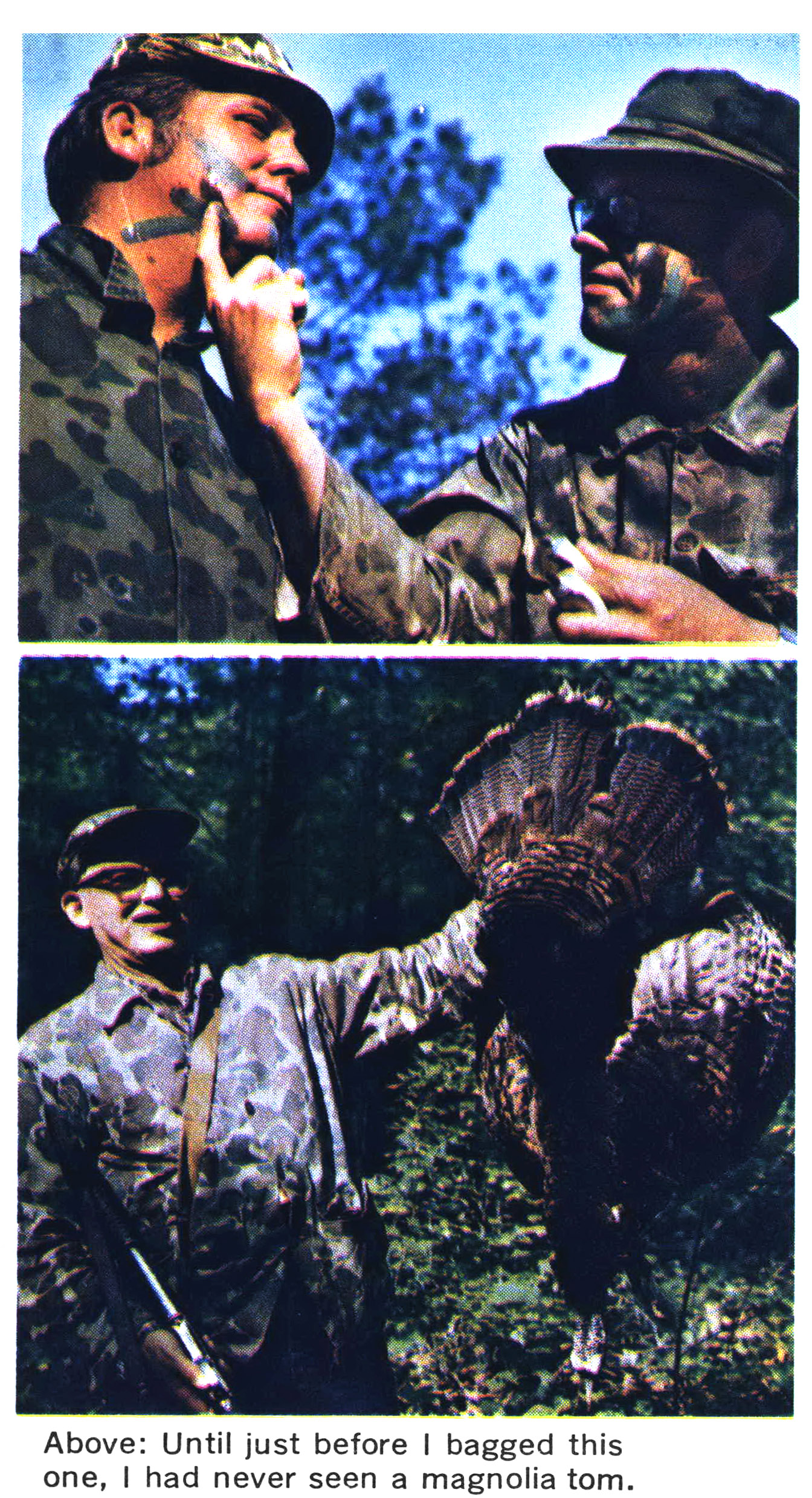
“That’ll at least give us a head start in the morning,” Pullen said fervently. When we pulled off the road again before dawn, not a star showed and lightning flickered to the west. The heavy air smelled of rain. Stribling led the way with his flashlight. The morning was gray enough for me to make out his outline as he stopped and pointed. “The turkeys I heard are somewhere beyond that corner of the field,” he said. “You and Bruce go to them. I’m gonna cut across here to the swamp.”
“What’s the matter with you two going to the gobblers you heard?” I asked. “Let me look for a new one.”
“I’m familiar with this country,” Stribling replied, “and know better than you where to look.”
Brady and I felt our way the last quarter-mile through the meadow to a line of low pines, where we paused to listen. A meadow lay in front of us. Beyond, tall trees were silhouetted.
“Ten to one the gobbler is roosting in one of those,” I said.
“I hope that in a little while you’ll find out for certain,” he whispered. We stood in the growing light. Lightning winked over the horizon, and thunder rumbled. The forest came to life. Then, loud and resonant, a tom’s gobble rang across the meadow.
Brady whispered: “You go to him, and I’ll step down this stretch of woods and listen for the other bird.”
“You take this one,” I said.
Being the sportsman he is, he wouldn’t hear of that. Since it was probable that he would run into the other bird farther down, I didn’t insist but cut through the forest bordering the upper end of the meadow. While I was circling, the tom gobbled twice.
It’s always a question how close a hunter should try to get to a buck turkey before sitting down to call. I have spooked them by approaching too near and have failed to interest them by stopping too far away. Here I tried to find a happy medium between 150 and 200 yards.
It’s always smart to pick out the best possible blind. You want to be well hidden, but not so much that you can’t see. This little swamp was so open that finding a blind was difficult. In the dim light I went from one spot to another, but none was right. I picked the fifth place. It was a large pine, growing on the edge of a shallow gully, with just enough low bushes within 30 or 40 feet to hide me and yet open enough around them for me to see an approaching bird. Behind was a screen of bushes, and beyond stretched grass and scattered pines.
While I had been looking for my stand, the gobbler flew down. I hadn’t heard him fly, but the next time I heard him, he was on the ground and farther away. I clucked but was sure he was too far away to hear me. I imitated the higher notes of a hen, and he gobbled back immediately.
I sat tight. The bird gobbled again from a different place, and I knew he was circling. To give him a better fix, I clucked a couple of times and then made a short series of low hen-yelps. He made the swamp woods ring. He was almost behind me, and I knew he would come in from there.
The approaching storm sent its scouts ahead, a few splattering drops and a gust that stirred the treetops. Thunder rumbled, and the air felt heavy enough to produce a downpour. Because I had no idea how this weather would affect the turkey, I did something that ordinarily I never would have dared do. I slid down from my sitting position into the gully. Then I wormed around to face the pine. I had to guess which side of the tree to put my gun on, and I hoped I was making the right choice. I put my Winchester Model 12’s stock to my shoulder and the 12-gauge tube against the trunk about level with a turkey’s head.
The tom had gobbled about a minute before I moved; then he’d shut up. Ten minutes passed, and the horrible thought grew that the bird had seen me.
A few more raindrops fell. I couldn’t cluck or yelp to find the gobbler. I had called on a Lynch box and Turpin yelper and failed to put the diaphragm call on the roof of my mouth.
More minutes passed, and I was sure I had made a mistake. I considered reaching for my diaphragm call or even my Turpin yelper, but I’d had enough experience with gobblers to abandon that idea fast. When an old gobbler clams up, he’s either going or coming, and you might as well stay put. So I waited.
I was wearing yellow-tinted glasses that pick up more light than my regular cheaters, and I’m sure not even a wood tick could have moved without my seeing it. It was one of those eternal moments when everything seems to hang by a thread or single note of sound. The woods were almost breathless.
It was one of those eternal moments when everything seems to hang by a thread or single note of sound. The woods were almost breathless.
A thick screen of brush lay beyond my gunsights. Occasionally I shifted my eyes without moving my head to glance to the right, should the bird slip in from there.
Then in the brush directly ahead, I thought I saw a leaf move. It could have been a wisp of wind or a raindrop. It moved again, only an inch, and I knew that I was looking at a very small yellow-whitish spot on top of the gobbler’s head.
I remained motionless, trying to judge how far away the gobbler stood. But with only that spot showing, I couldn’t. So I waited an interminable time. It must have taken the gobbler 10 minutes to travel four feet, and still I could see only the top of his head.
Another few feet would put him in the open, and then I would have to shift my barrel a few inches. If he saw that motion, he’d disappear as though the ground had swallowed him. I still had no notion of his distance. But with the raindrops getting a little thicker, I decided to take a chance. Lining up the front bead on his head, I squeezed off a shot as carefully as if I had been using a rifle.
The head disappeared, and I was on my feet, running. I’ve lost some gobblers by not getting there in a hurry. But my bird was flopping no more than 30 yards from where I had crouched and fired my high-brass load of No. 6 shot.
Meanwhile, Brady was busy on his own. Farther down — too far for me to hear — his gobbler had sounded off. Approaching as close as he dared, my partner took his position at the base of a big oak, with a screen of bushes in front of him. Later, he told me the details:
“I removed the cedar box from my pocket and chalked it. I was undecided about trying a call with my natural voice. Suddenly the big tom opened up again. I put the box down, cleared my throat and gave a seven-note yelp, the notes clear and rising in volume.
“The turkey fired right back. I forced myself to wait two or three minutes before making another call. This time I tried three lower yelps and followed them quickly with two clucks.
“I hardly got out the second cluck before the gobbler shook the woods again,” Brady went on. “This time he sounded fifty yards closer. I sat back and waited, certain he was on the way. After five minutes and still no sight or sound of the tom, I began to think I’d made a mistake by not using my box call. Finally I clucked three times.
“Almost at once, to my left, I heard steps in the leaves. Cutting my eyes that way, I saw the big turkey sprinting directly at me. When he closed to within twenty-five yards, I whirled and fired my Browning Sweet Sixteen at his head and neck.”
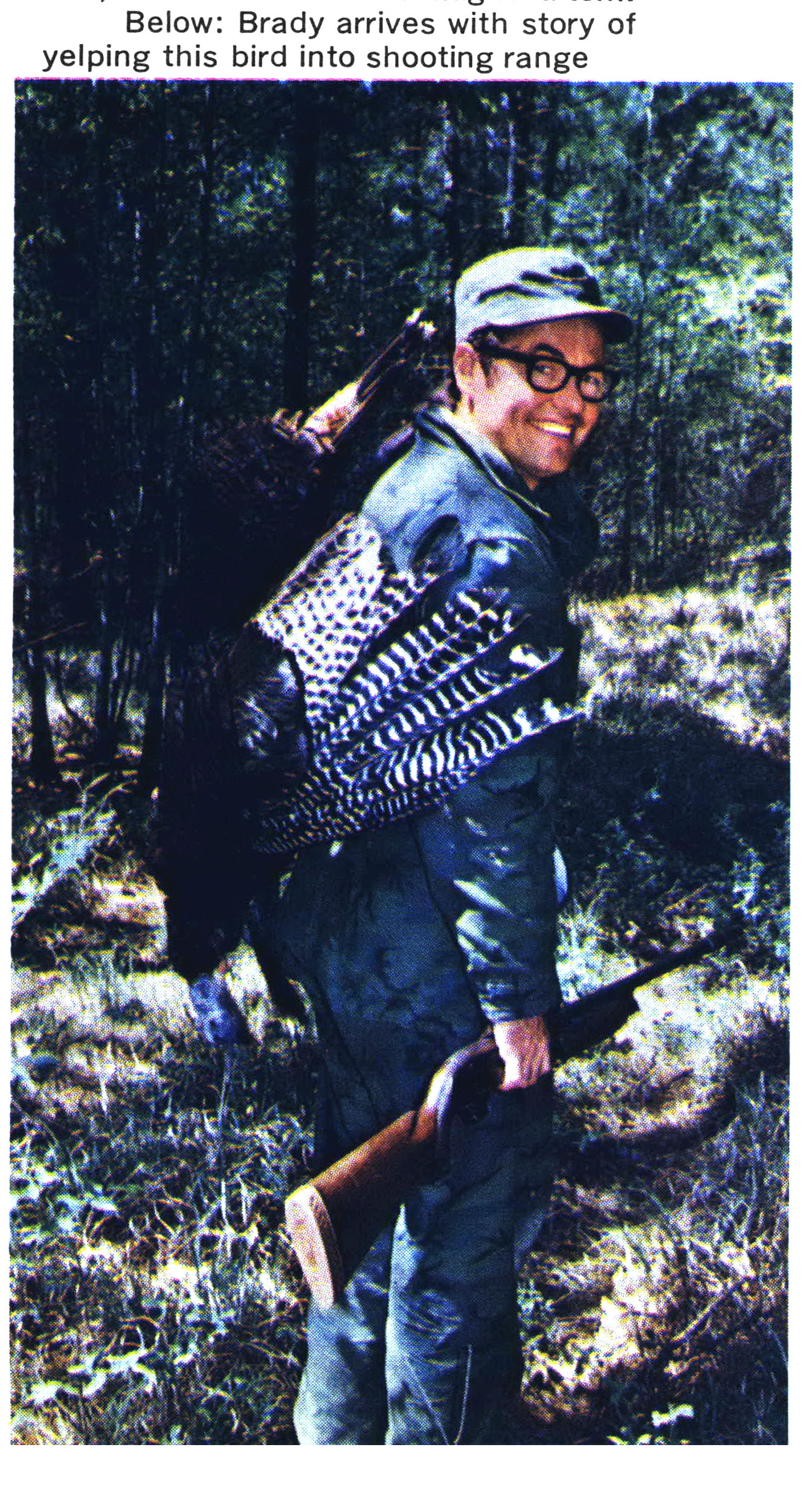
I had heard the shot on my way to meet Brady. He arrived at our rendezvous minutes after me, with the gobbler over his shoulder. It was a beautiful bird with a 10-inch beard.
Read Next: How to Hunt Public Land Turkeys Better Than the Competition
By now the rain came harder and the wind was blowing big. To keep from getting soaked, we walked in the edge of the woods for three-quarters of a mile to where we had parked in the yard of a small church. We reached the porch seconds before a heavy downpour blotted out the woods 100 yards away. Stribling arrived empty-handed in the storm, as wet as if someone had held his heels and dunked him in a pond. Norwood and Pullen had already returned to town without scoring. Stribling brought a jug of coffee from his car, and we celebrated.
Read the full article here