
Modern hunting rifles, which borrow many of their features from the precision shooting world, are optimized for long-range shooting — but they don’t have the handling or ergonomics for making accurate offhand shots. Traditional rifles have great handling — but they don’t have the same level of accuracy for long-range shooting.
These are, at least, the assumptions that so many hunters make about rifles today. That’s why on this week’s episode of the Outdoor Life Podcast, I’m talking to senior staff writer Tyler Freel about whether those assumptions are actually true. Freel recently conducted some simple range testing to decide for himself. Here’s what he did, and what he found out.
Listen to this episode of the Outdoor Life Podcast on Apple, Spotify, or wherever you get your podcasts.
Full Episode Transcript
Alex Robinson: Hey, Tyler. It’s almost hunting season, so I want to talk about hunting rifles.
Tyler Freel: Heck yeah, man. It’s the best time of the year.
Alex: There have just been ongoing, forever conversations about this — way back into the Outdoor Life archives. But I feel like especially right now, in this moment of modern rifle design and a lot of expansion of rifle designs that come from the precision shooting world bleeding into average everyday hunting rifles, there’s a lot of talk and a lot of debate around, well, are these new rifle designs, are these new — in air quotes — new rifle features really better than the old rifles? Like the wood-stocked rifles that our dads hunted with, or maybe that we grew up hunting with. And you’re an interesting person to talk to because you have a lot of good background in reading Outdoor Life and reading Jack O’Connor and all that kind of stuff.
But also, you’re just old enough that you hunted with old rifles. You’re kind of new to new rifles too — these aren’t the first guns you grew up shooting. So you just barely qualify as an old man who can yell at clouds if you want to.
Are High-End, NEW Rifles Really Better Than the Old Ones?
Tyler: Yeah, I don’t know. I seem to get called a kid by a lot of readers who disagree — which, I wish I could be a kid again. But yeah, I grew up in the late ’80s and through the ’90s. So you kind of saw this transition from where hunting rifles were almost exclusively wood-stocked and blued. There were always some variations, but I can remember stainless steel, synthetic-stock rifles were kind of the outlier when we were growing up. And I’ve seen that slowly change. People were mad about that then too, because, oh, if it’s not wood, it’s not a real hunting rifle — that type of mentality.
So this has been going on for a long time. But we’ve transitioned from mostly wood-stocked, blued-steel hunting rifles to almost entirely — there are still some wood stocks out there, but mostly composite, or different polymers, carbon fiber, all kinds of stuff, these modern-material synthetic stocks. And maybe not necessarily just stainless, but a lot of coatings too. So we’ve gone through that, and now we’re seeing a lot more features getting pulled directly over from precision rifle competition. I say precision rifle competition — there are lots of different styles of that, bench rest, but specifically from field shooting, like PRS and NRL Hunter type matches, that have really blown up in popularity in the last decade or so. When I was shooting service rifle, I don’t think PRS existed back at that time.
Related: The Best Wood-Stocked Deer Rifles
And frankly, target rifle features have been pulled into hunting rifles for many, many years. But a lot of people who grew up with the more traditional — when I say traditional, or classic hunting rifle style, I don’t even necessarily mean just wood stocks, but traditional styled stocks with traditional ergonomics, straighter grips, thinner grips. They’re designed to be shot a certain way. And some people are not a fan of the modern stuff for just the everyday hunting application.
Alex: Yeah, and that’s where this gets interesting, because it is so much more than just a wood stock versus a synthetic stock. It really comes down to a feature set that’s integrated into a lot of the new rifles, and then how hunters can use that feature set in the style of shooting that we’re doing on a hunt. So maybe to start us off, just for a clear understanding — go over the key features that in your mind say, okay, this is a modern rifle for a hunter who’s going to be incorporating some of this NRL style into their shooting.
Tyler: The first one that always comes to mind for me is the grip. Now, in these gamer rifles — rifles that are built specifically for NRL Hunter or PRS — a lot of times you’ll see these big, fat, larger grips, and a lot of times the angle is more vertical, as opposed to the straighter angle you’d see on any traditional old Model 70 or something. Those have some variability too, of course, but we’ve shifted to seeing a lot — whether the rifle comes with a vertical grip, or, like, the Browning X-Bolts now come with a grip module that’s vertical, and several others do too. That provides a totally different feel, and it’s designed for a different style of hand placement and shooting than what we probably grew up doing, and what guys like Jack O’Connor taught and kind of practiced.
So the grip is one. This is kind of a mixed bag too, but the fore-end is another, where a lot of times you’ll see either a straight ARCA rail or an embedded M-LOK rail that guys will use ARCA on. There are still a lot of Picatinny rails in use, but ARCA is kind of a great universal fit. It has its roots in cameras, I believe, but it snaps right into tripods, and now a lot of bipods, even lightweight bipods, are made to attach right to ARCA rail. It’s super simple and it just works really well — and kind of in conjunction, especially with a shooting bag, which is becoming more popular for hunters to bring around. Just a lightweight shooting bag, because it really expands the ways you can utilize the terrain and what you have around you for a stable rest.
Related: The Best Shooting Bags of 2026
So this is as much about the style of shooting — changes in the style of shooting, and rifles to accommodate those — as it is the rifles themselves. But grip, fore-end, and you’ll see a lot of oversized bolt handles, which are kind of a minor one. Adjustable combs and lengths of pull are very common now, even in factory rifles, and some of them are more well-executed than others. But being able to adjust that rifle’s fit and the comb height to allow for maybe a slightly higher scope — it’s really common to use 20 MOA slanted Picatinny rails to mount your scopes on, to allow for a little bit more elevation travel. So those are the big ones, I would say: grip, fore-end, adjustability, and features like rails to accommodate longer-distance shooting.
Alex: And is it fair to say that all those features, when added up together, are designed to be implemented in a style of shooting where the shooter is probably clipping into a tripod, or maybe laying prone and shooting off their bipod, or they have a tripod that they’re putting a shooting bag on top of? Basically they’re using these other tools that are really popular in the NRL world and incorporating that into their hunting.
Tyler: Yeah. And having dabbled in NRL and been introduced to it just within the last few years, and having gotten a bug for that type of shooting — if you’re paying attention, you pretty quickly see the advantages of that style of shooting. And it’s kind of just disconnected from how we grew up. You were taught to find a rest if you could, maybe your backpack or a tree limb or something like that, or your sling, where you’re just using these limited tools that can help you. You can develop really good shooting skills, but they’re just not on the same level of the precision and accuracy you can get when you develop skills in this style of shooting. If it was, then everyone would be doing that.
You glean the things that work from competition, because you pay attention to who’s winning and what’s winning in competition as far as just the raw ability to shoot a rifle accurately. And those things are what’s going to benefit you the most, I believe.
Alex: Yeah, and in those NRL games, so many people are using a tripod for such a variety of uses, right? Everybody’s kind of adapting and figuring out their own way, but a lightweight tripod that you can either clip into or put a sandbag on top of and shoot off of is just the cornerstone. When I did my trial NRL run — shot in the open, and it was basically my introduction to NRL — I just practiced deploying my tripod, because I was like, okay, this is the thing that everything grows out of. Every part of the stage evolves out of me setting up the tripod properly, so I’m just going to practice that. And I practiced for a couple hours just deploying my tripod at different heights, just to get good at it.
And when we were growing up, nobody was carrying a tripod into the mountains to hunt with. But now a lot of people do.
Tyler: Well, the key is practicing and becoming efficient with them. And like I said, it goes into a much bigger scope of how you shoot a rifle. For example, what I’ve learned in these styles of competitions is looking for and recognizing certain heights that you can shoot well at for a rest. It opens up a whole new world of different rests that just would not even be in your mind when we were younger, or for the guys who taught us to hunt. And I think it’s important to point out that when we’re kind of dissing or ragging on some of these older methods, that doesn’t mean that they didn’t work or that you can’t kill stuff that way.
I just want to be as effective as I can be. By tweaking and using different methods, we’re constantly on an upward trajectory and improving our skills, and there’s not really a logical reason to ignore that other than just being grouchy. And it’s okay to be grouchy about stuff. But that’s something to point out: we’re not saying older ways can’t work. This just gives you a new perspective on how to operate in the field. Not every hunt I go on is one where I’m going to carry a big tripod, but even a smaller tripod you can use for things that I never would have used them for before. And you even see this when you go — I attended the hunter safety thing with my kid, and they’re talking about, oh, well, you can’t ever shoot prone. It’s a thing that I think is missing in a lot of the modern. Just the way everything is taught is very old school, and that’s okay, but using some of these modern methods sets people up for success. And I’m kind of rambling, so get me back on track.
Alex: No, you’re right.
Tyler: It’s a much larger scope than just new rifle, old rifle.
Alex: Yeah, you’re right on track, actually. The new rifles are really designed to be part of this shooting system that we just described. And the old rifles are really designed to be shot in a system too — it’s just that that system was much more traditional. If you’re going to take a prone shot, you throw your backpack down and shoot off the backpack. If you’re going to take a kneeling shot, you’re resting off your knee. Or if you’re standing, you’ve got to find a tree branch or a rock, or maybe you’re just shooting offhand, which, believe it or not, people used to actually do. And I think the most logical pushback against the new rifles and the system around them is that, yeah, that new rifle system, clipping into a tripod, is great for taking a 600-yard shot. But in practical hunting situations where you just have to make a hundred-yard offhand shot — you see the deer, there he is, you’ve got two seconds to throw your rifle up and make a shot.
I think a lot of folks still believe that those more traditional style rifles are better for that type of shooting. And I think most of us really are shooting 300 yards or closer. A lot of the typical hunting shots are not these longer-range shots that we often see in competition. So you went about trying to test this, which I love — this has become your specialty, taking these arguments and then actually testing them out on the range or in the field for yourself. So talk about how you set this up and what your parameters were.
Related: Are New Hunting Rifles Really Better Than the Old Ones?
Tyler: Yeah. So I wanted to address some of the main critiques of modern-style rifles — the ones that have target-style features like grip and fore-end, and some have detachable magazines, suppressors, stuff like this. I wanted to address some of the biggest criticisms of them and just see if there was really much of a difference when they were used in similar ways. One of the big ones is that people will say these target rifles are fine if you can lay down prone or clip into a tripod, but if you’ve got to just pull up — whether you’re still hunting, which a lot of people do, or you’re in situations deer hunting in the woods where you have a few seconds and you’ve got to just pick up and shoot the animal, or maybe you bump something up and you’ve got to quickly shoot offhand — they’ll claim that modern rifles just don’t point as naturally as some of these other rifles do, as the classic, straighter-grip style rifles do. Kind of like a shotgun points.
So that was one of them I wanted to test. Another one was just straight offhand shooting, kind of slow fire, to see, is there any difference? Because I don’t know. And this is a limited test, it’s kind of subjective, and I just wanted to get a feel for whether the features and ergonomics of these modern rifles made them better or inhibited them in any way. So I had a couple of offhand challenges. The first one, I had three clay pigeons staggered between 45 and 75, 80 yards, where basically on a shot timer, as quickly as I could, I’d get off three shots and try to hit those clay pigeons. And I should have either slowed down or moved them a little closer, because I did not do very well with those.
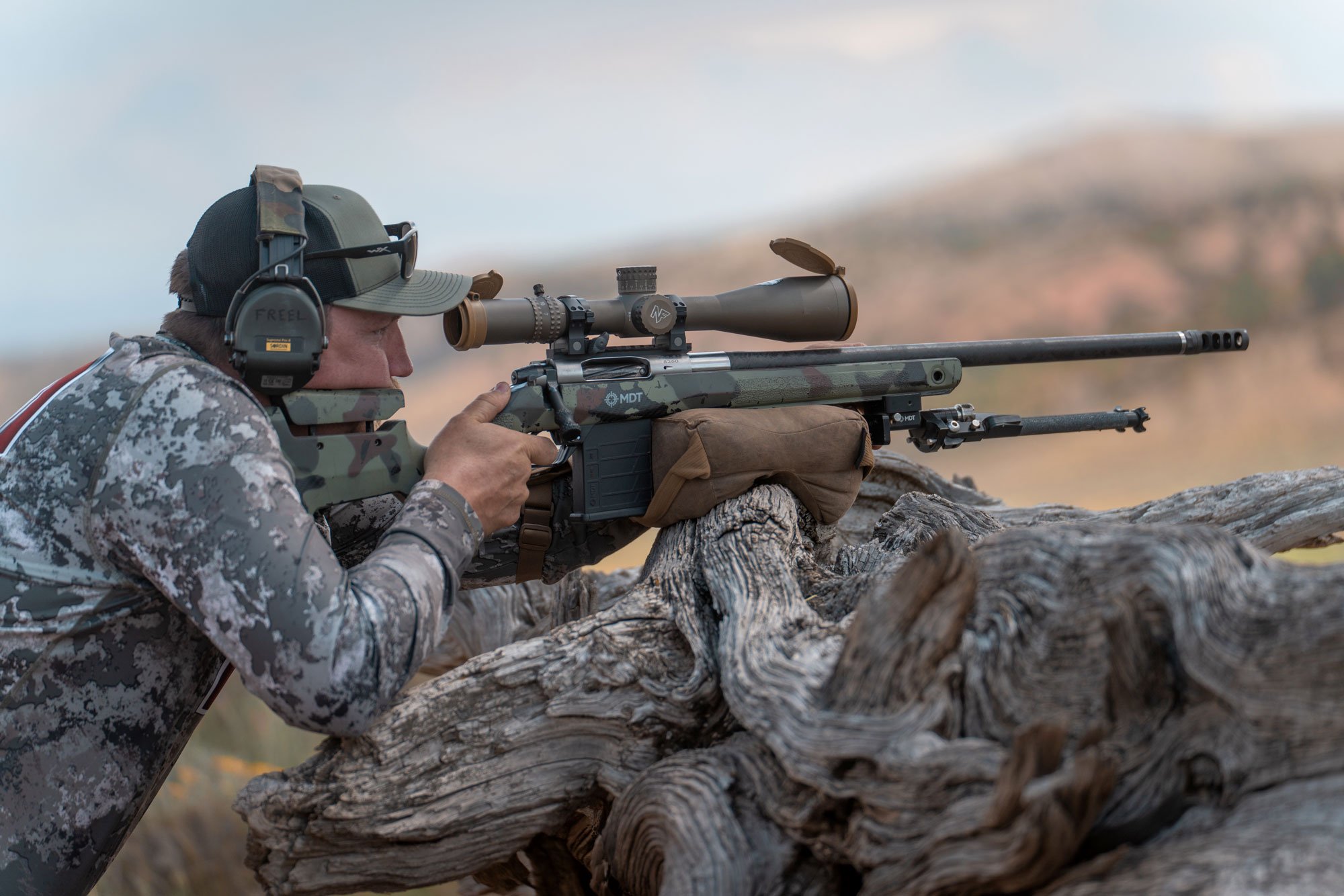
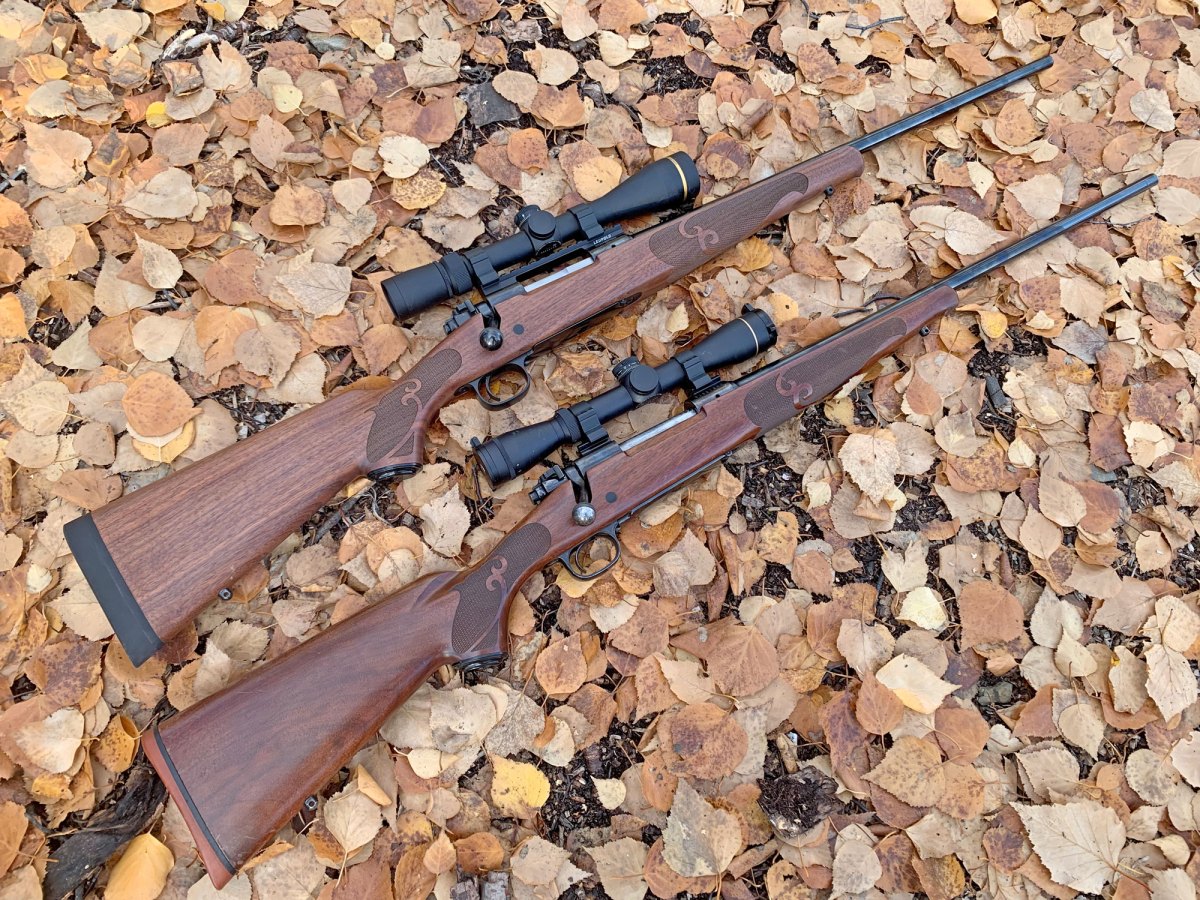
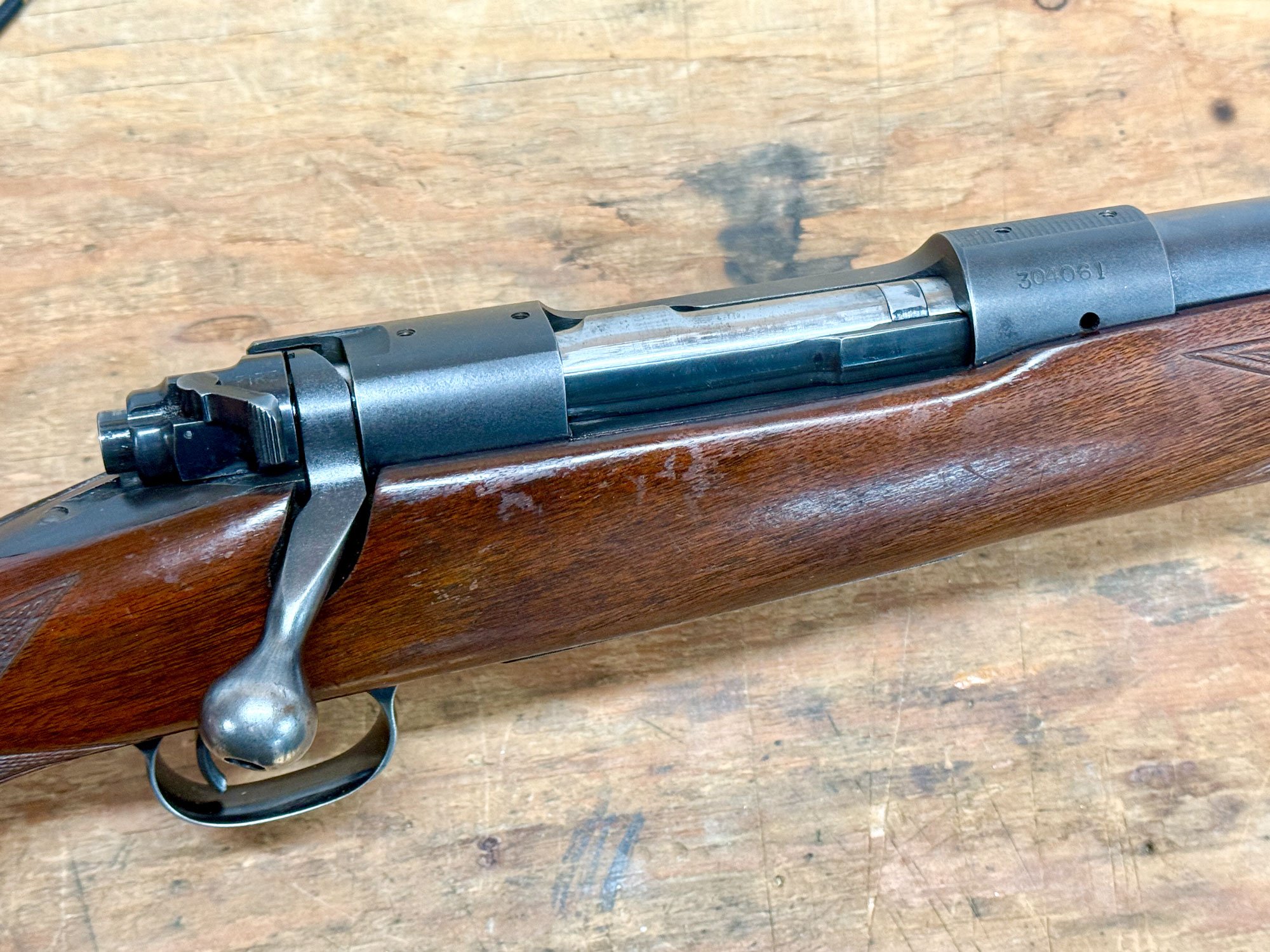
But interestingly, both new and old rifles had the same — well, before I get into results, I did this with four rifles. New rifles were my bolt-action 22 ARC and a bolt-action 300 PRC, both with as modern as it gets, target-style hybrid hunting stocks. In fact, the stock that was on my 22 ARC, I used in NRL and shot a PRS match with that stock this year. And I included, for some of the stages, tripods and fancy new bipods and thingamajigs, where the old rifles just had a sling. So for the old rifles, I had a 1951 Remington Model 721 in .300 H&H, and a 1953 Winchester Model 70 in .220 Swift, and we’ve seen some of those rifles in other videos.
So basically a light-recoiling .22-caliber rifle in each variety, and a heavy .30-caliber magnum for each. So I tested those both offhand, and ironically, in the timed drills with the clay pigeons, I had equally abysmal accuracy results — but the times were basically identical.
If you wanted to, you could always use a larger sample size, have a hundred hunters do this with a hundred rifles, whatever the case may be. But I didn’t really notice any loss in speed of pointing. That .300 H&H has a nice, kind of dainty, thin grip. Both of them have 26-inch barrels. They point really nicely, but that didn’t really give me any increase in speed for getting my shots off. And I didn’t really think it would. It’s just a different feel, something you’re getting used to. If you’re used to carrying it like a shotgun through the woods for kicking up birds, then probably one of those rifles you’re going to think is going to give you an advantage, or is going to be faster. That might not be the case, though.
Alex: Yeah.
Tyler: And as far as just straight offhand, I had a 12-by-12 target at about 225 yards, three shots each. I think I hit five of six with the modern rifles and one of six with the old guns, which mostly I would say is probably due to just factory triggers in them.
Alex: Talk about that difference in the trigger in your modern rifles, and how that plays out on an offhand shot where the reticle is just kind of hovering around the target, versus those older guns, which I’m guessing had heavier triggers.
Tyler: Yeah. I haven’t weighed those old triggers, but they’re functional hunting triggers. And there are two aspects to this. With the heavier trigger, if you’ve got your reticle floating there, the less movement you input in the gun pulling that trigger — you shouldn’t try to time it, but the heavier trigger is just going to be less accurate, because you’re going to put more movement into the gun breaking the trigger. It can be done, but it’s just more difficult. And when you have a relatively tuned cassette trigger that you can clip into any of these rifle actions, and that comes standard on a lot of factory hunting rifles now, it just cuts out a lot of error.
And the other aspect that I think helps with the modern rifles, and this is kind of overlooked, is that a lot of these grip styles and the style of shooting a bolt-action rifle with your thumb either resting on the tang or a lot of times to the right — a lot of these stocks have built-in thumb pads for your thumb to rest alongside, so you’re not putting any torque on or grabbing the rifle at all. But these grips also set up really good trigger geometry, or hand-to-trigger geometry. There are probably different ways of describing it, but basically it’s the relationship of how your hand fits on the grip and how that allows your finger to rest on the trigger. So ideally you can just pull the trigger with a straight-back motion without putting any torque on the gun.
And you can have more classic style grips that do still offer good trigger geometry. But there’s a reason why people doing this precision shooting prefer either steeply angled or vertical grips, and fatter grips, to give your hand a lot of purchase without inputting torque on the gun.
Alex: And you found that to be useful when shooting offhand, right? So it’s not just prone.
Tyler: No, in any shooting situation. The relationship between your finger and the trigger, and how easily that allows you to pull the trigger without torquing the gun — you’re going to shoot better.
Alex: All right. Talk about some of the other drills that you ran through with the old guns versus the new guns. Because I’ll admit, I did kind of think the old guns would win the offhand shooting. What else did you do?
Tyler: Well, the third and fourth drills were both from, I think, about 275 yards. I just had six-inch dots painted on a big steel target, and for each rifle I would shoot at one dot. The first iteration of this was to use each rifle with what it’s got. A lot of fans of just the old way of doing things, or of classic style hunting rifles, say you just need a sling and a backpack, or whatever the case may be. So I did a timed drill where at the beep, I’d shoot my first shot prone, move to sitting, shoot one shot sitting, then move to a barricade and rest on the barricade. I had a little dowel sticking off of there, kind of like a stick off a tree or something.
Related: The Best Bipods, Tested and Reviewed
So for the old rifles, I kind of wrapped up in the sling, prone and sitting, and then rested them straight on the dowel. For the new rifles, on my 300 PRC I had a lightweight bipod, and I had a lightweight, kind of smaller tripod that I would hunt with. And I wanted to see if I could still get acceptable accuracy with the old rifles at a much faster speed — because you’re going to think you’ll be way more efficient if you’ve got less stuff to deal with. That would be my assumption. And that’s the argument we see: all these gizmos and gadgets and toys are fine if you’re shooting from 800 yards, but if you have to set up and shoot quickly, does it really make you faster by just developing your skills with a sling?
And there’s something to be said for that. They were pretty close, but I think the 300 PRC had the fastest time, and that was shooting prone off a bipod with a rear shooting bag, setting up a tripod, clipping into it, shooting, taking that off, moving my shooting bag to the barricade, resting, and shooting on that. That was the fastest time with the best accuracy. And I will point out — because these rifles are going to be at different levels of accuracy. There are old rifles that are really accurate. On average, modern rifles are just going to shoot better. Sorry, that’s how it is. But there are accurate old rifles. So I was just looking at, did I get kind of acceptable hits, reasonable shots with the rifles? And that would be a pass/fail type of thing.
I’m not saying my 300 PRC is this much more accurate than the .300 H&H, so there wasn’t any weight put into that. My 22 ARC, I kind of fell apart on that, and that’s a good example of how the gadgets and gizmos can screw you. So, what happened: I put an MDT CKYE-POD Triple Pull bipod on there, which is really common for NRL and other competitive shooting, and is not a bad idea if you’re in the field and not having to backpack hunt with it. It allows you to set up sitting or even low standing, to set up at a wide variety of heights. And if you watch competitive shooters who are really tuned up on them, they can do amazing things with them.
So I shot the first shot prone and then decided I’m going to shoot sitting with this. And I just floundered with that bipod, because I’d been coming off some recent winter-long recovery and I just have not been using it. And some of these tools — like you mentioned practicing setting up your tripod — they’re extremely valuable, but you have to use them. You can’t figure it out in the moment, because you’re not going to figure it out in the moment. You already have to be pretty fluid at recognizing, like I said, different heights you need stuff to deploy to, and your economy of motion, just how you work with the tools. If you can practice with them, you can be very fast.
I think faster than setting up — because just jumping down and getting in a sling, you’re still dealing with float, and you’re trying to adjust your position to get stable. You’re still having to do all that stuff. So it ends up kind of being a wash if you’re up to speed with the gear you’re going to be using. So that was a pretty interesting one. It was pretty comparable accuracy-wise; like you said, the old rifles still shot well enough, but they are at a speed disadvantage when you’re practiced with your stuff. But if you’re going out with a bunch of new gear you’re not tuned up with, be prepared to be humbled, and it will cause you problems.
So that was the third test, and I thought it was pretty interesting. The fourth test was kind of a repeat, except I shot three shots all off the barricade — from prone, kneeling, and standing, all with the same rest, all just using a shooting bag. And I can’t remember the specific time difference. It was really close, and pretty acceptable results with all the guns. And at the end of the video we put it in there, because I couldn’t live with myself after floundering with my 22 ARC. I ran through that again.
Alex: Which we should say — the 22 ARC is like your baby.
Tyler: It’s my baby. I love that gun.
Alex: You love that gun. You’ve shot it really well at times, so you know it’s there.
Tyler: Yeah. And I’m glad it happened, because it does illustrate that when you’re not fluid with your gear, it can hurt you. It can cost you time. So there’s some validity to the argument that a simpler system has some potential benefits to it. But you also have to develop those skills too, if you’re going to do that. So I ran through with the ARC one more time with the Triple Pull, much more smoothly, and it was basically almost as fast as I did it with the 300 PRC. So I didn’t count that in the results, but my lesson was that, again, you’ve got to be tuned up with your gear. It can give you big advantages if you practice using it.
But yeah, that’s the four tests. I saw that the modern rifle ergonomics — some of these ergonomic features I’ve talked about — can offer you big advantages, in conjunction with the accessories, but you’ve got to be practiced up with using them to gain that advantage.
Alex: Yeah.
Tyler: But the older rifles still work. It’s not like we’re saying throw these old things out because they’re no good anymore, because they do still work. But like the new stuff, you’ve got to develop and maintain some skills.
Alex: Yeah. I think the big takeaway for me, kind of watching this play out and then seeing some of it myself, is that yes, from the bench, just shooting for groups, generally speaking, the new rifles — especially with new cartridges — are going to be more accurate across the board. But that also can, depending on the shooter, translate to more accuracy in the field. Especially a well-trained person using these systems. Watching some of the really skilled, more experienced NRL competitors shoot is amazing. Just how fluid they are, how quickly they’re moving without making it look like they’re moving quickly.
They look like they’re taking their sweet time. And then you look at the time, and it’s just a couple seconds and they’re already on target. So it’s really incredible to watch a skilled person use all these tools. And that, combined with the inherent accuracy of these rifles, really can translate to really good shooting in the field. That being said, like what you’re saying, those old rifles have all the bench accuracy needed in most cases to execute normal hunting shots in the field. The limiting factor with those rifles, again, isn’t really the rifle. It’s the person using it.
Tyler: And what I keep going back to is that some of these ergonomic features help facilitate you — they help you shoot better if you put in the work to use them. And you can get caught up in the weeds. It’s easy to get caught up in the weeds a little bit, because, well, my rifle that I’ve had for 30 years kills my deer every year just fine, so that’s what I’m using. That’s totally fine. But I think there’s value to a higher level of certainty when you shoot. And a lot of these modern stocks are designed to better manage recoil. It’s one of the things I say over and over: recoil management isn’t talking about whether your rifle hurts you or not. It’s just a more modern part of this modern system and method of shooting, where your sight picture is less disrupted.
A lot of times — maybe not at super close distances, but a lot of times — you can see your bullet hit. Whereas when we grew up, you just get ready and you focus on making your good shot, and you get the crosshairs on hair and you yank the trigger and everything goes black and, did I get him? And a lot of times that’s good enough to get the job done. It really is. But I’m not satisfied. It’s kind of like, after seeing what’s possible, that’s not where I want to live.
Alex: Yeah. And if we’re being totally fair about this — this summer, I mean, all of the last two years, we’ve really been republishing a lot of archive content, old stories from the Outdoor Life archive of some really iconic hunters and writers just telling their stories of sheep hunting or hunting elk. And if you actually read those stories, in so many cases the shooting in that story is not perfect. There are multiple shots, or shot over his back and then he ran closer and we got him, or shot and missed and didn’t know why, and then got on him again and shot him. There are so many not-perfect shooting scenarios, that to look back at the old days of rifle shooting, to be fair, you have to include that, because that was part of it.
Related: The Jack O’Connor Archives
Tyler: And I think the big thing this boils down to is — I don’t know how you would phrase this — kind of like looking at memories with rose-colored glasses, or your selective memory. You remember all the good stuff. Even people will refer to, even in the old, old days of Outdoor Life, Jack O’Connor and all this, and put people up on a pedestal and literally think that shooting skills were so much better back in the day. You were just a man and you learned to shoot your rifle and that’s what it was. Most people didn’t. Even the average, even the peak level of shooting was not what it is today. By any means.
So I think there’s some nostalgic stuff there that, like you said, once you really start digging into it — not that I would say people were wrong back then, that’s just how it was. And it just doesn’t have to be that way, especially when you get a taste for the level of certainty and the level of consistency that you can achieve in shooting with some modern tools.
Alex: Yeah. And I think, to be fair on the other side, the modern tools have their place, but sometimes the best gun for the job could be just a lever action .30-30. If you’re going on a deer drive, or you’re still hunting through the woods and your shot’s going to be 50 yards or closer and you just want a gun that’s easy to carry through the woods, that might still be the best option. I think every use and every skill, whether it’s a traditional one or a modern one, still can be really helpful. And someone like yourself, who has real experience shooting a bunch of different ways — that to me is building up to be the complete hunter, the complete shooter. Okay, I can shoot offhand, I can shoot a lever gun, I can shoot a precision rifle, I can shoot off a bipod or a tripod.

On The Gun Tip: How to Use a Shooting Bag
That is hopefully what we’re aspiring to. But to do that, you have to kind of let go of some of the rose-colored glasses thing that you’re talking about.
Tyler: Yeah. And I think there’s room for all of it — old guns, new guns. I like shooting old guns too. It’s not like this war on the past, as I think anyone feels when their favorite thing gets called into question. Their favorite old gun specifically, or cartridge. It’s not an attack on that. It’s just — people claim a lot of things in hunting and shooting, and I think it’s really interesting to take a little bit more objective look at them. Not that this test proved anything, but I think it’s a pretty interesting demonstration that can make you think on a variety of levels, whether you’re all into all the modern stuff or you only want to shoot classic style rifles. I think there are things to learn for both.
Alex: Yeah. And I will say that with the new style of shooting, you can practice so much of that. You don’t have to go to the range and burn thousands of rounds of ammo. Like how I was talking about just practicing setting up the tripod — that’s huge. If your plan for shooting an animal is, okay, I have my lightweight tripod that I somehow have attached to my backpack, and I’m going to deploy that and then clip my rifle into it and shoot — you should just practice doing that, and setting up at different levels on uneven ground, and just get used to taking your tripod out of your backpack, deploying it, and clipping it in. And if you get good at that and do that quickly, when you’re actually on target, you’re going to be so much more relaxed.
You’re going to feel very confident when you see the animal in your scope — versus if you’re fumbling around with your tripod and you’re like, oh no, he’s moving, and now you can’t find him. And then you finally do, and now you’re feeling like, I have to shoot now or he’s going to get away. That can totally mess you up mentally.
Tyler: I’ve done this and seen it happen, where someone with just a hunting rifle with a sling flails. Like, I’m trying to find a rest, trying to set my backpack — oh, that’s not going to work, I’ve got to go to this rock, and oh, this isn’t going to work. And so there are kind of failures and downsides to that too. One thing I did learn from this is that if you want to shoot a classic hunting rifle, or just a non-target-style hunting rifle, you can still adapt some of the gear and methods. Like just a lightweight shooting bag. That’s one thing I found, because the speed was pretty close to the same when I just used a shooting bag as a rest. You can rest it on rocks, just like you would a modern rifle.
That can improve — and again, practice with it, and learn how these different shooting bags are designed to be placed on different terrain and features to give you a really stable shooting platform. But incorporating just something like that, just a lightweight bag clipped on your belt or your pack strap, can improve your shooting dramatically with a classic style hunting rifle. You can just have one of those bags and bag the ball head on your tripod to shoot off of. And honestly, in a situation or a hunt where it’s appropriate or reasonable to carry a larger, standing-height tripod, if I can’t shoot prone, I would rather shoot standing bagged on a tripod than any other position.
And that’s something I had to learn by practicing and trying different positions. I know that a high kneeling height is just my worst — that’s my no-go zone. So either I’ve got to get lower, or I would rather just shoot standing. I shot a muzzleloader mule deer a couple years ago standing off a tripod, in the Nebraska Sandhills, in this grassy stuff. When we were on the stalk, I just deployed my tripod to what I knew would be standing height and had a little bag clipped on the top. And as we creep up this hill — the buck’s on a hillside. We’re down below going up a hill, and there’s a little bowl, and he’s on the hillside beyond the bowl.
And you can see him through the grass. And the guy I was with was like, oh, do you want to get down and crawl up closer? And I’m like, what? No.
Alex: It’s right there.
Tyler: Because I’m going to have to crawl? He’s 150 yards away, or 125 yards away. And I could see him through the grass, but I couldn’t shoot over it yet. So all I did was, I crouched down and popped my tripod legs out, held my tripod, took two steps forward to where my head was above the grass, set the tripod down, and shot him standing. Rather than try to crawl through the grass and then set up a kneeling tripod. There are just different things that you can figure out, whatever rifle system you’re using. I think just viewing it as a system, and practicing with that system or within that system, is the biggest key to success — or to improving your shooting.
Alex: Yeah, absolutely. And now there’s a bunch of adapters — like a swivel stud to ARCA rail adapter. So if you wanted to, you could have that on your gun if you wanted to clip in. Or like what you’re saying, you can shoot any rifle. If you can shoot a muzzleloader, you could shoot a lever gun off of a shooting bag on top of a tripod. You don’t need anything for that. I have a hunt where it used to be that we would carry around shooting sticks, just the two crossed shooting sticks. And I had a hunt where I couldn’t — there’s a big mule deer buck down below me, and I couldn’t get the shooting sticks up high enough to shoot above the brush to get on him.
And I was messing around with those stupid shooting sticks, trying to get a shot on this mule deer that was like 100 yards, 150 yards away, and I should have just stood up and shot him. But instead, I was messing around.
Tyler: Yeah, and that’s the other side: practice offhand shooting too. Because our friend Colton says this too. He’s like, dude, you’re at 100 yards, just pick the rifle up and shoot him. You should be able to do that too.
Alex: Yeah. I mean, I totally could have done that if I wasn’t so focused on trying to get a shot. Oh, well, maybe if I move a little to the right —
Tyler: I have to use my sticks.
Alex: I have to use my sticks. Exactly.
Tyler: That’s something I have learned. NRL is a good example, because you’re coming into blind stages, and unless you’re a gamer and you’ve shot the course before, there are some unknown aspects. You have to find your targets and recognize — in the marked positions you have to shoot from, you have to recognize what you can do with that. And a lot of it is thinking outside the box. You’ve got to be able to have a few different tools. Some guys, if they carry a tripod, cannot shoot unless — like, mentally — I’m using my tripod. And I do that too sometimes. I think the key for me, and it helps a lot of people — you watch really skilled shooters, they can look at a thing, they may have 15 different things they can do, but they’re really good at just being like, that’s a waste of time, I’m just going to do this.
And be able to pivot. Even the buck I shot standing off the tripod — I probably could have just, if I let that enter my mind, it was just like, he’s right there, just stand up and shoot him.
Alex: Yeah. Shooting the open division in NRL, we got to watch some other people go and kind of see how people would shoot a stage. And I can’t tell you how many people would spend time setting up their tripod right next to a giant tree branch — like a super big, stable tree branch that they could just put their bag on top of and shoot at a fairly close target.
Tyler: And use their tripod for rear support.
Alex: Or whatever. But they’ve got tunnel vision of, like, I shoot off my tripod, this is my tripod, no tripod is like it. And they’ve got to shoot off of it. And that can definitely mess you up too — just getting tunnel vision and then not really paying attention to your surroundings. But that happens on both disciplines, new and old. And some of that just comes with experience of having messed up a couple times, and then looking back and being like, oh, well, if I’d just done this, it would have been so much easier.
Tyler: Yeah. I think whatever you’re shooting, it’s the recognition of a mix of building the easiest, most stable position and what’s necessary. It’s funny, because I shot my first PRS match this year, and it’s a different game, where you get to look at everything before you shoot and have a plan. And that’s a good balance, because there are a lot of times where it’s like, no, it’s not worth the time to set this up or that — the target’s close enough where I can just shoot that off a bag on the rock, type of deal. So recognizing that. I don’t know, it’s getting deeper into just the general modern shooting method topic, but you can apply that to old rifles and new rifles.
I think the new ones just offer some advantages and sometimes maybe some disadvantages, but I don’t think those are quite as substantial as most people think. The key to whatever you’re doing is just practicing.
Alex: Yeah. I think the only one that I can really point out that’s a disadvantage is just carrying the modern style rifles in the field, on a hunt.
Tyler: How do you mean? Just like carrying in hand?
Alex: Yeah, carrying in hand, or through brush. If you’re on more of a mountain hunt where you have it strapped in your pack, okay, that’s one thing, that’s fine. But having a bipod on it, or having a suppressor, and having that gun with you and you’re kind of hiking through brush or hiking through terrain and you have the gun either slung or in your hand — to me, they still are a little. And maybe this is just my old man bias, but they are bulky and less nice to carry than the traditional guns.
Tyler: See, I think they just seem that way.

Moose Hunting with the .22 ARC
They can be. But take, for example, my 22 ARC — 20-inch barrel, I’ve got a five-and-a-half-inch or five-inch, tiny little ultralight suppressor. Unless you’ve got a really big optic — and typically, if I’m hunting, like if I’m hiking around sheep hunting in the brush, my bipod is in my pocket or my bino harness and I just pop it on. And QD cups, so I’ve got cups on the side of that thing if I want to sling it. I think there are examples of rifles that can be a little snaggier, and less so, for sure. But on average, I don’t buy it. I think that’s just perception.
You look at that blocky fore-end, and some people just have a predisposition to them not carrying through brush as well. And I’m sure there are examples of that, but I don’t —
Alex: Yeah, that’s fair. I mean —
Tyler: Your wood stock sounds like an antler going through the brush, and your carbon stock scratches. I mean, okay.
Alex: Yeah, I hadn’t thought about that part.
Tyler: There are some noisy stocks that are kind of annoying.
Alex: The wood stock will just bring the big bull moose to you.
Tyler: Yep.
Alex: Yeah, that’s fair. I guess if I was like, oh, I need a modern gun and a bunch of it is going to be hiking through brush or really brushy terrain, you could just design a gun that would be useful for that. It’s not like you couldn’t find one.
Tyler: I don’t know how they are. A lot of them are coming with 20-inch barrels — with a suppressor, your barrel isn’t really any longer than a 24- or 26-inch. I hear that going through brush is such a pain, but I don’t find it to be a pain, I guess. Or any more so.
Alex: Well, you’re just a giant, tough Alaskan dude. You just plow through the brush and don’t even think about it. So maybe that’s the problem.
Tyler: Just put my head down and go.
Alex: All right. I’ve been pestering you about this — you’re doing a moose hunt in the not-so-distant future. And this is like a traditional hunt for you. What rifle are you taking?
Video: Moose Hunting with the 22 ARC
Tyler: I’m going to take my 22 ARC.
Alex: Why wouldn’t you?
Tyler: It’s what I keep going back to. Within the ranges I could be shooting, the bullets I’m shooting — I’ve seen them in action and they’re going to do just fine. And I hate to wear out the term Fudd, but some people would say, well, that’s just your conscience, it’s just because you know better. Because sometimes I’m like, yeah, is this really — but I go back and look at how these bullets perform and the situations I’m using them in. If I’m putting myself at a disadvantage where I might have to pass a shot or two, I guess so be it. I shoot that rifle like a scalpel. Except maybe in the stage where I floundered in this video.
Tyler: That, not so much.
Alex: Well, there is something to be said for a hunt that’s important to you: bringing a rifle that you really love. This is part of the other old rifle advantage, I guess — that those rifles can have meaning, and there’s definitely nostalgia about them, maybe as your dad’s rifle or whatever. And that’s important. I would also say that new rifles can have that too. If you have a rifle that you’ve been shooting all summer and it shoots incredibly, and you’re just really proud of it and happy with it, I promise you that for the entire hunt, you’re going to be looking at that rifle and being like, man, that thing looks amazing. What a great rifle.
Tyler: Yeah. And a rifle that — whether you think you shoot well, as long as you shoot it well enough, it doesn’t matter. People think, oh, I’ve got a half-inch gun, and that gives you confidence, and you really like shooting that rifle.
Alex: It’s kind of good enough.
Tyler: You’re going to enjoy your hunting more. If it’s an actual practice-based confidence — not just, I bought this giant cartridge, so it’s going to do the work for me. That’s a misplaced confidence. But I’ve said many times, that 22 ARC — it’s a mix of things. It’s that stock, and it’s such a good shooting rifle, that it is the most confidence-inspiring rifle. When I killed the grizzly, I had it in a different stock that’s also a good one. I had it in a Manners this spring, because the MDT carbon stock was on my competition gun. But it’s the rifle I killed that grizzly bear with this spring. I’m going to use the same bullets, going like Mach Jesus.
I mean, they’re fast. So within 400 yards I’ve got excellent impact velocities. On a broadside shot, I bet that bullet will pass through a moose.
Alex: Nice.
Tyler: So I hope to test it out. But when that barrel — I don’t know how many rounds I have on that barrel. It’s a lot. And when it finally dies, I think I’m going to go bury that thing.
Alex: Aw.
Tyler: And I’ve already got a new one to screw on there when it finally goes.
Alex: Read a little eulogy for it. All right. Well, I hope you get to shoot it on your moose hunt, and I look forward to hearing about it. Thank you, Tyler.
Tyler: I hope so, too.
The Best Deer Hunting Rifles
Read the full article here