

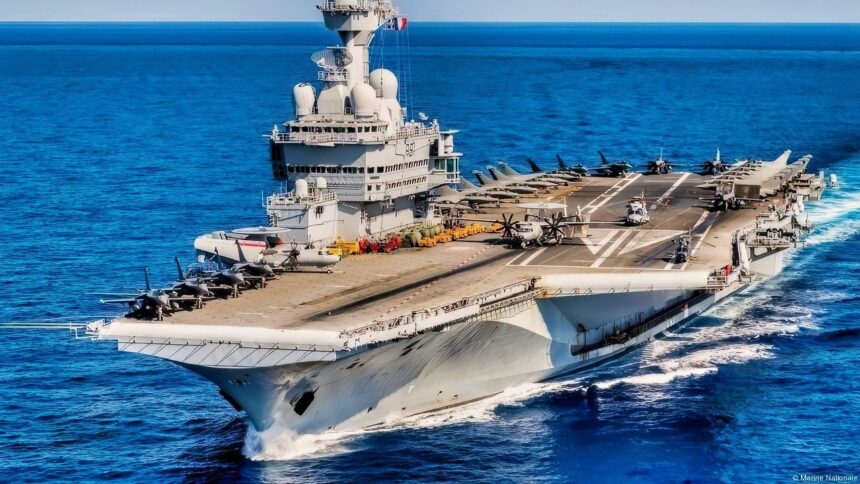
Summary and Key Points: France wanted a nuclear aircraft carrier so it would never have to depend on land bases or allied decks to project air power. It got one, the Charles de Gaulle, the only nuclear-powered carrier outside the U.S. Navy. But the second ship France planned was never built because the first one cost so much, so whenever the Charles de Gaulle is in the shipyard, France has no carrier at all. Now Paris is planning a successor, and the first ship’s troubled birth serves as a cautionary tale.
Charles de Gaulle: France’s Problem Child Aircraft Carrier
Charles de Gaulle is France’s only aircraft carrier, the flagship of the French Navy, and the only nuclear-powered aircraft carrier outside of the US Navy. But getting her into service was not smooth. Ordered at the end of the Cold War to replace the aging Clemenceau-class carriers, construction began in 1987. She was launched in 1994 but didn’t enter formal service until 2001, a full 14 years after construction began.
During that 14-year stretch, the project encountered several problems, including a shifting strategic environment, budget pressure, construction delays, propulsion problems, and propeller failure.
U.S. 5TH FLEET AREA OF OPERATIONS (April 24, 2019) A U.S. Marine MV-22 Osprey assigned to the 22nd Marine Expeditionary Unit sits on the flight deck of France’s Marine Nationale aircraft carrier FS Charles De Gaulle (R 91). This was the second time that Ospreys have landed aboard the French vessel. Marines and Sailors assigned to the 22nd MEU and Kearsarge Amphibious Ready Group are currently deployed to the U.S. 5th Fleet area of operations in support of naval operations to ensure maritime stability and security in the Central region, connecting the Mediterranean and the Pacific through the western Indian Ocean and three strategic choke points. (U.S. Marine Corps photo by Maj. Joshua Smith/Released)

French Aircraft Carrier Charles de Gaulle.
Charles de Gaulle eventually became an impressive symbol of French autonomy, but building her was truly an ordeal.
Pushing for Nuclear
France wanted a nuclear carrier.
Having operated the Clemenceau and Foch since the early 1960s, France needed a replacement by the 1980s.
France wanted to preserve its ability to operate independent carrier aviation rather than rely on land bases or allied carrier decks.
France was attracted to nuclear propulsion for its incredible endurance, sustained high-speed operations, and the increased strategic independence it provides.
Originally, the plan called for the construction of two carriers.
But the second ship was never built because of the first ship’s costs. That decision would reverberate as an availability problem, still felt today.
Compromising on Propulsion
Rather than designing clean-sheet naval reactors, France adapted the K15 reactors already in use aboard French ballistic-missile submarines.
So the Charles de Gaulle uses two K15 pressurized-water reactors, which are great in terms of commonality and cost, but because the reactors were originally designed for a much smaller submarine, they are underpowered for a carrier of de Gaulle’s size.
The ship measures 858 feet long and displaces 42,000 tons.
With the K15 reactor, the top speed is only about 27 knots—considerably slower than American nuclear supercarriers, which can exceed 30 knots.
Speed matters because carriers steaming into the wind contribute to the airflow needed to launch and recover aircraft.
France would eventually compensate with catapult and operational tweaks, but the propulsion choice illustrates a compromise at the heart of the massive project.
Budget Constriction
Construction began shortly before the Cold War ended. Naturally, when the Cold War did end, the French defense budget came under pressure.
Construction of de Gaulle was stopped and started multiple times as funding was stretched.
Ironically, delays increased the overall project cost, as workforce retention costs, shipyard overheads, and changing equipment requirements mounted.
The carrier was eventually launched in 1994, but it would still require years of fitting and testing.
The initial expectation was that the ship would enter service much earlier than its eventual commissioning in 2001.
But perhaps this was all to be expected.
The Charles de Gaulle wasn’t merely a ship that France was building; it was an entire nuclear carrier ecosystem being built from scratch.
Ongoing Problems
At sea, de Gaulle encountered several time-consuming problems.
One involved the flight deck, which was intended to launch both the Dassault Rafale M and E-2C Hawkeye.
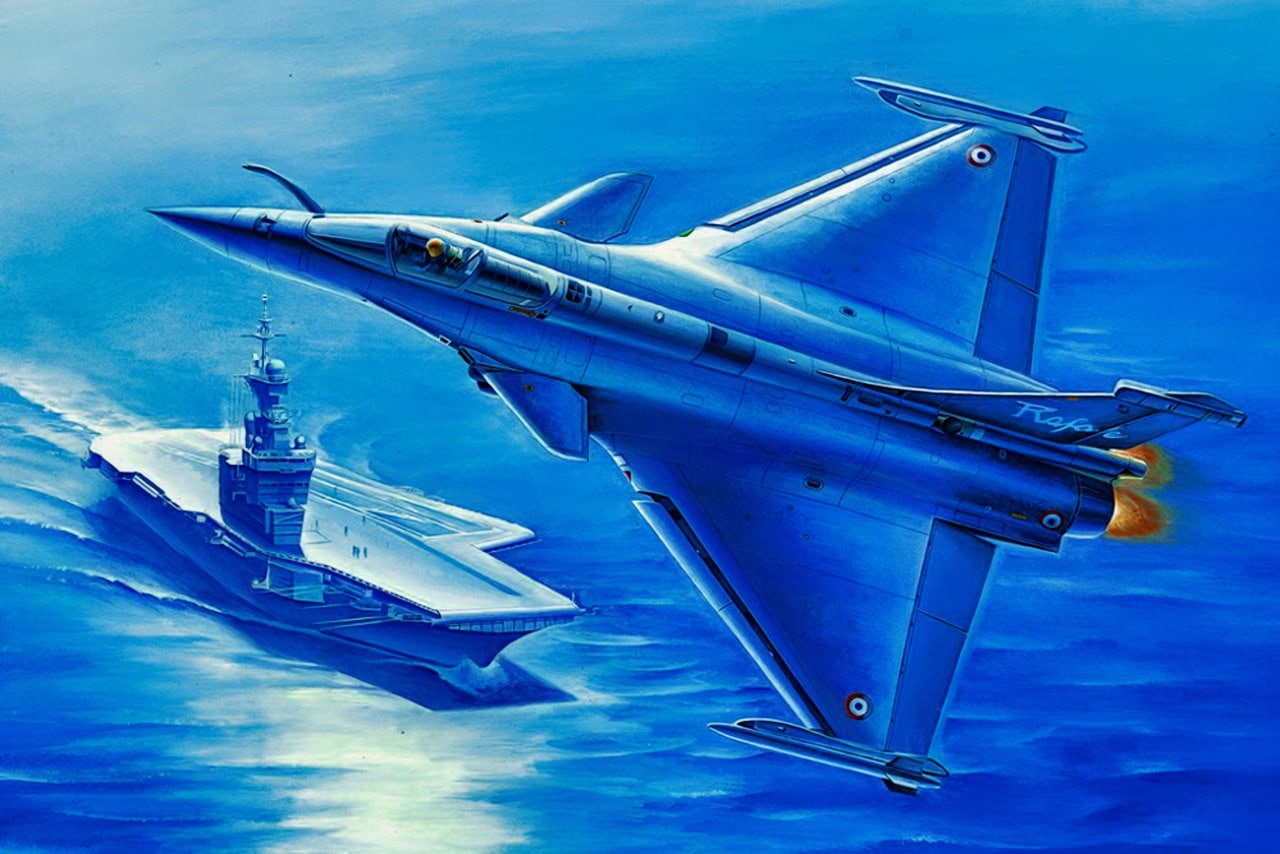
Dassault Rafale Fighter. Image Credit: Creative Commons.
But a problem emerged whereby the existing flight deck arrangement and length were inadequate for safe E-2C operations.
So the flight deck had to be extended by roughly 14 feet.
Obviously, this was a topic of immense criticism: the flight deck was too short for one of the two aircraft the project was designed to accommodate.
The carrier also experienced excessive vibration under certain operating conditions.
This wasn’t trivial—it affected crew habitability, machinery life, sensitive electronics, and aviation operations.
Testing isolated the problem, and changes were made, but it was another example of the project’s shortcomings.
And then in November 2000, the propeller broke.
This forced the ship back to port for repairs and prompted an investigation into quality issues.
France reportedly resorted to temporarily using propellers from older Clemenceau-era equipment, which further reduced performance and delayed operational deployment.
In the end, France commissioned its carrier, launching the only non-US nuclear carrier.
Today, after two decades of operation, the Charles de Gaulle is still serving admirably, though a replacement has been planned: the PANG next-generation carrier, also known as France Libre.

PANG France Nuclear Aircraft Carrier. Image Credit: French Government.

PANG Aircraft Carrier French Navy Photo.

PANG Aircraft Carrier from France. Image Credit: Industry Handout.
About the Author: Harrison Kass
Harrison Kass is a writer and attorney focused on national security, technology, and political culture. His work has appeared in Tablet, City Journal, The Hill, The Spectator, and The Cipher Brief. He holds a JD from the University of Oregon and a master’s in Global & Joint Program Studies from NYU. More at harrisonkass.com.