
“I THINK I see one now,” Roy Tumilson, one of our Idaho guides, said calmly as he pulled up his horse. “Let me see a glass, somebody.” I handed him mine. He steadied his mount with a tight rein and took a long, one-handed look. Then he gave me back my binoculars. “Cow,” he muttered. “Way up there. See the three green spruces together? Well, look to the right about 100 yards and then up. You’ll see a yellow spot right in the middle of a bush. That’s an old cow’s rump.”
“I see it,” Erv Malnarich, the other guide, and Fred Huntington, my companion, both said at once. Then it jumped out at me through the bright 9X glass—the yellowish, dirty-looking rump patch of a lone cow elk. She was browsing with her head deep in the bush, but presently she turned and ambled off along the sidehill, tan and brown, and looking oddly like a camel. The hill was so steep it looked as if she were pasted against it.
“Well, come on,” Erv said. “You guys are bull hunters and anyway, that beat-up old cow is a good half mile away.”
So we continued up the trail, our saddle scabbards feeling good under our legs, our beautiful horses dancing with eagerness. To our left the North Fork of Moose Creek, a famous trout stream, raced and swirled over its rocky bed, and all around us rose the steep and brushy mountains that form one of the finest of all North American elk areas. It’s odd country this, strangely beautiful and curiously repellent.
Once all these mountains around the streams that form the headwaters of Idaho’s Clearwater River were heavily wooded, thousands of square miles of pine, fir, spruce, and cedar.
Once the Clearwater country was almost devoid of game. When Lewis and Clark tramped through it in 1805, the area was so barren of eating meat that they almost starved. Then, in the early part of this century, a series of great fires swept the area, fires that the then recently organized U.S. Forest Service was powerless to combat. These fires opened up the country and later brush began to grow on it. As it grew, the elk and deer that fed on it began to increase.
Old-time residents of Idaho who hunted the area before World War I tell me that in those days a party of three or four men who went into this Selway country for a two-week hunt and came out with one elk were considered very successful. If every member of a party connected, they got their pictures in the paper.
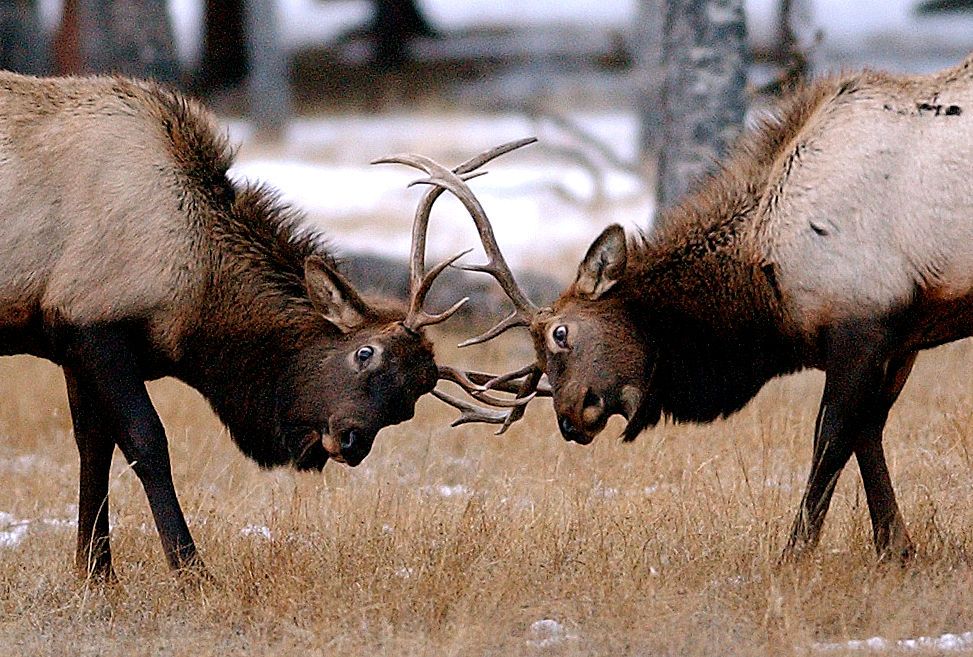
But nowadays hunters take 4,000 to 5,000 elk out of this area every year, and elk are so plentiful that the numbers of smaller deer are declining because they can’t compete with the elk for browse. The Clearwater herd is one of the two largest in the United States and the only one with ample winter range.
Before long we saw other elk, a little herd of cows and calves, eight or nine perhaps, feeding on a steep hillside just below snow line.
“Not a bull among them,” Erv said, watching through his binoculars as the elk browsed slowly over the ridge and out of sight. “The snow’s pushed everything down,” he went on, “but the bulls are higher than the cows generally—right up in the snow. We should see some from the trail today.”
The snow line was perhaps 1,000 feet or so above the trail, and above that, all over the vast Clearwater area, snow lay white and heavy. The day before, when California die-maker Fred Huntington and I were flying in by plane from Orofino, Idaho, we saw the tremendous expanse of snowy ridges cut by a network of purple canyons below. A couple of times we saw big bull elk bedded in the snow of lofty, wind-swept ridges, and the hills were crisscrossed with trails made in the snow by moving elk.
On the first morning of the hunt, we were about an hour out of the ranch where we’d spent the night when, far above us in a basin, we spotted a herd of at least 30 elk. Scattered around in the brush were cows, calves, and bulls. Of the five bulls, three were six-pointers.
We glassed them and saw that the bulls looked good. The plan of attack was obvious. We’d splash across the little stream that came down from the basin, go around a point, then up the side of a ridge and onto a saddle that we could see just above the herd. Nothing to it—and we’d look right down the throats of those bulls.
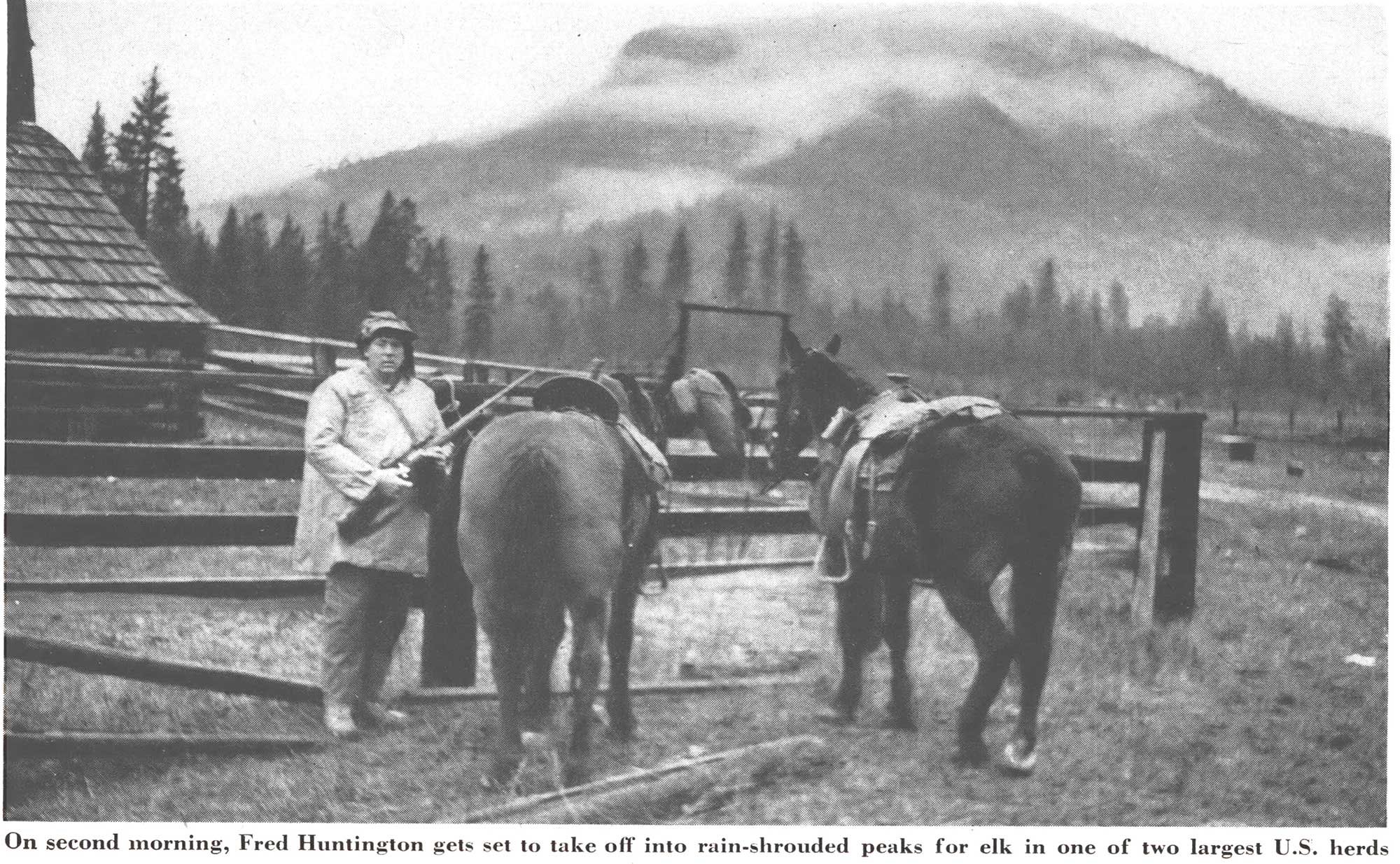
The 1,500-foot climb to that saddle was work. But I was fairly tough because I’d just spent a month riding and sheep hunting in the Yukon, then three weeks hunting pheasant in the rolling wheat country of Idaho and Washington. The hillsides were so steep that much of the time we had to cling to brush to keep to our feet. Erv and Roy were as tough as rawhide. They’d been doing this every day during a long season, and when they couldn’t climb the hills for elk they’d get out their hounds and chase cougars. But Fred and I found the going a bit grim. I’m not as young as I used to be, and Fred, who goes about 250 pounds on the hoof, hasn’t quite the right build for a mountaineer.
Finally we came out on our saddle only to find that the elk had taken off. We could see their trails in the snow, leading over a saddle into another brushy basin below. Then three bulls showed up on a ridge clear across the basin, high above us and at least 1,000 yards away. They didn’t seem particularly scared, but they just weren’t having any. I found a log that kept the seat of my pants out of the snow, sat there, and glassed the three. Magnificent against the skyline, they watched me idly while the cows and calves fed slowly up to the crest and then, one by one, crossed over and disappeared.
Our original plan had been to ford the creek and hunt a lofty snow-covered ridge that overlooked a series of basins and canyons beyond. One of the pilots who flew into the area had seen bulls there a week or so before. But our climb had taken so much time that we simply couldn’t make it.
At noon we were soaking up warmth from a fire beside the creek. And while we munched sandwiches and apples and drank hot tea, our horses caught up on some sleep. We’d seen about 70 elk that morning, and even if we saw no more, we felt we’d had a good day.
Then without warning, Roy stiffened. “For the love of Mike,” he whispered, “look at that big bear up there.”
I saw it instantly, far above us—a little restless, coal-black spot against the snow. I put my binoculars on him, and he looked big and fat and glossy. The hill was fairly open and so steep that I figured we could get the bear easily—just put a bullet in him good and hard and he’d practically roll into our laps.
“Your shot, Fred,” I said. “Take your time and get a good solid rest.” Close beside us lay the butt of a great tree that had been washed down by the high waters of spring, and we each got a good solid rest on it.
Fred was using a blown-out .300 Magnum that pushed a 180-grain bullet along at about 3,000 feet per second, and I was using a light Model 70 Winchester sporter in .270 that Al Biesen, Spokane, Wash. gunsmith and stockmaker, had remodeled for me and with which I’d already killed several elk. I was shooting the 150-grain Nosler bullet loaded to about 3,000 feet per second with 58.5-grains of No. 4831 powder, and I thought the trajectory would be about like that of Fred’s rifle.
“How far is that bear?” Fred asked, settling behind the tree trunk.
“About 500 yards,” I said. “Don’t you think so, Erv?”
“Just about,” Erv agreed. “Where shall I hold?”
“Try three feet over the top of his back,” I suggested. “I’ll see where your bullet strikes and then I’ll touch one off.”
Read Next: The .270 Isn’t Powerful Enough? Jack O’Connor Took His on a 30-Day African Safari
I had a solid rest as I watched the bear through my 4X scope while Fred prepared to shoot. The bear was digging, apparently fixing himself a den for his winter’s sleep. Then Fred’s .300 bellowed, and I was surprised to see snow and soil fly about two feet over the bear’s back. Apparently I’d given Fred a bum steer and was way off in my estimation of range. If he’d held three feet over the top of the bear’s back and was two feet high, I’d better hold just over the top of the bear’s back. I tripped off the shot with a perfect hold, and this time I saw snow and dirt fly well below the bear’s belly.
“Well, I’ll be damned,” I snorted. “You hold three feet over the bear’s back and hit way high. I correct for your shot and hit low. I don’t get it.”
“My fault,” Fred admitted shamefacedly. “I thought that bear was farther away than you guys did, so I held about five feet over the top of his back. If I’d held three feet high I think I would have hit him.”
The crack and smack of the two bullets striking close by and the booming echo of the shots through the great canyon made the bear suddenly remember an appointment he had on the other side of the ridge. Nothing can disappear faster than a scared black bear. It hadn’t been a tough day, but the lights of the ranch looked good as we rode up past the strip where our plane had landed and on toward the corral. Though empty-handed, we’d seen a lot of elk and we’d had the fun of burning a little powder at a bear without the hard work of skinning the critter out. There would be another day.
Moose Creek Ranch, from which Fred and I were hunting, is one of the most astonishing spots in North America. To equal it I suppose a man would have to hunt from a shooting lodge in the deer forest of some Scottish laird, Indian maharaja, or European millionaire. But Moose Creek is open to anyone who wants to hunt out of it and has the price.
The dude ranch is built right at the fork of the main Moose Creek and its North Fork, about 25 miles by pack-trail from the nearest automobile road, and about 45 minutes by air from Orofino, Idaho. The stoves, refrigerator, electric generator, and every morsel of food for horse or humans—all is either flown in or packed in. Even the jeep that takes dudes from the airstrip to the ranch was brought in by plane. It had to be cut in half and then welded together again.
After Fred and I piled off our horses at the corral, we took off our heavy hunting clothes, imbibed a warm and cheering hot rum, then soaked the grime off our hides and the chill out of our bones in hot showers. Erv Malnarich manages the ranch, and his wife Ardie does the cooking. That night Ardie had fixed elk roast, salad, potatoes, vegetables, homemade bread, pie and cake. There was homemade butter and pitchers of chilled, creamy milk. I’ve been on some fairly fancy hunts in my day, but on none have I eaten so well.
This stupendous dinner, on top of a long ride and hard climb, knocked me out that night. I don’t think I even turned over in bed. Then, in that confused and wonderful early-morning interlude between dreamless sleep and complete awakening, I gradually became aware of a booming, muffled by distance like the sound of surf on some faraway coast. Instantly I doped out a dream to match the sound. But a moment later I was awake enough to know I was in the Selway wilderness area of Idaho, not over 100 miles from my home in Lewiston. I was on an elk hunt, and what I’d thought was surf was only the snoring of my old pal Fred.
The first day of our elk hunt had been bitingly cold, brilliantly clear, yet altogether perfect. But on that second morning, after a staggering breakfast, we knew we were in for a different sort of day. We weren’t far up the trail when we saw long, high streamers of clouds tinted orange by the rising sun.
“I don’t much like the looks of this,” Erv said, cocking an eye skyward. “Looks like she’s blowing up a storm.”
On the way up the trail, we saw only a couple of elk, both lone cows. We weren’t much more than an hour out of camp when we hit the ford, splashed across it, and started up a trail that zigzagged over the mountain’s face. Soon we were in snow, and when finally we got on top, the snow was one to two feet deep.
Elk sign was everywhere. Once, far across the canyon, we saw a lone bull feeding. Another time, when we were close to the crest, Erv found with his binoculars a herd of 15 or 20 cows and calves feeding at the head of a high basin.
Every quarter of a mile or so we’d tie our horses and hunt down the ridges, working out the pockets and side draws. We saw a good many cows and calves, but not one bull.
Erv and I were riding well ahead of Roy and Fred when we heard a shot, then another. Turning in my saddle, I saw Fred off and shooting, and Roy signaling frantically for me to go down the hillside. I dragged the .270 out of the saddle scabbard and ran down the hill. In the meantime Fred had stopped shooting because the elk had gone around a point from him and he couldn’t see it.
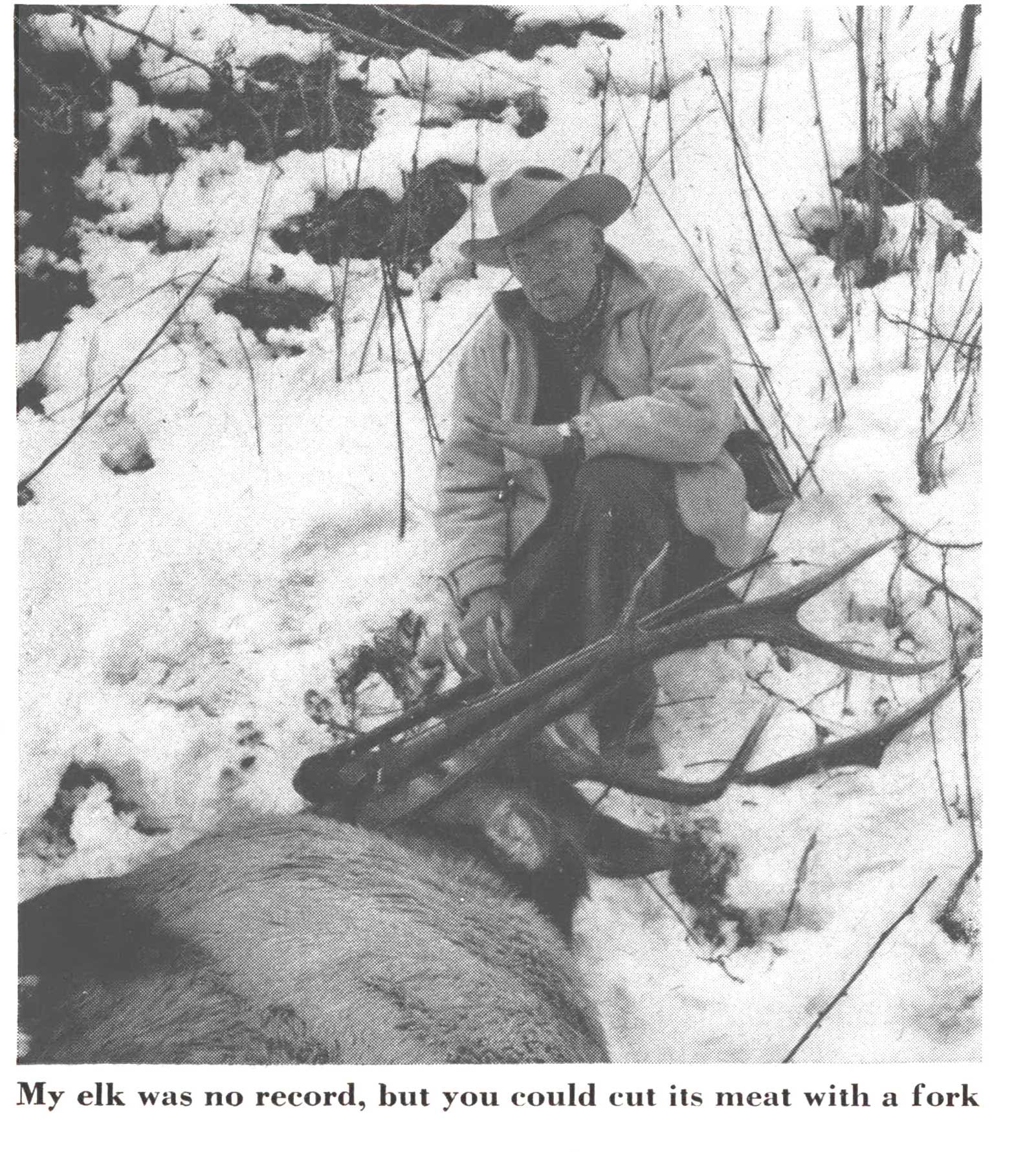
Then, far below me, I saw the elk—a bull that looked like a five-pointer, a two or three-year-old. I slid to a stop and sat in the snow. Holding the crosswires in the scope right on the top of the bull’s shoulders, I squeezed off the shot.
“Whump,” went the bullet. “Hit him,” Erv yelled.
The bull stopped and stood there, head down. I shot four more times with no results that I could see. Then, as I was stoking up Old Betsy so I could open fire once more, he fell.
It was a long way down to that elk, farther than I’d thought, and when we got to it we found it had been hit by only one shot, my first. As the elk had quartered away from me, the bullet entered far back on the left side, went diagonally through the intestines, and just barely hit the right lung before it came out. The four other shots merely tore up the ground in a 10- or 12-inch circle beneath the bull’s belly.
How far was the elk? Darned if I know. But when Fred—who’s no shrimp—started to come down the mountain toward me, he looked like a midget on a high wire.
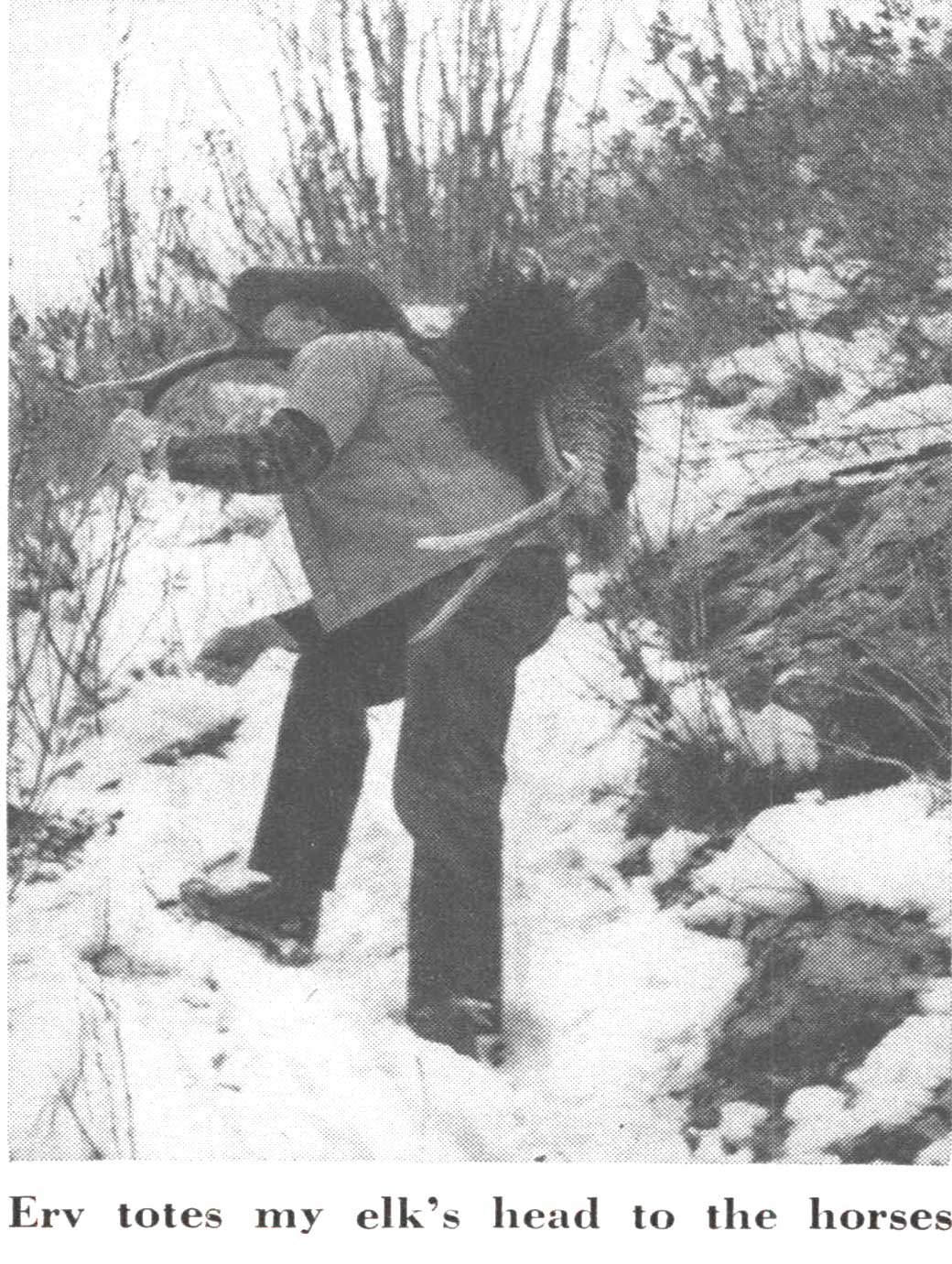
Working rapidly, we skinned and quartered the bull, loaded it on the packhorse, and climbed out of the canyon to the snow-covered ridge trail.
On the way back we saw more cows and calves and another bull. The trail back to the creek was almost like walking down a wall, and as we led those wonderful horses down, they slid a good part of the way.
Next morning rain was pouring down. I was supposed to go out with Fred that day and give him moral support, but the more I looked outside the better the inside seemed.
Read Next: I’ve Hunted Elk for 50 Years. Here’s How It’s Changed (and How It Has Stayed the Same)
So while Erv and Fred battled the elements, I sat in the living room at the lodge, toasting my shins by the fireplace and catching up on my reading. Erv and Fred returned after dark with a bull that was about a match for mine. Neither had a record-book head, but you could cut the meat with a fork.
This story was originally published in the September 1957 issue of Outdoor Life.
Read the full article here