

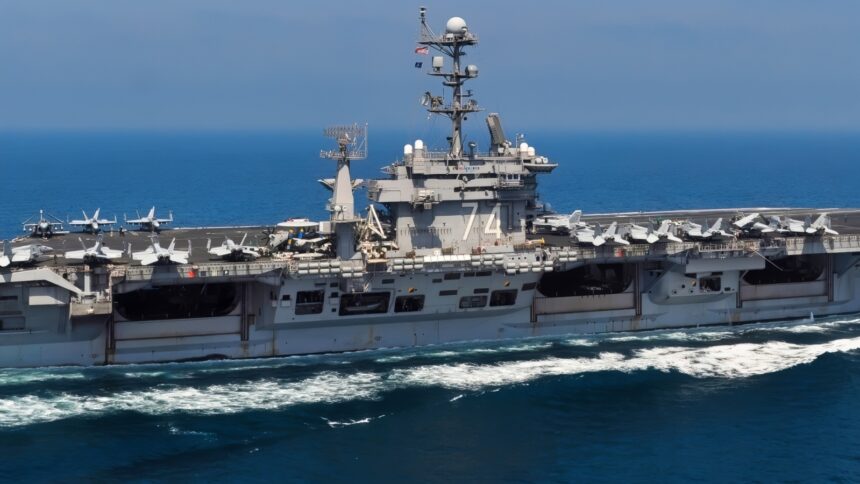
In the past decade, China has significantly expanded its shipbuilding capabilities.
As recently as 2022, China produced around 2,107 ships, both civilian and military, accounting for 51% of global shipbuilding.
In 2025, that number increased to 4,055 ships, or roughly 70% of all global shipbuilding.
In terms of sheer size, the PLAN has already surpassed the U.S. Navy with 787 ships and 384,000 active personnel as of 2025.
While experts have quibbled about the quality of these ships, the rate of China’s naval expansion is nothing short of impressive.
More recently, however, the PLAN has been expanding its fleet of submarines and aircraft carriers as a direct challenge to the U.S. in the South China Sea.
How China Became a Shipbuilding Superpower
Throughout the Cold War, Chinese shipbuilding struggled.
Its naval efforts were curtailed by Mao Zedong’s “Cultural Revolution,” which saw widespread persecution of highly educated individuals who were viewed as class traitors.
In the 1970s, China began to change course under the new leadership of Deng Xiaoping, who began to reform the country’s shipyards.
In the 1980s, the newly established China State Shipbuilding Corporation (CSSC) oversaw the creation of 26 shipyards, 66 factories, and 3 specialized universities and marine schools, and employed around 300,000 personnel.
Throughout this period, the government poured significant investments into the then-fledgling shipbuilding industry, which arguably would not pay off for several decades.
The investments paid off after the collapse of the USSR. China was relatively unaffected by the end of the Cold War.
The U.S. curtailed its own defense budget and greatly reduced its number of Naval orders.
At the same time, Russia’s shipbuilding industry nearly collapsed entirely in the tumultuous 90s. Chinese shipbuilding didn’t really take off until the 2000s.
By this point, China was expanding into the international market and receiving orders from foreign customers.
Although the global financial crisis caused some stagnation in the 2010s, the Communist Party continued to invest in and expand its naval shipyards.
Civilian and military ship production go hand in hand in China. As the country becomes a larger player in the civilian market, its military production has also increased.
The PLAN’s Growing Submarine Fleet
For a time, the U.S. maintained a firm lead in nuclear submarine production. Recently, however, China has closed this gap.
Bohai Shipbuilding Heavy Industry Co. builds the PLAN’s nuclear submarines at its shipyard in Huludao, northern China.
China PLAN Fleet of Aircraft Carriers. Image Credit: Creative Commons.
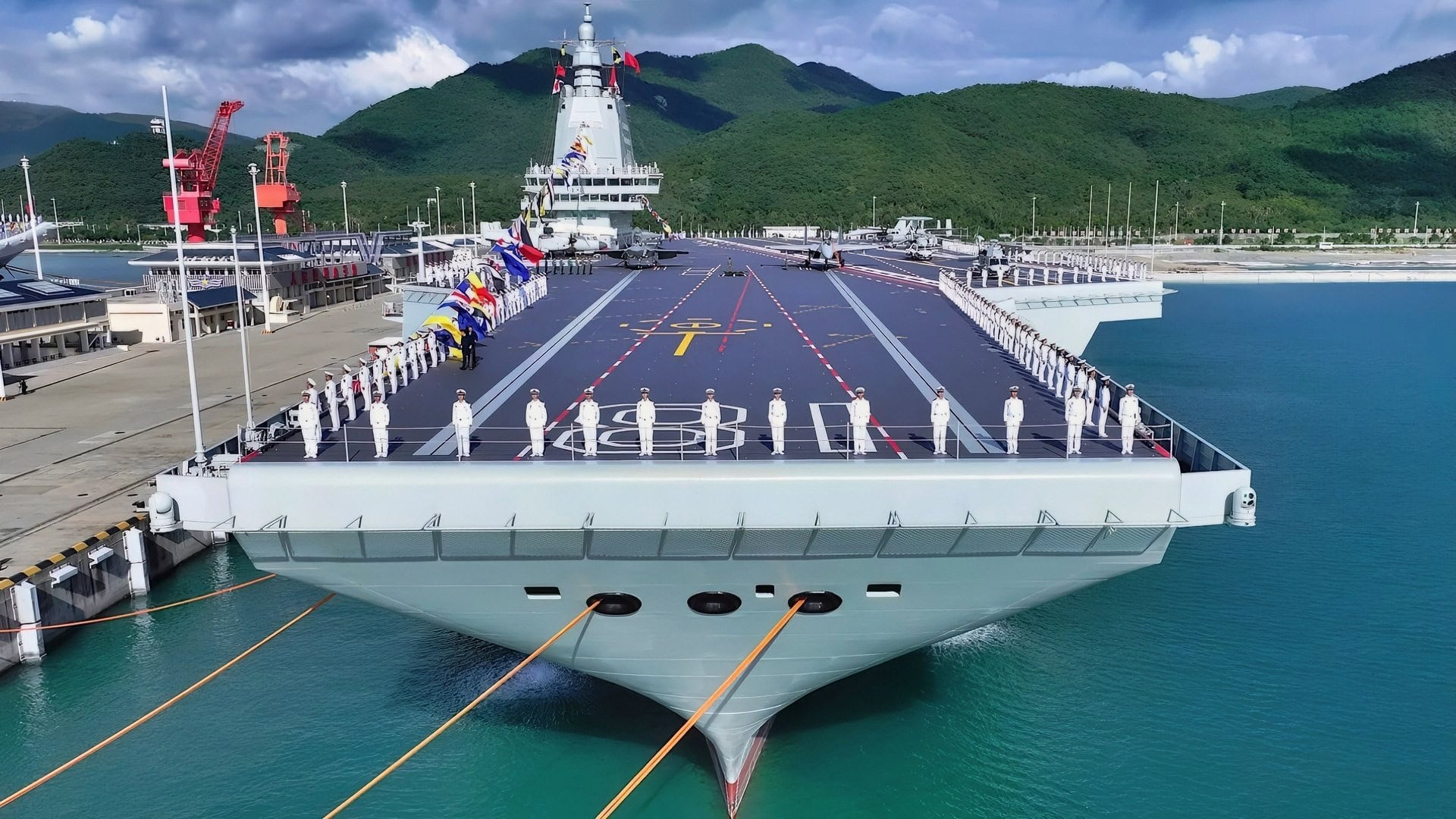
China Aircraft Carrier PLAN Image
Between 2019 and 2022, the Bohai shipyard underwent a notable expansion, with new production facilities and dry docks, and newer facilities still under construction.
Additionally, the CCP has been investing more in its nuclear submarine programs.
Some estimates project China’s submarine spending to exceed $36 billion through 2034, with $2.6 billion allocated to submarine construction in 2024.
The results speak for themselves.
From 2021 to 2025, China has outpaced the U.S. in submarine production.
In the next decade, the Bohai shipyard is expected to produce an additional 80 ships while retiring older, less capable models.
While the PLAN has historically relied on diesel-electric submarines (which still make up the majority of its fleet), most of its newer ships have been nuclear-powered.
From 2006 to 2017, China introduced four Type-094 ballistic missile submarines (SSBNs) and twoType-094A SSBNs into its Navy, along with 6 Type-093/Type-093A nuclear attack submarines.
Satellite imagery shows two more Type-093A SSNs and two Type-094 SSBNs under construction, along with 2 new Type-096 SSBNs.
China’s Carrier Ambitions
Aircraft carriers are the one area where the U.S. still holds a firm advantage, but China has made considerable progress here as well.
Its first two carriers, the Type 001 Liaoning and Type 002 Shandong, were based on the notoriously unreliable Soviet-era Kuznetsov-class.
Although these carriers were notably improved, their smaller size and ski-ramp configuration still limit their total sortie rates.
However, in an astonishingly short timeframe, the PLAN has progressed from ski-lift ramps to electromagnetic launch systems (EMALS) thanks to the introduction of the Type 003 Fujian.
Fujian was first laid down in 2015 and was commissioned in 2025. Most estimates put her displacement at roughly 80,000 tons, placing her in the same size category as the U.S. Navy’s Nimitz-class and Ford-class supercarriers.
According to the U.S. Department of War, China plans to field nine aircraft carriers by the year 2035.
It remains to be seen whether the CCP has developed the means to achieve this goal (assuming that the DoW’s claims are true to begin with), but China is actively working to expand its carrier fleet.
Satellite imagery from the Dalian shipyard reveals considerable progress on the Type 004, with large portions of its superstructure already taking shape.
Some reports suggest the Type 004 will share similar overall characteristics with Fujian in size and displacement, with the added bonus of nuclear propulsion.
It is still too early to tell what lies ahead for China’s carrier fleet, but based on trends across the rest of the PLAN, it is fair to assume its carrier fleet will also grow exponentially.
About the Author: Isaac Seitz
Isaac Seitz, a Defense Columnist, graduated from Patrick Henry College’s Strategic Intelligence and National Security program. He has also studied Russian at Middlebury Language Schools and has worked as an intelligence Analyst in the private sector.