
One thing I have learned about preparedness is that a good system should still work when the person using it is tired, injured, older, or simply unable to do the physical work he once could.
That is why aquaponics interests me.
A traditional garden asks a lot from the body. There is digging, bending, kneeling, pulling weeds, hauling watering cans, moving soil, and getting back up after spending twenty minutes on your knees. For someone with arthritis, a bad back, limited balance, or a wheelchair, even a small vegetable patch can become exhausting.
Aquaponics can remove much of that work.
The plants can be brought up to waist height. Water circulates through the system. Weeds are almost nonexistent. The fish provide nutrients for the plants, and the plants help clean the water for the fish.
Designed correctly, it can become a small food-producing system that someone with limited mobility can actually manage.
1. I Would Build The System Around The Person
I would never start by buying tanks and then asking where the person is supposed to stand.
I would start with the person.
Can he stand comfortably for ten minutes? Does she use a wheelchair? How far can she reach without leaning? Can he lift a bucket? Is balance a problem? Can both hands be used?
Those answers determine the design.
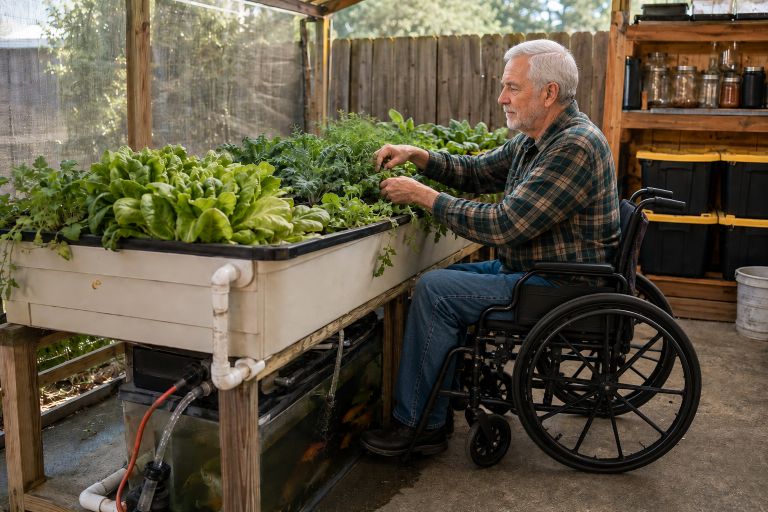
For someone working while standing, I would generally want the grow bed somewhere around waist height. For a wheelchair user, the working surface may need to be lower, with clear space underneath or beside it so the chair can get close.
The important thing is that plants should be reached without stretching across a wide bed.
If I have to lean over half the system to pick lettuce, I built it wrong.
2. Keep Everything Within Easy Reach
Reach distance matters more than total growing area.
I would rather have a narrow bed that I can reach completely than a huge bed with vegetables growing in the middle that nobody can comfortably harvest.
For one-sided access, I would keep the bed roughly two feet deep or less where possible. If both sides are accessible, a somewhat wider bed can work because the plants can be reached from either direction.
I would also leave generous paths.
A wheelchair, walker, or person using a cane needs room to turn without hitting pipes, tanks, or tools. Hoses and electrical cords should never cross the walkway where somebody can trip over them.
Accessibility is part of preparedness. A system that produces food but creates a fall hazard is not a good system.
3. Aquaponics Removes A Lot Of Heavy Garden Work
The part I like most is what disappears.
There is very little weeding.
There is no digging every spring.
There is no dragging a hose across the yard every evening.
There is no carrying watering cans from one end of the garden to another.
The water is already circulating past the roots. Once the system is running properly, daily work becomes more about checking than hauling.
I can look at the fish, inspect the plants, check water flow, feed the fish, remove damaged leaves, and harvest what is ready.
That makes food production possible for someone whose strength or mobility would make a conventional garden difficult.
4. Choose Crops That Are Easy To Manage
I would begin with plants that grow well and do not turn the system into a jungle.
Lettuce is an obvious choice. So are many herbs, leafy greens, bok choy, kale, and similar crops.
These are useful because they can be harvested repeatedly and do not require much lifting.
Larger fruiting plants such as tomatoes, peppers, and cucumbers can also be grown in suitable systems, but they need more support and management. Trellises should be positioned so the fruit remains reachable.
I would avoid creating a wall of vines that requires climbing, stretching, or reaching overhead.
The whole point is to bring food to the person.
5. Put The Fish Where They Can Be Reached Too
The grow bed usually gets most of the attention, but the fish tank needs to be accessible.
Someone has to feed the fish, observe them, remove debris, inspect plumbing, and occasionally work around the tank.
I would place the feeding point where it can be reached comfortably without bending deeply over a large container. A simple scoop with a long handle can make feeding even easier.
Frequently used valves should also be placed where the operator can reach them.
I do not want an emergency shutoff valve six inches above the floor behind a 200-gallon tank.
Good design means thinking about the bad day too.
6. Automate The Heavy Work, Keep The Important Work Visible
Aquaponics already uses pumps to move water, and a few simple additions can make the system easier to manage.
Timers can control lights where indoor growing is used. Automatic feeders can help when reaching the tank several times a day is difficult. Water-level markers can make changes easier to see. Battery alarms can warn about power failures.
I still want important information visible.
If the pump stops, somebody needs to notice. Fish can suffer quickly when circulation and aeration fail. I would keep a simple checklist beside the system showing what to check each morning.
- Fish moving normally.
- Water flowing.
- Pump running.
- Plants upright.
- No leaks.
That takes a few minutes.
7. Avoid Buckets Wherever Possible
Buckets are one of those things that seem harmless until your back tells you otherwise.
Water is heavy. A five-gallon bucket filled near the top weighs more than many elderly people should be carrying.
I would design water changes and top-offs around hoses, small pumps, valves, and containers on carts instead.
If water needs to move from one place to another, let a pump do the lifting.
The same goes for bags of growing media and fish feed. Buy manageable sizes or divide large bags into smaller containers before they need to be moved regularly.
Every pound of unnecessary lifting removed from the routine makes the system more sustainable.
8. Safety Has To Come First
Aquaponics combines water and electricity, so I take electrical safety seriously.
Pumps, air systems, and lights should use properly protected outlets, preferably with ground-fault protection. Connections need to stay dry, cords need drip loops, and electrical equipment should be positioned where leaking water cannot reach it easily.
The floor around the system also matters.
Water will eventually spill. I would use a surface that is easy to dry and gives good traction. Handrails or a sturdy work surface nearby may help someone with balance problems.
Large tanks are extremely heavy when filled, so floors, balconies, shelving, and raised platforms must be able to support the load. I would never guess about structural capacity.
9. Build A Backup For The Pump
Aquaponics has one weakness every prepper should understand.
It depends on circulation.
If the grid goes down, the fish still need oxygen and the system still needs water movement. A small battery backup, solar setup, generator, or emergency aerator can buy valuable time.
I would also keep spare tubing, fittings, an extra air pump, and ideally a replacement water pump.
The system should not depend on one inexpensive piece of equipment that cannot be replaced when stores are closed.
10. Food Production Should Grow With You
This is what makes the idea valuable to me.
A prepper may build a large garden at fifty and discover at seventy that his knees no longer cooperate. An injury can change mobility in one afternoon. A spouse may become disabled. A parent may move into the household.
Our preparedness systems should account for that.
A waist-high aquaponics system can keep producing greens, herbs, vegetables, and potentially edible fish while removing much of the digging, kneeling, weeding, and hauling associated with conventional gardening.
I still value soil gardens. I still believe in seeds, orchards, livestock, and traditional food production.
But I also believe in building systems people can actually use.
If I can stand beside a grow bed, reach everything comfortably, feed the fish, check the water, harvest supper, and walk away without aching knees or a strained back, that system has done something important.
It has made self-reliance accessible.
And that may allow someone to keep helping feed the household years after a traditional garden became too much to manage.





Read the full article here