
More than 80 military occupations are now designated as combat arms and require a combat field test be completed in addition to their standard service fitness test.
The Department of Defense’s physical fitness and body composition policy, which was updated on Aug. 31, lists Army, Navy, Marine Corps and Air Force jobs that fall under the new requirements. They include soldiers in infantry and Army Special Forces, Navy SEALs, Marine Raiders, Air Force pararescuemen and dozens of other occupations.
Under the policy, troops in combat arms occupations must complete a combat field test using standards set by their individual service branch. The tests must be able to be conducted “in any environment, at any time, with combat equipment,” according to the instruction.
The Army’s 23 listed occupations span infantry, combat engineers, diving, field artillery and fire support, Special Forces, armor and cavalry, and explosive ordnance disposal.
The Navy’s 19 designators cover four main communities: SEALs, special warfare combat crewmen, explosive ordnance disposal personnel and divers. The list includes officers, warrant officers, enlisted sailors and candidates within those fields.
The Marine Corps has the largest list, with 32 occupations spanning infantry, reconnaissance, Marine Raiders, field artillery and fires, combat engineers, amphibious vehicle crews and explosive ordnance disposal personnel.
The Air Force lists eight occupations, including special tactics officers, tactical air control party officers and airmen, combat rescue officers, pararescuemen, combat controllers, special reconnaissance airmen and explosive ordnance disposal personnel. The Space Force, perhaps unsurprisingly, has no occupations designated as combat arms.
Top Stories This Week
Combat arms troops will also face different standards on their regular service fitness tests. Under the policy, their tests must use sex-neutral, simplified age-normed and male-standard requirements, while troops outside combat arms will continue to be evaluated using sex- and age-normed standards. It wasn’t immediately clear what the difference was between the “simplified” age-normed requirements and the non-simplified age-normed requirements. The Defense Department referred Task & Purpose to the individual services for more information.
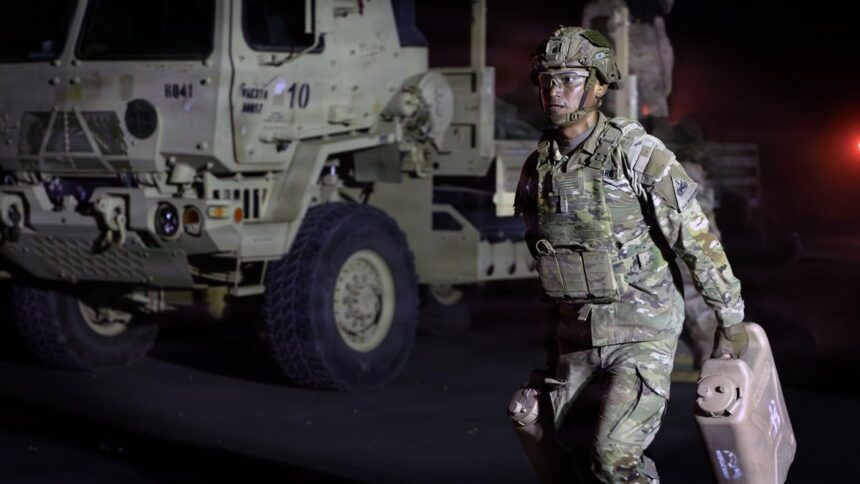
The Army’s Combat Field Test, which Task & Purpose reported on in April, is a seven-event, pass-fail assessment that includes two one-mile runs, dead-stop pushups, sandbag lifts, a water-can carry, and combat movement drills. Soldiers have 30 minutes to complete the test, and beginning in spring 2027, soldiers in designated combat jobs who repeatedly fail could be forced to reclassify or leave the Army.
The Navy’s version, rolled out earlier this year for SEALs, special warfare combat crewmen, explosive ordnance disposal technicians and fleet divers, includes an 800-meter swim followed by pushups, pullups and a one-mile run while wearing a 20-pound weighted vest for the latter events.
Service members who fail to meet fitness standards will be placed in remedial fitness programs. Continued failure can lead to administrative action, including separation, while failing to meet fitness standards can also result in unfavorable personnel actions, such as being passed over for promotion.
The combat field tests stem from a September 2025 directive from Defense Secretary Pete Hegseth, who ordered the services to develop sex-neutral physical standards for combat arms troops. Hegseth said the requirements could result in fewer women qualifying for some combat jobs.
The changes come amid a push by Hegseth to reassess military standards after all combat occupations were opened to women in 2015. Women who served in combat arms previously told Task & Purpose that they were already held to gender-neutral, job-specific standards and pushed back on suggestions that standards had been lowered for them.
The policy also requires the services to provide data allowing the department to evaluate fitness outcomes by sex, age, race, ethnicity, rank and military occupation.