
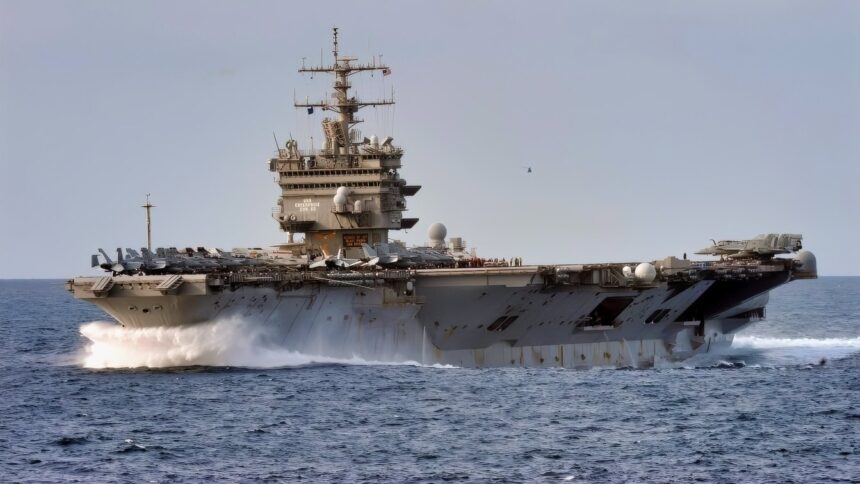
Building the USS Enterprise took less than four years. Taking her apart will take nearly 18 years.
The world’s first nuclear-powered aircraft carrier made her last deployment in 2012.
Image: Creative Commons.
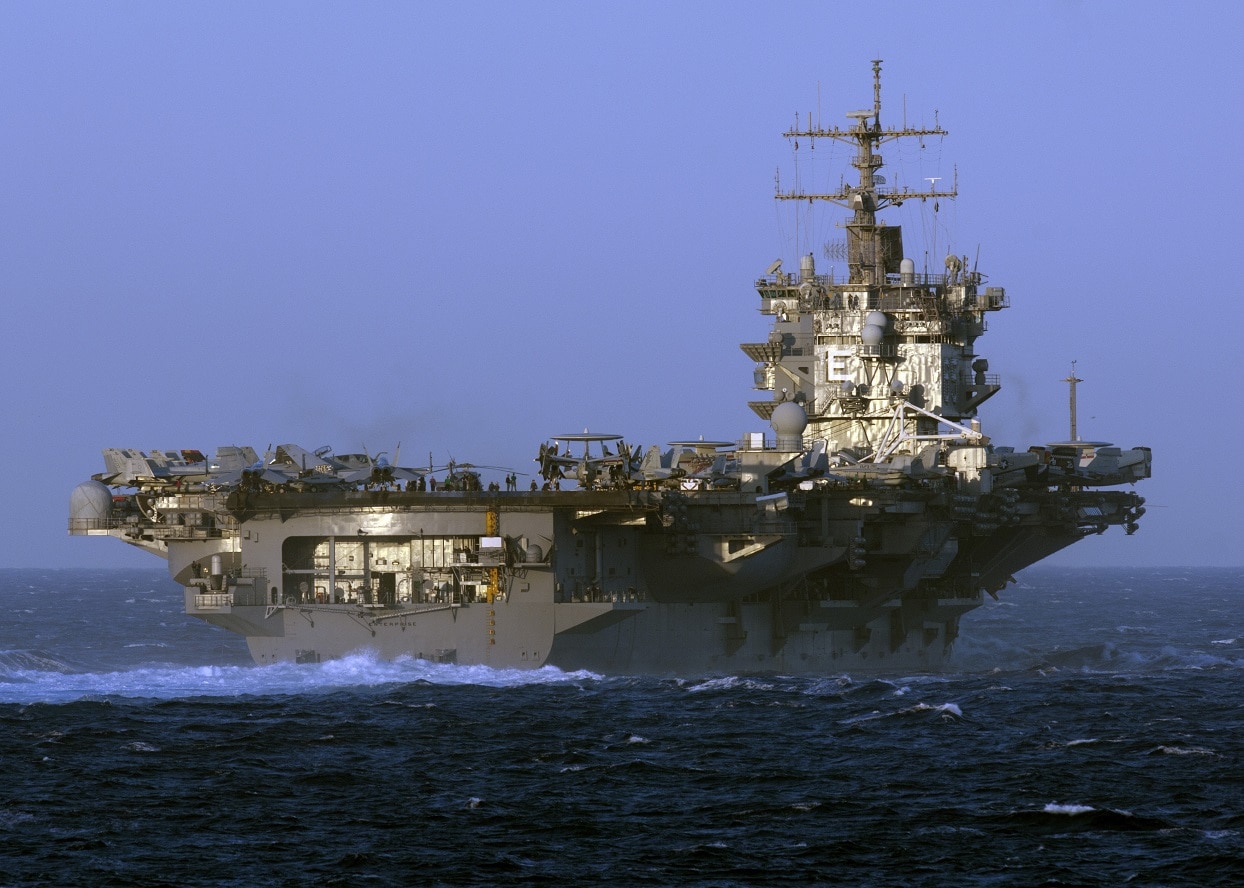
The aircraft carrier USS Enterprise (CVN 65) is underway in the Strait of Gibraltar. Enterprise is completing a deployment to the U.S. 5th and 6th Fleet areas of responsibility in support of maritime security operations and theater security cooperation efforts. The U.S. Navy has a 237-year heritage of defending freedom and projecting and protecting U.S. interests around the globe. Join the conversation on social media using #warfighting. (U.S. Navy photo by Mass Communication Specialist 3rd Class Daniel Meshel)
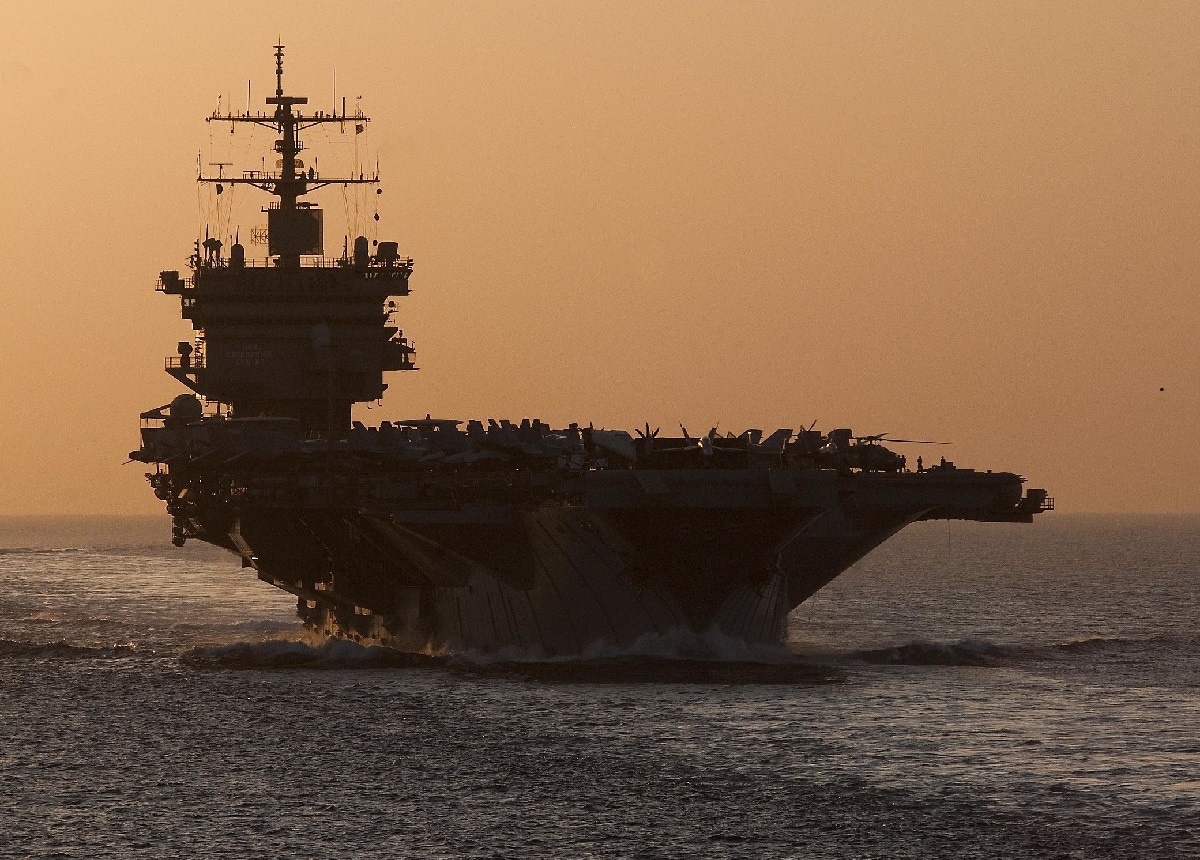
USS Enterprise. Image: Creative Commons.
She has spent most of the time since being tied to Pier 2 in Newport News, waiting while the Navy, the Department of Energy, the Nuclear Regulatory Commission, and a federal judge each had their say.
The work is finally underway. However, the Big E still has a long way to go before she’s scrap metal.
Step One Was Pulling The Fuel
A nuclear ship can’t be scrapped until the fuel is removed, and on the Enterprise, that meant eight reactors.
Every Nimitz-class carrier since has had two.
The eight A2W plants were what allowed the Navy of the late 1950s to get a 1,123-foot ship past 30 knots, and they did the job for 51 years.
They also made retirement four times harder.
Defueling and inactivation at Newport News took more than four years and cost about $902 million, according to USNI News.
The ship wasn’t formally decommissioned until February 2017. That $902 million didn’t take the ship apart.
It only made her safe enough to wait.
Step Two Was Deciding What To Do With Her
This is where the years piled up.
The Navy has scrapped well over a hundred nuclear submarines at Puget Sound Naval Shipyard.
Workers cut the reactor compartment out whole, seal it, and ship it to the Department of Energy’s Hanford Site in Washington for burial.
In 2012, the Navy planned to do the same with the Enterprise’s reactor compartments.
That plan didn’t survive contact with reality. A carrier’s reactor spaces are too large to be lifted out as a single block, so the hull has to be cut away around them.
Puget Sound was also already struggling to maintain its active fleet.
In 2018, the GAO warned that the job was “more akin to decommissioning a nuclear power plant” than breaking up a ship.
It put the public-shipyard route at up to $1.55 billion, with work not starting until 2034.
So the Navy started over with a full environmental impact statement.
It didn’t reach a decision until September 2023, when the Record of Decision picked commercial dismantlement.
The Navy said that option could be completed in about five years at roughly half the cost of the alternatives, compared with 15-plus years for the others.
That’s a long time to decide something.
Meanwhile, the ship’s storage bill reached $111 million.
Step Three Was Picking A Contractor, Twice
In June 2025, the Navy awarded a $536.7 million contract to NorthStar Maritime Dismantlement Services.
It was the first time a U.S. nuclear-powered warship would be taken apart commercially.
HII ShipCycle protested.
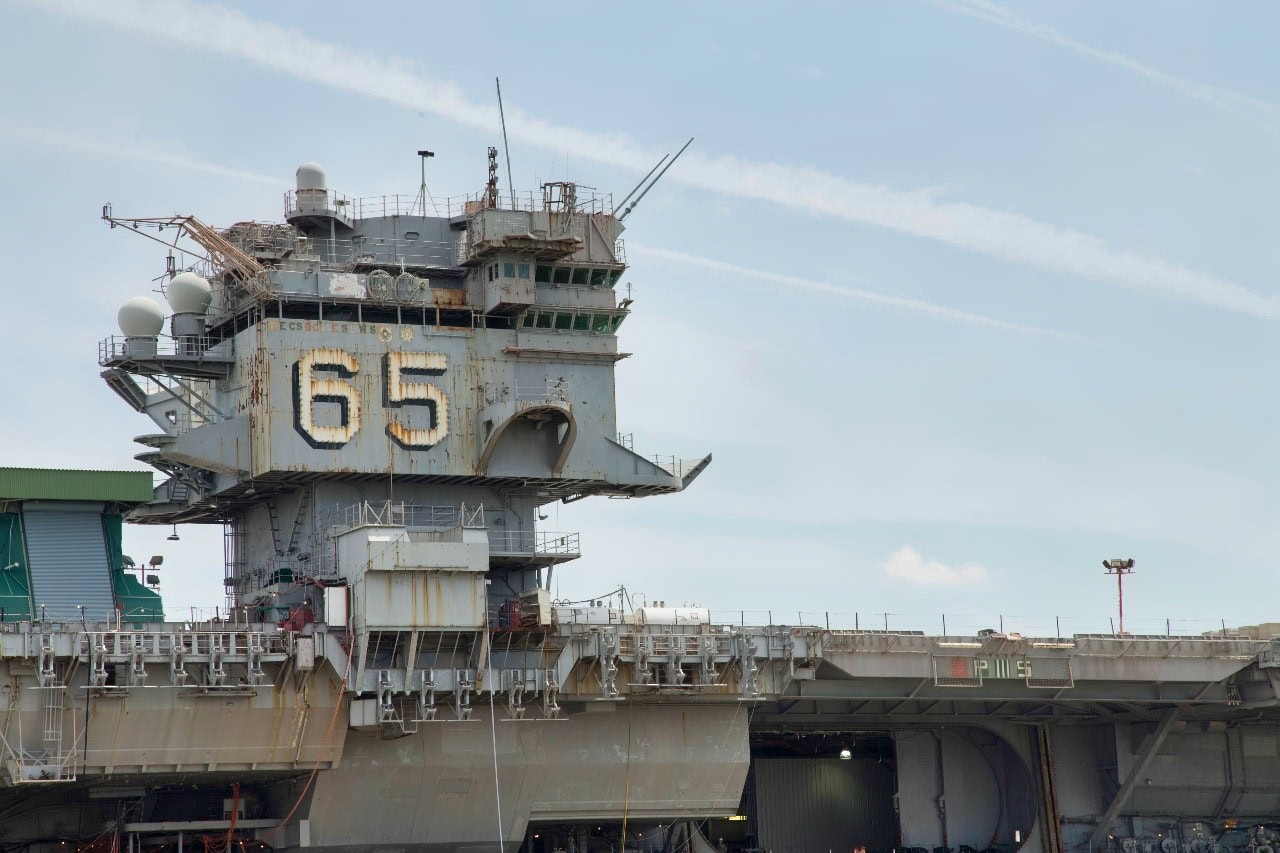
NEWPORT NEWS, Va. (July 15, 2018) — USS Enterprise (CVN 65) sits pierside at Newport News Shipbuilding following its decommissioning in February 2017. (U.S. Navy photo by Mass Communication Specialist 2nd Class Cat Campbell/RELEASED)
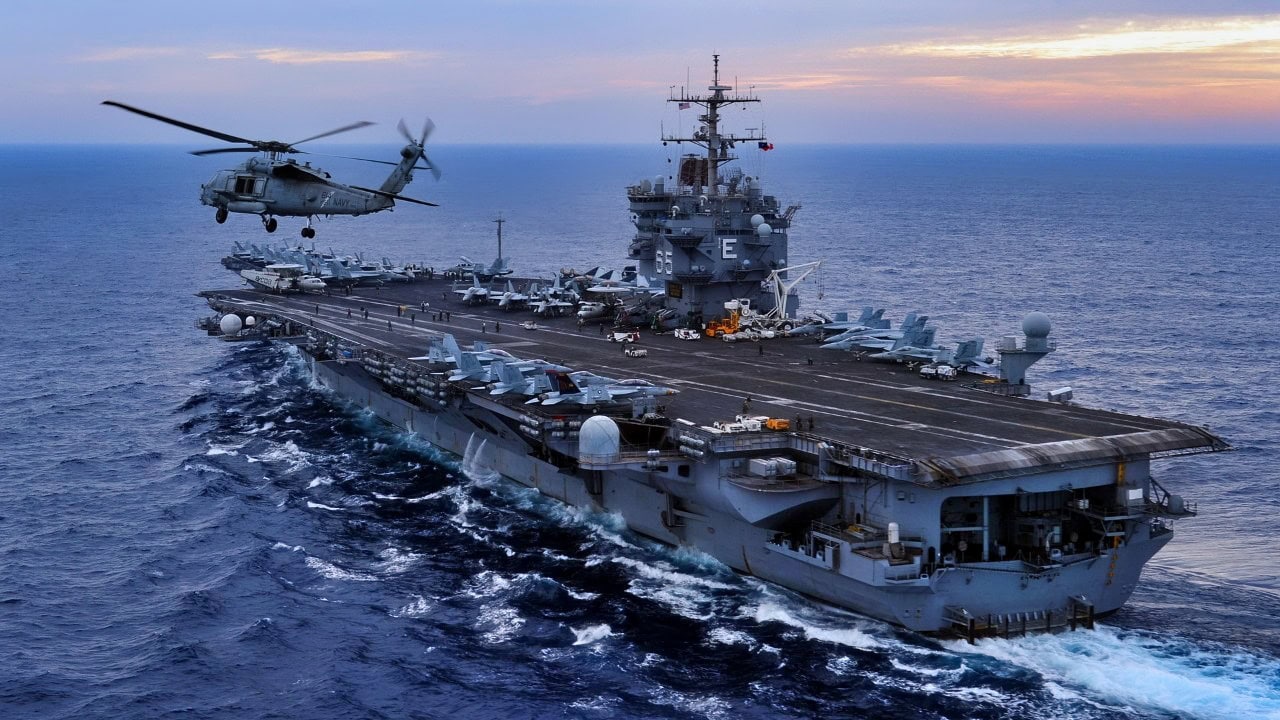
USS Enterprise from 2012. Image Credit: Creative Commons.
The Court of Federal Claims called the Navy’s exclusion of HII’s bid “arbitrary and capricious,” as Forbes reported.
The Navy rebid the work, and NorthStar won again in July 2026 at $418.5 million.
The protest saved the taxpayer about $118 million. It also cost another year.
Step Four Is The Regulators
This is the part most people miss.
Naval reactors normally fall under the Naval Nuclear Propulsion Program, not the NRC.
A private company dismantling them changes that.
NorthStar needs NRC sign-off at each stage.
In February 2026, the NRC approved the transfer of the ship to NorthStar so it could be characterized and moved.
The company’s decommissioning work plan was still under review at that point.
NorthStar isn’t new to this.
It holds NRC licenses for the Vermont Yankee and Crystal River 3 nuclear plants, which it is decommissioning now.
As Marine Log noted, its partner, Modern American Recycling and Radiological Services, led the salvage of the capsized car carrier Golden Ray.
That’s the right résumé for the job. None of it has been done on a nuclear carrier.
Step Five Is The Actual Cutting
The ship will be towed from Virginia to the MARS Deepwater facility in Mobile, Alabama.
There, crews will take apart 93,000-plus tons of steel, piece by piece.
Most of it is ordinary scrap and will be recycled.
However, anything inside or near the eight reactor compartments is low-level radioactive or mixed hazardous waste.
It has to be surveyed, cut, packaged, and shipped to Waste Control Specialists in Andrews, Texas.
A ship her age also carries lead paint, PCBs, and asbestos, each with its own handling rules.
Every one of those steps is slow on purpose. Radiological work means surveys before and after each cut, dosimetry for every worker, and paperwork for every container.
You can’t rush it, and you shouldn’t.
The contract runs to September 2030.
The Bill For The Big E Is More Than It Cost To Build
Add it up: inactivation at $902 million, storage at $111 million, and dismantling at $418.5 million.
That’s roughly $1.43 billion to dispose of a ship that cost $451.3 million to build in 1961.
Why It’s Worth Getting Right
Say what you want about the price.
That’s beside the point.
The USS Nimitz leaves service in 2027, and nine more Nimitz-class carriers will follow.
Each has two reactors instead of eight, but each will go through the same process.
In my opinion, the real product coming out of Mobile won’t be the scrap steel.
It’ll be the playbook.
SINKEX Was Not a Consideration For the Enterprise
The Navy has a way of disposing of old ships: it provides them for target practice during active-duty training for ships and aircraft.
The Navy calls these operations SINKEXs.
However, with the Enterprise and other nuclear-powered aircraft carriers, they can’t be used for a SINEX.
Although the reactors and nuclear fuel rods have been removed, the Navy’s Puget Sound Naval Shipyard and Intermediate Maintenance Facility said in a statement that”legacy radiological and hazardous wastes” remain on board.
CVNs Can’t Be Museums Due To Reactor Removal
Many former crewmen and citizens would love to see the carriers turned into museums for the public to enjoy for generations.
But this can’t be done either.
Andy Burns, a former surface warfare officer and flight officer, explained why this isn’t feasible.
He said that nuclear-powered ships are built around their reactors and the associated machinery. Removing the reactors without essentially taking the ship apart is impossible.
For obvious reasons, the Navy doesn’t want to (and can’t, per federal environmental laws and regulations) simply leave them in place.
Nuclear subs are built in sections that are disassembled when decommissioned, and their reactors are removed, sealed, and shipped to a long-term, secure storage facility in eastern Washington.
“Enterprise will probably have to be similarly disassembled, and unlike the Nimitz-class boats, she has eight reactors.
That process will be so invasive that reassembling her afterward would be cost-prohibitive, if not practically impossible,” he added.
The original aircraft carrier named the Enterprise (CV-6) from World War II fame was hoped to be turned into a museum ship, but funding fell short, and she was eventually scrapped.
The Enterprise was the first nuclear carrier to go to sea. Now she’s the first to come apart.
About the Author: Steve Balestrieri
Steve Balestrieri is a National Security Columnist. He served as a US Army Special Forces NCO and Warrant Officer. In addition to writing on defense, he covers the NFL for PatsFans.com and is a member of the Pro Football Writers of America (PFWA). His work was regularly featured in many military publications.