
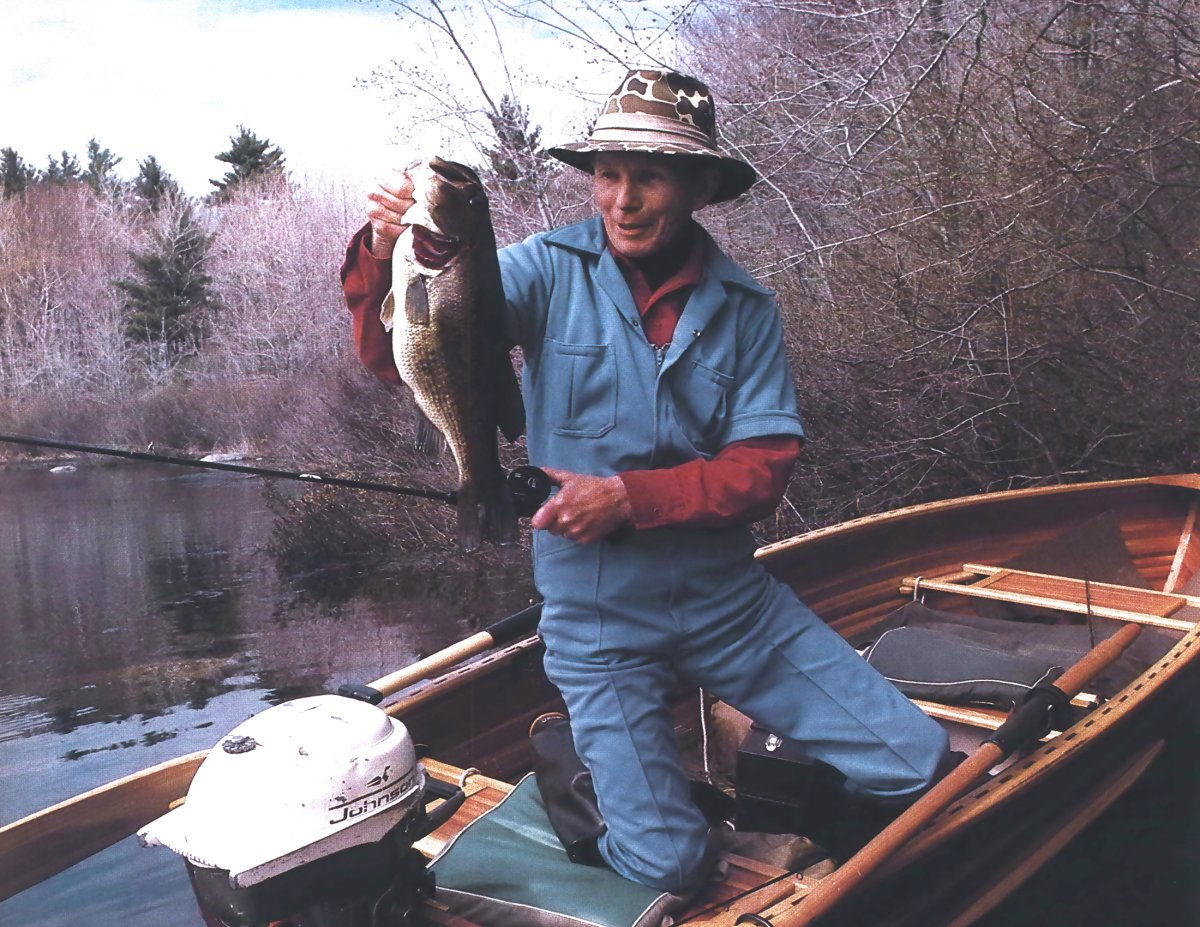
He is running the old 9-hp outboard, burning the last gas from the engine just off the gravel launch ramp that the big-boat boys don’t like because it drops off too slowly. The wide-brim camouflage safari hat and the plain blue, no-patch jump suit are silhouetted against the sun. The boat—a canvas-covered, wood-frame Old Town—is blue, too, and it’s 20 years old like the Evinrude. He takes two strokes with the oars, which are quiet in their protective collars and with their lock pins muffled and wrapped with leather. The 12-foot boat dances in, and Bill Plummer steps out in black hipboots. He looks exactly as he did in pictures 20 years ago—a hint of Jack Palance, but without the sinister undertones. He is trim, quick-moving, precise.
“Thought maybe it was you,” he says.
The boat floats like a leaf, waiting for him while he gets the Ranchwagon. “Need help?” “Nope.”
The 15-pound mushroom anchor with over-thick line, the modern graphite rods, the casting reels and the sprinkling of carefully selected tackle are all smartly off-loaded. Then come the tarps and rubber pads that protect the wood ribs and deaden sound aboard the boat; they’ll now serve a third function. The boat is spun around in the water, and the brass-handled, mahogany stern points in, nudging the tarps. The bow is flipped up, and with the boat on end and slowly easing itself over, Plummer comes around, catches it and guides it to the car-rack rollers. Bits of inner-tube-wrapped sponges cushion the gunwales here and there. The seat cushions cradle the engine and tackle in the wagon.
“Everything has a place. If it’s out, I’ll notice it,” he says.
Everything is perfect. Time elapsed is precious little more than is needed to drive a big bass boat onto a trailer and strap it down. The Old Town weighs 100 pounds, which is 10 pounds heavier than the Bass Hawk, the other boat in Bill’s system. The Bass Hawk is also 12 feet long and made of natural red cedar. It was designed by Plummer, and was built for a time by the Sundance Canoe Company in Gravenhurst, Ontario. It is a lovely thing, having been immaculately maintained through the years, and it’s reserved for the smaller ponds, lakes and backwaters rather than big reservoirs like Massachusetts’ Quabbin, where the blue Old Town is used. The same-weight mushroom anchor gets a lighter line on the Bass Hawk, and the engine is a 3-hp Johnson that is also 20 years old.
“At my age, the extra 10 pounds of boat make a difference,” Bill says. He smiles quickly, scanning the area for anything missed and checking all the hold-downs.
The years have been kind to 66-year-old Plummer. Maybe it has something to do with him having the good fortune to live his dreams—something that happens to so few of us. At the outset of World War II, he gave fledgling Navy combat pilots their first 50-hour tastes of flight in the open cockpit of a single-engine aircraft, and he still has a yen to fly rehabbed stunt biplanes. Under his father’s tutelage, he received a solid angling foundation that encompassed most freshwater and saltwater species, and in the 1950s, he was granted a patent on a weedless hook that lead naturally to the creation of the Superfrog, which is a topwater lure that’s still going strong.
Research fishing is Plummer’s game. From ice-out in March, the man fishes until Christmas. And the routine is always the same: From March until early June, five days of the week are spent on the water. From early June until the holidays, every day is spent fishing. And it’s done mostly alone, and in sun, rain or snow. It’s done in hurricane-edge winds—once in winds so strong that the harbored skiffs on Quabbin were being flipped over. Gusts, with some to 40 mph, are nothing strange. He’s handled them to 50, never fearing getting back. His little cockleshells, with their rounded lines, are lifted, not pushed or slammed by the flow of wind-driven water. And in normal weather, his crafts drift slower than most boats, and this is ideal for Bill’s style of fishing. The man is on the water more than 300 days a year, and before he stopped keeping records, he’d tallied some 2,000 bass per season. He hasn’t kept any for 10 years. The recording stopped when he found he was beginning to compete with himself. Fishing competition is not his game. Learning about the fish, is, and some of it has to rub off if you listen.
Now, he fishes only for bass—largemouths and smallmouths—which he finds the most fascinating quarry because of the diverse habitats in which they live. Intrigued with that diversity, Bill tries to include maybe 10 new waters every year among the 100 or so lakes and ponds he fishes per season. Learning those waters, playing them with skills tuned over the years and finally touching the right chords to make them produce may be his greatest pleasure. It is plain to see that the man is not in lock step with modern bass fishermen. He is also concerned that, rather than learning the fundamentals and the rhythms of the fish and fishing, too many entry-level anglers are seeking instant expertise in modern instrumentation—high-tech gadgetry.
“If you must have some instrument, make it a depth sounder,” he says, though he never uses one on the waters he regularly fishes. He figures every youngster should learn to fish with a bobber and bait, and any adult who hasn’t is missing out, according to him. After that, it’s the anchor.
Read Next: The 6 Best Live Bait Species You Can Catch Yourself
An anchor is vital equipment for Plummer. “Most bass anglers today rarely, if ever, anchor. If you catch a bass in the wind, usually you can’t control the boat fast enough with an electric to avoid drifting close and spooking the rest of the fish in the group while you fight the first. Before sonars, the anchor was my depth sounder.” Bill drifts with the wind whenever possible. Otherwise, he uses the oars—no electric. Every 50 feet or so, he quietly lowers the anchor if he’s near a good fish-holding area. His anchor line is marked at 12 and 20 feet to help him judge depth. If he’s marking a steady depth and then suddenly hits a little mound, he mentally files it, and then fishes it later. The same goes for a snag, a stump or other cover. There’s an anchor-line cleat on the wood stern seat and another on the side of the boat, making it easy for him to slip the weight down with one hand. When a fish hits, he sets the hook and lowers the anchor almost simultaneously. No marker buoy goes out. When was the last time you did that?
You know about parallel casting, too, don’t you? But answer this: As your boat eases in toward shore, can you resist throwing to or past that log, point or boulder that screams fish? Plummer can. He always combs like a mine sweeper, making long, parallel or diagonal casts when approaching a shoreline, cove or even point. Each change of depth is covered more efficiently than a troller can do it. He never trolls. Finally, when each inch of a fish’s potential approach to an emerged piece of cover or structure has been touched, Plummer will cast to the cover itself or to the sides of the points. Of course, you want to know what he fishes.
Bill Plummer is a percentage man. He’s tried the new lures as they come, and he pioneered the use of the nine-inch pork eel in the Northeast. (A big-fish getter, he calls it, but he says it’s too slow. “You have to wait for the bass to mouth it and get it in.”) He’s caught fish on spoons and plugs. He’s used spinnerbaits, but feels bass have been overexposed to them. Better, he says, is an unweighted or very slightly weighted shaft spinner ahead of a weedless hook that has a pork frog on it. This is a very effective subsurface bait for smallies in summer, according to him, and it’s good for working through dry willow branches. It’s not one of his regulars, though, because he’s found other lures that pay off in bigger bass.
All season, Bill uses jigs, favoring a skirted stand-up Mister Twister head because of its big single hook. The jig on one rod wears an Uncle Josh Flippin’ Frog, and the jig on his other rod sports a split-tail Josh pork bait. Regardless of water clarity, black is used 90 percent of the time. Sometimes, brown gets a chance. If there’s a change, it will be to either chartreuse or red-and-purple for both murky and clear water, or it will be to white, yellow or black/white for just murky water. Fish show color preference some days. Some days they prefer the split-tail or the frog. Bass have also shown him they favor a slow-dropping bait, and because of this, he rarely uses a lure weighing more than one-quarter ounce in water less than 25 feet deep. A jig and pork is the combination in early spring and in fall, but it’s used all year.
“With pork dressings, I’m rarely bothered by panfish,” Plummer says, “but with small plastic dressings, I am.”
That has not discouraged his development of his secret bait, which is plastic but which is large enough to discourage pint-size marauders. Similar to a jig, this is a dropping lure, and it’s a water-dog simulator with a dense plastic body, internal weight, and long, twin twisting tails. Bill calls it the Water Demon. He may market it this year.
As soon as surface weeds begin showing, Bill figures bass are ready to eat on top consistently, and he adds his Superfrog to the percentage baits at this time, along with an unweighted pork frog on a weedless hook. Unlike fast-paced anglers, Plummer fishes the surface from the time of weed emergence through summer and right through into fall until the first hard frost. And the fish come any time, including in the midday sun of midsummer. But the jigs and pork are always ready. His presentations are interesting.
Another different thing about Bill’s technique, besides his parallel casts, is his retrieve—it’s in nearly constant motion; that is, once he begins it. Often, he’ll let the subsurface lure sit there. Big bass will grab it and hold onto the jig-plus-pork if they don’t hit it on the drop. “When you pick up, you just feel them there,” he says. “In cold water, it can feel like a small weed or branch, and many fish are lost when anglers think that’s just what they have. They don’t set the hook, but sort of play with the rod, feeling out what they have.”
Once the retrieve starts, there are no twitches or sharp snaps of the tip. Plummer pulls, almost dragging the lure, and tightens by coming back with the rod. Then he drops the rod forward again, all the time keeping slack out of the line. All the while, his rod arm vibrates subtly, turning at the wrist and giving gentle life to the bait below. The lure is worked carefully for the first 10 feet, then it’s hustled back, unless Bill has pushed quietly into a dense weed bed. Then, he fishes the bait all the way back to the boat, expecting strikes to the end. He holds his casting rod with his hand behind the reel and his thumb on the reel arbor or frame (but he’s not palming the reel), and the rod is positioned at just less than a 45° angle. For surface fishing, he waits. Sometimes, he waits a full one-half minute after casting out his frog. “That’s too long, though,” he says. “When they’re taking it that slow, you’ve got to know precisely where the fish are.” In those conditions, he’ll often go to subsurface fishing. But before that, if the season is right for surface baits and the fish aren’t eating the slow frog, he’ll try a fast retrieve, hustling the little plastic croakers or unweighted pork frogs back. When that’s what they want, it can be the most thrilling fishing of all.
There’s another technique he reserves for times when fishing has been about as quick as the grease in your car at -20°; or when he’s fishing water more than 20 feet deep; or when he hasn’t really pegged the bass’ location or the day’s pattern; or when the fish just want a very long wait before the lure moves. For those times, Bill occasionally uses a two-rod system. He’ll cast and let the jig/pork or Demon settle on either tight or slack line, believing that it’s the soft lure, which the bass hold onto, that’s important and not the drop. Then, he’ll place the reel and rod handle in his lap on a little waterproof apron, which is used to keep the drips of water, which are invariably cold when the system is used, from seeping through his insulated coveralls. The rod blanks rest on the gunwales. He picks up a second rod, casts, feels the bait down, then places the rod in his lap. The first rod is lifted, the lure moved and dragged in a bit, then the outfit is returned to his lap. Rod two is taken up. The lures are worked alternately like that for the desired retrieve length. The boat may be anchored, drifting or its attitude shifted with the oars during the dual retrieve. Sometimes, a bass will hit the moment the first lure is moved the first time. Sometimes, the fish is there already, having mouthed and kept the bait and not rejected it because of the pork or soft plastic.
“I’ve had good fish on at the same time with this method,” Bill tells me. “Caught them, too. You strike, see the line moving on the second rod, put the first down, pick up the second and strike, go back and fight the first fish. By now, the second fish may have come under the boat. Usually, they’ll pretty much sit there when they’re not pressured. I’ve never really had backlashes doing this.”
That’s intriguing, considering how Plummer modifies his reels.
Levelwind reels are his exclusive tools. He likes the free-spool function and the smooth casting of modern reels, but that’s it. He removes the anti-reverse dogs, screws the drag down to total stop, and that’s that. The result is a direct-drive reel with handles that will spin in reverse when the unit is in gear and line is taken out. (Some current model casting reels offer the same function via a switch.)
“I don’t think drags are needed on freshwater bass reels,” Bill says. “I use my thumb for drag. It’s more accurate, especially in ticklish situations when a fish rushes under the boat. Besides, it’s more fun; it’s more satisfying.”
When he’s using two rods and the boat’s moving, he’ll slip a loop of line around one handle knob of the rod in his lap to keep line from paying out. The line on his reels is Dacron—not monofilament—for both a better sense of what’s happening to the lure and for hook setting, which Bill performs with hair-trigger reaction. I never saw him miss a fish he hit. The line is usually 14-pound test. He’ll sometimes use 17-pound test in heavy cover. To the Dacron is added 20 to 25 feet of mono leader—often 14-pound—but sometimes, 12 or eight-pound is used in clear water. “I hate to break a fish off in weeds and have to think about it with a lure left in its mouth,” he tells me. A jamb knot, which passes smoothly through the guides, joins line and leader.
Bill’s rods are stiffish graphite. He uses a 5-foot model for subsurface fishing, a 6-foot blank for surface angling to keep more line from the water and from the weeds. The longer rod also helps the line through the brush when Plummer fishes the willows.
In spring, when the scrub willows on boggy points or islands are flooded, Plummer sometimes works brush jungles few anglers would dream of fishing. Using a shaft spinner, his weedless hook and a pork frog, he’ll throw back over the willow tops so the lure drops into invisible pockets. The lure, of course, is now invisible, too. Plummer lifts the rod, listening for the spinner to tinkle or splash water. He daps it in place a little, then lifts it to the next pocket. If there’s any resistance as he lifts, he sets the hook. Sometimes, it’s brush. Often, it’s a fish.
A similar technique involves the light plastic Superfrog, which like the pork-plus-spinner is cast back into the willows. Then, the Superfrog is lifted gently and worked across the tops of the scrub trees that may be three feet high. The root networks of these small trees go down into the water, and the throbbing vibrations of the frog-turned-monkey that is working through the branches go down into the water, too. Plummer pauses for a second when the frog reaches the last willow, then eases it off so it falls tight to the bog with a gentle splat. If a fish has been back in there, it’ll have been going wild with awareness of some tantalizing creature just out of reach above, and it will nearly always slam the bait when the bait hits the water. A simple cast straight to the bog edge is about 90 percent less effective. When fishing such tough cover, Plummer changes his leader daily. Normally, the Dacron line is reversed once each season. Lures are always either tied directly to the leader or attached with a small snap. Bill feels minimal hardware is especially important for both surface lures and cold-water fishing. He never wears highly reflective colors, such as white or yellow, when he’s dressed to fish, and he insists that using sharp hooks may more than double your catch.
Those are some of the mechanics, and they represent just the tip of the iceberg for this Westborough, Massachusetts, angler. His observations on weather, seasons and lake and pond structural and cover configurations are equally enlightening. He fishes in fine weather and in rainy, blowy or frigid weather when freak storms can pile four inches of snow into his little boat—times when it’s too rough to anchor and most anglers have long since quit. Bill has deep-sixed the rule book on when bass should be doing a particular thing. Subtle natural environmental changes or more drastic man-made ones affect fish location, he maintains, and not only must you learn to make your own careful observations each season, but you must learn to act on them.
During a recent late-ice-out spring, Bill found his fish all shallow—less than 10 feet down. One day, with the air temperature 35°, the water 48° and the sky spitting rain with a 20-mph wind, Bill took largemouths—including two seven-pounders—along a terrible-looking shoreline. Because it was spring, the sudden shot of poor weather should have put the fish off, but it didn’t. There seemed to be nothing on that shore to hold them, but the year before, chemical weed control had knocked out normal holding cover and the fish had moved to the unlikely looking bank for a short time. Why did Bill fish it in the first place? According to him, it was process of elimination, for one thing—nothing had hit at the usual areas. It was careful observation, for another—the shore had a slight bite, consisting of a little crescent curve, and this was enough difference in an otherwise featureless bank to hold fish. And the fish could have been there for a few days, one day or a few hours. The key was to be there when they were and when they were active. That’s why Plummer has this advice: “If you have 10 hours to fish a week, don’t take them just mornings or afternoons or evenings; take them all at once. Your chances for being there when the fish are active are far better over a continuous period of time.”
Up in the north end of Quabbin Reservoir, there’s a stump-filled cove into which the bass move during the pre-spawn. There are good spawning places in the cove, but only the smaller bass will use them. The good fish, those weighing more than five pounds, will be there for maybe an afternoon before moving on. It’s not a question of insufficient depth. The water is quite clear, though, which may have some bearing on why the biggest bass are cautious about nesting there.
Generally, Bill feels that, except for spring when consistently good weather spells good fishing—too much of any given weather pattern can be a bad thing. Change triggers bass activity. That change can be from what we consider good to what we think bad, or vice versa. When I was fishing with him one spring morning, we’d caught nothing but pickerel for a while. It was overcast and cold, and there was a slight breeze. Then, the wind suddenly changed direction. The sun broke through. Bill hammered two bass. It had been only a tiny shift—a small weather pattern change within the general condition—but it might have been responsible for the fish activity. Longer-term, more encompassing weather shifts have far greater impact.
Normally, very high or low barometric readings mean so-so bassing, but drastic changes—especially on the drop—can trigger unbelievable action, Plummer feels. Once, he fished during the approach of a hurricane, stopping only when the ugliest of clouds came boiling in from the coast. He’d been having spectacular sport with largemouths. When he quit, the winds were too high to put the boat back on the vehicle, so Bill stashed the craft in the woods and ran for home, with telephone poles toppling over en route. “I checked the barometer when I got home,” he says, “it was way too low for good fishing; it was the sudden drop that did it.”
Plummer does not fish by barometric pressure or temperature, but he keeps track of the two as general indicators that suggest trends.
What about with that summer surface fishing that so few try? Wind is key here.
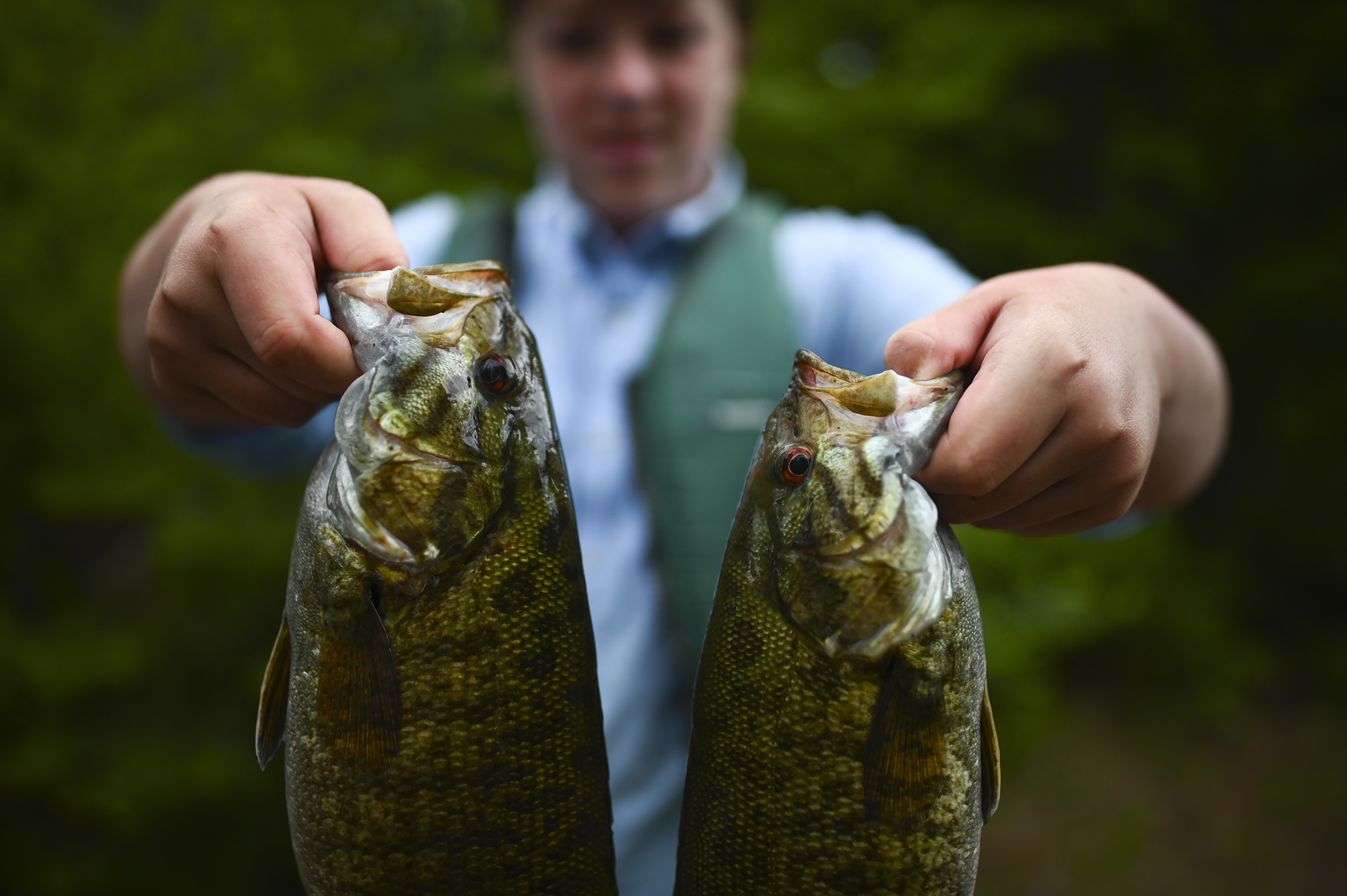
On blustery days when the wind churns up long sweeping rollers, Plummer has some of his greatest days on smallmouths. He uses surface baits, even at midday. The bass come to the top as far as 100 feet from the shoals, boulders, points and reefs they call home. They’re roaming, hunting for food. Largemouths, too, respond to these conditions, but to a lesser extent. They’ll usually be just off shore. Bill feels it’s not just that baitfish are being pushed around—especially onto windward shores or shoals—but that bass are more confident in the roily water, as they are secure in the knowledge that they are not as exposed as they are in a flat calm.
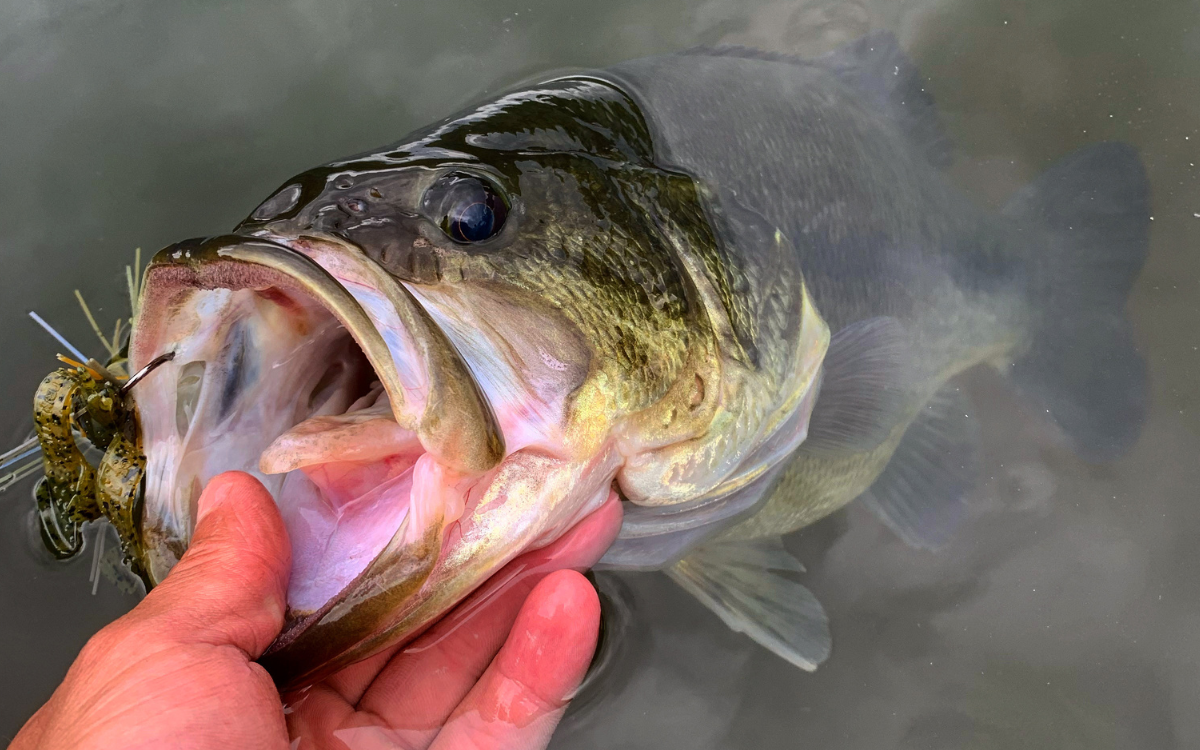
For consistently taking bigger fish, though, fall has it. At this time of year, Plummer is fishing constantly. If he had to pinpoint the top period during the fall, he says it would be following a cooling trend after a few storms, with the water temperature just dipping below 50° and into the high 40s.
“It may take as long as a week for the fishing to start after that happens, but this is when you get the last great action before winter,” he insists. “Where I fish, this usually takes place around Thanksgiving. And it usually comes very early in the morning or after you’ve toughed out a lousy day and you’re wondering why you’re still out. Then, when the temperature drops to about 41°, you have to work as hard as you do in early spring. The best late-season cold-water days are those with the crummiest weather. The fish may be moderately active once or several times at any time throughout such a day, but they’re never as intensely active as they are in late spring or summer. In the warmer weather, they feed for shorter periods, but they feed very aggressively. If it’s drizzly rain, though, the warm-weather feeding periods can be longer.”
Read Next: The Best Topwater Lures for Bass: 9 Classics That Still Catch Big Fish
We are out on a small lake in Massachusetts now, and Bill tells me how he likes the stability of smaller waters. “In the big reservoirs, the fish may be using a cover or flat steadily, but all it takes is water fluctuation to make them leave. Small waters are more stable unless you get a lot of heavy rain. But some of these lakes can be tougher than the big waters. The most difficult of all is the bowl-shaped pond with no distinct concentrating areas, or the little lake with fairly even vegetation over the whole bottom. The fish can be anywhere, and they probably are; they roam because the forage does.
“What you want,” continues Plummer, “is what I call a converging area—a small cove with two good points near its mouth. It would be even better if there was a nice offshore flat where the fish rested before moving in.”
This lake looks to have some of those things. There are irregular shorelines and islands. “See that point?” Bill says, interrupting my musing. “Looks beautiful, doesn’t it? I never took a fish from it. But I’ll always fish it. Always fish a good-looking place a little. One day, it’ll probably have bass. It’s the shore here,” he indicates with a sweep of the rod. “It always held them. It doesn’t look like something special, but it has a good fast break into deep water. For years, I caught big fish here. Not now. Nothing changed that I can tell. What little vegetation is there hasn’t changed. I think the fish that used it just died away and nothing’s replaced them yet. Another group of fish will, though. Maybe this year; maybe a few years from now. Maybe they’ll utilize the point, too, someday. I always try.”
We try a place where boulders march out from the shore, and Bill nails a bass weighing about three pounds. “First fish I’ve taken there this year,” he says. “It goes to show you that a place that has produced in the past is always worth fishing. I have to accept the possibility that sometimes, I just may be fishing a place at the wrong time.”
We make the controlled drift, correcting movement with the oars—no hard thrusts to send out frightening vibrations. There’s no thumping on the hull; there’s not even loud talking. When motoring, even with the fine old 3½-hp Johnson that purrs like a content tomcat, the engine is killed a good distance from the fishing area.
We try some gravel humps and other spots Bill finds through triangulation of shore objects. He’s fished this little lake a lot and doesn’t bother with a sounder. We take a fish here, another there. He snags on a branch, mentally cataloging the submerged tree to fish thoroughly later.
“On days when fishing’s been very poor, I sometimes catch one big fish,” Bill suddenly tells me. “If you asked how the fishing was, I’d have to say lousy. On some days they hit a lure only one way—say, while it’s dropping. If I see that happening, I just rush the bait on back after the drop and cast again, so as not to waste time.” He takes another fish. “It’s tough today, but not like in late spring or summer after a front, when you get that crystal clear weather. That’s the worst. Funny how smallmouths are less affected than largemouths then.”
Nothing eats at the present spot, and Bill hoists the anchor again with the same hand. My own hands are so cold and stiff now in the raw weather that I can no longer make the pen crawl across my note pad.
Despite the youthful looks, years of being out like this day after day have taken their toll on Plummer, who, 30 years ago, thought he would die from pinched nerves in his neck, arm and sciatic nerve. At that time, he’d fish a couple hours, then lie down in the boat and sleep. A chiropractor fixed him pretty well. He still hauls the anchor with the same arm. He’s developed some arthritis in his hands and in one arm now, and his hands are stiff and painful and swollen in the mornings. “Once I get my hand around a rod, though, it sticks there,” he quickly tells you. “My wife fishes with me sometimes five days a week in the summer in Maine. She asks why I don’t pace myself. ‘You don’t have to fish so much,’ she says. Hell, at my age, I can’t waste any time. Once you get older, unless you exercise, you’re on your way out.”
We are heading in now. Bill is rowing smoothly, with the muffled oars silent, and the oarsman picks up the thread of his last thinking. “Also, when you get older, you wonder at the season’s start if you can go the 10 months. You have to force yourself out in the mean weather. You skip one bad day, and it’s easy to skip the next one that’s just half-bad. By the time October and the cold weather comes, I’ve hit my stride. I love it.”
The red cedar boat is in the shallows now, and Bill Plummer is already out, talking about tomorrow and the big reservoir and a little backwater he plans to fish there. The unloading/loading ritual begins. The boat is spun in the water, flipped on end, and is carried easily up the steep embankment. As good a name as Bass Hawk is for the little craft, it’s a better one for the fisherman.
This story was originally published in the October 1987 issue of Outdoor Life.
Read the full article here