
A hunter who trains hard every summer still finds himself gassed halfway up a mountain in October, wondering how a body that felt strong on the gym floor is struggling this badly on an actual hunt. The gap almost always comes down to the same mistake: training that looks impressive in a gym mirror but never actually resembles what a backcountry hunt demands from a body carrying real weight over real terrain.
Most hunters who train at all default to fairly generic cardio and strength work, treadmill sessions and standard gym lifts that build general fitness without preparing the specific movement patterns and load-bearing demands a real hunt requires. This gap between generic fitness and hunt-specific conditioning is where a lot of preparation quietly falls short.
The mismatch usually only becomes obvious once a hunter is already miles into unfamiliar terrain, which is exactly the wrong time to discover that months of treadmill work did not translate the way expected. A body can be genuinely fit in a general sense and still poorly prepared for the specific combination of load, terrain, and elevation a real hunt demands.
Nutrition becomes a real practical consideration once training volume increases to match these actual demands. A shake built around fast digesting protein powder gives the body raw material to repair muscle tissue during a heavy training block, a real factor for anyone building the kind of strength and endurance base a genuine backcountry season requires. Hunters increasingly build this kind of supplementation directly into a training routine rather than relying purely on training table meals to cover a considerably increased workload.
A survey of experienced backcountry hunters conducted by the Mountain Tactical Institute found that a typical day in the field involves roughly 2,167 feet of elevation gain and loss, the physical equivalent of climbing more than 3,700 stairs, with total single-hunt mileage commonly reaching 16 to 25 miles once an animal is down and needs to be packed out. The same survey found hunting packs commonly range from 20 to over 50 pounds, meaning a hunter is covering that ground and elevation while carrying a genuinely heavy, awkwardly distributed load rather than moving freely.
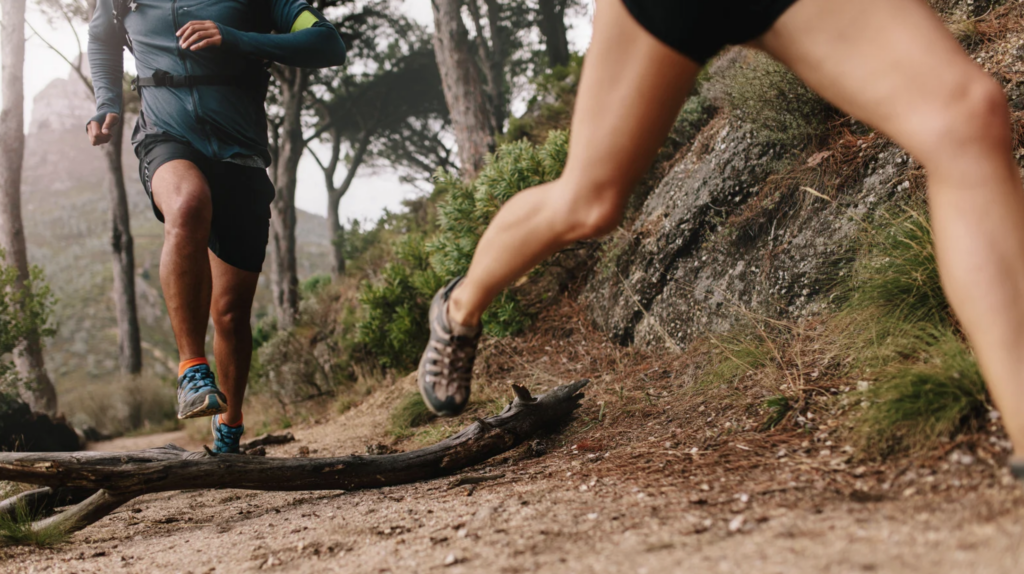
Loaded carries, essentially walking or hiking with a weighted pack, are one of the most directly transferable exercises a hunter can add to a training plan, since they replicate the exact combination of cardiovascular demand and load-bearing stress a real hunt requires. A hunter who has spent months training with an empty pack on flat ground is training a completely different skill than the one an actual mountain hunt will test.
Descending turns out to matter just as much as climbing, even though most training programs focus almost entirely on the uphill half of the equation. Eccentric loading on the way down a steep grade places real stress on knees and quadriceps, and a hunter who has never trained descents specifically often finds his legs failing on the way down rather than the way up, particularly while packing out a heavy load.
Core and hip stability deserve more attention than they typically get in a hunter’s training plan, since uneven terrain constantly challenges balance in ways a flat gym floor never replicates. A hunter with a strong cardiovascular base but weak stabilizing muscles still moves inefficiently and fatigues faster across genuinely uneven ground than one who has trained both systems together.
Grip and forearm endurance often go completely untrained despite playing a real role in a demanding hunt, from gripping trekking poles for hours to handling gear and eventually processing an animal after a long day already spent physically depleted. A hunter who has never trained grip endurance specifically often notices this gap only once his hands are failing him at the exact moment precision matters most.
Sleep quality in the weeks leading up to a hunt deserves more attention than it typically gets, since poor sleep during a demanding training block slows the very recovery process that training is supposed to build. A hunter cramming hard workouts into a schedule already short on sleep often ends up more fatigued heading into opening day than one who trained slightly less but recovered properly between sessions, a tradeoff that rarely occurs to someone focused purely on logging more miles.
Altitude adds a further variable that flatland training cannot fully replicate no matter how fit a hunter arrives. Thinner air at elevation genuinely slows recovery and increases perceived effort for anyone not already acclimated, which is part of why experienced Western hunters often build in a few extra days at elevation before opening day specifically to let their bodies begin adjusting before the real physical demands of the hunt begin.
Timing training around the actual season matters as much as the training itself. Starting a serious conditioning program twelve weeks out, rather than cramming in a few intense weeks right before opening day, gives the body time to build genuine load-bearing endurance rather than simply peaking on fatigue and soreness right when it matters most.
Recovery across a demanding multi-day hunt matters just as much as the physical preparation beforehand, particularly once a pack-out with real weight is added to an already long day. Stretching and basic mobility work remain the most common tools hunters reach for, and increasingly some serious hunters have added hyperbaric chambers to their home recovery setups, treating it as one part of managing cumulative physical stress during peak training and hunting season. None of this replaces the underlying conditioning work, but it gives a hunter’s body extra support absorbing a training and hunting load that most bodies are not naturally prepared for.
None of this requires a complicated program or an unlimited training budget to apply. Loaded carries on local trails, a deliberate focus on descents, and a training block that actually starts months before opening day rather than weeks closes most of the gap between generic gym fitness and what a real backcountry hunt actually demands.
Hunters in flatter regions face a particular challenge finding realistic elevation training close to home, and some have gotten creative, using stadium stairs, parking garage ramps, or weighted stair machines to approximate the demand a mountain hunt requires. The specific tool matters less than the underlying principle of training load and elevation together rather than treating them as separate problems.
Group training partners and hunting buddies training together tend to stick with a demanding pre-season program considerably longer than someone attempting the same plan alone, since a scheduled trail session with a partner is much harder to skip than a solo gym visit on a tired evening. This social accountability is a small factor on paper but a real one in practice, given how many ambitious training plans quietly fade by August without it, replaced by good intentions and a training log that stops updating right around the point it matters most.
The hunter who moves confidently through mile twelve of a pack-out, rather than gutting it out on willpower alone, is very often the one who trained the specific demands of the hunt itself rather than a generic version of fitness that looked good on paper back in July.
Read the full article here