
WE CHURNED OUT of the harbor at Prince Rupert on a wet, windy September day aboard Alvin Nystedt’s 37-foot Aristocrat I. Dark clouds were scudding overhead, rain was pelting down, storm warnings crackled from the two-way radio, and the fishing boat pitched and rolled in a heavy chop.
Nystedt headed south and we came under the lee of the soaring, mountainous islands that guard British Columbia’s half of the Inside Passage. The sailing was smoother, but there was no letup in the wind and rain. The weather that afternoon was only a foretaste of what we’d have for the next 12 days while hunting bears in the dripping rain forests and streamside thickets on the lower slopes of those timber-covered mountains.
We had planned this hunt for almost a year. There were four in the party, Art Hutchings and myself, Nystedt, and a young French-Indian deckhand. I’m 55, a wildlife-adventure movie maker and lecturer from Pontiac, Michigan, associated with the Mort Neff hunting and fishing TV show, Michigan Outdoors, at Detroit. Art is in his early 50’s and lives in the nearby town of Rochester. He’s the owner of an auto-parts plant in Detroit and manages to take enough time off for hunting and fishing. He and I have been companions in the bush for a long time. We paired up on hunting, fishing, and filming jaunts to Alaska, the Canadian Rockies, Northwest Territories, and quite a few places nearer home.
In the fall of 1963, we decided that our big project a year later would be a bear hunt along the Inside Passage. We both have a high regard for bears of any kind as trophy game, although neither of us had ever killed one. The very word bear has meant adventure and excitement to me as far back as I can remember. I had photographed blacks in Michigan and Canada and blacks and browns in Alaska. They stand at the very top of my list as interesting and entertaining actors in any wildlife movie. Art shares my enthusiasm, and we concluded it was time we did some bear hunting with rifles. The Prince Rupert section of British Columbia would afford us a chance for blacks and grizzlies. After making films from the Lake Superior country to Nome, I was also convinced that the islands and channels of the Inside Passage had great possibilities for a wildlife-adventure movie.
We contacted Nystedt, a Prince Rupert guide and outfitter, and several letters and two or three long-distance phone calls later, our arrangements were complete for a two-week hunt in September of 1964.
Although he is only 26, and looks even younger, Alvin Nystedt has been aboard fishing boats since he was knee-high to a duck, and we learned that he enjoys a topnotch rating as guide and skipper. His boat was brand-new and had good cooking facilities and bunk room for six or eight. We’d live aboard and go ashore to hunt.
Art and I really prepared for the trip. We had practiced with our rifles until we were shooting well enough to nail any bear that showed an ear.
We left home on Friday, September 11, drove to Detroit, crossed the border at Windsor, and boarded a Trans-Canada airliner for the flight to Vancouver. We stayed overnight there and flew on to Prince Rupert the next morning. Half an hour after we landed, a blockbuster was dropped into our hunting plans.
Nystedt met us at our hotel and we sat down for a brief get-acquainted coffee session with him and some people from the local chamber of commerce. Out of the blue, one of them turned and said, “Well, understand you’re going on a white-bear hunt?”
I looked at Nystedt in astonishment. In the year we had corresponded with him, no mention of white bears had been made. Up to that minute, I had thought that the nearest white bears were drifting around on the polar ice fields 1,500 miles or more to the north.
A hazy recollection went through the back of my mind of stories I had heard or read about a white race of black bears somewhere along the British Columbia coast, but I knew too little about the subject for it to mean much. We had told Nystedt we wanted a crack at blacks, grizzlies, and maybe a mountain goat, plus some salmon fishing and a chance for me to film the hunting and the matchless scenery of the Inside Passage. That seemed like assignment enough for two weeks.
Now he told us something that brought us up on the edges of our chairs. The white bears were indeed the little-known race or subspecies of black bear known as the Kermode, in all likelihood the rarest trophy-game animal on the North American continent. This beast is found only on a few big islands and a limited coastal area south of Prince Rupert. In the old days, a few skins taken by Natives had found their way into the Hudson’s Bay Company fur trade, and in recent years a very few of the animals had been shot under special permits for museum groups. Arthur Popham told the story of one such hunt in “Rare White Black-Bear,” in OUTDOOR LIFE, April, 1961. That bear is in the Kansas City, Missouri, Museum. Also, one of the white bears, captured alive with the aid of a hypodermic gun, was in the Stanley Park Zoo at Vancouver, Alvin said.
So far as he knew or we have been able to learn since, the Kermode was a trophy that no sportsman had ever taken under an ordinary hunting license because they had been completely protected since they became known to science 59 years before.
But last April, our outfitter went on, the British Columbia Fish and Game Branch had legalized hunting them on the ground that they were a color phase of black bear, and Jack Fox, the game warden at Prince Rupert, had suggested to Alvin that he take us into the Princess Royal and Gribbell Island country where the white bears are found. “If we have luck, and if someone doesn’t beat you to the punch, you could be the first hunters ever allowed to take one on an ordinary hunt,” Nystedt finished.
It was an exciting thought, but Art and I didn’t let our expectations build up too high. From the little we knew about the situation, a bear as rare as the Kermode, limited in range to 1,000 square miles or so of Pacific Coast rain forest and tide flats, seemed too much to hope for on a two-week hunt. For example, Popham said in his story that a fish-icing plant manager who had lived on Princess Royal for 14 years had seen only one of the white bears in all that time, and it had taken Popham three trips to the area by air, steamer, and boat to get the one he killed. We’d need fantastic luck to take one. All the same, we couldn’t get the idea out of our heads, and the white bears were the main topic of conversation as the Aristocrat I ran down the narrow, wind-lashed channels of the Passage that rainy afternoon.
We bought our nonresident licenses and left Prince Rupert right after noon on Saturday, only a few hours after we arrived. The licenses cost $25, plus $5 for a grizzly tag. No tag was needed for black bears.
The Aristocrat I carried a device that I had never seen before—two 30-foot poles mounted like masts on the deck about amidship and close to the rail on either side. Known as stabilizer poles, they were carried vertically in good weather, but during bad weather they could be lowered to a horizontal position and fastened there, standing out from the boat at a 90° angle. With an empty gas drum fastened at the end of each pole, they did a lot to check our rolling.
We anchored that night in a sheltered bay on one of the islands, and in spite of miserable weather the next morning, we went ashore to look for bears.
Every stream emptying into the sea along that coast is a potential hangout for either blacks or grizzlies, since all the creeks and rivers are spawning grounds of one kind or another of Pacific salmon. As long as the salmon runs last, from early summer to fall, bears congregate along the streams and on the tide flats where the fishing is fabulously good. We didn’t have to go far in search of bear sign. There were well-used bear paths along the stream at the head of the bay, and three or four times in a walk of half a mile we came on freshly caught salmon, tooth-punctured or partly eaten. But for all the abundance of sign, that island did not pay off. Late that afternoon, we nosed out of the bay and headed south.
There was no letup in the bad weather, but we refused to let it interfere with our hunting. Shortly after noon on Sunday, we felt our way into a cove on a small island, put the skiff and outboard over, and started up the stream that emptied into the cove. Less than a mile above the tide flats the stream became too shallow and fast for the boat, so we landed and continued up the valley on foot.
Bear trails followed the stream through brush and tall grass, and there was much evidence that the bears were catching all the salmon they wanted. We had walked about a quarter of a mile when we rounded a bend below a small waterfall and saw our first bear. He was only a cub, and we must have given him the surprise of his young life. When he turned a corner in a bear path and came face to face with us only a few feet away, he set his brakes, took one startled look, and went into the brush as if he’d seen ghosts.
Two hundred yards farther on, we sat down on a log near the water’s edge to look things over. “There are bigger bears than that fishing along here,” Alvin told us. “If we give them a little time, maybe one will show.”
It was a dark, dreary afternoon, with rain pelting down, not pleasant for hunting and no good at all for camera work. But we were snug enough in our rain gear, and I reminded myself that there was just as much chance of seeing bears in the rain as in sunshine.
I was carrying a pair of 7X binoculars in addition to the Weaver K4 scope on my bolt-action Remington Model 700. I started to glass the stream above us, going over both banks foot by foot. The river came down through a stretch of white water and spilled into a big pool. Thick tangles of brush closed in on both sides, and at the head of the rapids, 200 yards upstream, a logjam extended out from the left bank. A big, dark stump or snag at one end of the jam caught my eye. When I leveled the glasses for a better look, I was staring at the broad rump of a big black bear.
He was sitting astride a huge log, four feet above the water, hunched over, watching for salmon. I decided he was big enough to satisfy me, and passed the glasses first to Alvin and then to Art. It took them a few seconds to make him out.
I couldn’t have asked for better conditions for a stalk. The wind was blowing in my face and the rumble and roar of the rapids would cover any noise I might make. I started cautiously upstream among rocks, brush, and rubble with Art and Alvin trailing a few yards behind carrying two movie cameras. In spite of the weather and poor light, I wanted a film of my first bear kill if we could get it.
At a point 75 yards from the bear, I came to a protruding tree branch that afforded a perfect rest for the shot. I brought the rifle up, and then Art tapped me unexpectedly on the shoulder. “That isn’t a bear, Howard,” he whispered. “That’s a snag sticking up from the logjam.” What a letdown!
I lowered the rifle and went for my glasses again. After all, rain had blurred my vision and I hadn’t seen the bear move. Maybe Art was right. But just as I put the glasses on it, the upturned snag came to life. It was a bear shaking himself like an overgrown black dog to rid his head and shoulders of rainwater.
He was still hunched on his log with his rear toward me. I got the bear in the scope of the .30/06, put the Lee dot on his back between the shoulders, and drove a 180-grain softpoint into him. The Remington boomed like a cannon in that timber-enclosed valley, and before the echoes had died away, the bear was in the river, dead.
He was a good male with a fine, thick pelt, heavy enough so that the three of us had a hard time getting him ashore for skinning. Nystedt guessed his weight at around 325, and from what Art and I knew of bears, that seemed a good estimate. I had taken a trophy every bit as good as I had hoped for, and I was a proud and happy hunter.
I’m aware that along the British Columbia coast and in southeastern Alaska, the black bear is regarded with close to downright contempt, hardly worth hunting and certainly no kill to brag about. But where I come from, he’s considered about as exciting a trophy as a hunter can ask to take, and that happens to be my own feeling.
There was still the tantalizing possibility of a white bear to reckon with, and we moved south next morning and headed down the west coast of Princess Royal Island. It was there, Alvin told us, that we’d have the best chance of finding a Kermode.
Princess Royal is some 50 miles long, 10 to 25 wide, and, like the neighboring coastal area, is timbered with dense rain forest. There are tide flats only in the bays and coves, and even there the flats are exposed only at low tide, for when the tide comes in it drowns everything up to the bush. The timber was so thick that in many places we could see only a few yards ahead once we entered it. The forest dripped with the incessant rain and fog, and Art and I agreed that it would be hard to find a tougher place for a hunt. The rare white bear has a lot of natural advantages on his side.
We spent two fruitless days along the Princess Royal coast, cruising Laredo Sound and moving from one secluded bay to another. About noon on Wednesday, we anchored in a small bay in the southwestern part of the island, went ashore in the skiff, and found the usual stream running in.
The river was literally full of salmon fighting their way up through the reaches of fast water. We found fresh bear sign everywhere we looked—trails, beds, and a half-eaten fish, some so fresh that we suspected we had spooked a bear away from his meal.
We worked our way slowly upstream, and half a mile from the place where we had left the skiff we came to a fork in the river, surprised a small black bear fishing, and sent him scampering.
The fork of the stream looked like a good place for bear pictures, so I waited there while Art and Alvin pushed on up the right branch. I could see 100 yards up the left branch, and the pool in front of me was full of spawning salmon. But I realized that even if a bear came down to fish, I’d be under great handicaps. The day was foggy and dark and huge trees intertwined to form a canopy over the 40-foot width of the river.
I got my glasses out and settled down to watch the branch to my left. All of a sudden I thought I saw the forepaws of a bear move behind a screen of brush, as if the animal were standing erect to look for salmon. But there was no further movement and I wrote the bear off as imagination. For the next 20 minutes nothing happened. Then, without warning, a big bear dodged out among the boulders in the river 100 yards upstream, lunged for a salmon, and went out of sight again. I had only a hurried glimpse of him, but that was enough to tell me he was worth going after. I had my bear, so I decided to wait where I was until Art and Alvin came back.
Close to an hour went by before they showed up, and when they did I gave them a quick rundown on what I had seen. “But that was almost an hour ago,” I warned. “He may have cleared out.”
Nystedt shook his head. “Good chance he’s still around. Let’s go see.”
We started up the left fork of the stream, moving cautiously, with Art in the lead and Alvin backing him. I trailed behind with my camera ready. Within a few yards we broke out of the brush onto a bear trail packed down from constant use. At the first bend in the path, we found a salmon so fresh that blood still oozed where the bear had bitten into it.
There’s a tension in a situation of that kind that only a hunter can appreciate. We had the river on one side and brush on the other so thick a bear could have watched us three steps away without our knowing he was there. I’ve stalked a fair amount of big game in my day, but it never loses its excitement for me. I knew Art well enough to be sure that his blood pressure was as high as mine.
We came to the place where I had seen the bear and stopped at the top of the bank where we could look down into a gorgelike stretch. We stood there for a moment or two, waiting and peering into the thickets, but there was no bear in sight. Before we moved on, Art asked me in a whisper, “Would you trade guns? This damn scope has fogged up again.”
He was carrying a .30/06 Winchester Model 70. The scope had given him trouble all during the hunt, and when we exchanged guns, I could see nothing through it.
The afternoon was almost gone and the light, already bad, was beginning to fade. The bear trail continued along the river and we followed it to a big, open pool with a submerged beaver dam at the lower end and a jumble of logs, piled up by flood water, 75 yards upstream. We stopped at the edge of the brush to look things over.
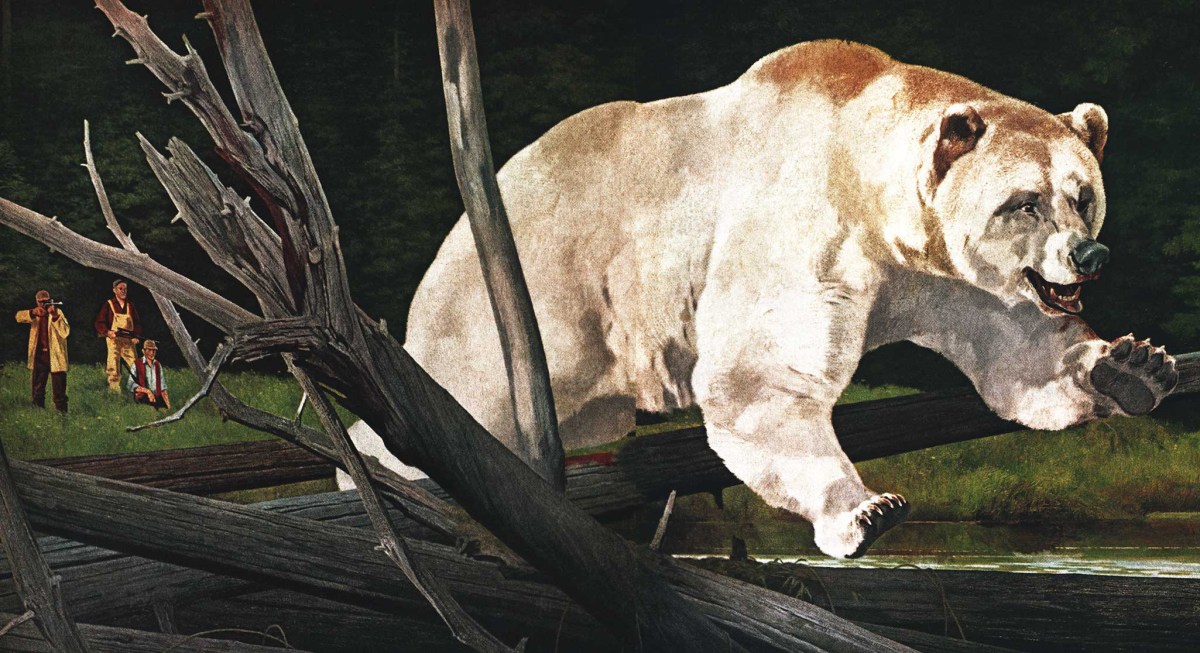
Halfway across the logjam a white bear was clambering toward our side of the river, slowly and surefootedly. Neither Art nor I will ever forget that minute. The bear simply materialized as if he had emerged out of the low-hanging fog. Against the background of green timber and rushing water, he looked unreal, a ghost bear from another world.
The white bear had no connection with the black I had seen earlier. It simply had been our incredible good luck to blunder into the trophy we had dreamed about. As Art said afterward, it wouldn’t happen again in two lifetimes.
Not quite believing his own eyes, Art took time to turn to Nystedt and whisper one startled question, “Is it a white bear or a light-colored grizzly?”
“It’s white,” Alvin barked back. “Shoot!”
Art shot twice, so close together that the reports sounded almost like one. Both shots were on target, behind the shoulder, and the range was only 75 yards, but the bear kept his footing on the logs. He let out a bawl, changed ends as nimbly as a red squirrel, and lunged for the far shore like a white streak. He was out of sight in thick brush before Art could fire again.
“He’s down,” Art shouted, “he’s got to be down.”
“He should be,” Nystedt agreed. “You hit him fair and square. But we won’t be sure until we get over there and take a look.”
Getting across the river and taking the look would both be ticklish, especially with darkness coming on, but we were too excited to think about that. Art had killed a white bear, or we thought he had, and nothing else mattered at the moment.
We tried the logjam first, but the main log, the one the bear had crossed on, was under a foot of rushing water in midstream and the pool beneath it was six or eight feet deep and icy cold. We went down to the beaver dam and Art inched out, but there was a foot of water pouring over it, too. My partner got a boot wedged between two rocks and nearly fell, gave up, and came back to shore. “The jam is better than that,” he grunted.
Walking the submerged log was as difficult as trying to balance on a greased slack wire, but we used long poles to brace ourselves against the rush of the current and finally made it. Then, with all three rifles ready—Alvin was carrying a .30 caliber of English make as a back-up gun—we started our search for the bear. We didn’t have far to look. He lay dead in the brush 50 feet from the river.
Art will never kill another trophy like that and I’ll never see one killed. Save for his strikingly beautiful color, he was a typical black bear in every way, but color converted him into a magnificent animal unlike anything I had ever expected to see.
He was milk-white on the sides and flanks, but the white was washed with bright orange-yellow around the face and on the shoulders and feet. A broad band of the yellow started between his ears, ran back over the shoulders, and faded out over his rump. So far as we could tell, it was natural color, not stain.
His nose, lips, and the pads of his feet were light gray. There was no black on him anywhere, but his small, beady eyes were dark like those of a normal black bear. Plainly this was no albino, but a member of a race apart. Studying him, we knew why the Natives held the white bear in great reverence, as Alvin had told us earlier.
He was a male, heavy and blocky, with the squarish head of a black bear, and we agreed he’d weigh at least 400 pounds. That was no wild guess begotten of our excitement, either. All three of us had seen plenty of bears and knew something about their weight. We measured and considered carefully before we came up with the figure. And when we got home with the pelt and skull, Al Hilde, the Pontiac taxidermist to whom Art took his trophy for mounting, told us he thought our estimate was very conservative.
It was dark before we finished the skinning. We found later that the pelt and head weighed 86 pounds, but Nystedt rolled them into a bundle and shouldered it, and the hike back to the skiff wasn’t bad in spite of the darkness and rain. We had only half a mile to go, and the bear trail that ran beside the river was worn and as easy to follow as a cowpath. If bears were using it that night, they cleared out when they heard us coming.
We fleshed out the skull and paws the next morning, salted the hide and put it on ice in the hold of the boat. Two days later, a well-intentioned but uninformed fisheries patrol officer took a lot of the fun out of our bear hunt when he tracked us down along a stream and told us he had gone aboard our boat and had examined the white bear hide. He bluntly demanded to know who shot it.
We explained the entire episode and showed our licenses and credentials, but he was not satisfied. He did not detain us, but warned us that he would report to the proper authorities by radio that night and told us we could expect to be checked as soon as we got back to Prince Rupert.
It was a thoroughly unpleasant spot to be in and we were extremely ill at ease the rest of the trip. Could there have been some misunderstanding between Fox, the game warden, and Nystedt? Had we mistakenly killed a bear that was still under protection? It seemed impossible, and Alvin was absolutely sure he was right. Nevertheless, it wasn’t an enjoyable situation.
Art killed a second bear a few days later, a 200-pound black, but the weather licked us when it came to finding a grizzly. We had 12 straight days of rain, plus wind and fog a fair share of the time. It had rained the day we left Prince Rupert and it was still pelting down when we got back on September 25.
We didn’t wait for the warden to come to us. We went to him almost the minute we were ashore, and he eliminated our worries immediately. Sure our white bear was legal, he assured us, and every phase of the hunt had been in accordance with British Columbia game laws. The fisheries patrol officer just wasn’t up to date on Kermode bear regulations. To two law-abiding nonresidents, that was a relief.
Certain questions will probably bother many sportsmen who read this story. Did the British Columbia Fish and Game Branch make a mistake when it opened the season on the very rare white bears? Are there enough of them to justify lumping them with black bears and stripping them of the protection they have enjoyed since they first became known to science? What were the reasons for that rather surprising action? Will widespread interest in the Kermodes as rare and beautiful trophies result in hunting pressure heavy enough to endanger the race?
Those questions bothered Art and me, and it was our feeling that they also bothered Jack Fox. Obviously we couldn’t answer them, but after OUTDOOR LIFE heard our story it went to the Fish and Game Branch to get the answers.
To begin with, almost nothing is known about the size of the Kermode bear population. Natives with whom we talked estimated it from as low as a few dozen to as high as 200, not large in any case. But those are no more than wild guesses. British Columbia game authorities say that because of the inaccessibility of the area where the bears are found, and the wild, rough terrain, no research has been undertaken and nobody has any reliable information on their numbers. Even the exact boundaries of their range are not known. But everybody acknowledges that pure-white bears such as Art killed are far from numerous. One official told us we might hunt 10 years on Princess Royal without seeing another like it.
Then why take a chance of allowing any hunting of such a rare animal? Dr. James Hatter, director of the Fish and Game Branch, replied to that question this way: “Because we thought the Kermode was a species that could stand a limited harvest under rigid controls.” No such controls were imposed, however. Any hunter who had a license could kill a white bear if he got the chance.
It seems evident that the game biologists underestimated the amount of hunting that might result and relied to some extent on the inaccessibility of the area to protect the bears. Also involved in the decision was the fact that the Kermode is regarded by scientists as a color phase of the black bear, not a separate race. One biologist compares them with the cinnamon bear, a brown phase of the black common in the West but rarely or never seen in the East, and also with the blue or glacier bear of coastal Alaska. Dr. Hatter says it is believed that two black bears, carrying the white genes as a hereditary characteristic, could mate and produce a white cub, or that a white bear could mate with a black and produce a black cub. Admittedly, however, there is no known case of a white cub being seen with a black mother or the reverse of this.
In any case, the Fish and Game Branch took a second hard look at the whole situation last winter and decided to return the Kermode to the closed list, at least for the next two years. So, after the present bear season expires on June 30 this year, hunters planning a British Columbia hunt in the hope of taking one are out of luck, and there is reason to doubt that the Kermode season will ever be opened again.
Read Next: Fred Bear’s Wildest Hunt: The Day He Faced a World‑Record Brown Bear at 20 Yards
That makes our hunt one that no sportsman will be able to repeat, and means that Art’s bear was not only the first of its kind ever taken under an ordinary hunting license but that it also may well be the last. That leaves him with a trophy that in all likelihood is the rarest in the world. Al Hilde made up the pelt as a rug with a full-head mount, and it’s every bit as beautiful as it is rare.
This article was originally published in the July 1965 issue of Outdoor Life. Today, the Kermode bear is protected and it’s estimated that between 100 and 500 fully white bears exist.
Read the full article here