
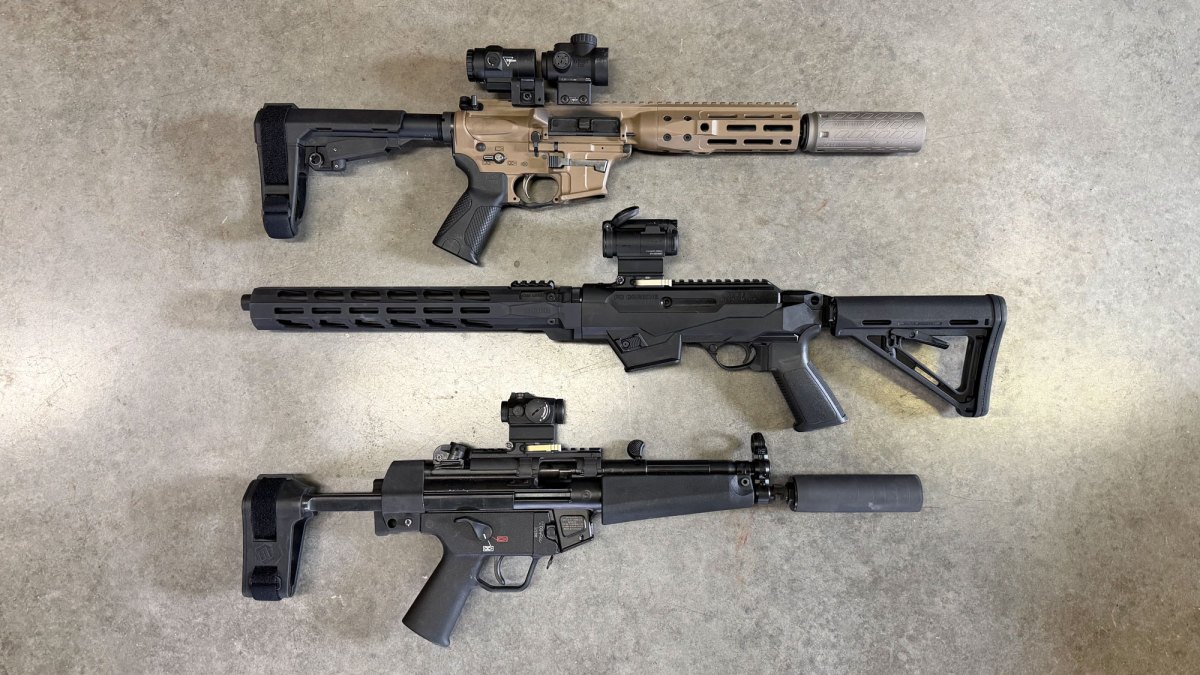
Pistol caliber carbines, or PCCs, make up one of the fastest-growing segments of the firearms industry. Most commonly chambered in 9mm, they are compact, easy and fun to shoot, and ammunition is relatively affordable. PCCs span a spectrum of price points, and we got an in-depth look at that in our 2026 Gun Test. More specifically, we had a hands-on, no-BS look at just what you’re getting for a premium PCC, and what you might be giving up going with one that’s more affordable.
In our testing, we found there to be three distinct tiers of PCCs, segmented by price. The upper tier consists of carbines and braced pistols priced over $2,000. The lowest, or budget tier, all retail for under $1,000. And many fall into the mid-priced tier of $1,000 to $2,000. Here’s a look at some key things that you’re getting for your money — and some of the downsides too.
Top-Tier PCCs ($2,000 plus)
Pros
- Better components and materials
- Better workmanship
- Smoother recoil
Cons
- There is often a premium on the brand name
- Some lower-priced options offer close competition
The highest priced PCCs are generally going to be really high-quality guns. These all use premium components, materials, and the fit and finish work is notably better than on many lower-priced models. A good example of this is the HK SP5 compared to both Turkish-made clones we tested. The SP5 has visibly better stamping and finish work. After hard use, the guide rails stamped into the receiver showed almost no wear compared to the notable finish wear on the Turks.
The recoil systems of higher-end PCCs are also typically more refined and they are smoother shooting. This is especially true when comparing to the lowest-priced PCCs. Nearly all PCCs are blowback operated, which means they rely on the recoil force of the cartridge to cycle the action. This can vary between direct blowback, roller-delayed blowback, and newer passive-style delayed blowback, as well as the Browning short recoil system. But the high-end guns simply do a better job, generally, of softening that recoil impulse.
The two biggest downsides of some top-end PCCs are that, one, you’re often paying a premium for the brand name as much as you are a quality firearm. Second, some of the mid-priced PCCs are nearly indistinguishable in performance from their more expensive counterparts. We found this to be the case, especially with some of the AR configurations.
Mid-Priced PCCs ($1,000 – $2,000)
Pros
- Good to great performance
- Optimal platforms for upgrades
- Great modularity
Cons
- Sometimes gassier than premium guns
- Often not as smooth and controllable as premium guns
The sweet spot for most shooters will be the mid-priced PCC, which mostly range between a thousand and two thousand bucks. There are many options in this category including ARs, AKs, MP5 clones, and a pile of others. We saw some real performers like the LWRC IC-9, which punches above its weight class. Others like the PSA AK-V, CZ Scorpion, and Kriss Vector all offered good quality with great functionality and shootability. All were set up to mesh with add-ons like lights and suppressors. The Century Arms AP5-P, an MP5K clone, has performed very well for me and comes in at a price that allows room for several major upgrades I’ve made.
We didn’t fall in love with all of them, and in this category, you’ll sometimes see awkward or less-refined controls and some magazine compatibility issues. Some, particularly those with an AR-style charging handle, are pretty gassy when shooting with a suppressor, and the heavier bolts and less-refined recoil systems, for the most part, aren’t quite as smooth as more expensive ones.
Budget PCCs (Under $1,000)
Pros
- Good Value
- Good Modularity
- Good Reliability
Cons
- Not smooth shooting
- Triggers and controls aren’t as good
We always celebrate a good value at Outdoor Life and, when it comes to PCCs, there are some great options that are really affordable. For someone who just wants a PCC to plink, shoot, or get started in competition, a budget-priced carbine might be the way to go. Models like the Ruger PC Carbine, which has a 10/22-style blowback action, offer tremendous versatility. The PC Carbine also sports a takedown feature and comes with the hardware to convert to use Glock-pattern mags. All the budget-priced PCCs we tested were accurate and ran reliably.
One of the drawbacks we noted was that recoil was notably snappier, with more vibration, in most budget PCCs than with the more expensive models. In direct-blowback guns, the bolt weight and spring stiffness are the only thing countering the force of recoil. The recoil systems on some of these are less refined and the shock from recoil resonating through the gun can be a bit harsh. In all cases, operation was improved by adding a suppressor. Some of the controls and ergonomics can be awkward and less refined on budget models. We had trouble with the Smith & Wesson FPC’s charging handle becoming stiff and the extractor didn’t always want to pull unfired cartridges from the chamber when attempting to clear the gun.
Final Thoughts
If you’re considering a PCC you can be happy that there are a lot of great options. As with so many other types of guns, the right choice for you will depend on your budget, application, and personal taste. Our takeaway is that with the most expensive PCCs, you’re going to get a great gun — even if a portion of that fee is for the brand. Mid-priced PCCs offer a ton of value, performance, and innovation. If you want some room left in your budget for upgrades, this is your jam. On a more limited budget, you’ve still got a lot of options. Their shortcomings aren’t fatal flaws, but performance certainly isn’t at a premium level.
Read the full article here