
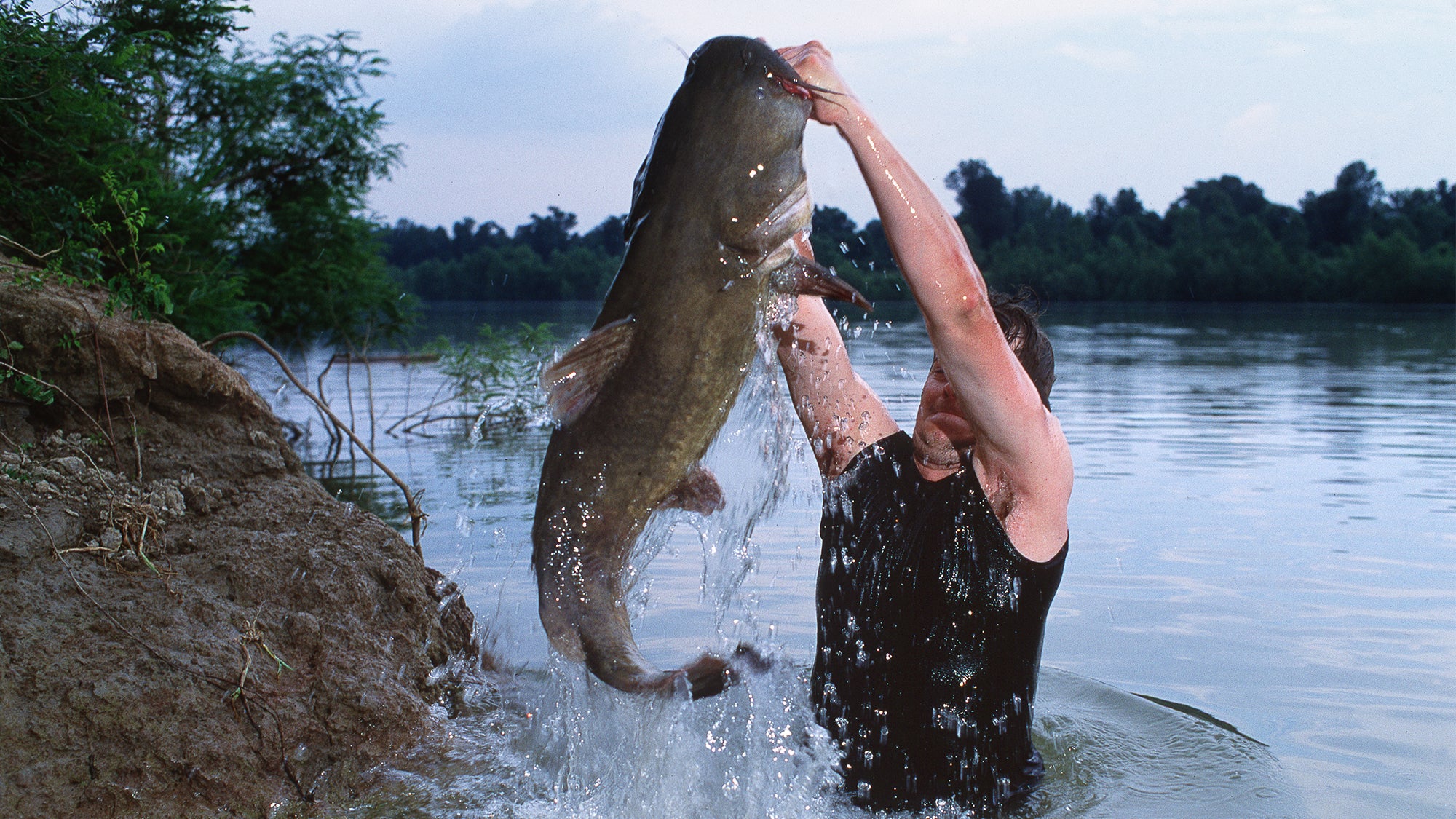
Catfish noodling means diving or reaching underwater, sticking your hand into a hole where catfish spawn, letting the fish bite down, then grabbing it by the jaw and wrestling it to the surface. It works on flathead, channel, and blue catfish. It is physically dangerous—broken fingers, torn tendons, and fin punctures are real risks—and it is only legal in certain states.
- Noodling is hands-only catfishing: reach into a spawning hole, let the fish bite, then wrestle it out.
- Target flathead, channel, and blue catfish during spawning season when fish hold in underwater holes.
- Injuries are common — broken fingers, torn tendons, dorsal-fin punctures, and lacerations from underwater debris.
- Verify legality before you go — noodling is not legal in all states.
- The technique goes by multiple regional names: tickling, hogging, and grabbing.
If I were to flip you the bird left-handed, which I sometimes do to mix things up, you’d notice that my middle finger is crooked, with a bulged knuckle. Why does it look like that? Catfish noodling. Last summer, a big flathead catfish broke my finger while I was wrestling him out of an underwater hole. Catfish noodlers aren’t known for crying, but wailing like a wasp-stung toddler is exactly what I wanted to do in that moment. Michelle, my wife, had watched the whole incident from the bow of my jon boat. I clutched my hand against my chest, having dropped the catfish, and looked at her with misty eyes.
She said, “You’re the idiot who reached in there and grabbed that catfish.”
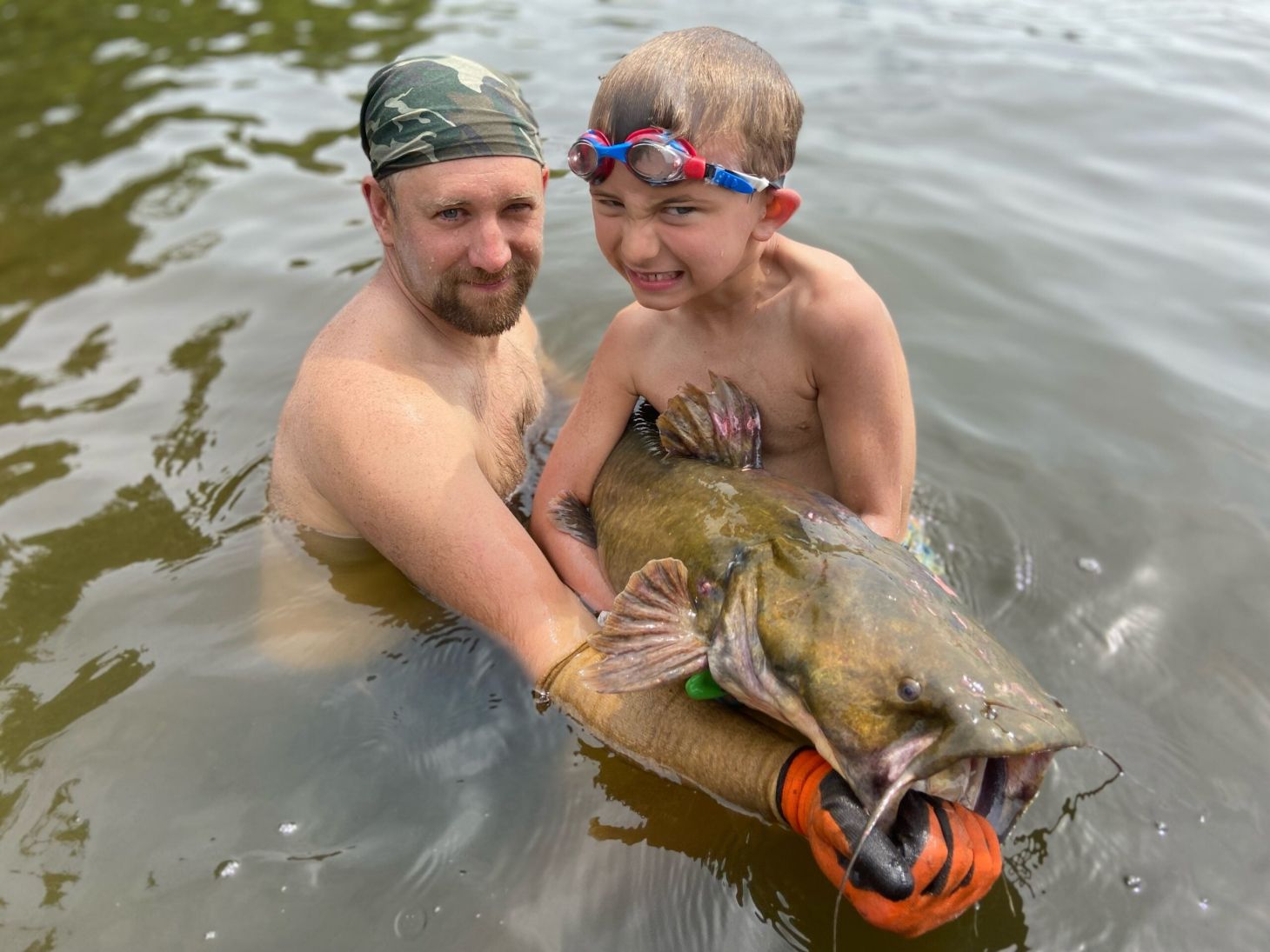
This summer will be my 18th year catfish noodling. Maybe I’ve wrestled a thousand flatheads in that time, or maybe not quite that many. I don’t keep count. But I do know that I dodged the odds of being injured, beyond the usual scrapes and bruises, for a long time. A few years ago, my buddy Tim spent months in an arm brace after a 90-pounder popped some tendons loose in his wrist. Another year, my brother, Matt, had to pay a hell of an ER bill after a channel cat impaled his arm with its dorsal-fin spine. I’ve seen noses bashed and blooded, fingertips smashed purple, and arms lacerated by underwater rebar. I tell you all of this so you know what you’re getting into. Noodling for catfish has never been more popular, thanks to social media. But that popularity—and the quest for #GetBit pictures on Instagram—can overshadow a fundamental reality: catfish noodling is a rough sport, in which people get hurt fairly often.
And still here you are, reading about it. That’s good, because the other reality of catfish noodling is that it’s my favorite way to catch big catfish, and for many people, it’s hopelessly addicting. I wrestled three big flatheads just this week, crooked finger and all. So, if you want in on all that catfish noodling has to offer, including the risk of injury, here is everything you need to know.
What Is Catfish Noodling?
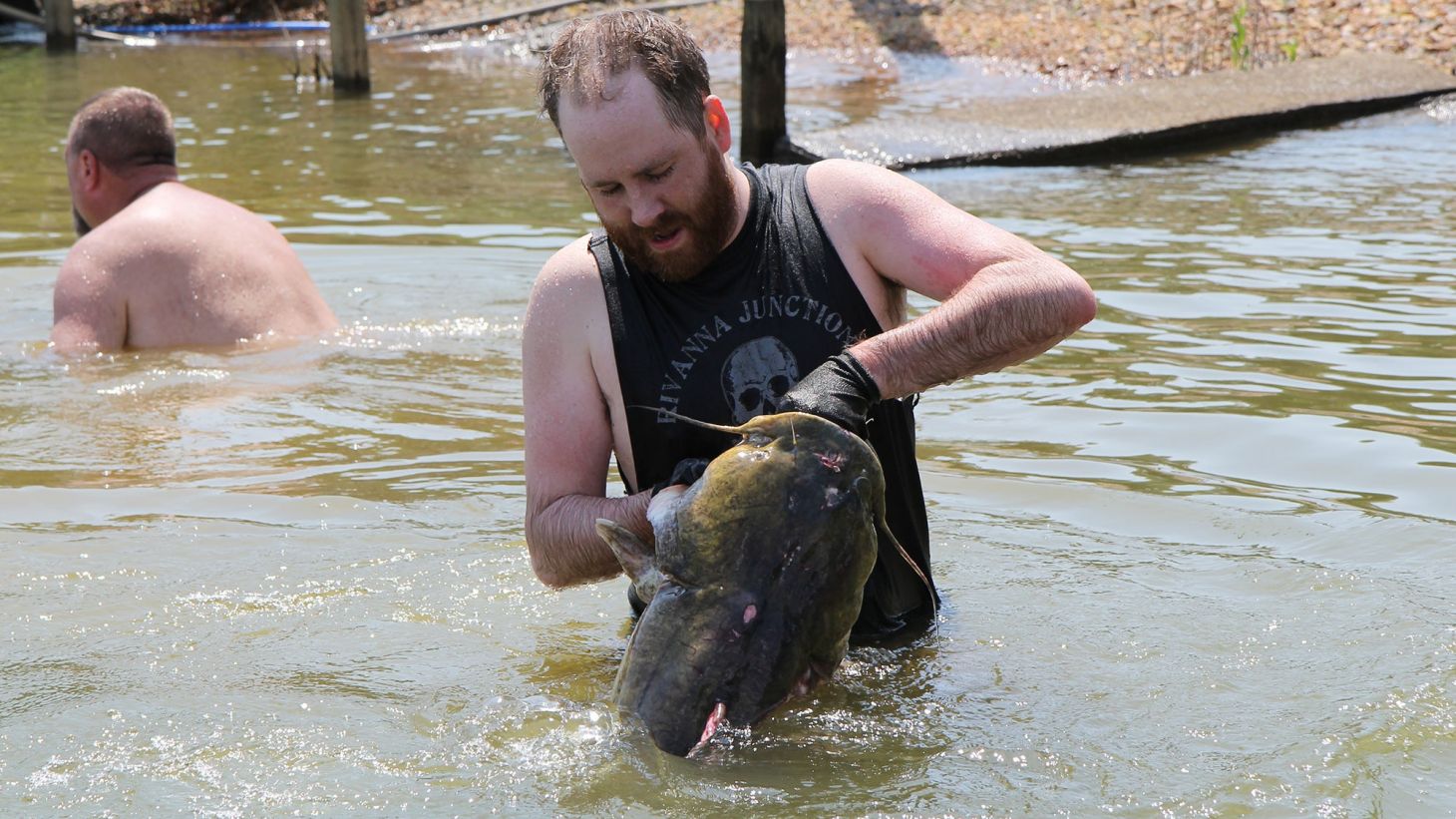
If you are just learning about catfish noodling, I’ll assume that you’re not from the South and that you could use a quick, basic explanation. Catfish noodling, also called “tickling,” “hogging,” and “grabbing,” is just a matter of catching flathead, channel, or blue catfish using your hands instead of catching them with rod and reel. Catfish spawn in underwater holes, so when spawning season comes, you reach or dive underwater, stick your hand in the an underwater hole, wait for a catfish to bite down on your hand, and then you grab the fish by its jaw and wrestle it out of its hole and up to the surface. There are, however, a few nuances you’ll want to know about.
Make Sure It’s Legal for You to Go Catfish Noodling
Catfish noodling is legal in more states now than it was when I started, but it’s still illegal in plenty of places, too. With laws subject to frequent change, it’s your responsibility to check the regulations for the state and waterway you’re planning to fish. Depending on your area, there can be seasons on handfishing (it runs June 1 to August 31 in my state of Kentucky), species-specific bag limits (flatheads only in Oklahoma), and size limits (only one catfish over 34 inches can be kept per day in Tennessee).
Some states allow noodlers to build and sink artificial habitat and to use tools, like handled hooks or scuba equipment. Others won’t let you pick up a stick on the bank for the purpose of fish poking. So, check the regulations carefully before you attempt to do any catfish noodling.
Find Flatheads for the Best Catfish Noodling
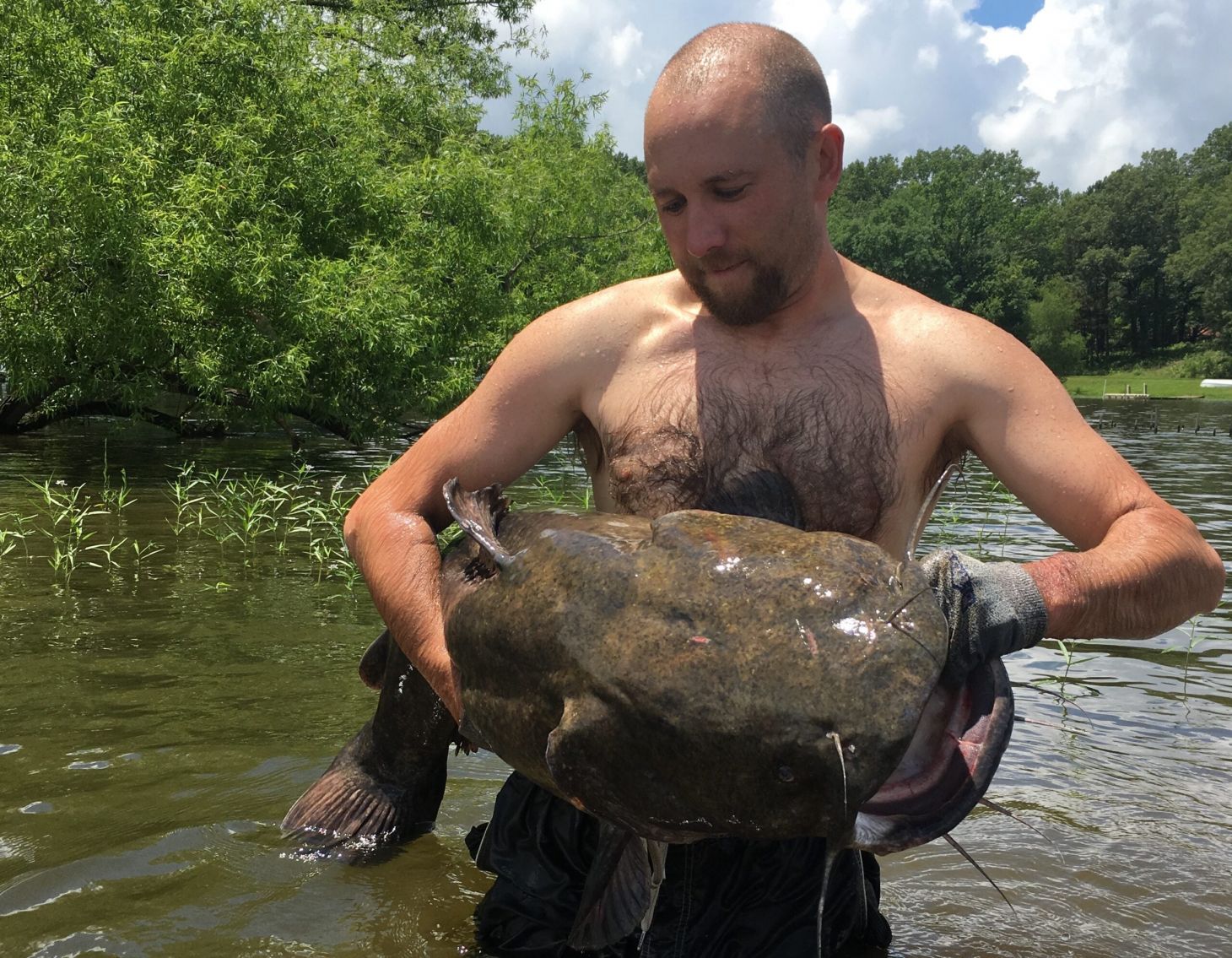
Noodling wouldn’t be the same without flathead catfish. Though channel and blue cats are frequently caught by noodlers, their smaller mouths, powerful bite force, and ill temper make them especially disagreeable when they attack your hand. A 20-pound blue cat bites like a rattrap with teeth. Speaking of teeth, catfish do indeed have them, called cardiform, lining both their upper and lower jaws. Blue cat teeth are a little bigger.
Flatheads are a predatory species with a gaping mouth and large, under-biting lower jaw that’s evolved for swallowing 3-pound bass whole. It makes a nice handle for noodlers to grab. Flatheads bite plenty hard enough to draw blood from bare skin, but they don’t apply the sustained pressure that blues and channels do. They grow rapidly where good forage is available, and can attain massive size. One-hundred pounders aren’t uncommon, though the average size of a noodled flathead is about 30 pounds. I’ve heard some claim that flatheads can live for a century, and that 50-pounders are 50 years old, but most biologists seem to agree that 25 years is about the maximum lifespan for a flathead in a healthy river system.
Virtually all southern reservoirs have good flathead populations, and the fish can be wrestled from tiny tributary streams, too. Good flathead water for noodling should be clean but not necessarily clear. They do well in turbid water, so long as there’s a good supply of food.
When and Where to Noodle Catfish
Blue, channel, and flathead catfish are all cavity nesters that spawn in underwater holes, such as washouts along the bank or under logs, brush piles, and rocks; or in man-made spawning habitat, like sunken culverts and bathtubs. These holes will be in mostly still water, anywhere from just under the surface to 10 feet deep. Within the cavity, the cat fans out a bowl-shaped depression, just like a bluegill or bass, and so the right bottom composition is important. My best catfish holes all have sand or fine pea gravel on the bottom.
The flathead spawn begins when the water hits 80 degrees, though not all the fish spawn at once. Here in Kentucky, we tend to see one peak in early June and a second one late in the month. The action wanes quickly after July 4. Early in the season, it’s not uncommon to catch two flatheads from the same hole, a male and a female, but as the summer wears on you’ll mostly encounter males that are guarding established nests.
Finding the holes is the most difficult part of catfish noodling. You can’t see them with your eyes or with a depth finder when they’re underwater. I have located some in the winter, when lakes were lowered for flood control, but we’ve found most of them after hours, days, and years of probing the shorelines with hands and feet. Some of our spots have been producing big flatheads for more than a decade. Some go inexplicably cold for a year or two, and then start producing again. And some fall victim to current and time and are washed away. Good noodlers are always on the hunt for new spots, and are very tight-lipped about their location to other noodlers.
Catfish Noodling Technique
Sometimes you find a likely catfish hole, take a deep breath, dive under the water, reach inside the hole with your hand—and there’s a flathead waiting inside that will engulf your entire arm. A few people, who are practiced and calm, can comfortably hold their breath for 2 minutes underwater. But nobody is calm when a 50-pound catfish is mangling their hand. Most folks have about a minute, on average, to get control of the fish and fight it to the surface before panic over drowning sets in. This is why you have to have good technique.
Good technique and a clear head allow you to take control of even a large catfish quickly. I like to run one hand underneath the gill plate and lock it together with the other hand. Then I pull the fish’s head into my chest and, if it’s a big one, wrap my legs around its tail. At that point, you just need a good buddy to pull you to the bank (never go noodling alone). Poor technique would be holding a flathead by the bottom jaw and attempting to hang onto him by grip pressure alone. That’s how I broke my middle finger.
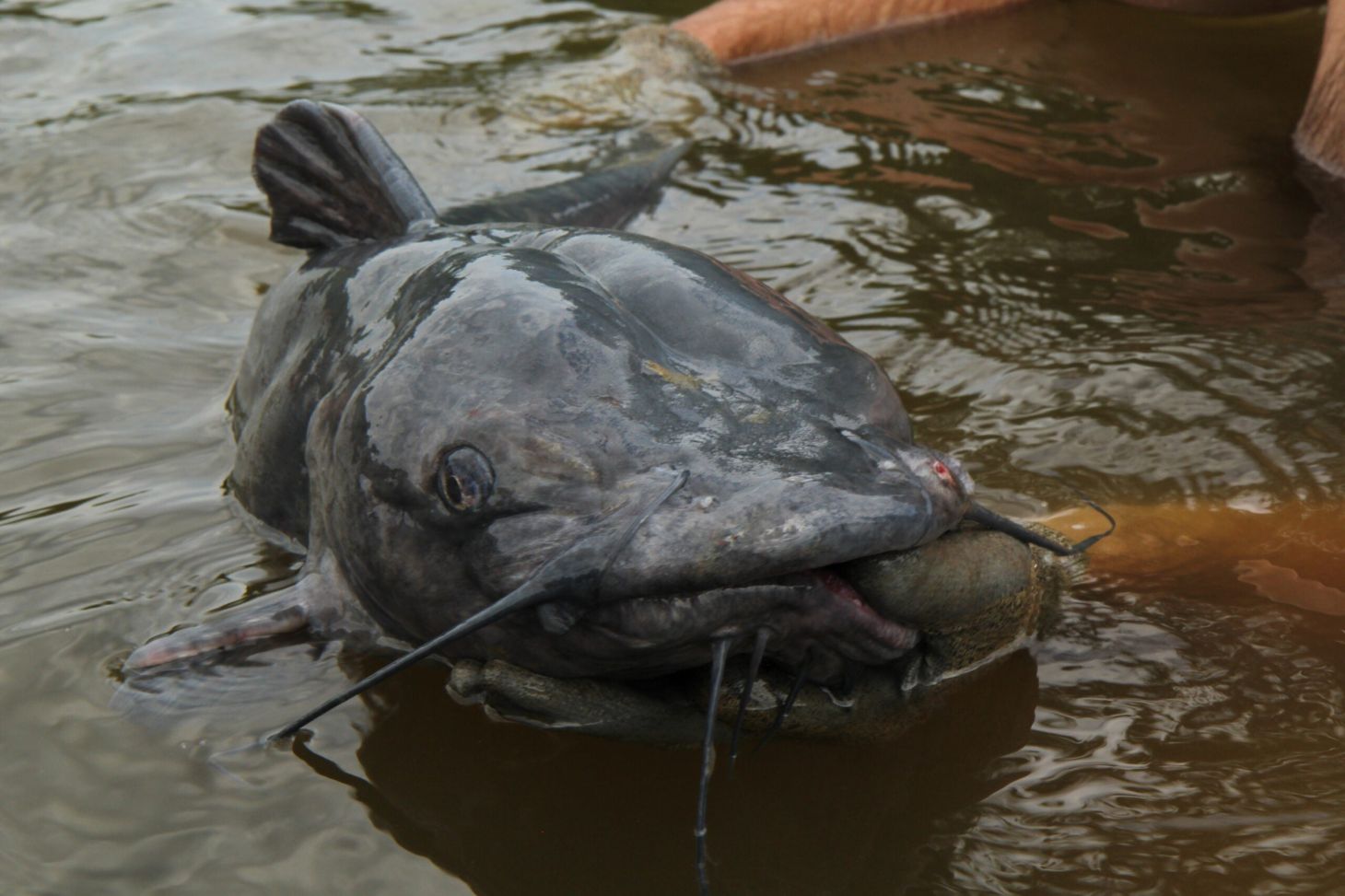
It’s a misconception that noodling is fast-paced and that a flathead will attack your hand every time. Some fish seem almost docile. And some catfish lairs are so deep that you can’t reach the fish inside with your hand. That’s where noodlers get creative. In places were grabbling sticks and the like aren’t allowed, noodlers get the extra reach by way of their feet. I’ve never fished that way, though, and can’t speak to the technique.
Single barbless hooks on the end of a stick or pole are legal aids in some states where noodling itself is legal, including here in Kentucky. We use dull screw hooks threaded into the ends of broom handles cut to various lengths as our tool of choice. Catfish will frequently bite the hook itself, which snags their jaw (but rarely pierces the skin) and allows us to drag the fish to within grabbing distance. It’s worth emphasizing that these hooks are dull, both to prevent injuring the catfish, and because the last thing I’d want while fighting a fish underwater is a sharp hook that I can’t see stuck in its jaw.
Flathead catfish are fine eating. I’m partial to the belly meat myself. But it doesn’t take many of them to stock even a robust fish fry, and so virtually every noodler I know practices catch and release most of the time. Memories are made in the form of pictures, scars, and occasional broken fingers, all of which serve as reminders of what can happen to “idiots” who reach into underwater holes and grab big catfish. And still, I can’t recommend highly enough.
Top 3 States for Catfish Noodling
Catfish noodling is currently legal in 16 states primarily in the South and Midwest, including Alabama, Arkansas, Georgia, Illinois, Kansas, Kentucky, Louisiana, Maryland, Mississippi, North Carolina, Oklahoma, South Carolina, Tennessee, Texas, West Virginia, and Wisconsin. Oklahoma has become well-known for catfish noodling thanks to the Okie Noodling Tournament and Festival, but if I had to name my top three states for catfish noodling, they’d be the ones below.
1. Mississippi
I wrestled my first flathead from the Yazoo River, but there’s a rich handfishing tradition throughout the state. The handfishing season runs from May 1 to July 15, and handfishermen can build and sink wooden boxes to attract catfish, but not other structures like barrels or water heaters. Ropes or poles with hooks are prohibited.
2. Texas
Catfish noodling was illegal in Texas until 2011, but Lone Star State noodlers have been making up for it since in the form of giant flatheads caught from many of the state’s legendary bass lakes. Aids such as pole hooks, gaffs, and sticks are illegal to use in Texas, as are artificial boxes in public waters.
3. North Carolina
Flathead and blue catfish are invasive in many North Carolina waterways, and so noodling regulations are pretty relaxed. That’s a good thing because I’ve gone noodling in North Carolina, and the flatheads were abundant if not massive (though we caught plenty of 30-pounders). Many of the highland reservoirs here are clear and rocky, providing a nice change of setting from turbid Mississippi River tributaries.
FAQs
Why is it called noodling?
The internet says it’s because the fish feel like a slimy noodle—but I’ve never actually heard another noodler say that. What it’s called actually depends on where it’s being practiced. Noodling seems to be the standard term in Oklahoma. Mississippians usually call it handfishing or grabbing. It’s tickling and hogging in Kentucky, and grabbling in North Carolina.
Are you afraid of beavers, turtles, and snakes?
This is the No. 1 question I get as a noodler, and the answer is no, I’m not. Those critters all breath air, and I don’t reach into a hole that’s not 100 percent submerged underwater. Still, your odds of being bitten on the face by a cottonmouth are higher while noodling than while attending a musical, for example.
Does noodling hurt catfish populations?
It could if taken to excess, but so could rod-and-reel, trotline, or jug fishing. Dead catfish don’t spawn, and the noodlers I know release just about everything (not that there are many noodlers out there anyway). I’ve heard opponents say that catching catfish off the nest causes them to abandon it, but that’s just not universally true. We’ve tagged flatheads for years, and have caught individual fish several times in the same season from the same hole.
What gloves should I wear while noodling?
I like regular fillet gloves, which are stretchable and coated with a polyurethane dip on the palms and fingers. They provide a good blend of feel and dexterity with protection for the hands. I’ve also taken to wearing a cut-resistant Kevlar sleeve that protects my forearm.
content_catfishing

THE 1871 CLUB
Recommended Products
Read the full article here