
Call it the Year of the Hunting Scope. Between new family lines from Nightforce, Zeiss, Leupold, Vortex, and Bushnell and some standout product-line extensions from other brands, there’s a scope for every hunt and budget.
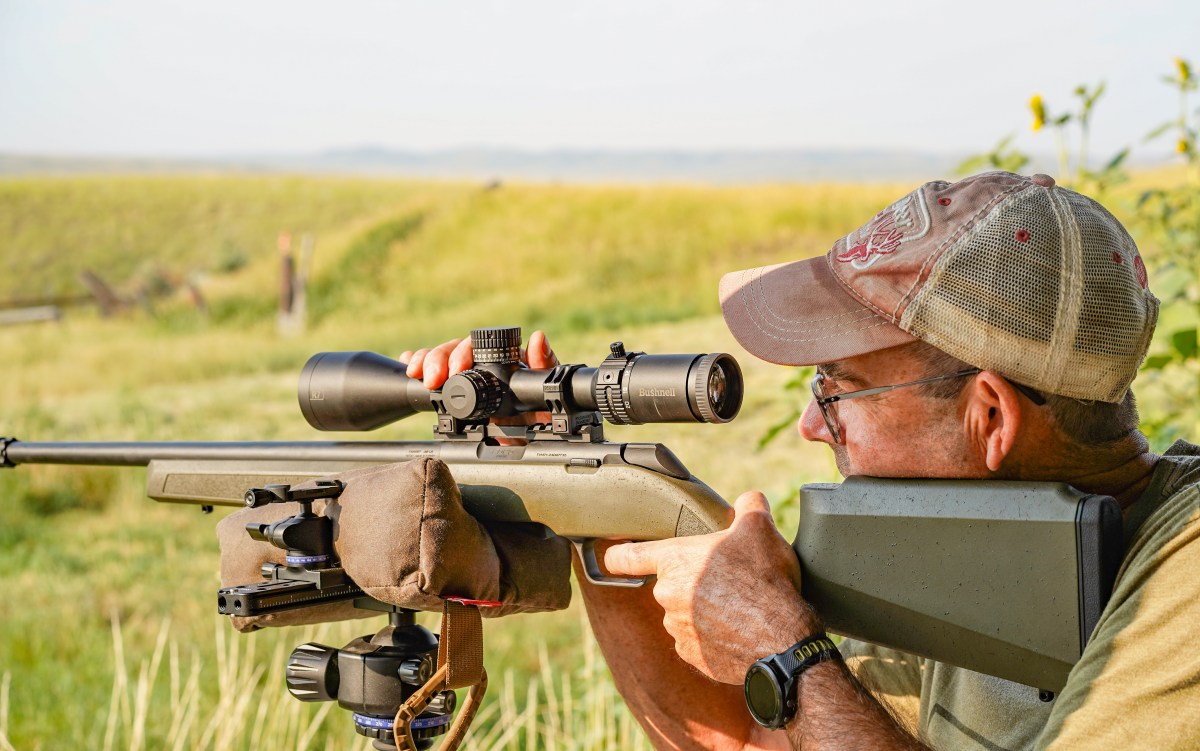
We tested 25 new hunting scopes, from rimfire plinkers to big first focal-plane crossover hunt/competition scopes, over a week at my home range in eastern Montana, evaluating reticles, turrets, illumination, and optics. Submissions ranged in price from right around $100 to over $2,000, in MOA and MIL, and when the shooting had ended and Visine had washed the red out of our eyes, we tallied scores, argued about which optics we hated and which we loved, and which we will be mounting on our own hunting rifles.
Here are the results of our testing, which includes benchrest shooting, situational field shooting, low-light resolution testing, drop testing, and turret tracking.
The Best Rifle Scopes for Hunting (We Tested 25 Scopes)
Best New Rifle Scopes for Hunting of 2026
Most Innovative Hunting Rifle Scopes of 2026
Best Lightweight Hunting Rifle Scopes of 2026
Best Hunting Rifle Scopes Under $400
Best Hunting Rifle Scopes of 2026, Reviews & Recommendations
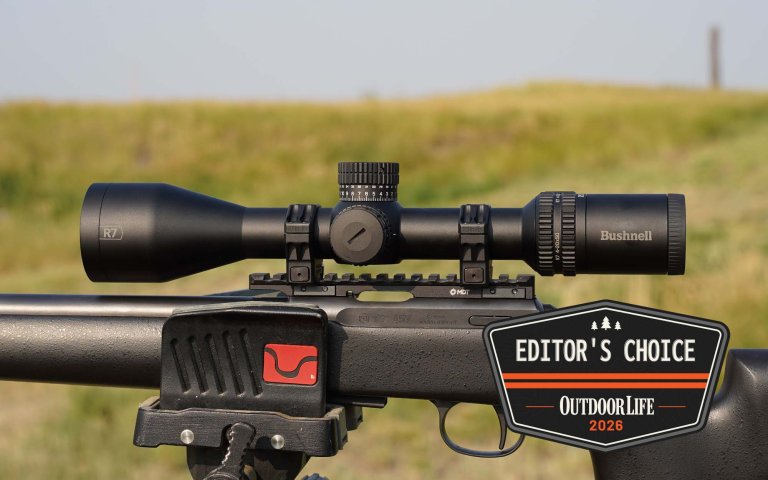
Editor’s Choice: Bushnell R7 4-20×50 FFP MOA Hybrid Dot Tree Illuminated
See It
Pros
- Precise and fast first-plane reticle
- Liberal mounting dimensions
- 3-position throw lever
- Zero stop
- Useful mag range for hunting
- Crossover hunt/target scope
Cons
- Parallax and illumination knob protrudes
- Reticle utility begins at about 8x
Key Features
-
30mm tube -
Available in MOA or MIL -
Available in first or second focal plane reticle -
Side parallax correction from 15 yards to infinity -
Exposed locking elevation turret, capped windage -
11-step red center-circle illumination -
Ships with sunshade, flip-up caps, and multi-tool
-
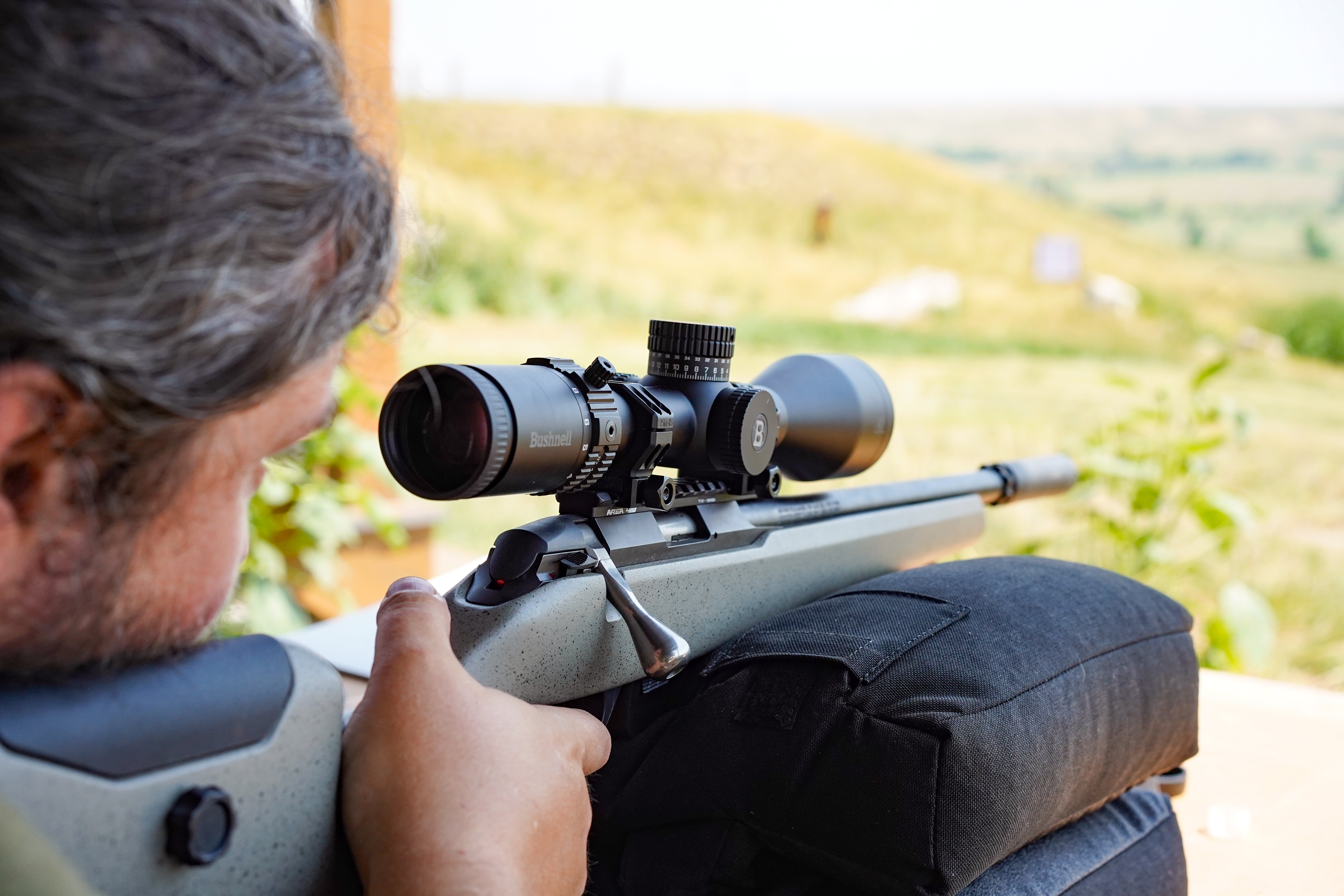
Testing the R7’s tracking on the tall target -
-
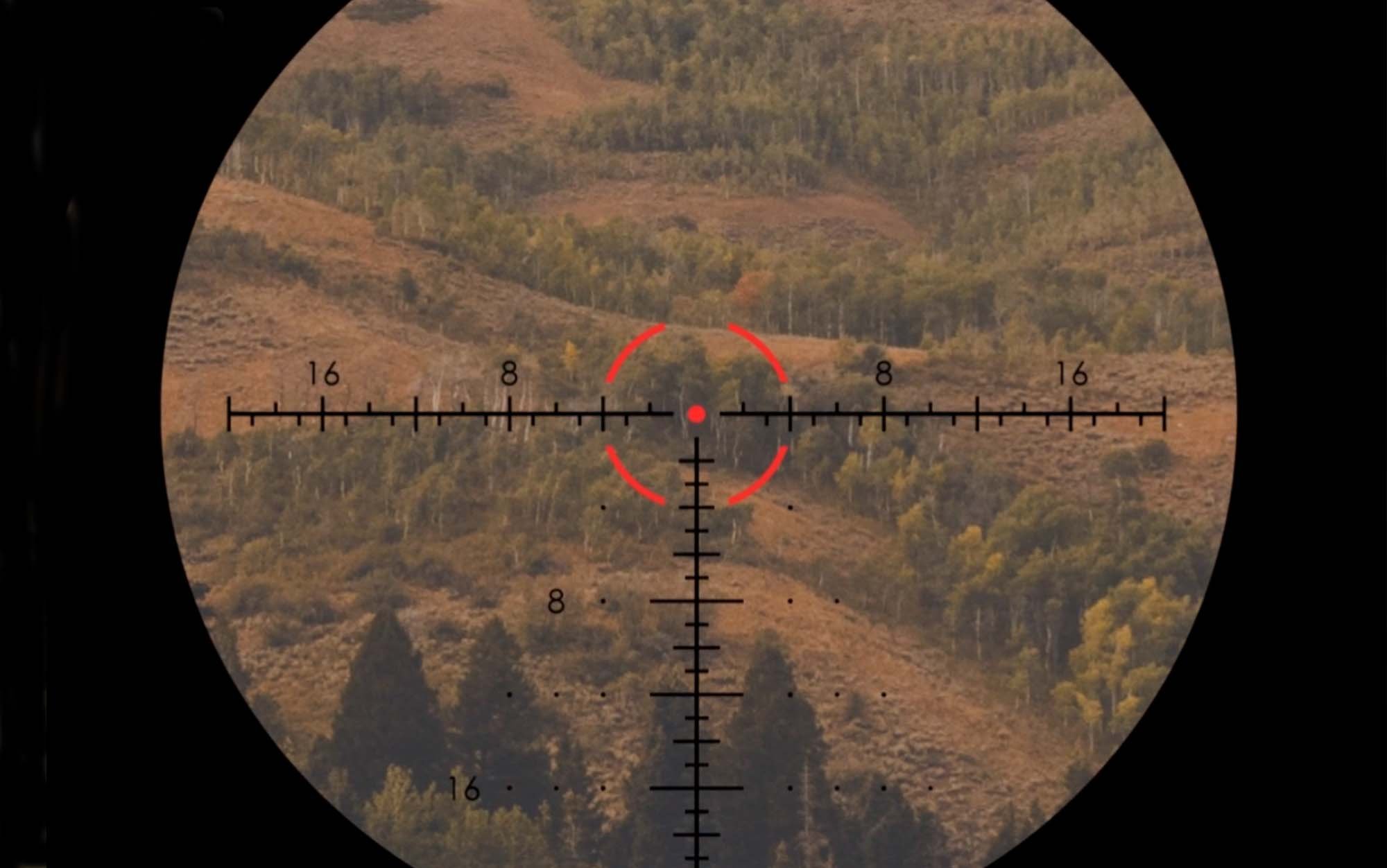
The Bushnell R7 FFP reticle
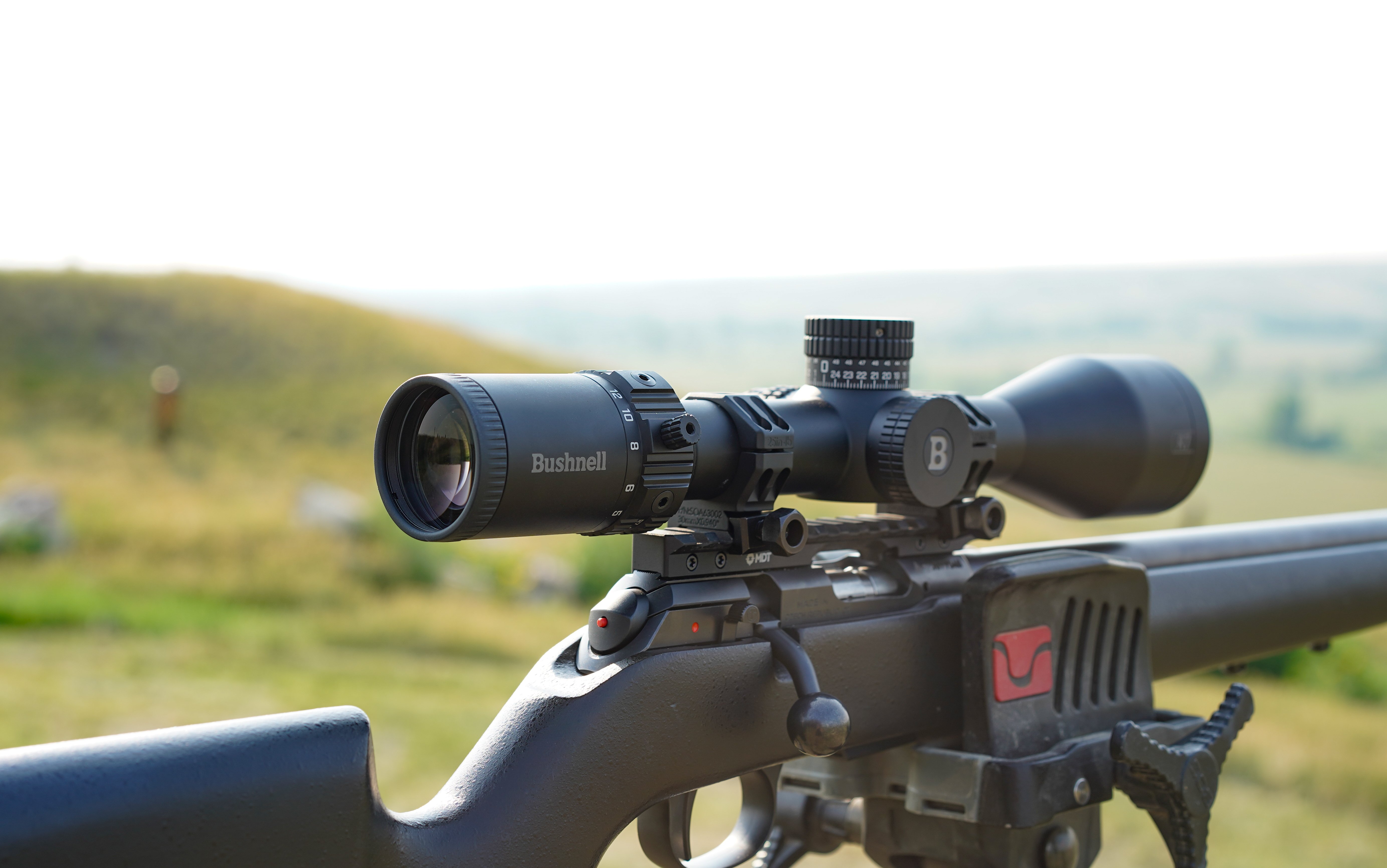
With this big, bright, and surprisingly sophisticated R7, Bushnell is restoring its relevance as a first-order hunting optic brand. The first focal-plane scope has an open tree-style reticle that’s anchored by an illuminated segmented circle and floating center dot that enables precision work as well as fast holdover and wind-informed shots at game.
For hunters and target shooters who would rather dial, the pull-to-turn elevation turret is nicely indexed and moves with positivity. The windage dial is capped.
Bushnell has invested heavily in the R7 line, which is the best of the Good/Better/Best product-line hierarchy that started with the R3 a couple years ago and continued with the R5 last year. The company has four different configurations of the R7, released just this month: a 1-8×24 LPVO, a 2-10×42, and a 3-15×50 in addition to the 4-20×50. The lower magnification scopes are available in second-plane reticles, but the two higher-mag versions come in either first- or second-plane reticles and either MIL or MOA, giving buyers a crazy number of variations on the platform.
We tested the second-plane MOA version of the 4-20×50, but for its versatility, performance on a wide range of targets and distances, and its flawless handling, we named the FFP R7 not only best Bushnell in the test, but the best overall hunting scope in the field of 25 excellent competitors. They include Nightforce’s new NX6, Leupold’s VX-4HD, and Zeiss’s new V3 families, along with some excellent submissions from Vortex, Trijicon, and Burris.
For its overall performance, the Bushnell R7 4-20×50 is this year’s Editor’s Choice winner as the top hunting scope of 2026.
The scope stacked points with a combination of good ED Prime glass, clear indexing on its controls, tight and positive turret and focus controls, and an illuminated Hybrid Dot Tree reticle that splits the difference between a precision competition and a hunting reticle. Its zero stop, which we’re glad to see on this type scope, is a 6-screw affair that’s a hassle to set, but works wonderfully as a solid backstop on elevation turret travel.
We worried about the durability of the R7, but it passed our inaugural drop test without skipping a beat. We dropped the scope three times from three feet on concrete covered by a 2-inch pad, and the Bushnell retained its zero.
Of course, our test teased out some deficiencies. The reticle references aren’t especially visible until about 7x, and I’d like to see one or two more intensity steps to the center-dot and segmented circle illumination to make them pop in daylight.
But if you’re looking for a rimfire or long-range competition scope that you can easily transition into a big-game hunt, this is a wonderful choice. The price, at about $950, is fair for the versatility and fine handling of this true crossover scope.
Bushnell R7 4-10×50 Specs
- Magnification: 4-10-power
- Objective Lens: 50mm
- Tube Diameter: 30mm
- Light Transmission: Not provided
- Exit Pupil Diameter: 12.5-5mm
- Twilight Factor: 14.1-22.4
- Field of View: 32-6.3 feet at 100 yards
- Reticle Plane: First (tested)
- Reticle Type: MOA Hybrid Dot Tree Illuminated
- Turret Click Values: ¼ MOA
- Adjustment Per Revolution: 15 MOA
- Total Internal Adjustment – Elevation: 80 MOA
- Total Internal Adjustment – Windage: 50 MOA
- Parallax Correction: 15 yards to infinity
- Weight: 25.2 ounces
- Length: 13.5 inches
Great Buy: Burris Fullfield 3-12×42 SFP Plex
See It
Pros
- Familiar hunting configuration
- Distinctive red accents
- Simple set-it-and-forget-it operation
- At about $260, priced right
- Also available in Ballistic E3 and illuminated wind plex reticles
- Fully transferable lifetime warranty
Cons
- Limited adjustability
- Green coatings
Key Features
-
1-inch tube -
Available only in MOA adjustments -
Rezeroable turret dials -
Parallax correction fixed at 100 yards -
42mm objective enables low-profile mounting
The problem with many budget rifle scopes is that they distract from disappointing glass with whiz-bang features like tactical turrets and add-ons like cheap rings, power-changing levers, and illuminated reticles.
The Burris Fullfield 3-9×42 has none of those. Instead, it’s a throwback, built on a 1-inch tube with capped turrets and a second-plane duplex reticle. This is the scope that appeals to your buddy who wants to hand-crank their pickup windows. By keeping things simple, Burris has produced a new classic that might be the perfect deer-hunting scope in our test of nearly 25 hunting scopes. That it’s able to sell the Fullfield 3-9×42 for under $300 made it the unanimous pick for the Great Buy award in this year’s rifle scope test.
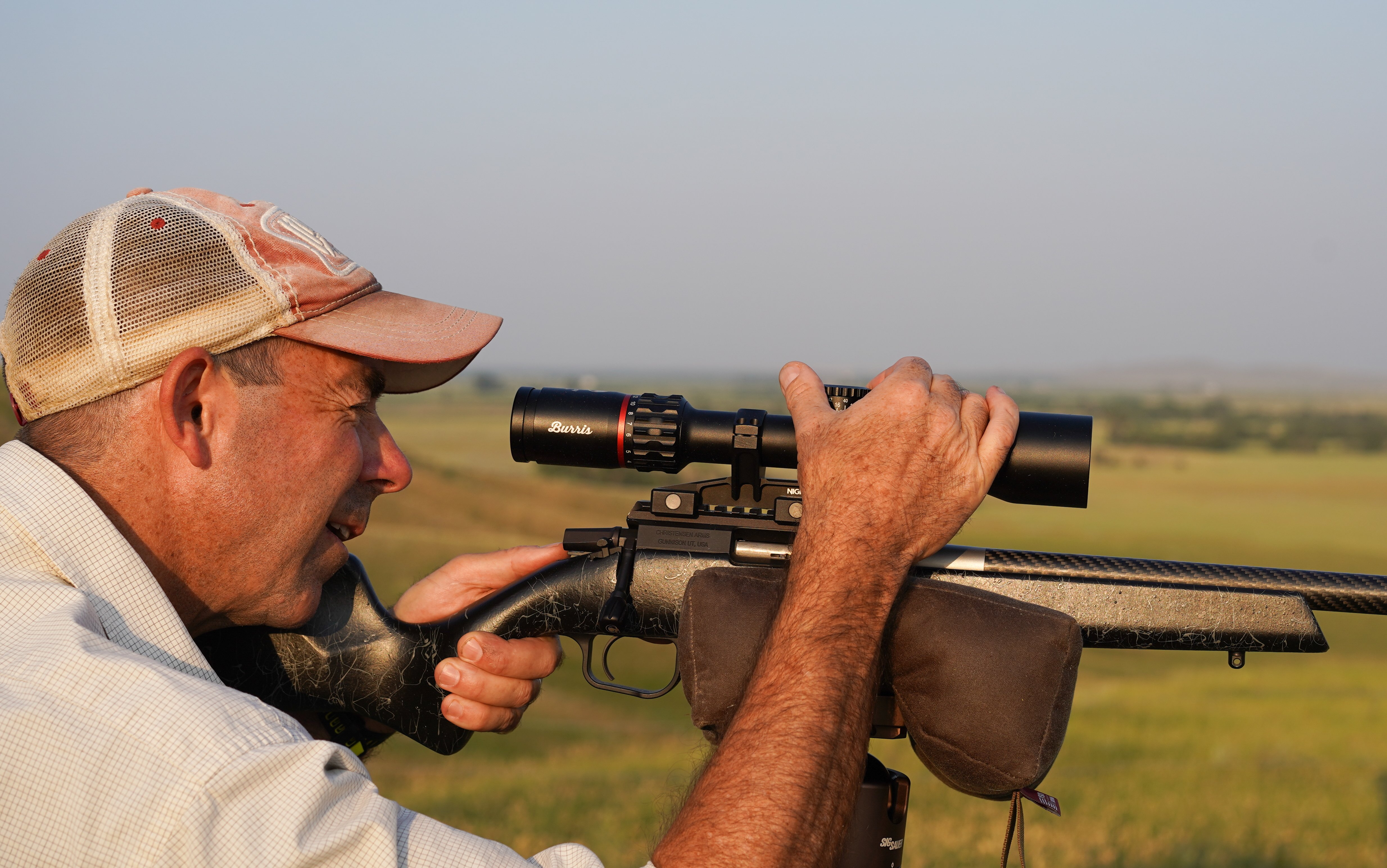
The Burris had plenty of competition for the honor. Vortex’s 3-9×40 Crossfire HD has many of the same features, second-plane reticle, and fuss-free performance for a little less money. But we felt the build and tight handling of the Burris make it a longer-wearing optic, and we tested that hunch by subjecting the scope to our inaugural drop test, which it passed with flying colors.
Don’t expect the Fullfield to engage steel targets way out there. And it’s not built for precision turret dialing. Instead, this is a straight-ahead hunting scope. Think straight-wall carbine, slug gun, rimfires, or just about any deer rifle on the market.
“It’s a set-it-and-forget-it scope,” notes tester Nate Ward. “Not a lot of moving parts to break or batteries to fail.”
Indeed, the Burris doesn’t have an illuminated reticle, and its parallax correction is set at 100 yards. The standard plex reticle is intended to be fast but not precise, since there are no reticle holds in the image plane. Hunters who want more reticle references should consider Burris’s excellent Ballistic E3 reticle, available in the 3-9×42 platform. If you’d rather have illumination, the Wind Ret reticle is available for another $100.
The standard-issue Fullfield has some nice features, including distinctive red accents on the power-changing ring and turret dials and rezeroable turrets. But we also noted some misses. It has a distracting greenish coating that’s especially noticeable in low-light conditions. Its turret indexing is so tiny that it’s hard to confirm when you’re zeroed. And some testers struggled to get both the target and reticle sharp in the same focus plane beyond 500 yards.
But for a good image, simple and repeatable controls, and abundant versatility, the Burris Fullfield 3-9×42 checks nearly every box for a hunting scope. By doing it for under $300, it is the very definition of a Great Buy.
Burris 3-12×42 Specs
- Magnification: 3-12
- Objective Lens: 42mm
- Tube Diameter: 1-inch
- Light Transmission: Not provided
- Exit Pupil Diameter: 14-4.7mm
- Twilight Factor: 11.2-19.4
- Field of View: 36-9.25 feet at 100 yards
- Reticle Plane: Second
- Reticle Type: Plex
- Turret Click Values: ¼ MOA
- Adjustment Per Revolution: 25 MOA
- Total Internal Adjustment – Elevation: 72 MOA
- Total Internal Adjustment – Windage: 72 MOA
- Parallax Correction: Fixed at 100 yards
- Weight: 14.7 ounces
- Length: 11.1 inches
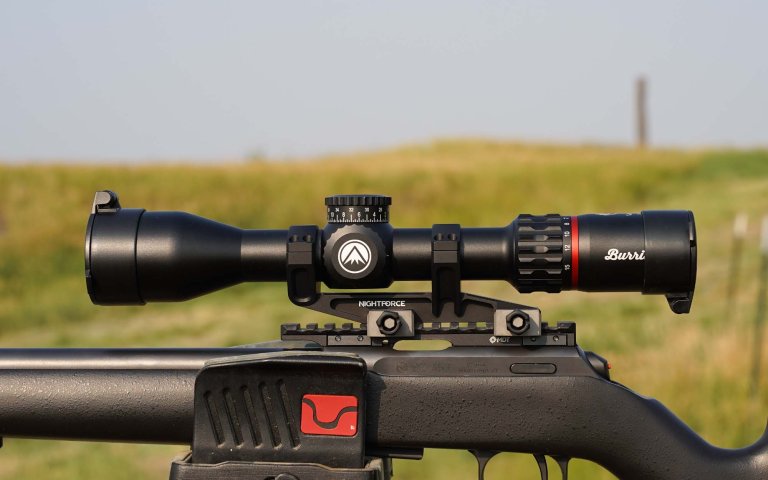
Burris Veracity
Get It From Midway USA
Get It From Amazon
Pros
- Exposed low-profile elevation turret
- Clear turret and focus-knob indexing
- Excellent glass
- Zero stop Lifetime warranty
Cons
- Simple plex reticle
- No illumination
Key Features
-
30mm tube -
Second-plane plex reticle -
Exposed elevation turret, capped windage turret -
25-yards-to-infinity side focus -
“Knob Synergy” elevation turret -
Ships with sunshade
Set-it-and-forget-it hunters will appreciate this solid, honest scope for its lack of adornments. No illumination. A simple plex reticle in the second focal plane. It’s like the Fullfield mentioned above but with better glass and controls.
But hunters who are practiced at ranging a target, then dialing an aiming solution based on ballistic solvers will go crazy for this new configuration of the venerable Burris Veracity. The elevation knob is exposed, nicely indexed, and ready to dial. A little too ready, as it doesn’t lock. For some OL testers, that’s a problem, as an exposed turret can easily get pushed off zero given the hard knocks of the field.
But Burris has that figured out, too, with a zero stop that ensures a return to zero. It’s a tedious 6-screw affair to set, but once the zero stop is established, it is a rock-solid baseline for dialing.
Given the wave of hunting scopes containing first-plane reticles with busy windage and elevation references and illumination modules, this iteration of the Veracity is refreshing. But it also forces users into either dialing for distance or sticking with the single aiming point at the crosshairs. We’d rather see the 3-15×44 Veracity with the illuminated RC-MOA (Rapid Cross) reticle that gives hunters the option of dialing or using reticle references to hold for elevation and wind.
We quibble a bit at the $1,000 price for such a stripped-down scope, but the turret tracking was among the best in the field, and Burris’s “Knob Synergy” elevation dial is tight, positive, and the low-profile build won’t hang up in the field. All in, the 3-15×44 version of the Veracity is a welcome addition to the 2.5-12×42 and 5-25×50 versions.
Burris Veracity 3-15×44 Specs
- Magnification: 3-15-power
- Objective Lens: 44mm
- Tube Diameter: 30mm
- Light Transmission: Not provided
- Exit Pupil Diameter: 14mm to 2.9mm
- Twilight Factor: 11.5-25.7
- Field of View: 34.5-7 feet at 100 yards
- Reticle Plane: Second
- Reticle Type: Plex
- Illumination: No
- Turret Click Values: ¼ MOA
- Adjustment Per Revolution: 25 MOA
- Total Internal Adjustment – Elevation: 77 MOA
- Total Internal Adjustment – Windage: 77 MOA
- Parallax Correction: 25 yards to infinity
- Weight: 24.2 oz. with mount
- Length: 13 inches
Nightforce NX6 3-18×50
Get the F1
Get the F2
Pros
- Battle-proven durability
- Capped turrets
- Capped turret can be converted to exposed FieldSet dial
- Free custom BDC dial with voucher
- Abundant internal adjustment range
- Excellent glass
Cons
- Locking eyepiece takes time to set
Key Features
-
Capped re-zeroable turrets -
Push-button red and green illumination -
10 yards to infinity side parallax control -
Field-proven MOAR reticle
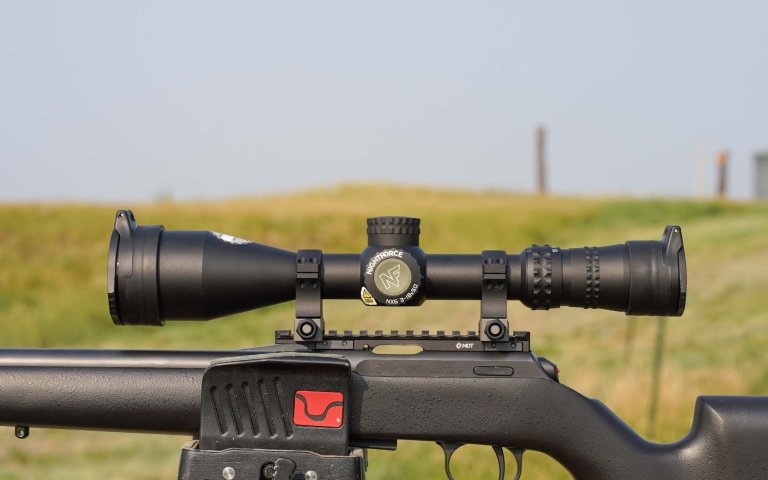
We could spend an entire article talking about Nightforce’s new NX6 family. The topline take-away for hunters is that the Idaho company’s new product line has a configuration and aiming system for just about any type of hunter or shooter. You want a first focal plane reticle with capped turrets? The 3-18×50 F1 is yours to convert the exposed FieldSet toolless turret to a capped version. You want a second-plane system with a custom BDC turret? The 4-24×50 is tailor-made for long-range hunters like you.
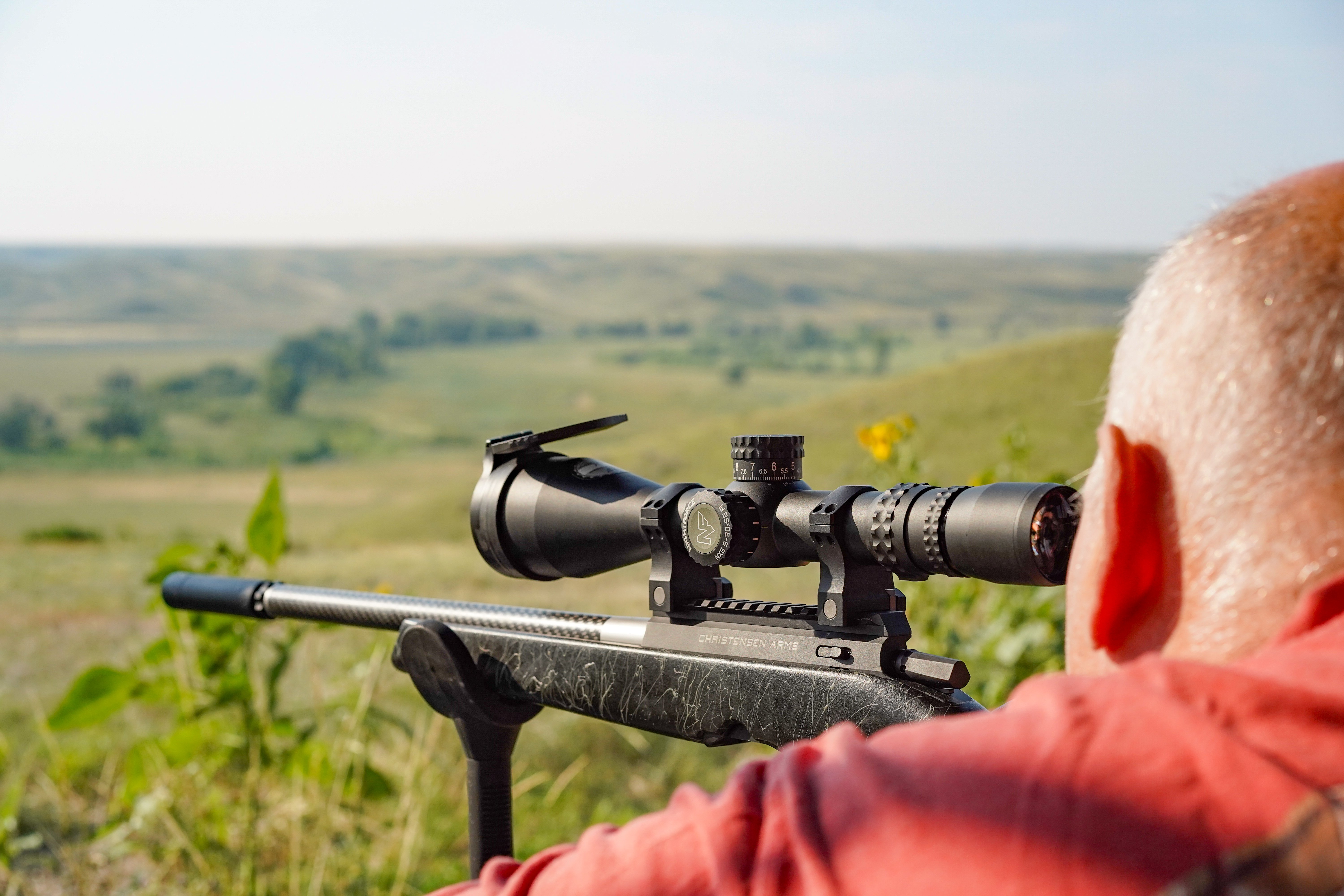
We tested three configurations of the new NX6 family in our hunting scope test, and two are similar enough that we’ll cover them in this single review. The 3-18×50 version was by far our favorite, mainly because the configuration in the second-plane system is better configured for a wider range of hunting and shooting scenarios. But the really handy 2-12×42 version has wide utility for whitetail hunters and will fit more rifle platforms.
Both versions feature Nightforce’s proven MOAR MOA-based reticle. Both have the smart and elegant Digillum red-and-green push-button illumination module. And both have precise parallax correction down to 11 yards. Significantly, they both have capped turrets with Nightforce’s rezeroable dial. This is a simple system that allows users to loosen the cap, turn it to zero, then retighten the center screw. As the screw tightens, it widens a wedge inside the works that causes the dial to engage the teeth of the turret, sort of like a vehicle’s clutch engages the transmission.
The MOAR system is fast and precise enough for hunters who prefer a second-plane reticle. But I wish we had tested the first-plane version of the 3-18×50. It features four reticle choices — two in MOA (MOA-C and MOA-XT) and the same styles in MIL. This configuration has more versatility for both hunting and precision shooting, but significantly, it also features Nightforce’s new toolless elevation turret.
Because Nightforce is the originator of the patented ZeroStop system, it’s worth detailing the merits of the new FieldSet turret system. Once you’ve established your zero, any simple tool — a coin, or knife, flat rock — will loosen the exposed turret cap, allowing you to reset your zero and set the zero stop. The stop can be set a full revolution above zero, or 2 MILs (4 MOA) below zero.
One of the many cool things about this system is that any NX6 model except the 1-6x can be converted from capped to exposed turret, and the standard exposed turret can be traded for a custom BDC turret. It’s another indication that the NX6 is positioned to be the ultimate versatile scope family.
In terms of our test models, the Nightforce performed well, but some testers dissed the MOAR reticle, with its 2 MOA floating cross and 1 MOA hashes as too busy and lacking a bold central aiming point. Others wanted the illumination limited to the central aiming point. But other testers like the fine, open design for fast target acquisition and holds in dynamic hunting situations.
The NX6 is priced below Nightforce’s flagship NX8 and ATACR scopes, but it’s still a lift for most hunters. The 3-18×50 version retails for $1,900, and the 2-12×42 runs $1,800. For the brand’s legendary durability and thoughtful features, that price seems about right, especially considering a custom BDC is part of the deal.
Nightforce NX6 3-18×50 Specs
- Magnification: 3-18-power
- Objective Lens: 50mm
- Tube Diameter: 30mm
- Light Transmission: Not provided
- Exit Pupil Diameter: 16.7mm to 2.8mm
- Twilight Factor: 12.2-30
- Field of View: 35.3-7.3 feet at 100 yards
- Reticle Plane: Second
- Reticle Type: Illuminated MOAR
- Illumination: yes, red and green full-reticle illumination
- Turret Click Values: ¼ MOA
- Adjustment Per Revolution: 20 MOA
- Total Internal Adjustment – Elevation: 120 MOA
- Total Internal Adjustment – Windage: 85 MOA
- Parallax Correction: 11 yards to infinity
- Weight: 26.7 ounces
- Length: 13.9 inches
Leupold VX-4HD 4-16×50
See It
Pros
- Redesigned optical prescription
- Includes 2-turn CDS-ZL2 elevation turrets
- One of lightest 50mm scopes on market
- Adjustable parallax control knob
- Excellent low-light performance
Cons
- Pedestrian reticles
- Available only in MOA
Key Features
-
4-times zoom ratio -
Integrated power-control throw lever -
Optional illumination -
Compatible with custom ballistic dials -
Pop-up rezeroable windage dial
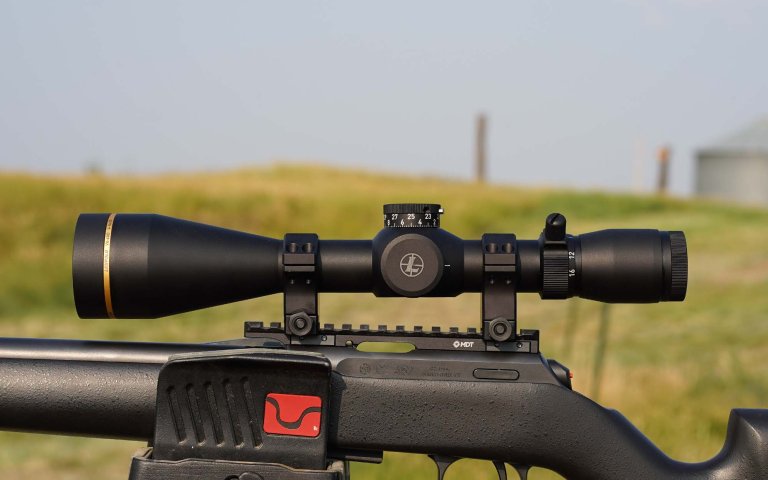
Leupold is filling out its product line with this 4-times zoom ratio family that bridges the gap between the VX-3HD and the VX-5HD. Significantly, the VX-4HD scopes feature Leupold’s excellent push-button 2-revolution CDS-ZL2 elevation dials, and not the toolless Gen2 turrets that it’s rolling out with its other premium scope lines.
If you’re a Leupold fan boy, you’ll recognize many of the features of the VX-4HD line. It’s built on a second focal-plane system with a fairly standard selection of reticles: duplex, Wind-Plex with 1 MOA hashes extending to 10 MOA on either side of the center crosshair, and illuminated FireDot Twilight Hunter.
But the family has upgraded optics, delivering a bright, crisp, and vibrant image. The 4-20×50 won our low-light test, thanks to the big 50mm objective lens and the excellent glass and coatings. Its removeable elevation turret can be traded out for a free custom ballistic dial tuned to your own bullet and load (second CDS dials cost $80). The scope itself costs about $1,000, with illumination adding another $100 to $200, depending on configuration.
The VX-4HD line is limited to three configurations, all with MOA controls and reticles: the 4-20×50 we tested, a lightweight marvel in 3-12×42, and a 3-12×50. Maybe the line is still growing, but we’d like to see additional magnification ranges and additional reticles to take advantage of the very useful 4-times magnification range of the family.
The limitations of the family, with elevation turrets limited to two revolutions (38 MOA) and fairly pedestrian second-plane reticles, held the Leupolds back from a higher score, since they’re competing with cross-over target/hunting scopes with more features and adjustability.
“The use-case is big-game hunting and dialing for range,” noted tester Nate Ward. “I like this as a hunting scope but it isn’t as refined as other scopes in its price range.”
We like the toolless simplicity of the capped rezeroable windage turret, and we like the ability to slip the low-profile parallax control to specific yardage. We love the image. Our conclusion: the VX-4HD delivers a great image but is a bit limited by its old-school aiming system.
Leupold 4-16×50 Specs
- Magnification: 4-16-power
- Objective Lens: 50mm
- Tube Diameter: 30mm
- Light Transmission: Not provided
- Exit Pupil Diameter: 12.5mm to 3.125mm
- Twilight Factor: 14.1-28.3
- Field of View: 25.1-6.3 feet at 100 yards
- Reticle Plane: Second
- Reticle Type: Wind-Plex (also tested Duplex)
- Illumination: No
- Turret Click Values: ¼ MOA
- Adjustment Per Revolution: 20 MOA
- Total Internal Adjustment – Elevation: 65 MOA
- Total Internal Adjustment – Windage: 50 MOA
- Parallax Correction: 30 yards to infinity
- Weight: 20.5 ounces
- Length: 13.4 inches
Hawke Vantage HD 30 4-16×50 SF

See It
Pros
- Useful second-plane bullet-drop reticle
- Fine floating illuminated center aiming dot
- At under $500, a good value
- Locking exposed turrets
- Excellent field of view
Cons
- Reticle references valid at highest mag
Key Features
-
Multi-position magnification throw lever -
Liberal mounting dimensions -
Rezeroable turrets -
Red and green illumination -
Abundant internal reticle adjustment

Another in a long line of solid, bright Hawke scopes. This sub-$450 Vantage 30 is an upscale sibling to the Vortex Crossfire HD 6-18×50. Both sport useful second focal-plane BDC reticles with center-dot illumination. But the Hawke brings a little more sophistication to its controls, with exposed pull-to-turn turrets, immersive field of view, and a floating center-dot aiming point that lights up in either green or red.
Optics are good but not great. The illumination is good but we wish it was more intense to boost visibility in bright sunlight. And turret tracking started to slip a bit at the very end of its elevation travel.
But the Hawke impressed us with its smooth, tactile controls, and the BDC reticle is fast, with MOA-based references that correspond to the drop of standard center-fire loads. With a 50-yard zero with our standard 40-grain CCI .22 LR ammunition, we easily stretched the reticle to 300 yards by dialing 35 MOA of elevation and holding another 10 MOA. That’s impressive range for the scope-and-rimfire combo.
“It’s a simple, straightforward hunting scope that’s priced about right,” says tester Dale Manning. Enough said.
Hawke Vantage 30 4-16×50
- Magnification: 4-16-power
- Objective Lens: 50mm
- Tube Diameter: 30mm
- Light Transmission: Not provided
- Exit Pupil Diameter: 12.5mm to 3.125mm
- Twilight Factor: 14.1-28.3
- Field of View: 28.8-7.8 feet at 100 yards
- Reticle Plane: Second
- Reticle Type: LR2 Dot
- Illumination: Red and green center dot
- Turret Click Values: ¼ MOA
- Adjustment Per Revolution: 15 MOA
- Total Internal Adjustment – Elevation: 95 MOA
- Total Internal Adjustment – Windage: 95 MOA
- Parallax Correction: 10 yards to infinity
- Weight: 26.1 ounces
- Length: 13.7 inches
Most Innovative Scopes of 2026
Trijicon Credo HX 2.5-15×42
See It
Pros
- Toolless elevation turret
- Zero stop
- Red and green illuminated center dot
- Exposed elevation turret, capped windage
- Liberal mounting dimensions
- Excellent glass
Cons
- At over $1,500, expensive
- Reticle has limited precision utility
- Reticle intensity not daylight bright
Key Features
-
Floating BDC reticle in second focal plane -
Multi-position magnification throw lever -
Both-eyes-open aiming system -
Easy-to-set toolless zero adjuster -
68 hours battery life -
Low-profile mounting
This is nearly the platonic ideal for a hunting scope, if you’re into second-plane BDC reticles. It features the best glass in the test, a precisely illuminated center-dot aiming point, and a magnification range that can transition from whitetail woods to pronghorn prairies.
It’s the latest configuration of Trijicon’s mid-tier hunting scope — the Credo HX line sits between the Huron and the premium Tenmile — that features a new toolless elevation turret adjustment and zero stop. Priced at a cool $1,500, it’s not for everyone, but the test team praised its mannerly controls, excellent glass, and easy-to-set and adjust zero stop.
The exposed elevation turret — the Credo HX is only available in MOA at this time — has clear indexing and a grippy dial that sets it up nicely for hunters who want to dial to their aiming solution. Setting the zero stop is as easy as removing the turret cap by hand — the cap screws off the dial — then turning the dial over and using it as a wrench to set the internal zero. Once set, simply tighten the components back down. It’s fast, precise, and elegant.
We dinged the Trijicon on its dim illumination and its price. But everything else about this gem-bright scope is right and tight. If you have the budget for a stylish, precise, and smart hunting scope, it’s a great choice.
Trijicon Credo HX 2.5-15×42 Specs
- Magnification: 2.5-15-power
- Objective Lens: 42mm
- Tube Diameter: 30mm
- Light Transmission: Not provided
- Exit Pupil Diameter: 10.7-2.8mm
- Twilight Factor: 16.2-25.7
- Field of View: 41.2-6.9 feet at 100 yards
- Reticle Plane: Second
- Reticle Type: illuminated PowerDot BDC Hunter Holds
- Illumination: 10 intensity steps: 5 red, 5 green
- Turret Click Values: ¼ MOA
- Total Internal Adjustment – Elevation: 100 MOA
- Total Internal Adjustment – Windage: 80 MOA
- Parallax Correction: 10 yards to infinity
- Weight: 22.9 ounces
- Length: 13.9 inches
GPO Centuri 4-16x44i FFP Compact
See It
Pros
- At 9.9 inches, super compact
- Simple ballistic stop
- Designed for tactical carbines
- Infinitely adjustable rheostat illumination module
- First focal-plane dual-purpose reticle
- Priced under $700
Cons
- Limited mounting dimensions
- Stingy eyebox at higher magnifications
Key Features
-
Pull-to-turn exposed turrets -
Oversized magnification throw lever -
Free custom turret -
Mounts nicely on cantilever extension mount
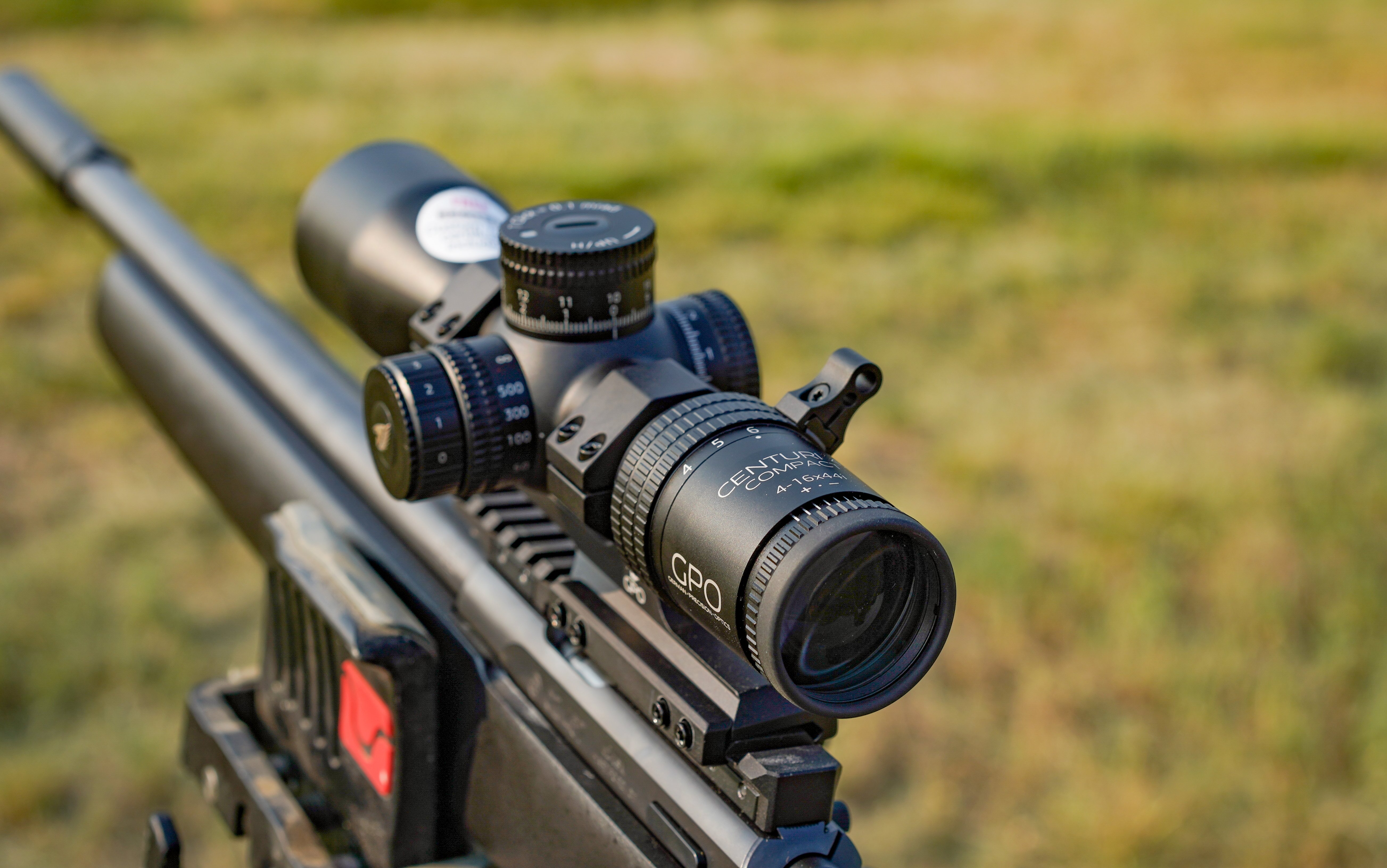
One of the surprises of the test is how testers universally fell in love with this little, versatile scope. On the surface, it seems like an oddball. Less than 10 inches long, it requires a cantilever mount to fit most rifle receivers, and it looks more like an LPVO than a serious precision scope.
But once you get behind the GPO Centuri Compact, a whole world is revealed through the excellent milling reticle. At lower magnifications with the illumination at its highest intensity, the reticle functions as a point-and-shoot red-dot sight. But at higher magnifications, starting about 10x, the reticle’s precision references become visible. A series of .1 MRAD hashes enables pinpoint aiming. For shooters who prefer to dial, the big exposed turrets pull to turn and move with authority. A smart revolution indicator pops up on the elevation turret when shooters enter the second revolution.
If you’d rather tune the reticle to your specific load, GPO offers a free custom ballistic turret with purchase. That’s an additional value for a scope that’s already priced fairly at about $650.
Testers debated the best use cases for the Centuri Compact. Some felt it’s best suited to an AR carbine. Others wanted it on their big-woods whitetail rifle, and still others felt it would be an excellent scope for stalking elk in dark timber. That latter use is enabled with a smart illumination that lights up the floating center dot and inverted horseshoe. The red illumination is infinitely adjustable thanks to a rheostat control.
The eyebox is stingy at higher magnifications, which forces shooters to have perfect alignment. But that’s a minor miss. The scope garnered enough pluses to finish in the top third of the field of scopes that are much more squarely configured for hunting.
GPO Centuri 4-16x44i Compact Specs
- Magnification: 4-16-power
- Objective Lens: 44mm
- Tube Diameter: 30mm
- Light Transmission: Not available
- Exit Pupil Diameter: 11mm to 2.75mm
- Twilight Factor: 13.3 to 26.5
- Field of View: 34-9 feet at 100 yards
- Reticle Plane: First
- Reticle Type: MIL inverted horseshoe/hash style
- Illumination: Yes
- Turret Click Values: .1 MIL
- Adjustment Per Revolution: 10 MIL
- Total Internal Adjustment – Elevation: 22 MIL
- Total Internal Adjustment – Windage: 36 MIL
- Parallax Correction: 10 yards to infinity
- Weight: 20 ounces
- Length: 9.9 inches
Best Digital Scope: DNT ZULUS 4K 3-24×50
See It
Pros
- Totally digital rifle scope
- Built-in 1,300-yard laser rangefinder
- Connects to mobile app
- Ships with 30mm rings
Cons
- Image resolution is poor
- Takes time to connect to Wi-Fi and phone
Key Features
-
One-shot zero -
Supplies aiming solution based on specific ballistics -
Records 4K video and high-resolution photos -
2-year warranty, extended to 3 years with registration
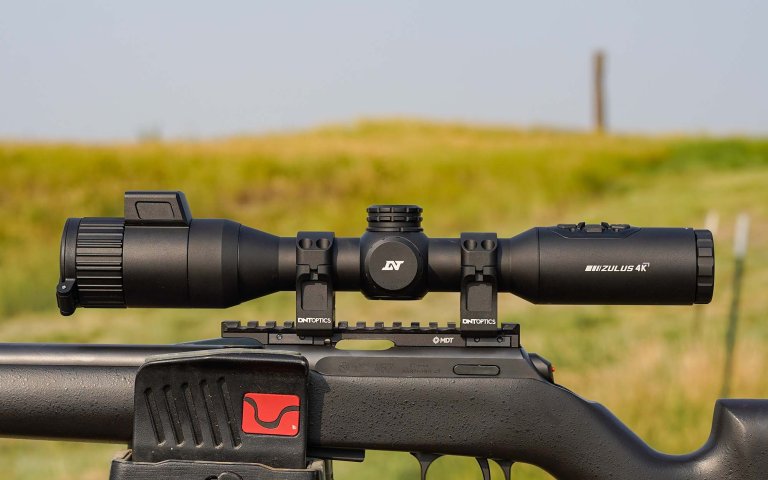
This is a groundbreaking “optic,” but if you’ve spent any time behind thermal devices, you’ll recognize the origins of the DNT ZULUS4K. Inside the conventional 30mm tube is a high-resolution digital sensor that converts optical images into a digital display in the eyepiece. It doesn’t have the germanium lens of a thermal; instead it converts daylight into pixels.
The electronic imaging allows the device to apply filters and other digital treatments, so the image that reaches your eye is a shimmering, low-rez rendition of the real thing.
“This scope is fun, but it’s not the tack-sharp image you’re used to seeing,” noted tester Scott Einsmann. “The image is more like a recording from a Gen 1 iPhone.”
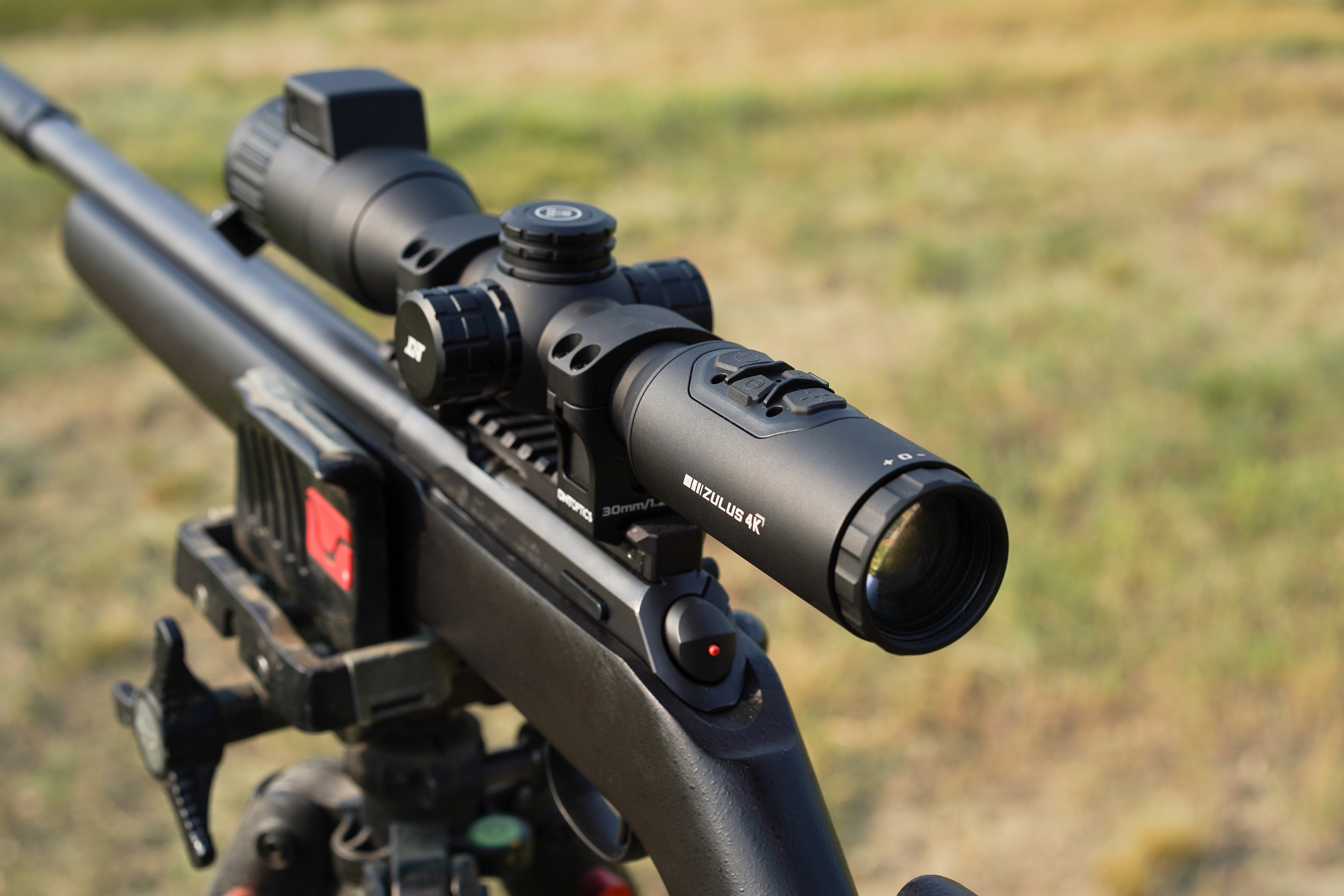
But the image is only one attribute of the DNT. It connects through local Wi-Fi and Bluetooth to a mobile app. Users can build a ballistic profile of their bullet and load, then import it into the device. The ZULUS4K’s integrated 1,300-yard laser rangefinder ranges targets, and then superimposes the distance- and ballistics-corrected aiming point on the screen. Making one-shot hits is as simple as ranging, holding the adjusted aiming point on your target, and shooting.
We loaded the ballistics of our favorite rimfire load, CCI’s 40-grain Green Tag .22 LR, then made successive hits on a 12-inch steel target at 300 yards. Then we turned around and made one-shot hits on steel ranging from 22 yards to 80 yards before returning to the 300-yard steel. Ring. Ring. Ring.
So far so good. But the image is so skritchy that target recognition can be difficult in some light conditions. We tested the low-light capabilities of the DNT, and while its display outlasted conventional optics in “seeing” into the dark, we couldn’t make out enough resolution to make a responsible shot. We’d give the slight edge to conventional scopes of the same configuration for low-light performance.
Still, the ZULUS4K, priced under $1,000, is disruptive. We’ve seen the integration of electronics in conventional optics for a few years, so it’s just a matter of time before integrated circuits replace ED glass. If the thermal category is any indication, you can expect to see many more of these fully digital scopes to come to the market in the next few years.
The scope is more than a gimmick, but we also struggled to think through how we might use it in hunting situations.
“The best use-case I can imagine is for pest control,” notes Einsmann. “Or poaching.”
DNT ZULUS4K 3-24×50 Specs
- Magnification: 3-24-power
- Objective Lens: 50mm
- Tube Diameter: 30mm
- Light Transmission: Not provided
- Exit Pupil Diameter: Not applicable
- Twilight Factor: Not applicable
- Field of View: 46-25 feet at 100 yards
- Reticle Plane: 2 FFP, 7 SFP
- Reticle Type: Both MIL and MOA
- Illumination: Yes, 5 brightness settings
- Turret Click Values: ¼ MOA, .1 MIL, inches, centimeters
- Adjustment Per Revolution: Not applicable
- Total Internal Adjustment – Elevation: @100 MOA
- Total Internal Adjustment – Windage: @100 MOA
- Parallax Correction: Not applicable
- Weight: 24.3 ounces with mount
- Length: 14 inches
Best Lightweight Hunting Scopes
Zeiss V3 4.5-14×44

See It
Pros
- Brand new design
- Exposed elevation turret with ballistic stop
- Hash-style Smart Hunting Reticle
- Precise center-dot 10-step illumination
- Impressive internal adjustment range
- Also available in capped turrets and plex reticle
Cons
- Reticle references are crowded
- Exposed elevation turret turns too easily
Key Features
-
Parallax correction fixed at 150 yards -
Premium glass and coatings -
5-turn revolution indicators -
Two-screw adjustment for ballistic stop -
Transferable limited lifetime warranty
Like the new Nightforce NX6, we could write a tome on Zeiss’s new V3 family of second-plane scopes that are going to compete well with Leupold and Vortex for America’s favorite deer-hunting optic. We tested three versions with similar enough features that we’ll cover our general impressions before teasing apart some of the points of differentiation between the 3.5-10×42, 4.5-14×44, and 6-18×50.
Note that this family is so new that we tested what Zeiss calls “pre-production” models of the V3. Some of our critiques, including indistinct turret clicks, have been improved in the mass-produced versions of the scopes.
The big news is that these premium Zeiss scopes are no longer made in Europe. They’re sourced in Japan, but if that suggests a decline in optical performance or brand integrity, relax. These represent the best of Japanese precision manufacturing, built around premium components and curated with American hunters in mind. That’s an important inflection; previous Zeiss rifle scopes were almost maddeningly European, with metric controls that often turned the wrong way.
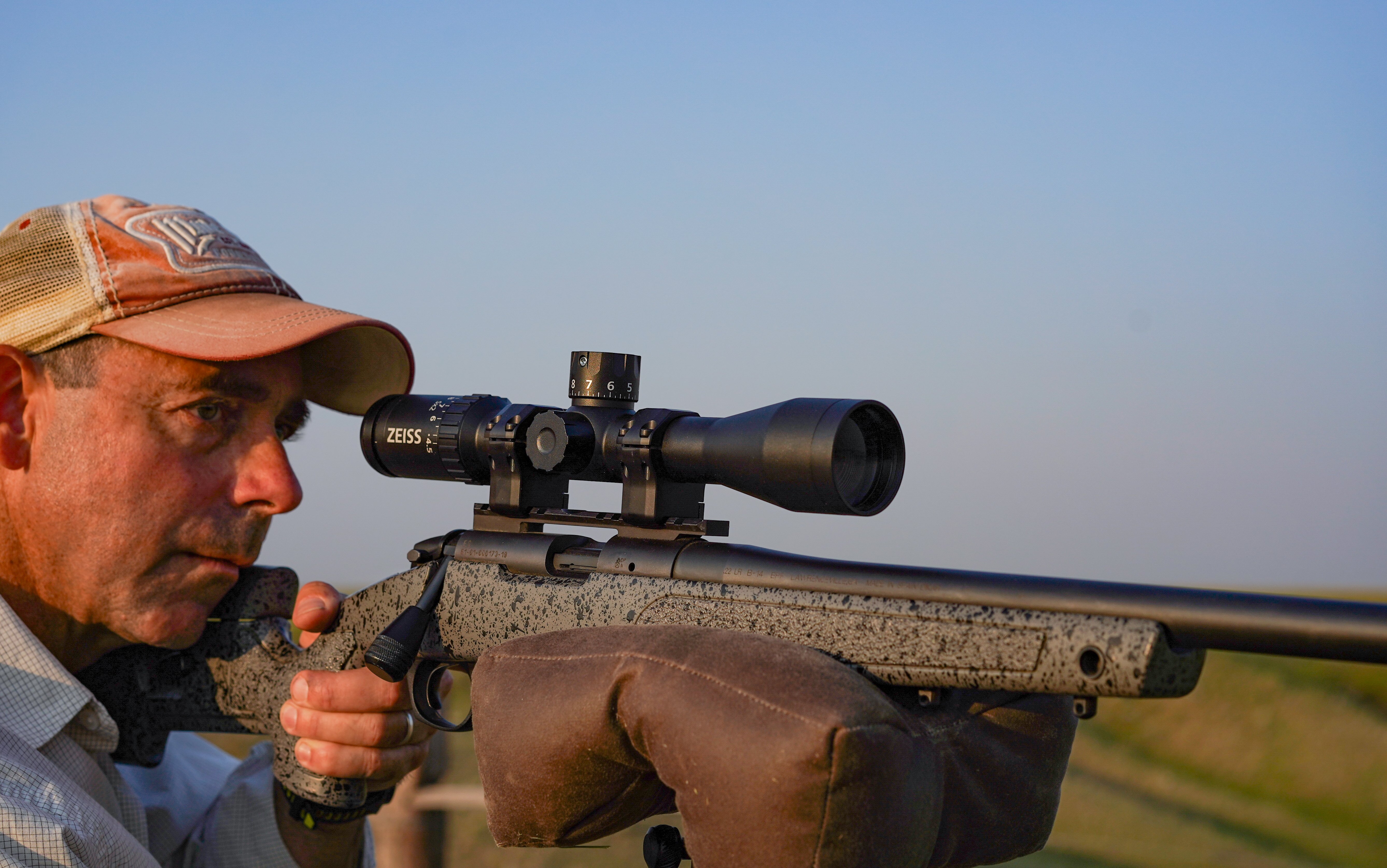
The V3 line includes six configurations, from the rimfire-friendly 2.5-8×35 that will cost an appealing $300 to the all-around 3.5-10×42 up to the 6-18×50 that’s purpose-built for long shots in open country.
All three of our test samples featured Zeiss’s new exposed elevation turret with Ballistic Stop. The 3.5-10×42 has a dime-bright illuminated center aiming point but parallax fixed at 150 yards. The 4.5-14×44 has both independent parallax correction and illumination. Both these scopes have Zeiss’s Smart Hunting Reticle (SHR), which we found a bit too crowded. The 6-18×50 V3 has a non-illuminated XRR (eXtended Range) reticle, which we like better for fast target acquisition in dynamic hunting situations.
Like Vortex’s Crossfire HD family, the NX6 from Nightforce, and Leupold’s new VX-4HD family, the V3 has a number of variations on its basic theme of second-plane, 3-times zoom with prices that range from that $300 plinker to $950. Given the abundant attributes packed into the most feature-rich V3s, that price is right in line with its competitors.
The V3 has noticeably bright glass. Zeiss claims at least 90 percent light transmission through the entire optic, not just one or two lens elements. That brightness is achieved partly through wire-frame reticles that don’t require the additional lens elements of engraved reticles, but also with excellent glass and Zeiss’s proprietary coatings, which tame flaring, boost contrast, and maximize light transmission.
The test team appreciated the tactility and ease of adjusting the exposed elevation turret, but its operation held the entire line back from a higher score. The turret, with an impressive five revolutions of travel, wobbles slightly, and simply moves too easily. It’s important to note that turret performance is a function of the pre-production build. Following our test, Zeiss sent production models that have deeper detents and much more positive action in what could be called the “slow-speed” turret. The V3 dials allow only 10 MOA of travel per revolution, but because they have just 40 clicks, each gear is deeper and more positive than the shallower detents in “high-speed” turrets with 20 to 25 MOA of travel per revolution.
Because it doesn’t lock, some testers fretted that the exposed turret could get knocked off zero in a hard hunt. You can easily return the turret to its zero, thanks to the solid, mechanical ballistic stop, but we’d like to see a pull-to-turn locking feature on the exposed turret. Of course, you can always get the version with a capped elevation turret.
Our only other gripe was the crowded appearance of the SHR reticle. With its 1 MOA hashes clustered on both the horizontal and vertical stadia and no numeric references, we found ourselves counting aloud the holdover and holdoff references. We like the XRR reticle in the 6-18×50 better, largely because it’s more open, allowing for quicker, more assured holds.
There’s plenty that we did like about this new V3 family. The center-dot illumination is sharp and bright, and enhances reticle visibility in the SHR configuration. The glass is excellent, with edge clarity and nice contrast, color fidelity, and that quantifiable brightness. We like the light weight of all the models. The 3.5-10×42 weighs less than a pound, even with the overlarge exposed elevation turret. We like the controls, which turn with style and confidence. Lastly, we really like the huge internal adjustment range of the V3. Some models feature twice the reticle adjustment of their peers.
The entire V3 line is priced in the sweet spot considering its excellent glass, abundant features, quality of components, and impressive versatility of these light and very bright new scopes.
Zeiss V3 3.5-10×42 Specs
- Magnification: 3.5-10-power
- Objective Lens: 42mm
- Tube Diameter: 30mm
- Light Transmission: 90 percent
- Exit Pupil Diameter: 11.7mm to 4.2mm
- Twilight Factor: 12-20.5
- Field of View: 34-11.8 feet at 100 yards
- Reticle Plane: Second
- Reticle Type: Illuminated SHR #87
- Illumination: yes, 10-step intensities
- Turret Click Values: ¼ MOA
- Adjustment Per Revolution: 10 MOA
- Total Internal Adjustment – Elevation: 100 MOA
- Total Internal Adjustment – Windage: 80 MOA
- Parallax Correction: Fixed at 150 yards
- Weight: 15.3 ounces w/ Ballistic Stop
- Length: 12.4 inches
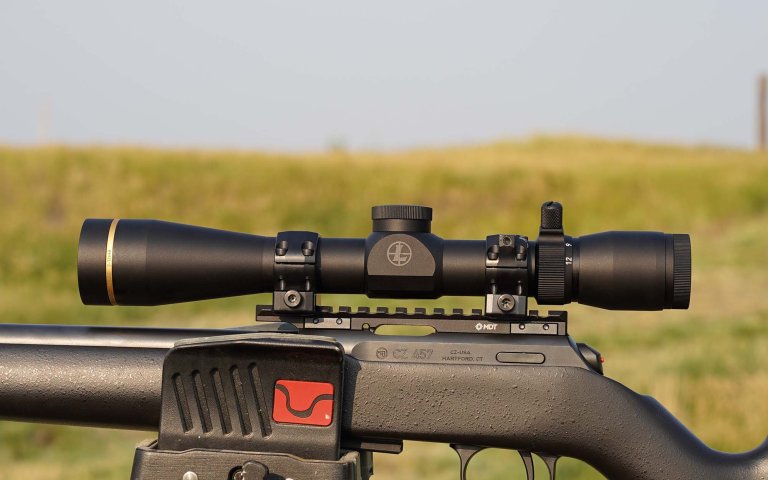
Leupold VX-4HD 3-12×40
See It
Pros
- At 14.6 ounces, incredibly light
- Simple, durable operation
- Upgraded optical system
- Capped turrets
Cons
- Indistinct turret clicks
- Duplex reticle has few aiming references
Key Features
-
Handy throw lever -
Easy-to-rezero turrets -
Old-school design with upgraded optics -
40mm objective enables low-profile mounting
This might be the ultimate low-maintenance mountain scope. Zero this scope, cap the turrets, and go hunting. For those hunters and shooters distracted by the crazy amount of adjustability in a modern scope — exposed eager-to-turn turrets, busy reticles that require a math degree to comprehend, and illumination and parallax all requiring your attention before a shot — this stripped-down VX-4HD is your huckleberry.
At 14.6 ounces, it is one of the best lightweight mountain-rifle scopes in this year’s test. “Belongs on my sheep rifle,” declared one tester.
The team was sharply divided on the merits of this old-school optic. Half felt its simplicity was a feature. The other half thought its unilluminated “Hunt-Plex” reticle, 150-yard fixed parallax, and capped turrets are a liability in an era of scope adjustability.
For the former, the 3-12×40’s excellent glass and “huntability” is the point. The fixed parallax didn’t affect focus; we were able to keep the reticle and target in sharp focus out beyond 500 yards, which is near the maximum range of this reticle. The eyebox is forgiving, meaning you don’t have to have a perfect eye alignment to see the entire image. Images were bright and vibrant in daylight, though the scope finished last in our low-light test, probably limited by the 40mm objective lens. The lightweight and low-profile mounting dimensions add to the Leupold’s versatility.
But for the critics, versatility is limited by the unforgivable tactility of the turrets and the pedestrian aiming system.
“The turrets are maddeningly hard to turn, too tight, and they have indistinct clicks,” noted one tester. “I can’t really hear or feel the clicks, and the turret indexing is very poor. This is a good set-and-forget hunting scope, but the turrets are a letdown, especially at the price” of about $800.
The 3-12×40 version is the only VX-4HD with capped turrets. The rest of the family has the updated CDS-ZL2 elevation turrets. If Leupold revisits this model, it would further endear itself to those go-light hunters who want the combination of simplicity and a small measure of adjustability.
Leupold VX-4HD 3-12×40
- Magnification: 3-12-power
- Objective Lens: 40mm
- Tube Diameter: 30mm
- Light Transmission: Not provided
- Exit Pupil Diameter: 13.3mm to 3.3mm
- Twilight Factor: 10.9-21.9
- Field of View: 33.5-8.4 feet at 100 yards
- Reticle Plane: Second
- Reticle Type: Hunt-Plex duplex
- Illumination: No
- Turret Click Values: ¼ MOA
- Adjustment Per Revolution: 20 MOA
- Total Internal Adjustment – Elevation: 65 MOA
- Total Internal Adjustment – Windage: 65 MOA
- Parallax Correction: Fixed at 150 yards
- Weight: 14.6 ounces
- Length: 13 inches
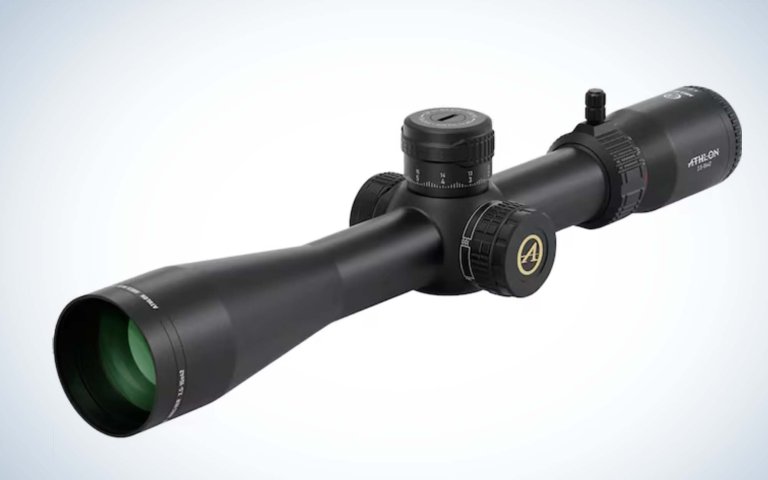
Athlon Ares HLR 2.5-15×42
See It
Pros
- One of the lightest scopes in this year’s test
- Push-button illumination control
- Distinctive and grippy turret caps
- Re-zeroable turrets
- Liberal mounting dimensions
Cons
- Lacks a zero stop
- Stingy eyebox
Key Features
-
Also available in MIL-based reticle -
Second-plane reticle -
Hash-style reticle with simple numeric references -
Illuminated floating-cross aiming point -
Fully transferable lifetime warranty
Athlon has upped its game with a lightweight hunting scope that features a fast and very useful hash-style reticle that should find favor with hunters who want simple references for those times shots extend the point-blank zero range of their rifles.
The APLR-H2 IR MOA reticle (say that three times quickly) has 2 MOA hashes that offer 30 MOA of holdover and 10 MOA of windage on either side of the floating center-cross aiming point, which is nicely illuminated. There’s enough going on in the image to make precise shots, but it’s a fast design that won’t impede snap shots at moving game.
The entire build is noteworthy for its light weight and low-profile mounting dimensions. The exposed elevation turret turns with authority and pleasing clicks, though the indexing is a little fine for our liking, and we’d like a revolution indicator to keep track of turns. Athlon has added a nice flourish with textured grips on the turret dials, and the push-button illumination keeps the scope’s lines compact and tidy.
We tested two configurations of the new Ares HLR line, this 2.5-15×42 and a 4-24×50 with Athlon’s MIL-based second-plane reticle, similarly illuminated, though with a floating center dot instead of a cross. This 4-24x model weighs just 21 ounces, a remarkable achievement for a big, serious scope.
The new Ares HLR family has six members, with a nice variety of reticles and illumination systems. These Japanese-build scopes will retail for well under $1,000, making them good choices for hunters looking for a lightweight build from a value-oriented brand.
Athlon Ares HLR 2.5-15×42 Specs
- Magnification: 2.5-15-power
- Objective Lens: 42mm
- Tube Diameter: 30mm
- Light Transmission: Not provided
- Exit Pupil Diameter: 16.8mm to 2.8mm
- Twilight Factor: 10.2-25.1
- Field of View: 40.9-6.9 feet at 100 yards
- Reticle Plane: Second
- Reticle Type: APLR-H2 SPF IR MOA hash-style
- Illumination: Yes, fiber optic dot
- Turret Click Values: ¼ MOA
- Adjustment Per Revolution: 25 MOA
- Total Internal Adjustment – Elevation: 120 MOA
- Total Internal Adjustment – Windage: 120 MOA
- Parallax Correction: 10 yards to infinity
- Weight: 18.9 ounces with mount
- Length: 13.8 inches
Best Hunting Scopes Under $400
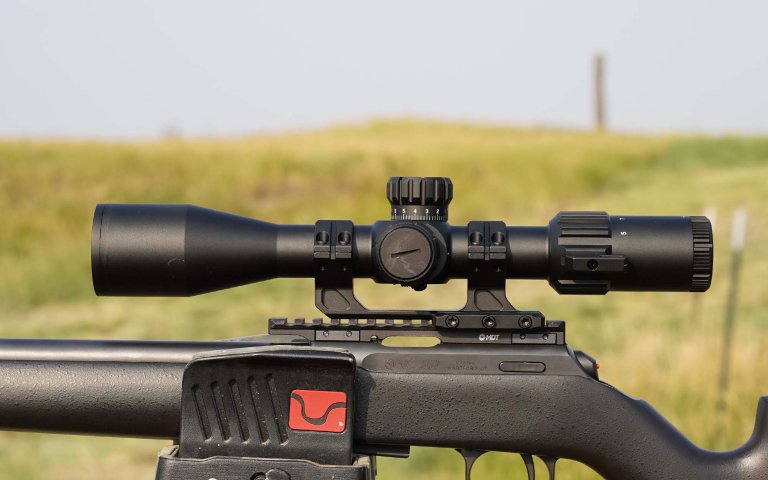
Monstrum Beast 3-15×44
See It
Pros
- Priced at just over $100, an insane value
- Ships with cantilever mount
- Fiber-optic illumination creates bright aiming point
- Push-to-turn locking turrets
Cons
- Reticle adjustments are mushy
- Stingy eyebox
Key Features
-
Rezeroable turret dials -
Second-plane reticle -
Hash-style reticle tuned to MOA references -
Fully transferable lifetime warranty
How does Monstrum do it – produce a decent precision optic for a few bucks over $100, include a cantilever mount and bright illuminated reticle ship it for free, and stay in business?
We’re not sure how the accounting works, but one answer is by producing optics with inexpensive components. While the entirety of the new Monstrum Beast 3-15×44 works together to place bullets on targets, each constituent part of the scope is problematic. The turrets are mushy and track poorly at the outer ends of their adjustment range. The eyebox is so narrow that it’s easy to lose sight of your target. And the image blurs on the edge of the woozy glass.
But did I mention this full-size, high-performance, second focal-plane scope costs less than the average monthly cell phone bill?
The inexpensive build raised a question among testers: Is it worth the money?
“This scope works, but it feels cheap,” notes tester Nate Ward. “The stingy eyebox really impacts shootability for me. I just can’t keep the target in range unless my eye alignment is absolutely centered.”
But the scope, and the company that makes it, serve an important service as an on-ramp to shooters and hunters. Maybe you can’t afford a $300 scope just now. This $100 unit will get you on the range and into the field. That more expensive and higher-performing optic can wait.
Monstrum Beast 3-15×44 Specs
- Magnification: 3-15-power
- Objective Lens: 44mm
- Tube Diameter: 30mm
- Light Transmission: Not provided
- Exit Pupil Diameter: 14.7mm to 2.9mm
- Twilight Factor: 11.5-25.7
- Field of View: 34-7 feet at 100 yards
- Reticle Plane: Second
- Reticle Type: Hash style MOA
- Illumination: Yes, fiber optic dot
- Turret Click Values: ¼ MOA
- Adjustment Per Revolution: 15 MOA
- Total Internal Adjustment – Elevation: 74 MOA
- Total Internal Adjustment – Windage: 80 MOA
- Parallax Correction: 10 yards to infinity
- Weight: 29 ounces with mount
- Length: 13.2 inches
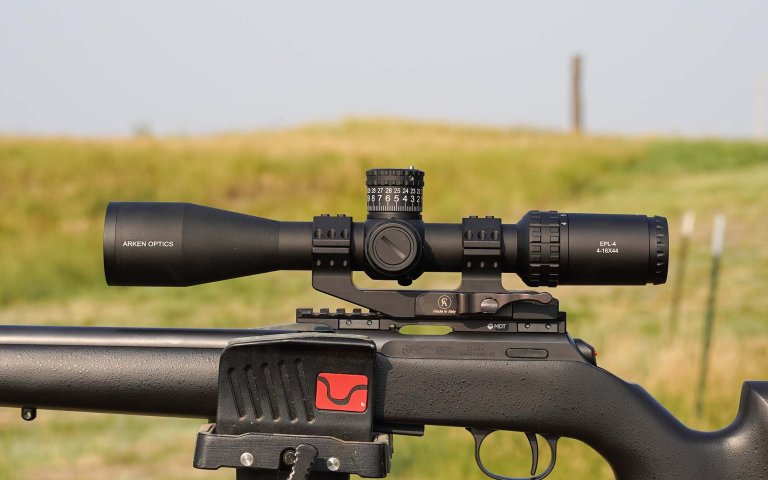
Arken EPL-4 4-16×44 MOA VHR
See It
Pros
- Excellent crossover hunt/target scope
- Modified hash-style first focal-plane reticle
- AZS Zero Stop system At about $300, a screaming deal
- Also available in precision MIL reticle styles
Cons
- Limited windage adjustment range
Key Features
-
Solid mechanical zero stop -
High exposed tactical-style elevation turret -
Capped and rezeroable windage dial -
Ships with sunshade -
Fully transferable lifetime warranty
We’ve seen this astonishingly affordable, capable scope from Arken in the past, but the new version has the VHR reticle, a less busy design compared to the VPR tree-style reticle of the first-gen EPL-4. Is that enough to qualify it for this year’s optics test? Yes, because the Arken represents more than just this single update.
This is a remarkable scope at twice the price of $299, which is the real-world street price. The glass is bright and decent enough, though we detected some edge distortion and flaring in full sun. The turret adjustment turns with positive authority, and we confirmed excellent tracking except on the very end of the adjustment range. The reticle is visible at its lowest magnification. The configuration lands right in the sweet spot for hunters looking for a scope to ring steel and for target shooters who want to hunt.
The exposed elevation turret, which contains a redesigned zero stop, is a little too proud for some testers, and others wanted a reticle with a few more windage references in the elevation field. Happily, Arken makes one in the first generation of the EPL-4. It’s called the MIL/MOA VPR, a tree-style reticle that’s optimized for precision, not speed. Whichever you choose, the Arken represents an amazing value.
Arken EPL-4 4-16×44 Specs
- Magnification: 4-16-power
- Objective Lens: 44mm
- Tube Diameter: 30mm
- Light Transmission: Not provided
- Exit Pupil Diameter: 11mm to 2.75mm
- Twilight Factor: 7.3-26.5
- Field of View: 30-7.5 feet at 100 yards
- Reticle Plane: First
- Reticle Type: Illuminated VHR MOA
- Illumination: yes, 6-step intensities
- Turret Click Values: ¼ MOA
- Adjustment Per Revolution: 20 MOA
- Total Internal Adjustment – Elevation: 86 MOA
- Total Internal Adjustment – Windage: 41 MOA
- Parallax Correction: 10 yards to infinity
- Weight: 24.1 ounces
- Length: 13.2 inches
Vortex Crossfire HD 6-18×50
See It
Pros
- Useful second-plane bullet-drop reticle
- 15-yards-to-infinity side parallax correction
- At about $300, an excellent value
- Rezeroable turret dials
Cons
- Reticle references valid at highest mag
- Forgettable glass
Key Features
-
Capped turrets 30mm tube -
Second-plane reticle has elevation and windage holds -
Highest-mag version of Crossfire HD family -
Fully transferable lifetime warranty
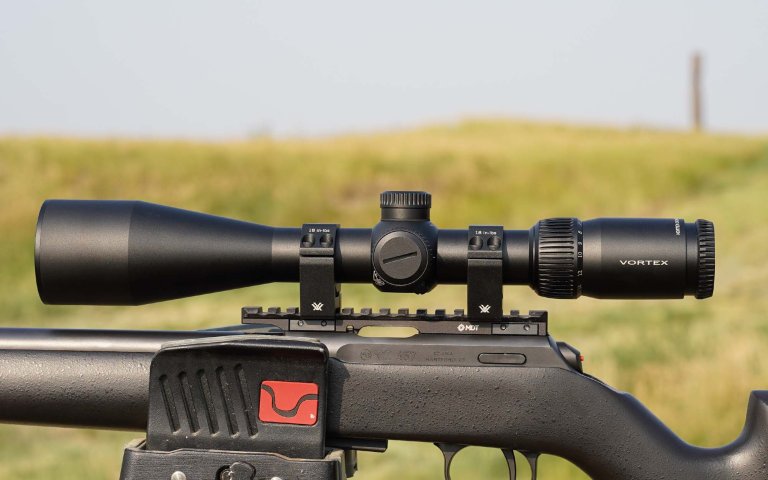
Like Nightforce, Zeiss, and Leupold, Vortex is completing the buildout of an entire rifle scope family. The Crossfire HD line, slowly replacing the Crossfire 2 line, has a scope for every hunter, from a handy LPVO to this high-mag optic that’s optimized for hunters but which has some stoke for target shooters.
We tested other configurations of the family last year. This year we evaluated the 3-9×40 and 2-7×32 versions of the Crossfire HD line, so while this review is mainly focused on the 6-18×50 build, our perspectives apply to those other scopes with similar reticles and operating systems.
The 6-18×50 gained points for its hunter-centric BDC reticle, which has MOA-based hashes at 1.5, 4.5, and 7.5 MOA below the illuminated center aiming point. Those spacings conform to the drop of standard-velocity bullets zeroed at 100 yards or high-velocity and magnum calibers zeroed at 200 yards (Vortex ships a chart of zeroing recommendations with its scopes).
Users are encouraged to match their load ballistics with Vortex’s Long Range Ballistic Calculator to understand subtensions at various magnifications. That’s an important consideration, since published subtensions are only valid at the highest magnification of the second-plane reticle. For most hunters, who will throw away the reticle reference manual the minute they mount the scope, the 4-12×44 or 3-9×40 are more useful magnification ranges for the Dead-Hold BDC reticle than the 6-18×50 version. But when we plugged our specific ballistics into the Vortex calculator, we got magnification-adjusted holds out to 500 yards with center-fire ammo, and out to 145 yards with our 40-grain CCI Green Tag .22 Long Rifle load, which has become the go-to rimfire bullet for our test because of its consistency and affordability.
It’s interesting to observe that the Crossfire HD scopes are only available in MOA configurations, and Vortex has leaned heavily into its Dead-Hold 2A BDC reticle. For shooters and hunters who want Vortex scopes with MIL references or first focal-plane systems, the Diamondback and Strike Eagle families have more options.
The glass in the Crossfire HD line is underwhelming, with a milky veil and some edge distortion. The eyebox in the 6-18 is pretty stingy, and with no manual parallax correction, the focus on the 3-9×40 version is glitchy, with testers complaining that they could rarely keep both the reticle and the target in the same focal plane.
Also of note: the 2-8×32 Crossfire HD was one of the few scopes to struggle in our drop test. After three drops from 36 inches on a pad, the scope’s zero shifted about 2 MOA at 50 yards. The 3-9×40 version passed the drop test with no detectable zero shift.
Durability certainly matters, but we reckoned that hunters aren’t buying these scopes for the glass; they’re buying them because they represent a raging value for all-around hunting optics. Turrets tracked well. Controls are generally smooth and precise. And for scopes costing under $300, the Crossfire HD line earned mammoth price/value scores.
“Easy, simple, hunting budget workhorse,” notes tester Todd Netto. “I think your average hunter would take this over the other $300 scopes in our test. It’s worth that price all day long.”
Vortex Crossfire HD 6-18×50
- Magnification: 6-18-power
- Objective Lens: 50mm
- Tube Diameter: 30mm
- Light Transmission: Not provided
- Exit Pupil Diameter: 8.3mm to 2.8mm
- Twilight Factor: 17.3-30
- Field of View: 18.7-6 feet at 100 yards
- Reticle Plane: Second
- Reticle Type: Dead-Hold 2A BDC MOA
- Illumination: Yes, center dot
- Turret Click Values: ¼ MOA
- Adjustment Per Revolution: 15 MOA
- Total Internal Adjustment – Elevation: 70 MOA
- Total Internal Adjustment – Windage: 70 MOA
- Parallax Correction: 10 yards to infinity
- Weight: 23.2 ounces
- Length: 13.9 inches
Burris Fullfield 4-16×50
See It
Pros
- Useful windage-hash reticle
- 25-yards-to-infinity side parallax correction
- Burris Knob Synergy exposed elevation dial
- Ability to request custom ballistic turret
- Priced under $400, a solid value
Cons
- Reticle has no elevation references
- Greenish tint to the image
Key Features
-
Most useful Fullfield configuration for Western hunters -
1-inch tube -
Floating center-cross aiming point -
Zero stop -
Fully transferable lifetime warranty
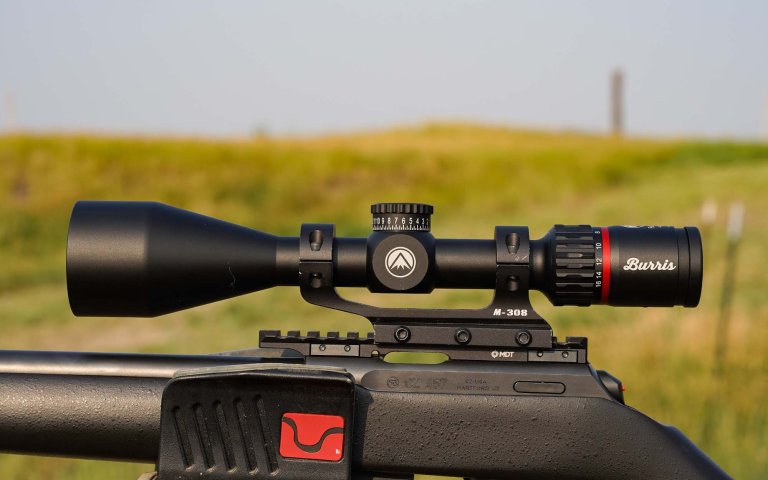
This most useful member of the Burris Fullfield family has some remarkably nice features for a $400 scope. The most surprising is a zero stop, which Burris calls its “zero click stop.” It’s a bit of a pain to loosen or remove five tiny screws to set the stop, but once it’s in place, it provides a rock-solid return to zero. That’s a key consideration for a scope with an exposed, non-locking elevation turret.
Burris calls this system its “Knob Synergy” dial, and it’s intended for hunters who want to dial their elevation aiming solution. I’m all for that, but in a hunting scope, I want some assurance my exposed turret won’t move inadvertently. For me, the Knob Synergy moves a little too easily, and I found I was always fussing the turret back to the zero stop.
But that’s one of the few demerits we handed out to this otherwise smart and useful second-plane scope, which is built around Burris’s Wind Ret MOA-based reticle. The modified plex design has 8 MOA of hashes (in 1 MOA spacing) on either side of a precise floating center-cross aiming point. The idea is to dial for distance and hold for wind, and the system is fast and precise enough once you’ve established your zero and set the zero stop. The reticle has no illumination, but it’s both bold enough to see and fine enough to not obscure your target. In all, a fast and smart hunting system.
We tested 3-12×42 Fullfield, as well, with a plex reticle. It’s a nice hunting rig, but I would opt for the excellent Ballistic E3 reticle, which has windage and distance holds in an elegant, useful design.
Both scopes had decent glass, but testers noted that the Burris optics both have a distracting green tint that’s especially noticeable in low-light conditions. The 1-inch tube is surprising in this era of 30mm builds, but we like the slim profile and light weight it gives the 17-ounce scope.
“My only knock is that the 4-15×50 Fullfield has relatively little internal travel, but besides that it’s a solid scope, almost on par with the [Burris] Veracity,” notes tester Todd Netto. “I’d hunt with this and not look back.”
Burris Fullfield 4-16×50 Specs
- Magnification: 4-16-power
- Objective Lens: 50mm
- Tube Diameter: 1 inch
- Light Transmission: Not provided
- Exit Pupil Diameter: 10mm to 3.8mm
- Twilight Factor: 14.1-28.3
- Field of View: 27-6.75 feet at 100 yards
- Reticle Plane: Second
- Reticle Type: Wind Ret
- Illumination: No
- Turret Click Values: ¼ MOA
- Adjustment Per Revolution: 25 MOA
- Total Internal Adjustment – Elevation: 54 MOA
- Total Internal Adjustment – Windage: 54 MOA
- Parallax Correction: 25 yards to infinity
- Weight: 17.7 ounces
- Length: 12.3 inches
How We Tested the Best Hunting Scopes

How We Low Light Test Optics
Because rifle scopes are essentially aiming devices, we evaluate them on a different basis than binoculars or spotting scopes, optical instruments that have broader utility. We’re interested in the precision of a rifle scope, so our scoring criteria gives more weight to attributes that achieve that goal.
We test optical performance, same as we do spotters and binoculars. But we spend more time on four criteria that we think are the beating heart of a solid rifle scope. Our interior aiming system considerations are reticle style and utility, illumination, reticle references, and visibility. Our exterior aiming system evaluation considers turret positivity and indexing, the scope’s zero stop, parallax control, and total adjustment range, or how far shooters can stretch the turrets’ elevation and windage clicks. We also test a range of attributes that we bundle under the heading precision, which includes turret tracking, return to zero, the trueness of the scope’s magnification, parallax, and field of view. And then we ask testers to rate a scope’s shootability, which considers eye relief, eyebox, the ease of use at various magnifications, and the scope’s versatility.
That last consideration — versatility — is probably the most meaningful in this category. We’re interested in scopes that can span a wide range of uses, from ringing steel at a mile to killing a twitchy mule deer at a quarter that distance. Target-shooting attributes are a plus, but so is portability, a clean but useful reticle, precise and positive turret clicks, illumination, and clear glass. We also reward scopes that can do triple duty as close-in rimfire target optics, mountain hunting companions, and long-range competition scopes.
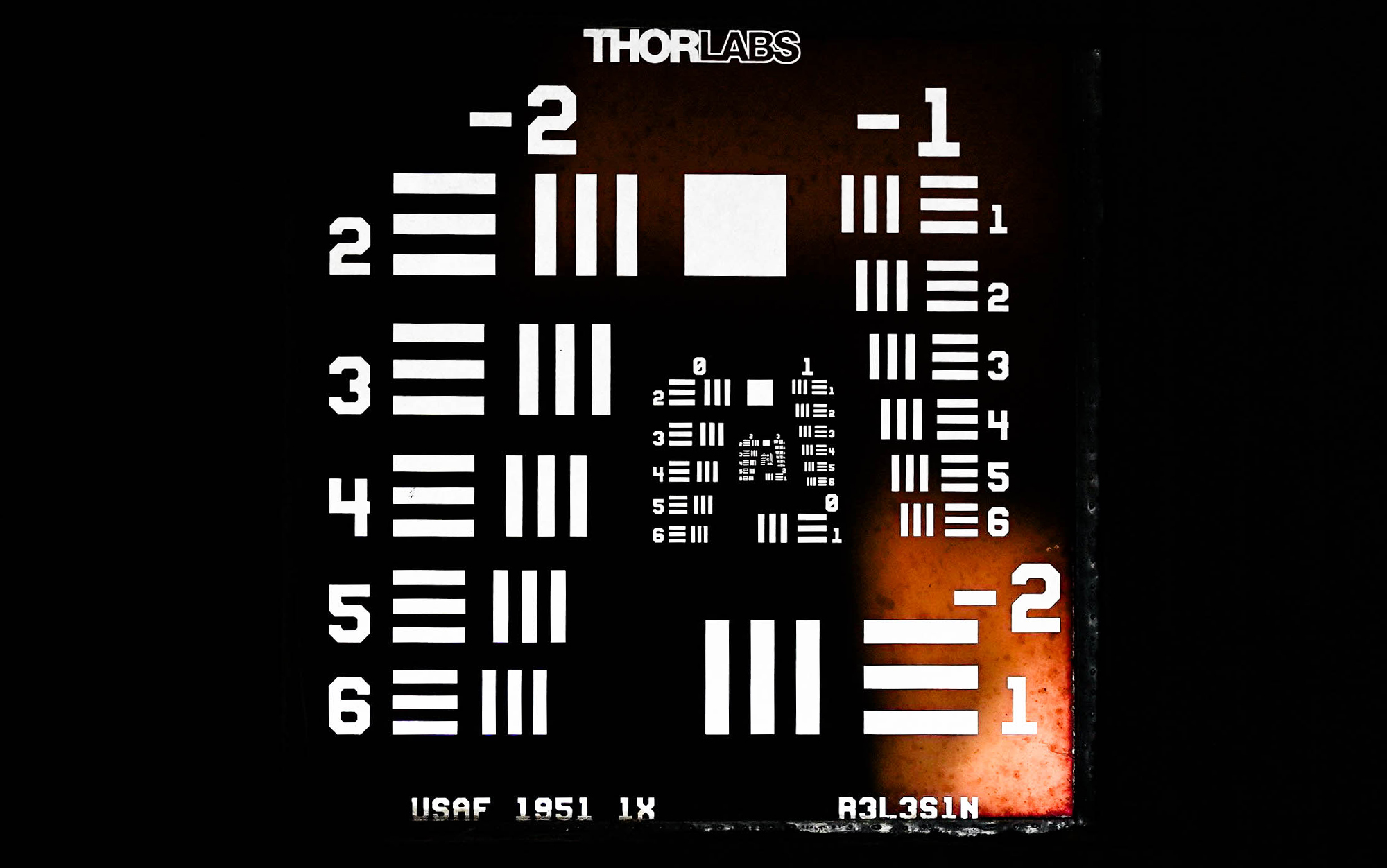
We put all submissions through the same criteria. First, we measure optical resolution, using the diminishing black-and-white lines of a 1951 Air Force Resolution Target to score the optical performance of each submission. We also measure the low-light performance of each “versatile” scope by mounting them to tripods and focusing them as a group at 200 yards at a black-and-white resolution target at twilight, all in order to measure the brightness and sharpness of the glass and visibility of the unilluminated reticle.
We break our 10-point scoring into four general categories: optical performance (25 percent of total grade), aiming system (50 percent of total grade), design (15 percent), and value (10 percent). The average of these categories is the basis of our grades, detailed below.
Optical performance includes the resolution and low-light tests plus the more subjective assessments of image quality and brightness. Aiming-system performance assesses interior and exterior aiming system, precision, and that squishy shootability assessment. Design considers the exterior finish, interior blacking, mounting dimensions, and durability.
And then our price/value score rates how much scope — along with warranty and amenities such as rings, extra turrets, and lens covers — you get for your money. The rifle scope that gets the highest overall score wins our editor’s choice award for the best in the category; the optic with the highest price/value score wins our great buy recognition, and we give other awards based on specific attributes.
How We Grade Hunting Scopes
Our 100-point evaluation adds up to a total numeric score, but we translate those to grades for each submission. The optical performance grade combines the scores from resolution, low-light, and image quality. Our aiming system performance grade aggregates the interior/exterior aiming system, precision, and shootability scores. The design grade considers construction, innovation, versatility, and durability. And then the price/value grade is our value grade.
To earn an excellent grade, the average of that category must be 9 or higher, which is extremely hard to achieve. Very good is an average score of 7 to 9. A good grade is 5 to 7. Our fair grade is 3 to 5, and poor is anything under 3.
FAQs
I get asked all the time which brand of rifle scope is better than the next, and it’s often framed as whether Leupold is better than Vortex, largely because those are among the highest-profile optics brands. The answer is, it depends. It depends on which particular product you’re comparing. In general, Leupold’s VX-3HD line has better glass, more precise controls, and more durability than Vortex’s lower-end scopes, in the Crossfire II, Diamondback, and Strike Eagle lines. But Vortex’s higher-end scopes, those in the Razor HD line, deliver performance every bit as good or even better than Leupold’s VX-3 line. On the other hand, Leupold’s upper-end product lines—the Mark 5HD, Mark 6, and Mark 8—are among the top rifle scopes on the market, with prices to match.
Rifle scopes have to do one thing very well, and that is deliver a bullet with repeatable precision where you want it. In order to do that, you need not only decent glass in order to see your target, but you need a scope to make tiny adjustments and then stay put under the punishing recoil of a gun.
It’s hard to achieve all those goals with an optical instrument that costs less than $100. Some brands have managed it—the Simmons Truplex and Tasco’s World Class and Sportsman scopes are a couple that come to mind—but the best combination of durability and repeatable precision I’ve seen is Bushnell’s Banner, which retails for just under $100 and should deliver years of adequate performance. One thing to consider for a budget-priced optic: make sure it comes with a good, reliable warranty.
Rifle scopes have several different lens elements, and often brands use different qualities of glass for each lens. But the most important of these lenses in terms of image quality is the biggest one. That’s the objective lens, or the big lens that’s closest to your target. You’ll see qualities of glass described as ED (extra-low dispersion) or HD (high-definition), and generally these specialized glass will be clearer than generic glass. But equal to the quality of glass in a scope is the quality of the coatings. These are the microscopic films that help reduce glare, boost contrast and color fidelity, and make images and the reticle “pop” when you look through the scope. It’s almost always worth paying a little more to get proprietary coatings and a better grade of objective-lens glass.
Are hunting rifle scopes used in the military? Not generally. Because military optics have to take more punishment than hunting scopes do, they are generally overbuilt. Some rifle scopes that you might see at your local sporting goods store are found on military rifles—Leupold’s Mark 5HD is a good example. It’s been selected for the U.S. Army’s Precision Sniper Rifle program—but generally, the military specifications are so rigorous in terms of holding up to the punishment of war that sports-optics brands don’t compete for contracts. That said, Steiner’s M7Xi is a favorite of military snipers, and Nightforce’s precision rifle scopes are used by Marine Corps snipers.
Generally, Burris scopes have good quality and durability. That said, the lower-priced product lines tend to have lesser-quality glass and a less robust build than higher-priced product lines. That stands to reason. Also, the more electronics inside a scope, the less durable they are, simply because recoil, moisture, and field abuse are hard on electronics. That’s why Burris’s celebrated Eliminator line of rangefinding rifle scopes tends to have weaker warranties than non-electronic scopes. But Burris’s XTR Pro series of tactical scopes are among the best and most durable precision scopes on the market.
You can spend anywhere from $100 to $4,000 on a rifle scope. So, what differentiates the widely divergent prices? Everything from the quality of glass in the scope to the precision of the erector system and turret controls. The most precise optical instruments have such intricate moving parts that they require extra manufacturing and quality-control steps, adding to the cost. And the best grades of German and Japanese glass can cost three to four times the lower grades of Chinese and Malaysian glass on the market. Once you start adding features like Bluetooth connectivity, an illuminated reticle, and rangefinding capabilities to a scope, the price rockets upward. But all those features make the scopes even more precise and reliable tools for placing bullets at great distance, and isn’t that what you want a rifle scope to do?
Final Thoughts on Rifle Scopes
Rifle scopes have such variability (of magnification, size, reticle type, and turret design) that picking a purpose-built optic for multiple uses is fraught with problems. On the other hand, expecting a do-everything versatile scope to perform the specific tasks of mile-long steel-plate shooting or low-light, close-quarters combat shooting has just as many problems.
The idea of this roundup is to introduce readers to a wide variety of scope types, and discuss their attributes for specific shooting tasks as well as their ability to solve a number of diverse shooting challenges. Ultimately, you should pick a type of scope—whether a long-range precision scope, a low-power variable optic, or maybe an all-around hunting scope—that suits your needs and then compare models within that niche.
Read the full article here