
Over the years Ruger has offered many their rifles chambered for classic cartridges either as cataloged items or through distributors like Lipsey’s. And it seems like Lipsey’s always offers the best of the exclusive firearms by Ruger, as well as from other manufacturers. The Ruger M77 Alaskan Bush Rifle is a perfect example. It takes what is arguably the best rifle action Ruger has ever offered and combines it with two classic and highly revered cartridges: the 35 Whelen and 9.3×62. The rifle’s name perfectly describes the job it was built for and will excel at. I got a chance to put Lipsey’s new offering to the test at my home range. Here is my full review.
Lipsey’s Ruger M77 Alaskan Bush Rifle Specs
- Length: 40.5 inches
- Weight: 7 pounds, 12 ounces
- Barrel: 20 inches
- Action: Ruger M77 bolt action
- Trigger: 4.8 pounds (as tested)
- Capacity: 4+1
- Chamberings: 35 Whelen (tested), 9.3×62
- Finish: Satin stainless steel
- Stock: Laminated green-grey hardwood
- Sights: Express V rear, white bead front
- Price: $1,579
Related: Marlin 1884 Trapper 10mm Rifle Review
Lipsey’s Ruger M77 Alaskan Bush Rifle Overview
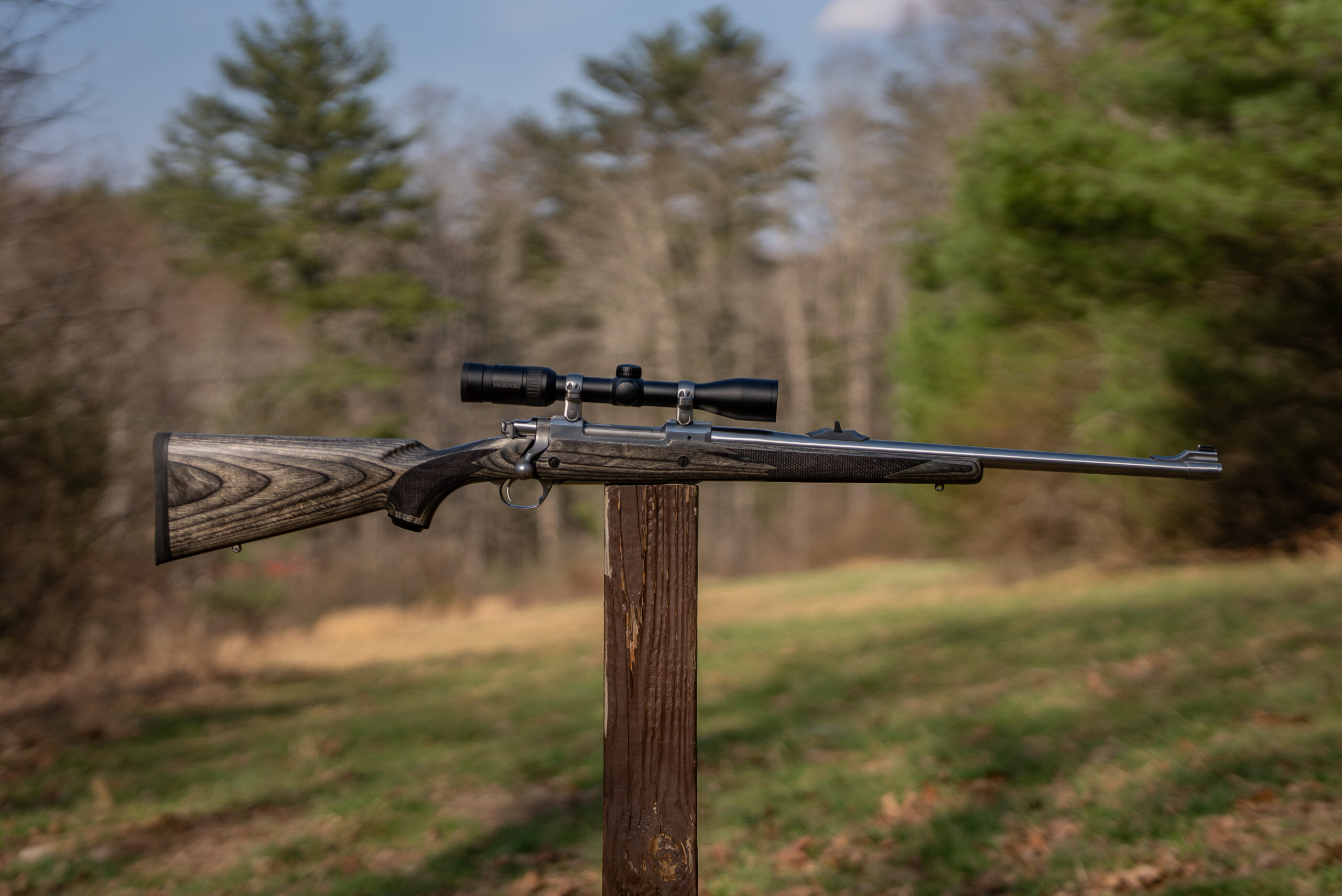
The factory-offered M77 line of Ruger rifles has been reduced to rifles chambered for rimfire or revolver cartridges. Ruger’s flagship bolt-action rifles for centerfire rifle cartridges are now cataloged as “Hawkeye” rifles. The Alaskan Bush Rifle is only available through Lipsey’s, but even though it is an exclusive offering, it is priced similarly to current factory cataloged Hawkeye rifles. And, like the current Hawkeye line of bolt actions from Ruger, the Alaskan Bush Rifle is built on the same M77 action. It features Ruger’s integral scope mounts, the controlled-round-feed Mauser style bolt with a non-rotating extractor, and the bolt-mounted and bolt-locking three-position safety. The rifle ships with stainless steel, one-inch, medium scope rings.
All the metal work on the Alaskan Bush Rifle is stainless steel, in fact, and it has a brushed finished. The barrel is a medium-contour 20-inch tube that measures 0.671 at the muzzle. The muzzle is not threaded, but it is finished out with a banded front ramp with a tasteful taper, and it has a replaceable—for elevation adjustment—white-bead front sight that measures 0.10-inch in diameter. At mid barrel (4 5/8 inches forward of the action), there is a stainless saddle with a black express V sight with a vertical white line at its center that is drift-adjustable for windage.
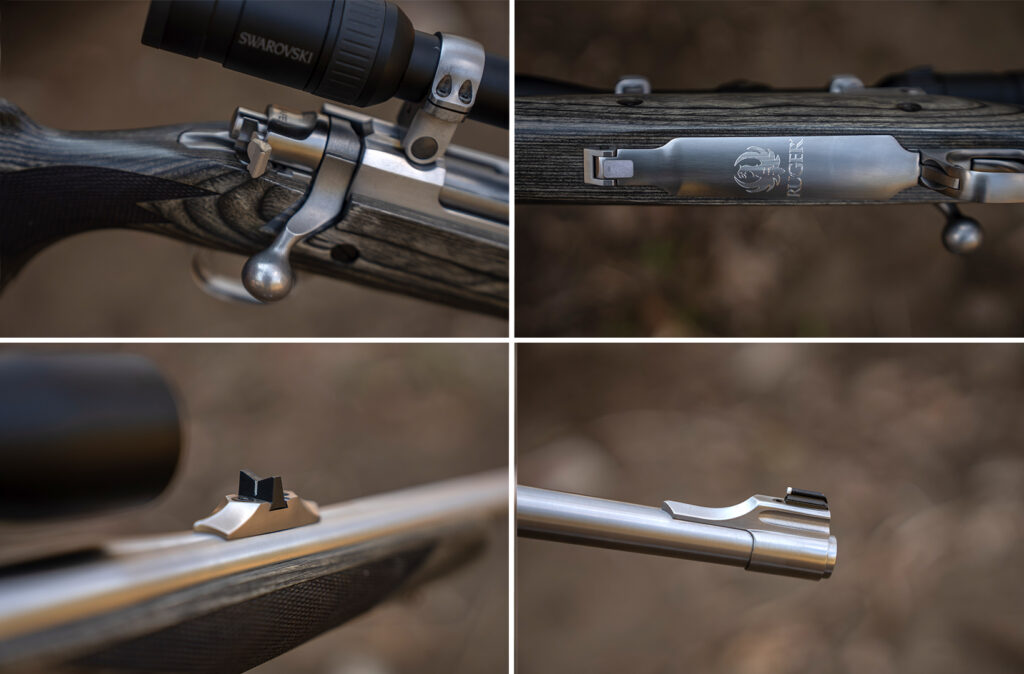
The rifle’s stock is a hardwood laminate with varying tones of grey and black, and there are checked panels along the forend and on the grip. The stock is straight with minimal drop, and at the butt there is a ¼-inch, black, recoil pad. The grip has a matching black cap with a white and black Ruger logo. The trigger guard and floor plate are also brushed-finished stainless steel, with an engraved Ruger logo, and the internal magazine box will hold four cartridges. There are stainless-steel sling swivels in the common locations, about 3 inches forward of the toe of the butt stock and about 2 inches behind the tip of the forend.
Related: Sako Grizzly Rifle Review
Lipsey’s Ruger M77 Alaskan Bush Rifle Test Results
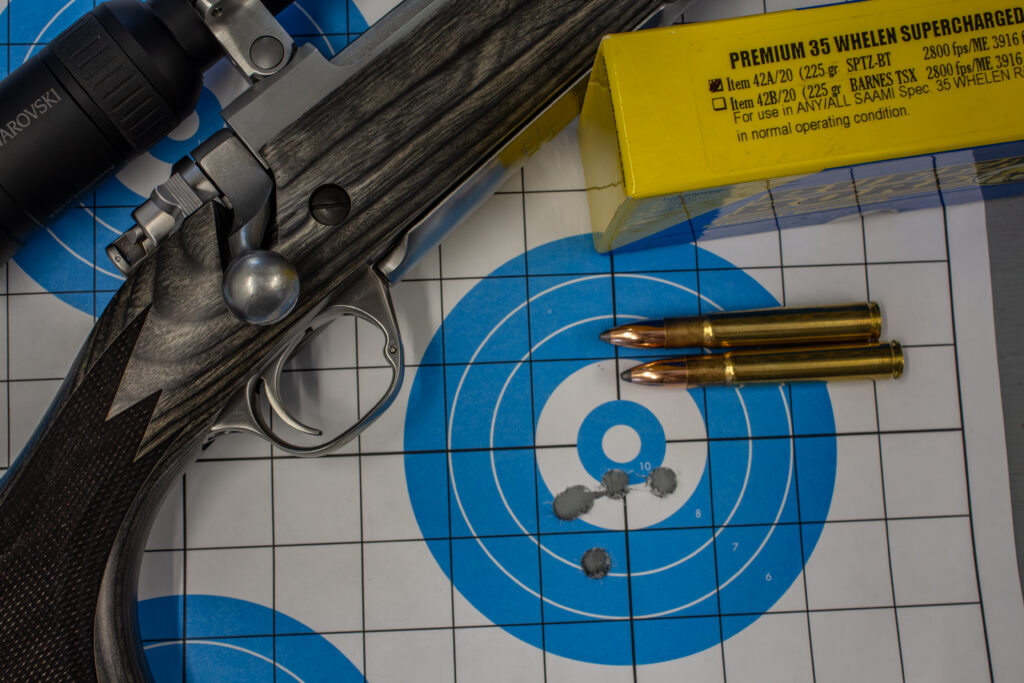
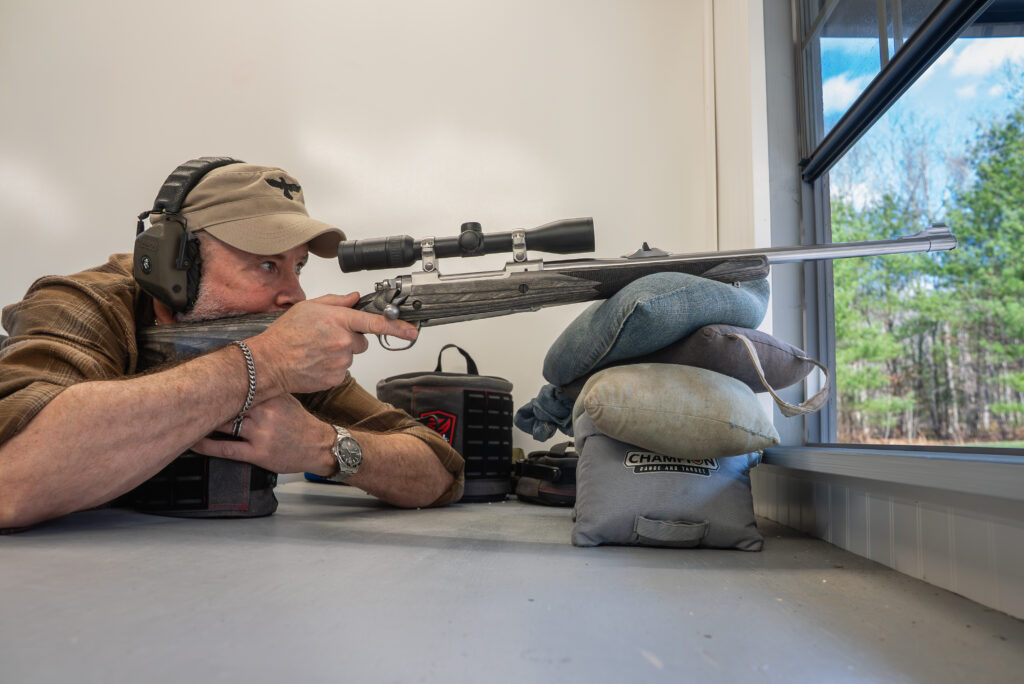
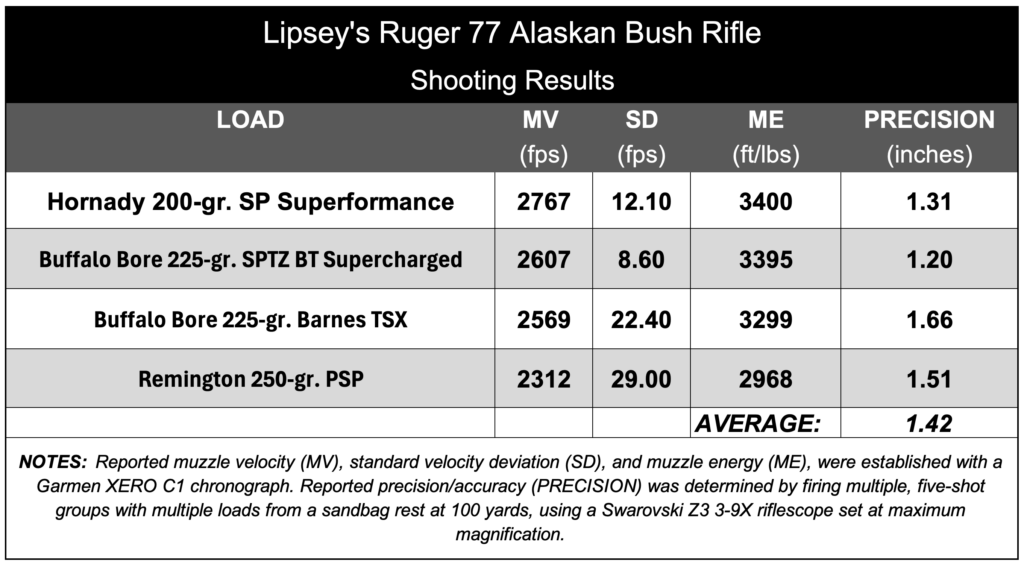
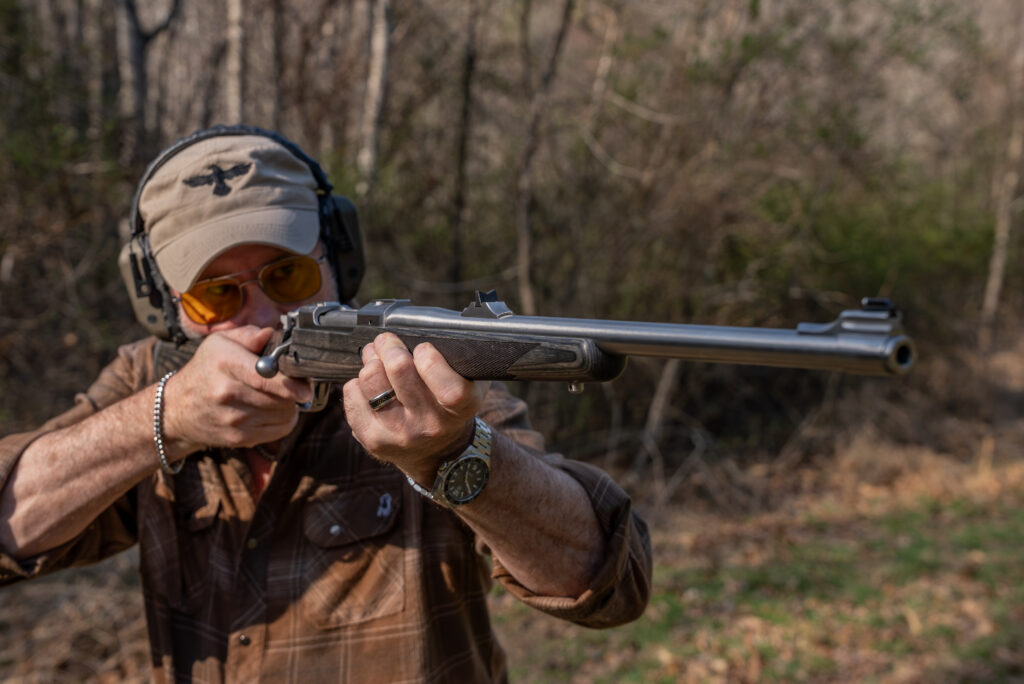
The only thing I did not enjoy with this rifle was shooting it from the bench. The recoil was stiff, but not in a way that hurt your shoulder. It was the unsuppressed muzzle blast combined with the seemingly, semi-concussion-like feeling each shot applied to my head. I’m convinced the rifle can deliver precision better than what I was able to extract from it had a shooter with a higher tolerance for hard-kicking rifles been behind it. Still, the rifle averaged less than 1.5 MOA for the 16, five-shot groups fired. Conversely, when shooting the rifle off-hand, recoil was easily managed. Make no mistake, you know you have hold of a powerful rifle, but shooting from field positions was tolerable.
Aside from the punch this rifle delivered from the bench, it performed flawlessly in every way. It balanced well for off-hand shooting; the trigger—though a bit on the heavy side—was very crisp; and the cartridges fed through the action without a hiccup. It’s also worth noting that the alignment of the ejector is just slightly forward of the back of the magazine box, which is a critical design feature of controlled-round-feed actions that limits the possibility of a double feed due to short stroking. With some controlled-round-feed actions manufacturers overlook this.
What I really enjoyed about the Alaskan Bush Rifle was shooting it with the open sights. The express style rear sight perfectly interfaced with the bold white front bead, and the resulting sight picture was lightning fast to get on target. Snap shooting a 4-inch target at 25 yards in less than two seconds was easily accomplished. The open sights also provided enough precision for kill zone hits out to 100 yards or so. You could argue that with the current popularity of suppressors, the lack of a threaded muzzle reduces the appeal of this rifle. However, a suppressor capable of stifling either of the cartridges the Alaskan Bush Rifle is chambered for would be so large it would dramatically hinder the handiness of this rifle, which is one of its greatest assets.
Final Thoughts on Lipsey’s Ruger M77 Alaskan Bush Rifle
Pros
- Very handy
- Superb open sights
- Integral scope mounts
Cons
Hunters today have moved beyond the concept of one rifle that they might use for everything. Specialization is now the norm. Those looking for a rifle that is ideally specialized for hunting the Alaskan bush would be hard pressed to find a better option. This rifle is fully capable of delivering kill zone kits on big-game animals like moose and bear out to 300 yards when equipped with a riflescope. But it is also perfectly configured—in cartridge and design—for stopping a charge from a pissed off grizzly in close quarters. If you just want to hammer whitetails, this rifle will do that too, with authority.
I’ve hunted a lot with the 35 Whelen, a little bit with the 9.3×62, and I think many modern hunters do not have a practical concept of the power of either cartridge. A good friend used a 35 Whelen to stop a charging grizzly on Kodiak Island several years back, and the 9.3×62 is commonly used in Africa for dangerous game. I fell in love with this rifle the moment I put it to my shoulder. The open sights are fantastic, and it handles like a wizard’s wand. If I was going hunting in Alaska, this is would be the rifle I would take. I just would not spend a great deal of time shooting it from a bench rest.
Read Next: The Best Rifles, Tested and Reviewed
Editor’s Note: Richard Mann’s new book, Rifle Cartridges for the Hunter: A Hunting Journal Spanning a Half-Century details 50 rifle cartridges through real hunts, practical insight, and hard-earned lessons. It is essential reading for serious hunters and riflemen who appreciate ballistic science and authentic outdoor adventure.
Why Trust Us
For more than 125 years, Field & Stream has been providing readers with honest and authentic coverage of outdoor gear. Our writers and editors eat, sleep, and breathe the outdoors, and that passion comes through in our product reviews. You can count on F&S to keep you up to date on the best new gear. And when we write about a product—whether it’s a bass lure or a backpack—we cover the good and the bad, so you know exactly what to expect before you decide to make a purchase.
content_rifles,content_guns,content_outdoor-gear

THE 1871 CLUB

Recommended Products
Read the full article here