
Photos by Frank Thai
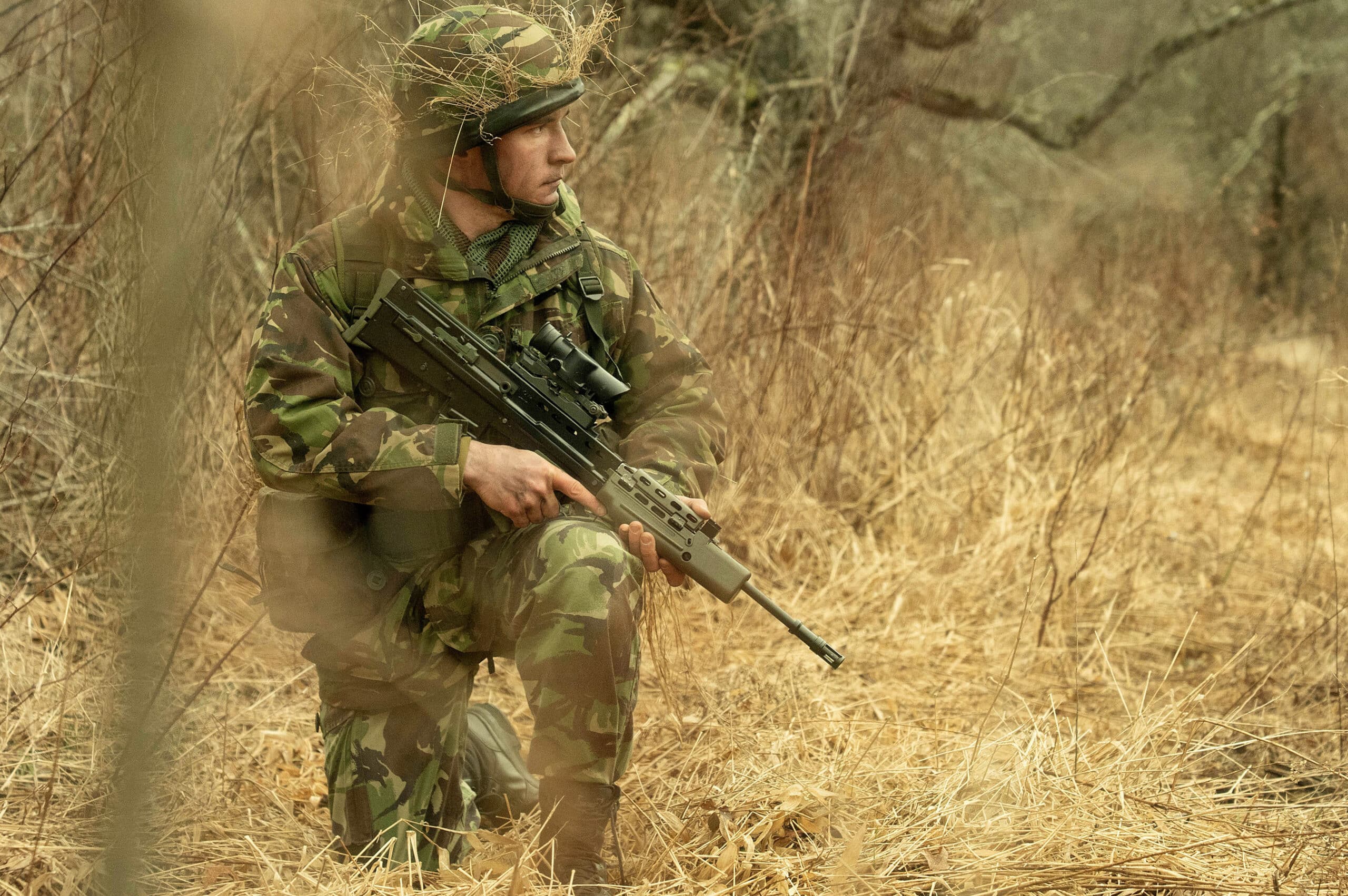
Once described as “an AR-18 shoved up the arse of an EM2,” the SA80 continued the British defense establishment’s fascination with bullpups, which started in the late 1940s. Following the .280 British cartridge debacle where Winston Churchill bent the knee to adopt the American T65 round, the Brits were saddled with a service rifle that was longer than they wanted, heavier than needed, and chambered in a cartridge overly powerful for the role it was supposed to fill. Conceived at the height of the Cold War, the SA80 was supposed to address all of these concerns.
In 1971, the Director General Weapons (Army) asked staff at the Royal Small Arms Factory (Enfield) to conduct a study to define the nature of the target a future infantry small arm should be able to hit, and what were the criteria that would result in defeating that target.
Other objectives were to assess a range of ammunition calibers in terms of performance inside a 4-600m effective range, to look at a variety of weapon configurations to produce something smaller and lighter than what was currently available, and to assess what was happening outside the confines of the British Isles regarding small arms developments.
Oh, and an area effect weapon such as a rifle grenade or underslung grenade launcher would be jolly nice, too.
The following year, they reported back with their conclusions that a target size of about 18 by 35 inches was appropriate, and that 466 joules of energy were needed to punch through the helmets of the day. Quite why this might be a requirement, given the amount of real estate not covered by a steel pot wasn’t addressed, but hey, at least it was a starting point.
From there, the RSAF committee recommended an optimum caliber of around 5mm for both an Individual Weapon (IW) and a Light Support Weapon (LSW). Both the IW and LSW should be of an unorthodox configuration with a straight butt, which would give a shorter overall weapon, save weight, and improve handling, i.e., a bullpup. Both were expected to be able to accurately engage the specified target out to 600 meters, have as many parts in common as possible, be select fire, gas operated, multi-lugged bolt weapons capable of using an optical sight, and have a cyclic rate of between 300 and 1,000 rounds per minute.

With those parameters in mind, the engineers at RSAF went to work. As a concept, the LSW was doomed from the start. Like every other attempt to create a fire team-level support weapon based on a rifle, it quickly went afoul of the laws of thermodynamics, due to its closed bolt operating system and non-replaceable barrel. But political considerations trumped practical ones, and its development continued alongside the rifle.
Both guns made their first public appearance in 1976, then took part in the NATO ammunition trials in 1977, where it was decided that the Belgian SS109 round was to be everyone’s new common ammo. As a result of the RSAF guns’ poor showing due to their early stage of development, lots of redesign and improvements were made to address shortcomings in feeding, extraction, and ejection. The revised guns were then sent for a series of trials in 1981 in anticipation of them being in service by 1985.
The Conservative government at the time was dogmatically wedded to the idea of selling off as many state assets as possible, as several strategically important industries had been nationalized by socialist administrations during the 20th century. A series of high-profile privatizations was carried out, with the state-owned steel, auto, airlines, and telecoms companies all going back into the hands of shareholders.
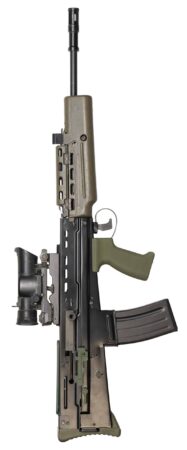
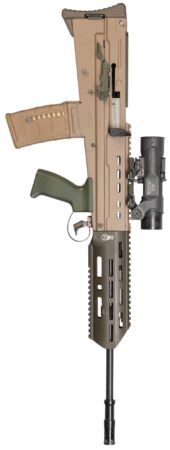
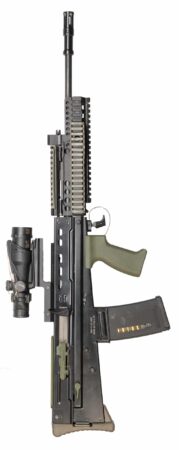
In 1982, the government announced its intention to sell off RSAF, with the deal to be completed by 1986. It then became apparent that in order to sweeten the deal, the British MOD was going to buy whatever new service rifle the guys at Enfield were going to make, so that the new owners would take on a company with full order books.
As a result, pressure came down from corridors of power to push the sample rifles through testing quickly in order to meet the new timeline, and as a consequentially host of faults that should have been discovered and corrected were brushed aside. Those rifles tested were essentially hand-built prototypes, and nevertheless the system was accepted by the MOD into service without trialing actual production guns.
As anyone who’s ever worked in a production environment will tell you, there’s a world of difference between products that emerge from R&D versus the ones produced at scale. The rifle was adopted officially as the L85A1, and the first troops issued them became beta testers on operations.
When the gun works, it’s actually pretty decent, despite being a porky bitch with a crappy trigger, and the A2 variant fixed most of the problems with the original gun. And yes, they were many. I’ve personally had one fail to reset the trigger during a weeks-long live-fire exercise, but the workaround was running it in full auto for the duration. The bolt release is garbage and breaks easily, which is why troops are trained to release the bolt by sling-shotting the charging handle. Which is reciprocating, and means that you can’t use it off the left shoulder without losing half your teefs.

Shortly after my unit got them, armorers showed up with a new magazine release catch with a raised portion added to the casting, which was supposed to prevent mags from falling out when the catch came into contact with your web gear. It didn’t. The next solution was to epoxy a metal fence to the lower receiver (or Trigger Mechanism Housing in Brit parlance).
Next, it was discovered that the weapon wasn’t drop safe, and in the event of it falling muzzle-first onto a hard surface, the trigger bar had enough momentum to trip the sear. The solution to this was to increase the trigger’s mass to counterbalance it, which also gave an opportunity to change its rear profile into a chisel shape — in Arctic climates, snow would sometimes pack between the trigger and pistol grip, tieing up the gun — the new profile would clear it out of the way.
In all, £24 million was spent on fixes to the weapon system in the couple of years after it was introduced, all of which should have been caught during troop trials. This still didn’t address some of the other gripes, such as the issued mags being sh!t, handguards that randomly pop open, and that any part made of plastic would melt if it came in contact with insect repellent, but at least there was progress.

It wasn’t until the advent of operation Desert Storm that the true shortcomings of the weapon system became apparent. In a parliamentary inquiry spurred by the SA80’s failure in desert conditions, an awkward fact came to light that during development the rifle was submitted for the necessary sand tests three times. And it failed each one. Of course, whoever pencil-whipped it through to acceptance was never called to account.
The resulting furore lead to a complete workover by HK, which produced the A2 variant. The reason for Heckler & Koch being awarded the contract were twofold. First, the original Royal Ordnance facility at Enfield was now a housing development, having been shuttered almost as soon as ink dried on the privatization agreement, and the second production facility in Nottingham was about to suffer the same fate. This left the UK without any domestic firearms production capacity. The second reason was that at the time, HK was British-owned and therefore the political embarrassment of having to go overseas to fix the UK’s service rifle was slightly mitigated.

HK’s bill for its services worked out to around $500 per rifle, or roughly the cost of a new Colt M4, and by 2001, the first of the revised guns were deployed to Afghanistan.
The L85A2 was the rifle that should have entered service, some 15 years earlier. Following its rebirth, it struggled to shake off the reputation gained in the previous decade, but as troops stacked bodies, the end users begrudgingly came to appreciate its qualities.
For most shooters, the SA80, or L85, will always be a novelty item. Like anyone who’s ever cloned an issued weapon after handing in their uniform, there’s a few of us in the U.S. with a soft spot for the rifle. Evan Murdoch is one of them.
SA80 REBORN
Murdoch, a 28-year-old pilot, has an interesting pedigree. Son of an English father and American mother, he grew up in the UK before moving to the U.S. in his late teens. During his time across the pond, he spent time in the CCF, or combined cadet force, and one of the first rifles he shot was an SA80 variant. Recounting his early experiences, “It might sound cheesy, but that was a rite of passage. Something changed when I was first handed that rifle in the armory at cadets, and you’re then trusted with a firearm,” Murdoch said.
On moving to the U.S., he joined the Marine Corps but was medically discharged after being injured. “After blowing my knee out, I worked three jobs, as a mechanic, at the airport, and landscaping, but in my free time I pursued my other passion, which is flying. As I couldn’t do the thing I wanted to do, which was a career in the Marine Corps, my life revolved around work, gym, study, and sleep.” After becoming a pilot, he logged hours on turbine engined aircraft to build his logbook, then went on to fly charter planes, which allowed him the spare time to dedicate to bringing the SA80 to life.

During downtime, he had a hankering to recreate the rifle from his childhood. “Even if it was just a 10/22 inside an airsoft chassis. I had a good friend teach me CAD, so started tinkering with designs for a gas block.’ Before long, Murdoch had bought piston AR kit and was experimenting with ways to convert it into something more along the lines of the SA80. “I set myself three rules. I wasn’t going to mess with the bolt, barrel, or fire control components, because no matter what, I wasn’t going to blow my face off, but I wanted a semi-auto SA80.”
The first major problem he encountered involved the requirement to stamp a sheetmetal body. “The airsoft guns I using to try and shoehorn a live gun into were made from Chinesium and simply wouldn’t stand up to repeated firing. So I read three or four old books on the subject of working with sheet steel, everything from forming it on an English wheel to blacksmithing, because I wanted to learn how the material works.”
Putting together a rifle that went out of production 30 years ago is not exactly a simple task, especially when you consider the TDP was never released to the public and there aren’t any civilian versions to work from.
Fortunately, the UK has a priceless collection of sample guns in the Royal Armories collection, which form the definitive reference material for every small arm to have ever entered service since the Renaissance era. Murdoch spent hours in the museum, carefully measuring and photographing the original guns. “We’re the only company to have worked with both the British MOD and the Armories to reverse engineer the SA80 and get it as close to the real thing as possible.”

Murdoch also enlisted help from an unlikely source. “Some of my friends in the UK fly old warbirds, so I got introduced to some old guys who work on sheetmetal for Spitfires and showed them what I was trying to recreate. They jotted some formulas down on a notepad and said, ‘Just do this, and make the radius here this value,’ and sure enough on the first try, 99 percent of the die was perfect.”
Piece by piece, the dies to make a complete rifle were machined, tested, modified, and tested again. It took three iterations to get to where the receivers could be used to build a rifle, and two more to reach perfection. “At that point a light bulb went off. I had originally intended to just make one rifle for my own use, but I now had production-quality dies, plus some small parts which had been imported from the UK years ago, so it occurred to me that I could now make this thing from the ground up.”
The story of how components such as magwells, triggers, mag catches etc., became available is story in itself. When RSAF Nottingham was closing down, they sent most of the remaining inventory to HK, which at the time was owned by BAE Systems. A private individual bought the factory in the early 2000s and part of the sales agreement was that not only did he purchase the building, but all machinery and contents as well. It turns out there were some pallets of parts and even complete rifles under the floorboards in one of the buildings, completely unbeknownst to the MOD.

The ministry sued to get them back, but, in court, the judge decided in favor of the new owner, so he ended up with a considerable inventory of spares, mostly in the white. Over the past decades, these have trickled out all over the world, with many winding up in the U.S. as another company had the intention of building semi-auto SA80s at the turn of the century. This never came to fruition, but they contacted Murdoch and offered them for sale. What happened to the complete rifles? Well, that’s another story …
The problem then became one of financing, as making a one-off is comparatively easy — but making a production run is capital intensive. “There have been three other companies try and fail to bring this gun to market, and I didn’t want to fail. Instead of trying to copy every little dimension, we had to accept that this will never be an exact replica, down to the nearest micron. Instead, it’s its own thing, and we can design it to be able to be produced more easily on modern equipment.”
The new gun won’t accept an original bolt carrier, recoil rod, or trigger pack, but this is mainly as a result of adhering to ATF requirements designed to make conversion to full auto difficult. There’s one other area that isn’t faithful to the old design. “We made a deliberate decision not to make the original buttpad interchangeable, because they’re notorious for pulling the sling loops out, and we didn’t want to deal with the customer service headaches that would involve.”
We’ll be the first to admit that this isn’t a gun people are going to add to their collection on a whim. Its $12,000 price tag is going to put it out of reach of a lot of folks, so we asked Murdoch how he came up with his pricing strategy. “From the spares we managed to collect, we came up with 40 magwells. The magazine well is the most complicated part of the gun to stamp due to its design, and creating a die for that was going to be really expensive. So, I figured keep five guns inside the company, sell 35 — break even was going to be the cost of setup divided by 35 and that worked out to be around 11 thousand, so call it 12 to cover any surprises. The magwells were what limited the first batch of guns.”
Since then, and once word got out, the company has managed to find another batch of magwells, so the next 100 guns are in the works and that has funded development of a dedicated magwell die. With that, the company is able to create the L85A3, which is the variant currently in service — A1 and A2 versions will always be limited due to original parts availability. For example, building an injection molding die to recreate the original plastic handguards of the A1 is simply economically unfeasible.
In part two of this article, we’ll take the EM85 as it’s now called to the range and put it up against some of its contemporaries. Is it as bad as everyone makes out? Has Murdoch created a truly accurate facsimile? We’re going to find out.
Since our founding in 2012, RECOIL remains the premier firearms lifestyle publication for the modern shooting enthusiast. We deliver cutting-edge coverage of guns, gear, accessories and technology. We go beyond basic reviews, providing no B.S. buyer’s guides, hands-on testing and expert analysis on everything from firearms and survival equipment to watches and vehicles.
Our reviewers are the backbone of our operation and come from diverse shooting backgrounds: Former law enforcement, military veterans, competitive shooters, seasoned hunters and plain old firearms enthusiasts. Furthermore, we’re not just gun experts, but dedicated journalists who adhere to the strictest standards of our profession.
At RECOIL, editorial independence is the foundation of everything we publish and the cornerstone of reader trust. Our editors, writers and content creators make all editorial decisions independently, free from outside influence. That boils down to: advertisers don’t dictate our coverage, the outcomes of our reviews or what we recommend in our buyer’s guides. First and always, our commitment is to our audience—ensuring every review and article is accurate, unbiased, and driven by real-world experience.
Whether you’re selecting your next firearm, upgrading your gear, or exploring the latest innovations in the shooting world, RECOIL provides the trusted insights you need to make informed decisions. Learn more about our Editorial Standards and how we review products.

NEXT STEP: Download Your Free Target Pack from RECOIL
For years, RECOIL magazine has treated its readers to a full-size (sometimes full color!) shooting target tucked into each big issue. Now we’ve compiled over 50 of our most popular targets into this one digital PDF download. From handgun drills to AR-15 practice, these 50+ targets have you covered. Print off as many as you like (ammo not included).
Get your pack of 50 Print-at-Home targets when you subscribe to the RECOIL email newsletter. We’ll send you weekly updates on guns, gear, industry news, and special offers from leading manufacturers – your guide to the firearms lifestyle.
You want this. Trust Us.
Read the full article here