

Estimated reading time: 9 minutes
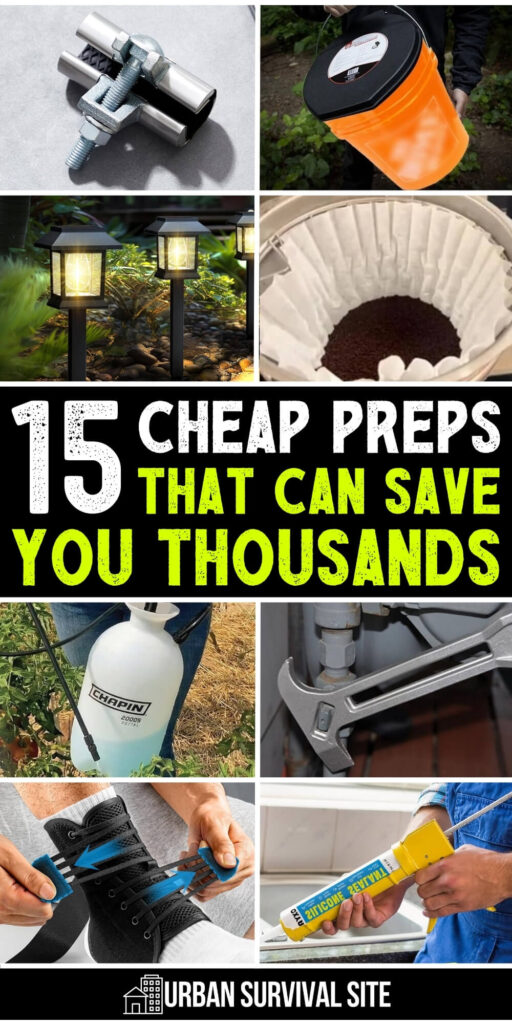
Browse any prepper forum or scroll through enough survival gear content online, and it won’t be long before you’re looking at $3,000 generators, $500 water filtration systems, and pre-made bug out bags that cost more than a month’s rent.
The prepping industry has a vested interest in making you feel completely helpless if you don’t have that one piece of survival gear, and that pressure pushes people to either spend way more than necessary or give up on preparedness altogether.
The truth is that many of the scenarios most likely to affect everyday people — things like burst pipes, long power outages, water supply disruptions, and minor injuries — can be mitigated with cheap, low-tech solutions. Being smart about preparedness means thinking in terms of ROI (return on investment): what’s the cheapest item that solves the most expensive problem?
Want to save this post for later? Click Here to Pin It On Pinterest!
In this video, J.R. from DIY Prepper TV talks about practical, overlooked items that deliver massive value when things go wrong. He covers 15 cheap preps that could literally save you thousands. You can watch the video and view his list below.
1. Pipe Repair Clamps
A burst pipe doesn’t just cost you the repair bill; it costs you everything the water damages on its way out. Flooring, drywall, insulation, and furniture can all be ruined in the time it takes to get a plumber on-site, and if that moisture lingers, mold removal can cost thousands more.
A pipe repair clamp is a simple sleeve device that you can slap over a burst or leaking pipe to temporarily stop the flow until a proper fix can be made. They’re inexpensive and easy to store, and you’ll be glad to have them if you ever need them.
If a pipe bursts and you can’t patch it immediately, the next best move is cutting off the water supply to your home entirely. Utility shutoff tools, which can shut off your water meter, gas line, or both, are what make that possible without calling anyone.
There are basic multi-use versions that handle both water and gas, and more heavy-duty dedicated water shutoff tools that will hold up better under real force. Having one stored near your emergency gear means that when something goes wrong at 2 a.m., you’re not standing in rising water waiting for help.
3. Caulk and Silicone
Caulk and silicone sealant pull double duty as both a prep-now and prep-for-later item. Right now, sealing up leaky windows can noticeably cut your energy costs. In an emergency, especially during a heavy rainstorm, they can seal gaps and prevent water from getting into your home and causing damage.
Keep a tube or two on hand and you’ve got a really cheap solution for a problem that can get expensive fast.
4. Deck Screws
This one serves two very different purposes. First, security: the screws that most builders use for door hinges and strike plates are short, shallow fasteners that won’t stand up to someone kicking in your door. Swapping them out for 3-inch or 3.5-inch deck screws drives the hardware all the way into the stud behind the door frame, making forced entry far more difficult.
Second, storm prep: if you live in a coastal or storm-prone area and you’re boarding up windows with plywood, screws are far superior to nails. They’re less likely to pull out during high winds, and when the storm passes, you can remove the boards with an impact driver without tearing up the wood, which means you can reuse those boards the next time around.
5. Ty-Rap Cable Ties (Heavy-Duty Zip Ties)
Standard zip ties are fine until they’re not. Exposure to UV and weather turns them brittle and causes the plastic locking tab to snap under stress. Ty-Rap style cable ties solve both of those problems with a stainless steel locking tab and a weather-stabilized band. They also use a textured grip rather than ratchet notches, giving you finer adjustment.
When something breaks and you need to rig a fix in a hurry, having ties you can actually trust makes a real difference.
6. Bucket Toilet Seat with Lid
In a long-term emergency, sanitation becomes a serious health concern. Poor waste management opens the door to diseases like dysentery and cholera that most people in the developed world don’t think about. History is full of examples of those diseases spreading rapidly through otherwise manageable disaster situations.
A bucket toilet lid converts a standard 5-gallon bucket into a covered field toilet. The lid matters more than you might think: it keeps odors contained and prevents insects from landing in the waste and then spreading contaminants around the house. It’s one of the cheapest items on this list and one of the most important for a long-term grid-down scenario.
7. Garden Sprayers
A garden sprayer is useful in a surprising number of ways. For sanitation, it can disinfect large surface areas quickly, which is a huge advantage if someone in your household gets sick and you need to decontaminate a room efficiently. For personal hygiene, the pressurized spray is strong enough to function as a field shower.
In the absence of toilet paper, a small sprayer filled with water works as a makeshift bidet, a common and effective practice in much of the world. The key is keeping dedicated, labeled sprayers for each use (pesticides, cleaning, personal hygiene) so there’s no cross-contamination.
8. Braces and Wraps
When you’re in a physically demanding emergency like bugging out on foot, working through a natural disaster, or doing manual labor without rest, minor sprains and joint injuries that you’d normally walk off can become serious liabilities. A sprain that gets no support and no rest in those conditions will keep getting worse.
A basic collection of ankle braces, wrist wraps, and elastic bandages is cheap, takes up almost no space, and can keep you functional through situations where stopping to heal simply isn’t an option.
9. Propane Bottle Refill Kit (Fuel Keg)
Those small green 1-pound propane canisters have gotten expensive, and once they’re empty, they’re garbage. A refillable system like the Fuel Keg kit changes the equation entirely. These kits usually run around $30, and the refillable tanks are a modest additional cost, but the tanks are purpose-built for repeated use, with reinforced construction and proper valves.
Over time, the savings stack up considerably compared to buying disposable canisters. If camp stoves are part of your cooking backup plan, this is a straightforward upgrade worth making.
10. Battery Spacers (D to AA Adapters)
D-cell batteries are expensive and hard to find during emergencies when everyone’s buying them at once, but a lot of emergency lighting gear runs on them. Battery spacers solve this by letting you run a AA battery in a device designed for a D cell.
The tradeoff is reduced runtime since a AA battery holds less capacity than a D, but the advantage is that you’re standardizing on a single battery format that’s cheaper, more available, and compatible with far more devices. These are specifically designed for use with rechargeable AA batteries, making them even more cost-effective in the long run.
11. Solar Pathway Lights
Solar pathway lights are usually sold in multipacks, which means you can pick up several light sources for less than the price of one decent flashlight. In normal times, they live outside as landscape lighting and charge themselves daily. When the power goes out, you bring them inside.
They won’t flood a room with light the way a lantern would, but they’re more than enough to navigate safely without running into things or resorting to candles, which start more house fires than most people realize. They run cool (no heat from LEDs), which matters in a summer outage, and there’s virtually nothing that can go wrong with them.
Not everyone can afford a generator, solar or otherwise. But most people have a vehicle sitting in the driveway, and that vehicle is essentially a mobile power source for small devices. If you keep a set of charging cables in your car, then even in a total grid-down scenario, you can maintain communication and access outside information as long as you have fuel.
If your car doesn’t have USB ports built in, a simple 12-volt to USB adapter handles that for a few dollars. It’s a minimal investment that keeps your most essential communication tools operational.
13. Stainless Steel Stock Pot
Most people can’t realistically store the volume of water needed for a true long-term emergency. A large stainless steel stock pot bridges that gap by giving you the ability to boil large quantities of water collected from natural sources. It also lets you cook large batches of soup, stew, beans, or rice in a single go, which is important when you’re feeding multiple people and trying to conserve fuel.
Stainless steel earns its place here because it’s compatible with virtually any heat source: glass-top stove, propane camp stove, rocket stove, or open campfire. That versatility matters when you don’t know exactly what conditions you’ll be cooking under.
14. Paper Plates and Plastic Utensils
Washing dishes takes more water than most people realize. In a water-scarce emergency, every gallon counts, and paper plates and disposable utensils eliminate dishwashing entirely.
This is especially important if your water storage runs lower than expected. Having a supply of disposable plates and utensils gives you a buffer and stretches what you have further. They’re cheap, and they make a real logistical difference when water is at a premium.
15. Coffee Filters
Coffee filters are an underrated prep that earn their place in a kit for at least three reasons. First, they act as a pre-filter for water from ponds, streams, puddles, and lakes, which is typically full of sediment and debris that will quickly clog a water filter. Running that water through a coffee filter first removes most of the large particles before they ever reach your main filter, which will extend its lifespan significantly.
Beyond water filtration, coffee filters work as disposable bowls or plates in a pinch, can be used to collect small foraged items like berries, and can even make storage pouches when tied off with a zip tie or bread tie. For a couple of dollars, the versatility of coffee filters is hard to beat.
Like this post? Don’t Forget to Pin It On Pinterest!
You May Also Like:

Read the full article here