
Summary and Key Points: The US Navy bought the New Mexico-class battleship USS Idaho (BB-42) from New York Shipbuilding for $7.25 million in 1914 and commissioned her in 1919, too late for World War I. Rebuilt at Norfolk in 1931-34, she carried twelve 14-inch guns from the Aleutians to Okinawa, earned seven battle stars and downed five kamikazes in a day, but never fired at another battleship. Carrier aircraft sank Yamato before they could meet. Lipsett scrapped her in 1947.
The USS Idaho US Navy Battleship Was a Real Powerhouse
The Navy awarded USS Idaho a $7.25 million fixed-price construction contract. The New Mexico-class battleship displaced 32,000 tons as designed, carried twelve 14-inch guns, and served for just over 27 years before leaving active duty in 1946.
The contract price is the cleanest construction number, but it doesn’t reflect the full economic cost. A 1925 congressional report documented nearly $1 million in government-directed wage increases, a $315,000 overtime claim, and about $700,000 in other losses absorbed by New York Shipbuilding as World War I disrupted labor and material assumptions.
Idaho measured 624 feet long, reached 97 feet 5 inches across the beam, and initially produced 32,000 shaft horsepower through four propeller shafts. Nine oil-fired boilers and four turbines gave the ship a top speed of 21 knots and an as-built range of roughly 8,000 nautical miles at 10 knots.
She earned seven World War II battle stars and fought from the Aleutians to Okinawa. She never fired at another battleship. Her closest chance came in April 1945, when American battleships prepared to meet Japan’s Yamato near Okinawa before carrier aircraft sank the Japanese ship.
The $7.25 Million Contract Built a Standard-Type Battleship
New York Shipbuilding constructed Idaho at Camden, New Jersey, after receiving the contract on November 9, 1914. Work began in 1915, the hull entered the water on June 30, 1917, and the Navy commissioned BB-42 on March 24, 1919. She arrived too late for combat in World War I.
Idaho belonged to the American standard-type battleship system, which gave several classes similar speed, turning characteristics, and armor principles. Her belt reached 13.5 inches around vital areas, turret faces measured 18 inches, and the armored deck reached 3.5 inches before later reinforcement.
Twelve 14-Inch Guns Produced an 18,000-Pound Broadside
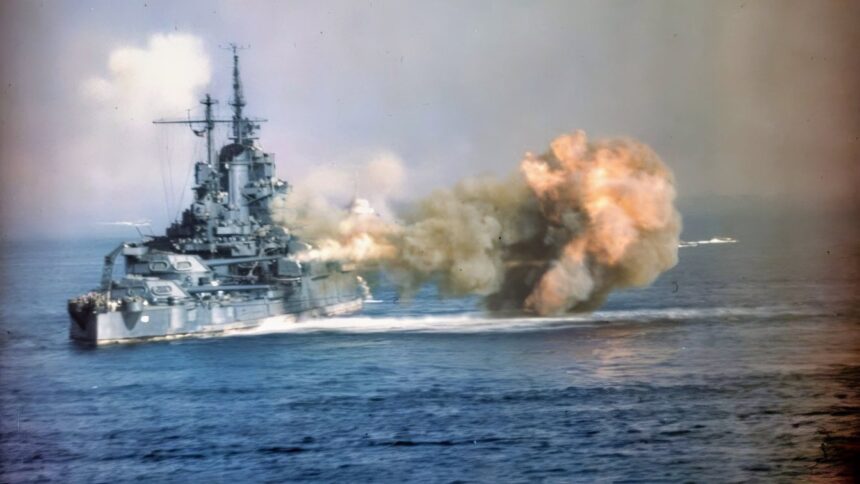
Four triple turrets held twelve 14-inch/50-caliber guns, with two turrets forward and two aft. Unlike earlier American triple mounts, each barrel elevated independently. By World War II, the heavy armor-piercing projectile weighed 1,500 pounds. Firing all twelve placed 18,000 pounds of armor-piercing steel in one broadside.
The guns were designed for surface combat, but Idaho used them mainly against islands, bunkers, and artillery positions. That transition also defined other older standard-type battleships used for shore bombardment. Carrier aircraft had taken over long-range fleet combat before Idaho entered service.
Modernization Added 8,000 Horsepower and More Than 3,000 Tons
A reconstruction at Norfolk between 1931 and 1934 substantially changed the ship. Six new boilers and Westinghouse geared turbines raised output to 40,000 shaft horsepower and top speed to 22 knots. The Navy increased the main guns’ elevation to 30 degrees, strengthened deck protection, improved underwater defenses and replaced the cage masts with a tower bridge and pole mast.
The work raised displacement to 33,420 long tons standard and 36,157 long tons fully loaded. Crew size grew to 1,443. A wartime refit added ten quadruple 40mm Bofors mounts and eventually 43 20mm Oerlikon guns. Late in 1944, Idaho received ten single 5-inch/38 dual-purpose guns, making her the only New Mexico-class ship with that secondary battery.
Seven Battle Stars Covered a Long Pacific Campaign
Idaho was stationed in Iceland when Japan attacked Pearl Harbor. She returned to the Pacific, trained through much of 1942, and reached her first combat zone in 1943. At Attu, she served as the bombardment force’s flagship and supported Army landings. She also covered the operation against Kiska, where American troops found the Japanese garrison had already withdrawn.
The battleship then shelled Makin in the Gilbert Islands, Kwajalein in the Marshalls, Japanese positions in the Marianas, and the defenses of Peleliu. In February 1945, her 14-inch guns supported the invasion of Iwo Jima. The seven battle stars awarded to Idaho represented campaign credits rather than seven isolated gun battles.
Her record reflected the broader changes in naval warfare. Battleships still delivered heavy fire near shore, but aircraft decided most encounters between major fleets. USS Mississippi, Idaho’s sister, fired a final salvo during the battleship action at Surigao Strait. Idaho never received the same opportunity.
Yamato Never Reached Idaho’s Battle Line
Idaho began bombarding Okinawa on March 25, 1945. On April 12, her anti-aircraft crews shot down five kamikazes during a mass attack. A near miss damaged the port-side anti-torpedo bulge, forcing temporary repairs and a short trip to Guam. She returned to the bombardment line on May 22.
When Yamato sailed toward Okinawa, Rear Admiral Morton Deyo prepared a force of older American battleships that included Idaho. The planned engagement would have placed her twelve 14-inch guns against Yamato’s nine 18.1-inch weapons. The Japanese battleship was destroyed by carrier aircraft on April 7, and the gun battle never occurred.
Twenty-Seven Years Ended at the Scrapyard
Idaho entered Tokyo Bay on August 27 with occupation troops and remained there for the surrender ceremony aboard USS Missouri on September 2. She reached Norfolk on October 16 and was decommissioned on July 3, 1946. Her service had lasted 27 years, three months, and nine days.
The Navy later returned the Idaho name to the fleet with a Virginia-class attack submarine, but BB-42 did not survive as a museum.
The Navy struck her from the register on September 16, 1947. Lipsett, Inc., bought the battleship for scrap on November 24 and dismantled the hull.
About the Author: Harry J. Kazianis
Harry J. Kazianis (@Grecianformula) was the former Senior Director of National Security Affairs at the Center for the National Interest (CFTNI), a foreign policy think tank founded by Richard Nixon based in Washington, DC. Harry has over a decade of experience in think tanks and national security publishing. His ideas have been published in the NY Times, The Washington Post, The Wall Street Journal, CNN, and many other outlets worldwide. He has held positions at CSIS, the Heritage Foundation, the University of Nottingham, and several other institutions related to national security research and studies. He is the former Executive Editor of the National Interest and the Diplomat. He holds a Master’s degree focusing on international affairs from Harvard University.