

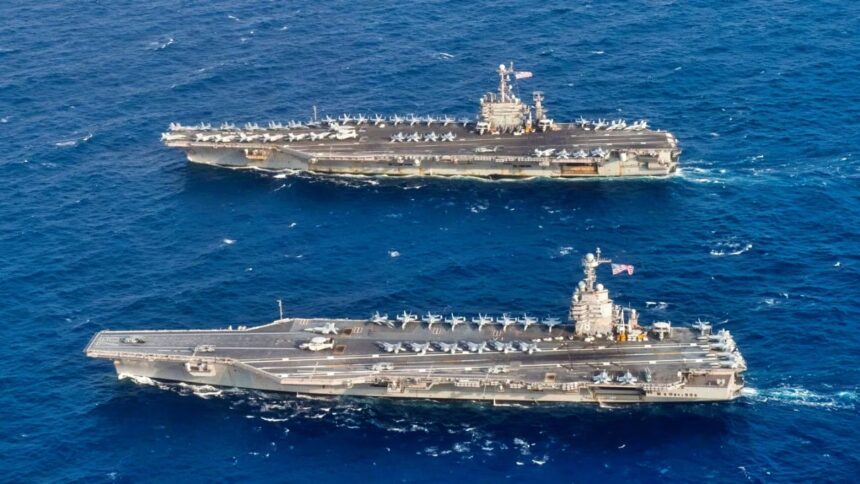
On paper, the USS Ford offers a substantial boost in capabilities compared with the older Nimitz-class ship it replaces.
But the ship’s extensive — and costly — teething issues meant the full promise of the Gerald R. Ford-class wasn’t yet realized.
Changes Between the USS Ford and USS Kennedy
One of the very concrete changes between the USS Gerald R. Ford and the USS John F. Kennedy was the steel and deck construction.
The USS Ford used thinner, and therefore lighter, deck and bulkhead plates than the Nimitz-class carrier that preceded it, a move taken to save weight and preserve future weight-growth margins.
In practice, however, the thinner steel was more difficult to handle during construction.
It required additional temporary bracing, more manipulation during construction, and additional reinforcement in areas that would experience higher loads during operations.
For the USS Kennedy, the design was altered to simplify construction.
Another aspect of the USS Kennedy that differs from the USS Ford is that a substantial portion of the ship’s construction was done in a modular fashion before the ship was more broadly assembled.
This decision allowed work on various parts of the ship before they were assembled within the hull, reducing man-hours by about five to ten percent compared with the USS Ford.
Perhaps one of the more significant changes to the USS Kennedy, however, was that ship’s radar. The USS Ford is outfitted with Dual Band Radar, SPY-3 Multi-Function Radar, and SPY-4 Volume Search Radar.
The world’s largest aircraft carrier, USS Gerald R. Ford (CVN 78), transits the Strait of Gibraltar, Oct. 1, 2025. Gerald R. Ford, a first-in-class aircraft carrier and deployed flagship of Carrier Strike Group Twelve, is on a scheduled deployment in the U.S. 6th Fleet area of operations to support the warfighting effectiveness, lethality and readiness of U.S. Naval Forces Europe-Africa, and defend U.S., Allied and partner interests in the region. (U.S. Navy photo by Mass Communication Specialist Seaman Apprentice Alyssa Joy)

NEWPORT NEWS, Va. (Oct. 25, 2019) USS Gerald R. Ford (CVN 78) gets underway for the first time since beginning its post-shakedown availability July 2018. Ford is currently conducting sea trials, a comprehensive test of the ship’s systems and technologies. (U.S. Navy photo by Mass Communication Specialist 3rd Class Connor Loessin)

A U.S. Sailor signals to an F/A-18F Super Hornet aircraft, attached to Strike Fighter Squadron 213, on the flight deck of the world’s largest aircraft carrier, Ford-class aircraft carrier USS Gerald R. Ford (CVN 78), while underway in the Caribbean Sea, Feb. 5, 2026. U.S. military forces are deployed to the Caribbean in support of the U.S. Southern Command mission, Department of War-directed operations, and the president’s priorities to disrupt illicit drug trafficking and protect the homeland. (U.S. Navy photo)
The USS Kennedy, by contrast, is outfitted with AN/SPY-6(V)3 Enterprise Air Surveillance Radar and accompanying radar systems.
The U.S. Navy decided the Dual Band Radar installation on the USS Ford was too expensive and too complicated for future Ford-class aircraft carriers.
Enterprise Air Surveillance Radar, and the U.S. Navy estimates that the move will save about $180 million compared to the radar costs of the USS Ford.
Integration with the F-35C was also advanced aboard the USS Kennedy.
The Navy originally envisioned a two-phase approach for the USS Kennedy, which would have delayed some systems.
Congress, however, required the USS Kennedy to be capable of operating the F-35C fighters before it finished its post-shakedown — in essence requiring the carrier to make substantial progress accommodating air wings before delivery rather than backfiring the capability.
Another less visible, but still substantial, change to the USS Kennedy was the U.S. Navy’s maturation of the ship’s Electromagnetic Aircraft Launch System, or EMALS.
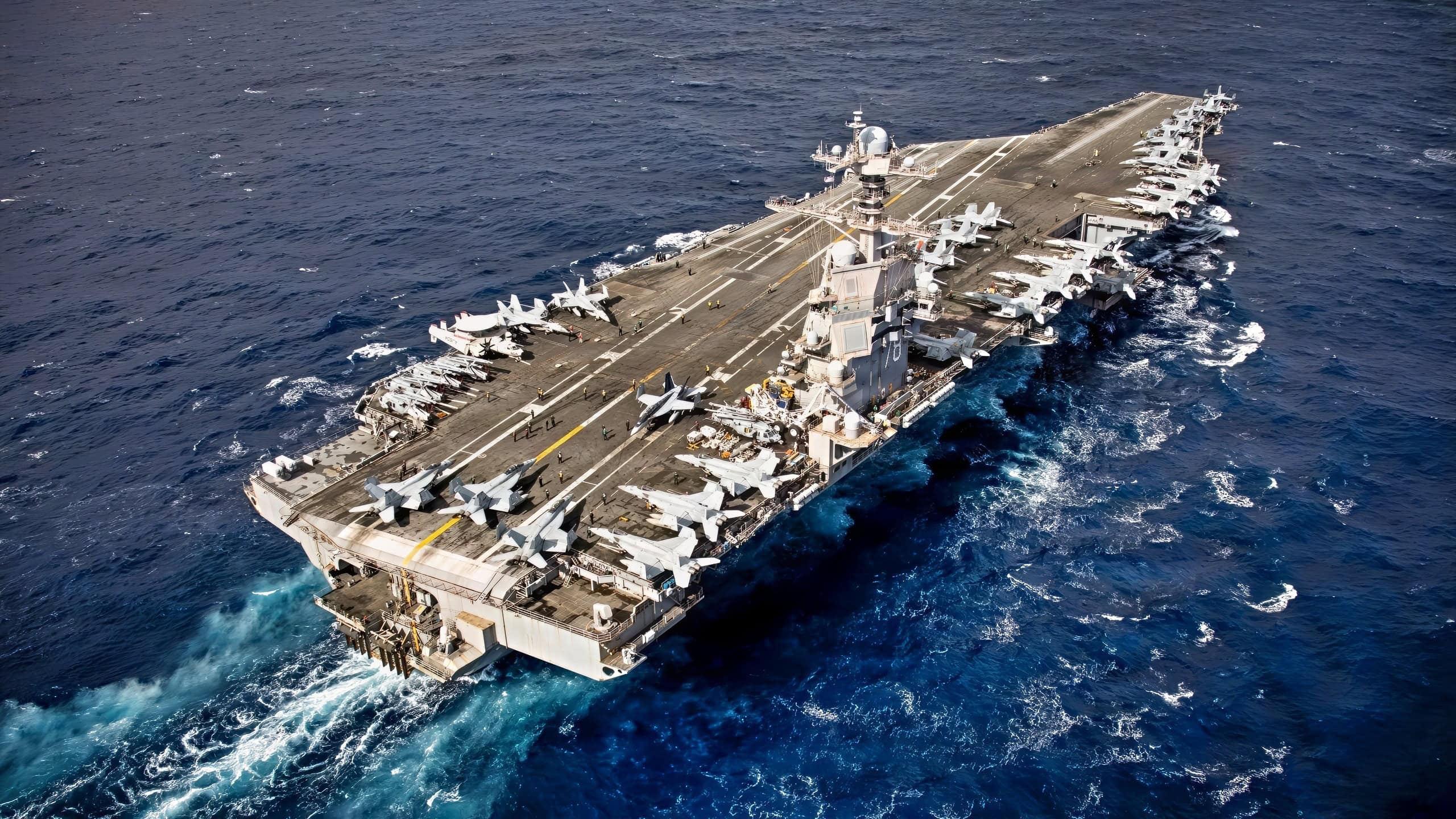
U.S. Sailors conduct routine flight deck operations on the flight deck of the world’s largest aircraft carrier, USS Gerald R. Ford (CVN 78), while underway in the Eastern Mediterranean Sea, March 22, 2026. Gerald R. Ford is on a scheduled deployment in the U.S. 6th Fleet area of operations to support the warfighting effectiveness, lethality and readiness of U.S. Naval Forces Europe Africa, and defend U.S., Allied and partner interests in the region. (U.S. Navy photo by Mass Communication Specialist 2nd Class Tajh Payne)
The system replaces the steam-powered catapults the U.S. Navy relied on for decades with a modern, electronically controlled aircraft launch system that can be tuned to various aircraft configurations, optimizing launch power for small, unmanned drones as well as much heavier, fully laden fighters.
But it experienced significant teething issues.
But the USS Kennedy’s EMALS systems incorporated engineering change proposals developed after the USS Ford’s construction, software upgrades, an altered testing regimen, and revised certification procedures, all of which reflected operational experience gleaned from the Ford’s development.
The class’ Advanced Arresting Gear, used to recover aircraft on the carrier’s deck, similarly experienced reliability and developmental issues on the USS Ford, which led the U.S. Navy to change how it integrated and used the AAG on the USS Kennedy.
However, that process was not entirely successful, and AAG certification on the USS John F. Kennedy delayed the carrier’s delivery.
One of the most troublesome pieces of new technology first integrated onto the USS Ford, however, was the class’ Advanced Weapons Elevators. These movers ferry ammunition and aircraft throughout the ship to the flight deck.
Design hiccups and installation issues during the USS Ford’s construction allowed the USS Kennedy to retain the Advanced Weapons Elevators originally intended in its design, while refining AWE construction, testing, and the certification process.
Despite the streamlining in the USS Kennedy’s design and construction, the ship still experienced delays.
One of the major reasons the ship’s delivery slipped from July 2025 to March 2027 was the USS Kennedy’s AAG certification and work on its Advanced Weapons Elevators.
And while the USS Kennedy was not without its own issues, work on the subsequent Ford-class carriers, the USS Enterprise and the USS Doris Miller, will ultimately benefit from lessons learned during the construction of both the USS Ford and USS Kennedy.
About the Author: Caleb Larson
Caleb Larson is an American multi-format journalist based in Berlin, Germany. His work covers the intersection of conflict and society, with a focus on American foreign policy and European security. He has reported from Germany, Russia, and the United States. Most recently, he covered the war in Ukraine, reporting extensively on the war’s shifting battle lines in the Donbas and writing on the war’s civilian and humanitarian toll. Previously, he worked as a Defense Reporter for POLITICO Europe. You can follow his latest work on X.