
Earlier this year, shortly before the start of Operation Epic Fury against Iran, reports emerged that the USS Gerald R. Ford aircraft carrier was experiencing clogging issues in its plumbing system.
The Ford-class, like many other vessels, uses a type of vacuum-based plumbing system called Vacuum Collection, Holding, and Transfer (VCHT). There are several advantages to the VCHT system: it is lighter, uses less water, and, on paper, requires less maintenance. However, as Ford so helpfully demonstrates, the system is also a mechanical nightmare, prone to constant malfunctions that can seriously hurt morale on the ship.
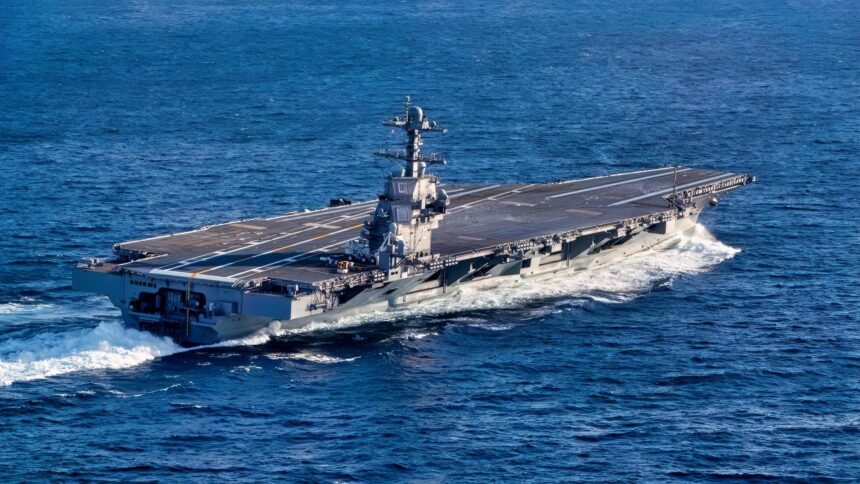
NEWPORT NEWS, Va. (April 8, 2017) – Pre-Commissioning Unit Gerald R. Ford (CVN 78) Sailors man the rails as the ship departs Huntington Ingalls Industries Newport News Shipbuilding for builder’s sea trials off the coast. The first- of-class ship—the first new U.S. aircraft carrier design in 40 years—will spend several days conducting builder’s sea trials, a comprehensive test of many of the ship’s key systems and technologies. (U.S. Navy photo by Chief Mass Communication Specialist Christopher Delano).
Why The Navy Adopted the Vacuum System to Begin With
Marine vacuum-based plumbing systems are used frequently on civilian cruise ships. The basic principle of a VCHT system is relatively straightforward.
When a toilet is flushed, a series of pumps creates a vacuum that rapidly pulls waste through a network of pipes toward the collection tank.
This system requires significantly less water than a conventional flushing system.
For this reason, the Navy likely decided to implement a VCHT system on its newest carriers.
Although modern carriers can produce freshwater from seawater using onboard desalination equipment, reducing water consumption still helped improve efficiency and ease the burden on the ship’s utility system.
For longer deployments, this means that water that would usually be reserved for sanitation can instead be used for drinking and cooking.
Furthermore, a VCHT system helps reduce the size of sewage piping required throughout the ship. Because vacuum pressure moves waste rather than large volumes of water, the system can use smaller pipes than a traditional plumbing system.
This has the advantage of saving weight and internal volume, which is always helpful on an aircraft carrier. In addition, the system offers greater routing flexibility.
Whereas gravity-based sewage systems rely on gravity, VCHT systems can transport waste through more complex pathways, thanks to their suction force.
This also helps free up more space on claustrophobic naval vessels. The ability to route sanitary piping around obstacles without relying on gravity is, at the very least, helpful to the ship’s designers.
Overly Complex and Prone to Clogging
That said, the VCHT system has drawbacks that have drawn heavy criticism, thanks to the experience aboard Ford.
While the basic concept of a vacuum-based system is relatively simple, the engineering required to operate such a system is anything but.
Unlike a gravity-based system, which relies heavily on gravity and large volumes of water, the vacuum system consists of 30 miles of specialized copper piping, along with pumping machinery, valves, and sensors to maintain proper operation.
If any of these components fail, large portions of the network can quickly become inoperable. Consequently, because the system relies so heavily on air pressure, even a small air leak can dramatically reduce its effectiveness.
As mentioned earlier, because the vacuum system uses less water, the sanitation pipes aboard Ford are much smaller than those of carriers that use traditional sewage systems.
The drawback to this system is that if a large enough foreign object is dropped into it, the VCHT might, in theory, experience a massive system-wide clog.
Unclogging a VCHT system requires engineers to manually breach and depressurize the system and usually involves applying some sort of acid flush.
If they don’t, or if maintenance is done incorrectly, the result is a “black water blowout,” where a pressurized geyser of raw sewage blasts into one of the ship’s passageways.
Obviously, avoiding these blowouts is a top priority for those involved, but because of the system’s finicky nature, clogs in a vacuum system are unfortunately unavoidable.
A Disaster Waiting to Happen
As far back as 2020, the U.S. Government Accountability Office (GAO) sounded the alarm on potential issues with the Ford-class’s VCHT systems.
The report noted that the system was poorly designed for use aboard a ship the size of an aircraft carrier and that the pipes were too small for the level of use it was expected to support.
Other naval vessels, such as the Nimitz-class USS George H.W. Bush, the Seawolf-class submarines, and other types of surface ships, use similar vacuum-based systems and have experienced similar clogging issues.
Because the Navy was either unable or unwilling to address the known issues when implementing them on the Ford-class, Ford garnered significant media attention when her plumbing systems inevitably failed.
According to some reports, however, maintenance crews found that a number of foreign objects, such as shirts, wipes, and other large items, had been flushed into the system, which likely explains why it failed as catastrophically as it did. Some have suspected deliberate sabotage by one or more sailors.
By that point, Ford’s deployment had been extended multiple times, and crew morale was already plummeting.
About the Author: Isaac Seitz
Isaac Seitz, a Defense Columnist, graduated from Patrick Henry College’s Strategic Intelligence and National Security program. He has also studied Russian at Middlebury Language Schools and has worked as an intelligence Analyst in the private sector.