
Boeing Gets the F/A-XX Contract and Releases Some Amazing Renderings – The United States Navy has awarded the contract for its F/A-XX sixth-generation stealth warplane to Boeing.
These planes are meant to replace the Navy’s aging F/A-18E/F Super Hornet starting within the next decade.
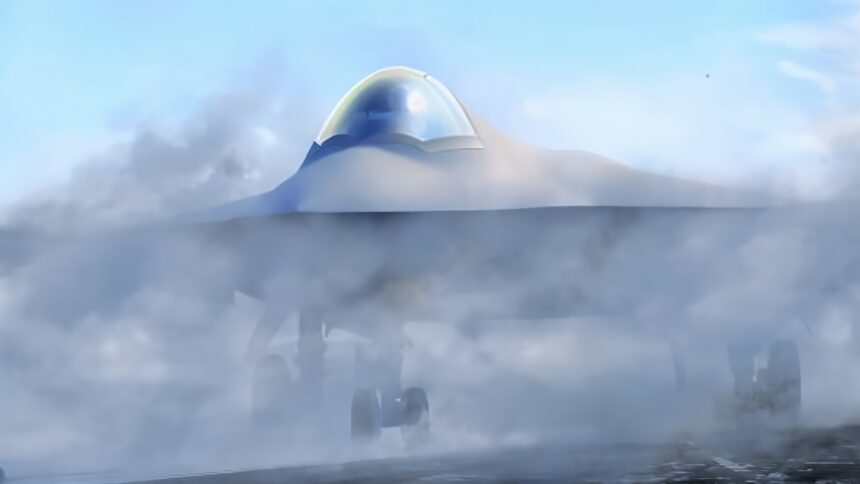
F/A-XX NG Photo. Image Credit: Northrop Grumman.
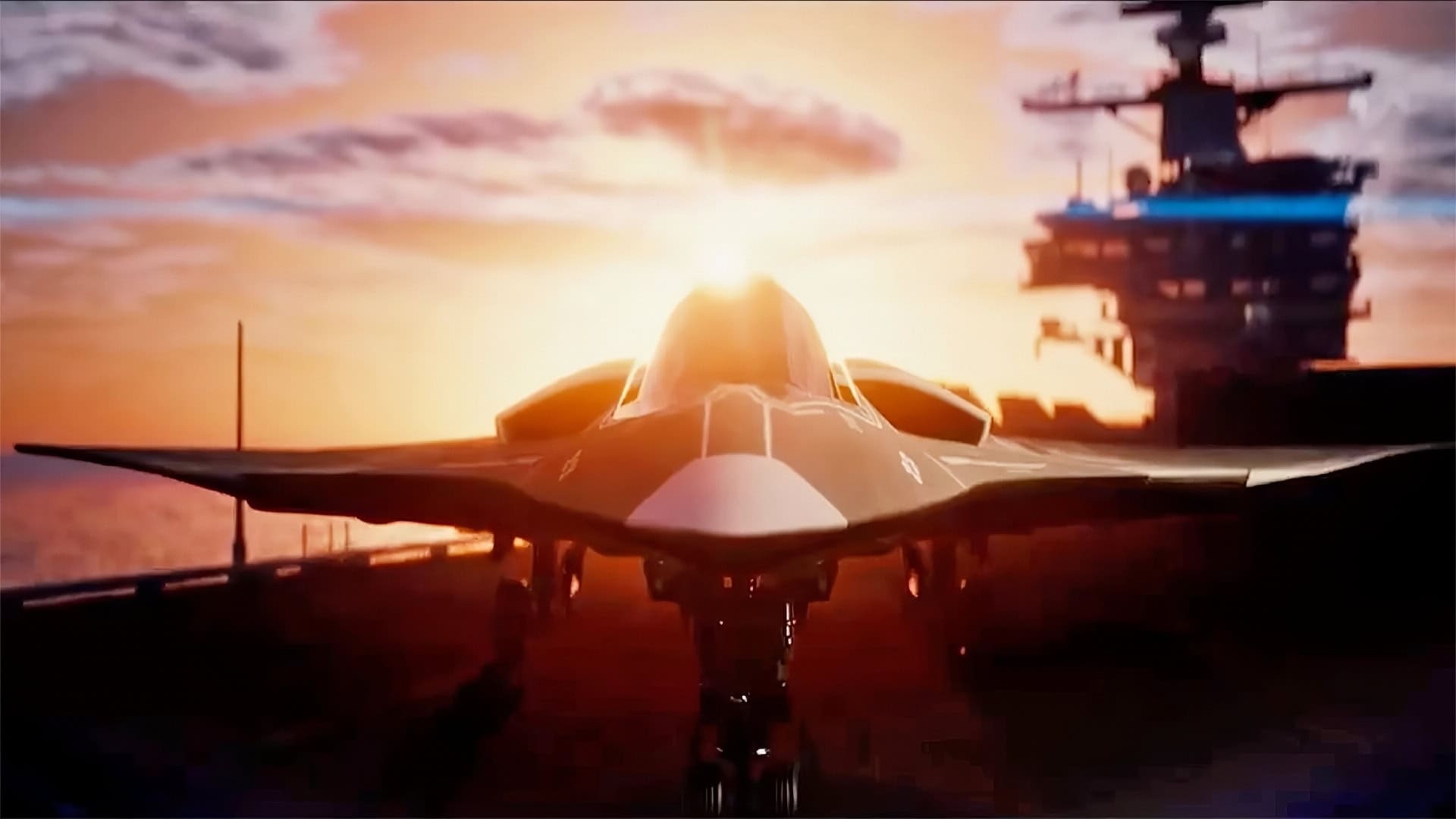
FA-XX Fighter Video Screenshot. Image Credit: NG Video Screencap.
But Boeing’s selection shouldn’t be all that surprising. After all, Boeing was already selected to build the Air Force’s F-47.
Boeing is the Exclusive Contractor for America’s Sixth-Generation Warplanes
Another reason this selection was unsurprising was that the Pentagon previously entrusted Lockheed Martin with both of its fifth-generation stealth warplanes — the F-22 Raptor and the F-35 Lightning II. Of course, multiple defense contractors can build warplanes for the Air Force and Navy.
There’s no reason why Boeing had to build both sixth-generation planes.
Northrop Grumman, for example, builds America’s long-range stealth bombers. As noted, Lockheed has decades of experience building the F-22 and F-35 stealth warplanes.
But the defense contracting system doesn’t work precisely like a free market.
It’s a relatively closed market that allows competition among a handful of contractors, but the government oversees that competition.
This goes back to the formation of the military-industrial complex and the rationale behind the government’s desire to reduce the defense market’s freedom in favor of what amounts to central planning.
The logic is that the Pentagon wants to ensure that its primary contractors have baseline capabilities.
If the military started favoring firms that already built other critical stealth warplanes, such as Lockheed or even Northrop, while leaving others–Boeing, in this case–out of the loop, then there’d be a capabilities gap between the companies.
Fewer firms would reliably compete for stealth contracts over time.
In fact, one could argue the Pentagon chose Boeing to avoid accusations that Lockheed or Northrop was monopolizing stealth contracts.
The Rendering
Boeing just released the firm’s F/A-XX rendering. You can see that photo at the very top of this article.
According to a breaking analysis by Tyler Rogoway at The War Zone, a popular online trade publication, the carrier-based sixth-generation stealth warplane appears to be massive.
It has broad wings and is tailless.
What’s more, the plane appears to have enormous internal volume.
That last bit is key, considering the F/A-XX will likely be used in a confrontation against the People’s Republic of China (PRC), which has developed one of the most advanced, comprehensive anti-access/aread-denial (A2/AD) networks in the world that US warplanes would need to penetrate.
Because of that A2/AD network, US Navy aircraft carriers would likely be forced to operate much farther over the horizon than in previous wars, meaning the planes those carriers launch will need to fly farther to do combat missions.
Hence, the F/A-XX needs a greater fuel load. These new planes will also need significant weapons-carrying capacity.
The supposition has always been that the Navy’s F/A-XX would need to be more than an augmented Super Hornet. It’d need to be more like a long-range, penetrating bird that just so happens to be deployed from a US aircraft carrier.
Getting a Read on the Bird
Per the renderings Boeing released, the F/A-XX will be a single-seater, like the F-35C and the Super Hornet.
Those who remember the iconic Top Gun film with Tom Cruise will remember the Navy planes of those days: the two-seat Grumman F-14 Tomcat.
Boeing went with the single-seat configuration. In other words, the second seat that would have theoretically been used to control drone swarms operating in tandem with the F/A-XX will not be there. Instead, Boeing likely intends to rely entirely on drone automation to compensate for the lack of a weapons systems officer.
Analysts are getting hung up on the broad fuselage shown in the rendering.
To fit inside an aircraft carrier, planes need special design. Space is especially cramped. So, why the broader fuselage? One theory is an enlarged radar aperture.
A larger nose than its predecessors, for example, might indicate a larger aperture for the plane’s AESA radar, ensuring the F/A-XX has considerable sensor capability.
Another important aspect of the F/A-XX is its landing gear. To land on a carrier, a plane needs to be specially fitted for hard landings that require an immediate reduction in speed (lest the plane fall off the deck). One interesting feature of the F/A-XX is the main landing gear with twin-wheel nose gear. That’s some serious reinforcement. In other words, the F/A-XX is likely a very heavy aircraft.
This is another indicator that the Navy favors long-range operations over agile, short-range operations.
TWZ points out how the wings on Boeing’s proposed F/A-XX are angled upward. It is very much like the wing design of the Air Force’s F-47. Tyler Rogoway is right to highlight how the design directly links to the Boeing Bird of Prey stealth demonstrator from the 1990s.
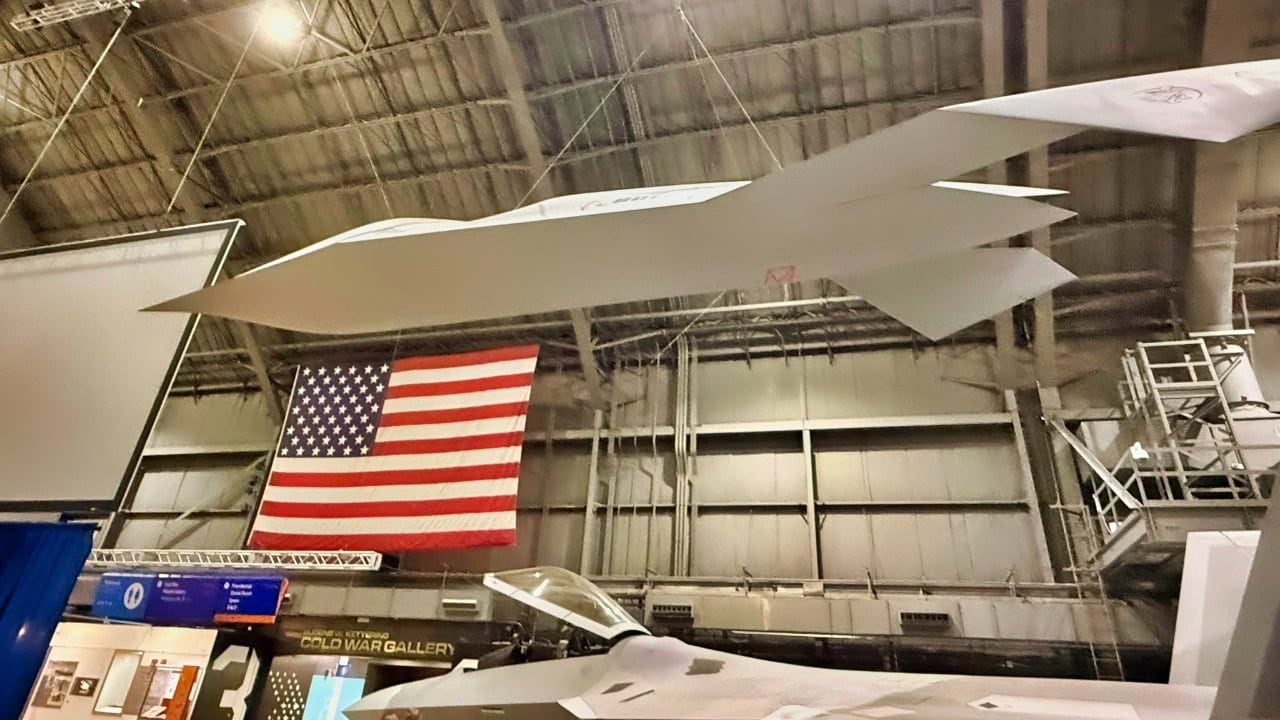
YF-118G. Image taken by Harry J. Kazianis for 19FortyFive.
Of course, there are some benefits to keeping both primary sixth-generation warplane projects inside the Boeing family. Theoretically, the firm could create interesting overlap in both the planes’ design and the underlying software that runs them. The two planes could share sensors and other manufacturing approaches, saving the taxpayer money and increasing efficiency.
No Canards?
Earlier speculation about the F/A-XX suggested the proposed plane would have canards. The recently released rendering does not show canards. Of course, canards can reduce the plane’s all-important stealth.
But the presence of canards–on a plane lacking a traditional tail–could help pilots better control the F/A-XX as it flew at low speeds, such as when the plane came in for what are inherently dangerous landings on carrier flight decks.
Then again, these are renderings of a classified system. It might be intentionally misleading.
Back in the Cold War, aircraft carriers needed to launch long-range fighter interceptors to protect carrier battle groups from Soviet bombers and anti-ship ballistic missiles. After the F-14s were retired, the Super Hornets took over the main mission: protecting carriers from enemy fire and striking anywhere in the world.
With the advent of advanced A2/AD, however, the Navy requires planes that are longer-range, heavier, stealthier, and more automated than ever before (or at least more closely integrated with automated systems.
F/A-XX appears to accomplish that last part especially well, given the sheer volume of the vehicle featured in Boeing’s new rendering.
About the Author: Brandon J. Weichert
Brandon J. Weichert is the Senior National Security Editor at 19FortyFive.com. He also manages The Weichert Brief on Substack. Weichert also hosts “National Security Talk” on Rumble. He is the author of four bestselling national security books, most recently A Disaster of Our Own Making: How the West Lost Ukraine (Encounter Books). Follow him via Twitter/X @WeTheBrandon.