

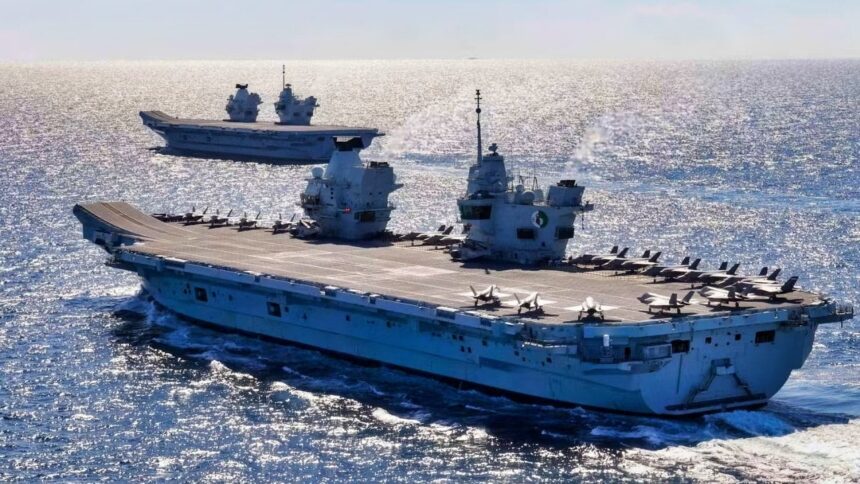
The Royal Navy’s Queen Elizabeth-class was developed to address a fairly simple strategic issue. By the late 1990s, the Royal Navy was facing the retirement of the Invincible-class and did not want Britain to lose its fixed-wing carrier aviation completely once that class left service. To fill that gap, the Royal Navy needed a larger warship designed to expand its capabilities and restore a more ambitious kind of carrier strike—one that could project formidable airpower worldwide, independent of foreign airfields.
The 1998 Strategic Defense Review spelled out that need, arguing that carriers were valuable because they offered offensive airpower, flexibility across a wide range of aircraft, and the ability to operate independently.
That review concluded that a pair of warships could replace the Invincible-class, provided they were somewhat larger.
To that end, the planned Invincible-class replacement warships would have a displacement of roughly 30,000 to 40,000 tons and an aircraft complement of about 50 aircraft, including helicopters.
What the Queen Elizabeth-class Replaced
The Queen Elizabeth-class would ultimately replace the three Invincible-class carriers — HMS Invincible, HMS Illustrious, and HMS Ark Royal.
Those three ships gave the Royal Navy a compact aircraft carrier capability, but they were significantly smaller in deck size and hangar space and, consequently, could host fewer aircraft than their much larger counterparts in the United States Navy.
Though useful as light aircraft carriers and as platforms for helicopters conducting anti-submarine warfare, the Invincibles were too small to sustain the kind of air wing and sortie rates that other nations could maintain.
Why the Royal Navy Wanted the Queen Elizabeth-class
The United Kingdom, via the Royal Navy, had long relied on seaborne air power to respond to crises. And in the post-Cold War era, that mission took on new importance.
Queen Elizabeth-Class Aircraft Carrier Deck. Image Credit: Creative Commons.
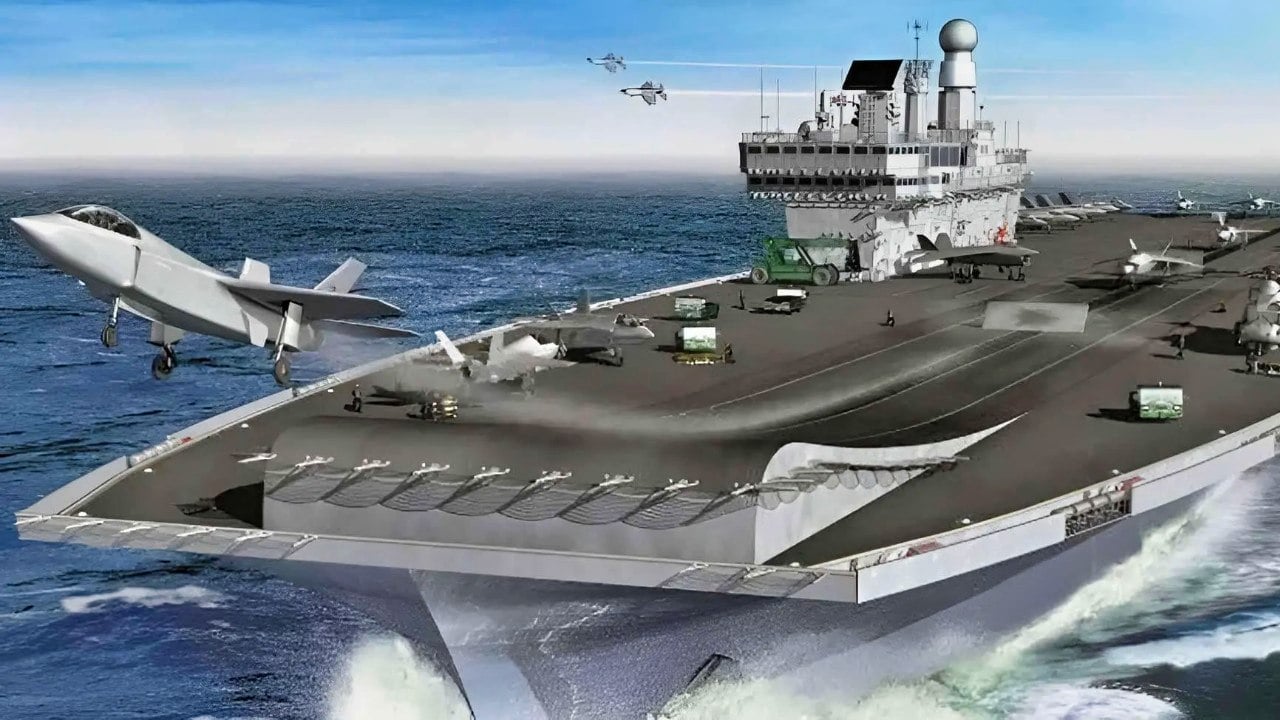
Queen Elizabeth-Class Aircraft Carrier Artist Rendering.
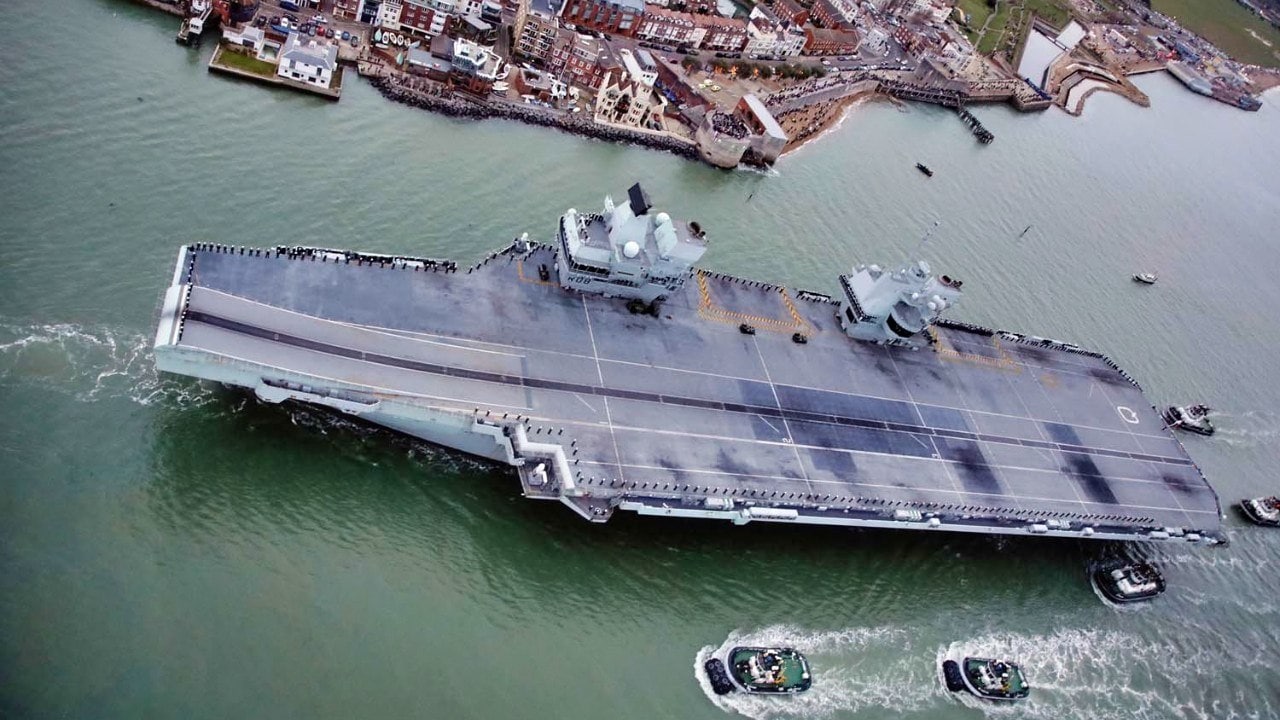
HMS Queen Elizabeth Aircraft Carrier. Image Credit: Royal Navy.
Though the prestige of operating aircraft certainly mattered to a country with a deep, rich naval tradition, the necessity and utility of operating a carrier fleet also mattered.
But a doctrinal and industrial argument also supported a new class of aircraft carriers.
The 1998 review and subsequent work showed that Britain could build two large aircraft carriers capable of accommodating a wide variety of aircraft and remaining adaptable enough to withstand future aircraft and doctrinal shifts.
The proposed adaptability of the Queen Elizabeth-class mattered because the Royal Navy was moving toward a world in which carrier aviation had to fit into a joint expeditionary model of warfare, not just the Cold War-era doctrine of fleet defense.
The Wide Angle View
The Queen Elizabeth-class was, in a way, a return to a previous Royal Navy proposal.
During the 1960s, the Royal Navy canceled of proposed aircraft carrier class, provisionally dubbed CVA-01.
That class of flattop would have created a much larger fleet carrier force for the Royal Navy, but rising costs and inter-service rivalry canceled it, ultimately leaving the Royal Navy with a fleet of smaller aircraft carriers.
The Queen Elizabeth-class is therefore a kind of belated recovery of some of that earlier proposed capability, but on a more politically assured and affordable platform.
By the late 1990s, the question was not whether the Royal Navy needed aircraft carriers, but what kind of carriers it would add.
The answer settled on a pair of warships large enough to make fixed-wing aviation credible, but modest enough to survive Treasury scrutiny.
In essence, the Queen Elizabeth-class was shaped by a desire to restore Britain’s carrier strike role, tempered by the realities of politics and procurement, as well as associated costs.
What Changed Later, and the Aftermath
One important caveat is how the Queen Elizabeth-class design evolved once the class was settled.
Early plans envisaged a more complex aircraft carrier equipped with catapults and arresting gear.
But the design eventually settled on the STOVL path that was suitable for the F-35B.
Though the question is now settled, it was a costly one, and the flip-flop would add billions to the final price tag for the Queen Elizabeth-class.
Though now in service and, on paper, more operationally capable than their predecessors, the Queen Elizabeth-class has been far from problem-free.
A number of issues related to construction and build quality have led to costly repairs and retrofits.
Quality-of-life concerns have emerged since they entered service as well, underscoring the importance of not only having a schematic — but also implementing it correctly.
About the Author: Caleb Larson
Caleb Larson is an American multiformat journalist based in Berlin, Germany. His work covers the intersection of conflict and society, focusing on American foreign policy and European security. He has reported from Germany, Russia, and the United States. Most recently, he covered the war in Ukraine, reporting extensively on the war’s shifting battle lines in the Donbas and writing on the war’s civilian and humanitarian toll. Previously, he worked as a Defense Reporter for POLITICO Europe. You can follow his latest work on X.