
In Alaska we have the high cost of living beaten because we can live off the land. With a home canning outfit and a cold-storage locker it is possible to have a well-stocked larder high in food calories but low in cost. When it is also possible to fill these containers in the pursuit of the greatest of all sports, fishing and hunting, one has achieved a very desirable state.
I bore down heavily on the “full locker” part of this combination in convincing my wife we should move from the States to Ketchikan. I considered it wisest not to stress the sport involved.
Beth has never entertained a very high regard for my ability to provide a bit of game for the bubbling pot. Because of its scarcity in the sections of the States we have called “home,” she has developed the rather prosaic viewpoint that meat comes cheaper out of a butcher shop than from a sporting-goods store.
For three years, while in uniform, I had traveled around Alaska, and was amazed at the great variety of her waters and the immensity of her vast forests. I had seen a sportsman towing a halibut that was too big to haul into his skiff. In any of the modern little cities of southeastern Alaska it was not at all uncommon to see a red-hatted hunter strolling nonchalantly down the main drag, with a drawn deer astride his back in a rather intimate embrace. Game and seafood were regular items on the menus of the many homes I visited.
About the time we were all enjoying the illusion that the end of hostilities was the end of the war I had a stroke of good luck. A resourceful Canadian had built a float house that was of great value to him in living off the land. As a hunter, fisherman, trapper, or logger acting according to the season or his inclination he could move his home to the location that best suited his current activity. Hearing that this ingenious individual would soon have to go “Outside,” I called on him. After considerable bargaining he agreed to part with his modern Ark for but little more than twice its actual value.
This broke down the last of Beth’s objections to the trek north. We could not only laugh at the High Cost of Living, I told her, but we could jeer at his sinister buddy, the Housing Shortage.
Along with our floating palace we fell heir to a full cold-storage locker and the simple instructions necessary to keep it full. “Venison is the main thing,” the Canadian told me. “I’m leaving you some moose, bear, and goat, but mostly deer. You can eat it jist like you eat beef, every day. And they’re the easiest to git.” Then he added: “But don’t run your damn-fool legs off. Jist take this deer call; git set comfortable on a trail near the beach and call the deer to you. All you have to do is knock him over and you have your winter’s meat right beside your skiff. Nothing to it! Of course, you can piece out with fish, clams, crabs, abalones, rock oysters, or ducks and geese. You can pick wild berries or green things like goose tongue, but the main thing is venison.”
I’m the kind of sucker that falls for anything I want to believe. Listening to that backwoods salesman, I most certainly came to believe I had at last found the Promised Land.
“You can eat venison jist like it was beef,” he had said, and we found that part of his sales talk to be true. The flesh of the Sitkan black-tail deer, the native in this district, is delicious and never tires one’s palate. It does not have that strong gamy taste of its larger stateside cousins. We proceeded to eat our locker empty of it before any other item was exhausted.
“Next fall, good wife,” I rashly promised, “we’ll have four nice fat bucks put away. We are allowed two apiece, and they are so easy to get we’ll just pick out young ones in the best of condition.”
Beth has a way of looking at me that is much more effective than any combination of words could ever be. She let it ride, however, and suggested we turn our attention to seafood, which was in season.
This called for the purchase of a rowboat, which is the only key needed for the lock nature has placed on the resources of the Alexander Archipelago. We fished with astonishing and very satisfying results; we went clamming and crabbing; we explored a few of the bays and inlets that make the country a wonderland of scenic beauty.
The forests that cover most of the mountainsides comprising the Panhandle of Alaska have few deciduous trees. They have a sly habit of letting fall slip up on one without any warning flags of changing reds and yellows. I was totally unprepared for the morning that Beth dug out my old red hat and said, “Well, Robin Hood, how about those four fat deer? Are you going to take your bow and arrow or do you think it will pay to waste gunpowder on the dumb brutes?”
The first day was rather unsatisfactory. It was raining, a not unusual occurrence, and when I attempted to “git set comfortable,” according to instructions, I couldn’t find a dry thing to set on. I finally conceived the brilliant idea of using my gunstock for a seat, and a big spruce for a backrest. My restricted view included a small section of a well-traveled deer trail. I was fairly dry and comfortable; so much so that after I tired of blowing the deer call I dozed off.
A terrifying noise awakened me. In the deep silence of heavy woods, broken only by the sound of leaking foliage, any sound is startlingly loud. The alarm sounded by a surprised deer, under such circumstances, defies description. Then, when I realized I was staring a buck in the eye at twenty paces, I couldn’t find my gun. I had never been in a like situation, nor had I ever heard of a buck charging a prostrate, unarmed man, but I was under the impression that such a thing was about to take place. And while the Sitkan deer is small, this one to my sleep-dazed eyes looked the size of an elk. In whirling to put the spruce between me and those wildly tossing antlers, I discovered, or rather uncovered, my gun. But I never had a chance to use it. That deer danced around at right angles to the trail and, without any more sound than a seal diving, he disappeared into brush so thick I had to get down on all fours to crawl through.
In jungle like that my long-barreled .32 Special was useless. If it were possible to overtake any animal the encounter could be settled only in the classic Roman-gladiator style. Having had very little training in that type of combat I was more concerned about finding the beach and my skiff than in tracking down an adversary. It was dark when I succeeded.
Well, I went back to see if I could get another chance under more dignified circumstances at the prancing buck, but evidently he had declared that particular trail off limits. From September 1 to October 1, I tried the stand every time I went out, but I never saw another deer on it.
There was still a month and a half of the season left but I was becoming discouraged. Beth suggested I take the matter up with a neighbor who had brought home his limit the first day of the season. He was a cantankerous old sourdough known, for reasons I have never been able to learn, as Fresh Water Johnny. The only time I was ever able to get a civil word out of him was when he was slightly under the influence, so I invested in a bottle and shanghaied him in to dinner.
Thanks to Beth’s excellent culinary efforts he mellowed up a bit and, in a moment of weakness, consented to take me out. He was very confident and painfully frank.
“I’ll show you plenty of deer,” he belched, “but you’ll have to do your own shooting. I’ve got mine and I don’t go for a man taking more than his limit. They’s too many dang cheechakos coming in and shooting everything in sight, limit or no limit!”
I agreed with him heartily, feeling that while I might be a greenhorn, I couldn’t, even yet, qualify for the category of tenderfoot he had in mind. Except to sight it in, I had yet to fire my piece. The following week-end Johnny made his promise good. His technique brought results in the first hour and continued to do so all day. He would walk along the beach until he found a good game trail leading up through the strip of big timber that usually skirts the salt water. I learned to describe any passable opening through these almost impenetrable forests as a trail; a “good” trail is one that permits a man to travel in an upright position over brief stretches.
Johnny’s trails would branch out in the first muskeg flat above the big trees. Muskeg seems to be the Alaska version of swamp. Cheechakos often refer to it as tundra, much to the disgust of sourdoughs. In dry weather it is a springy mass of moss, roots, and decayed vegetation; when wet, it becomes a sponge without bottom. After the fall rains start, the water stands in dark brown pools that always seem to be between where you are and where you want to be. Around the pools several varieties of tough, knee-high, evergreen shrubs grow. The higher outcroppings are bare rock and around them are larger shrubs, bull pines, or stunted cedars that afford natural cover for wildlife.
After what seemed to me a very casual survey Johnny would say, “Try that brush over there.”
Five times that day he pointed out likely cover and every time he did I jumped deer; sometimes one, sometimes several, but not one of them had horns. The first four times he had me work the brush well, thinking a buck would be close by. The fifth time he growled, “Just like I told you. Shot out. They’s getting to be too dang many people in this country.” I was elated at having seen more deer in one day than I had previously seen in a month. Refusing to take offense, and with the help of another bottle, I had Johnny in a talkative mood by the time we’d rowed home. He even grudgingly admitted that—considering the number of young deer we had seen with the does—there might still be a few bucks “higher up.”
All through October I hunted alone, sometimes on the beaches, sometimes higher up. I worked out ideas of my own without success. And then I had a break: it snowed.
I was on a fresh trail by daylight. It meandered aimlessly in and out of cover where the walking was easy. In no time at all I came upon steaming droppings; also, to my disgust, I came upon a hunter’s tracks following the trail. Anxious to be in on the kill, at least, I speeded up. To my amazement I soon saw that two sets of prints were following the fresh trail.
It was then I began talking to myself. “Hold everything,” I said, aware of the truth yet ashamed to admit it. I had heard the old story often enough but never believed until that moment that it could really happen.
“These prints look very much alike,” said I to myself. “Let’s try them on for size.”
My pac fitted exactly; the prints were mine. I had been playing ring-around-a-rosy and the game was supposed to be hide-and-seek. The shock was too much for me. I hate to admit it but I gave up: just turned around and went home. I had reached the breaking point and was no longer safe running loose with a deadly weapon in my hands.
Beth never said a word. That empty locker was assuming a great deal of significance.
The morning of the last day of the season she was up and had a hearty breakfast ready before daylight. My hunting gear was all laid out. “I knew you’d want to get an early start,” she said.
To tell the truth, a start at hunting—early or late—was the last thing I wanted that morning. But when a fellow has made his brag, what can he do?
I bundled up and went out in the rain. And how it was raining! Usually it tapers off in the daytime. This time it reversed the procedure. It rained so hard that by the time I had rowed to Gravina every trail was a roaring rapids. I stood under a dripping cedar and gave myself a pep talk. It must have been a good one because I eased out of my cover and began casting about for sign. The rain had softened up everything. I could damn near see my own footprints on bare rock.
Fresh tracks showed where several good-size deer had been down to the beach and headed back for the muskeg. The trail was easy to follow, for they were sinking into muck up to their knees. They went straight across the first muskeg flat and up a bare rise, where I lost the trail. It became visible again where they’d milled around before heading up toward the second flat. I figured they were watching their back trail and had been spooked by me. This time I circled, attempting to get above them. The going was getting rougher—steep, with heavy brush and no footing. And, of course, it was miserably wet.
When I broke out into a little deer meadow I was too late. They were still going straight up. For the first time that day I began to feel the thrill of the chase. I was on the trail of something a little bigger and a little smarter than anything I had yet followed. But the pattern was wrong! Ordinarily the trails would circle leisurely back to the point of beginning. There was something strange about this unusual behavior, and strangest of all was the feeling that I had a chance.
The muskeg was left behind, nothing but wooded mountainside ahead. High above I could see a bare knoll that was the last ridge before the main divide. As I started a big circle to reach it I recalled the Canadian’s advice, “Don’t run your damn-fool legs off!”
I thought of that often as I fought through the last mile of devil’s-club, huckleberry bushes, down timber, old slides, and rotten logs. But somehow I kept on going. It was late afternoon when I worked around to the upper side of the knob. My heart was pounding. I hadn’t stopped to eat my lunch. With my goal in sight I was dazed by fatigue. Then I slipped and fell face-down in a pool that tasted like a compound of blood, sweat, and rain water. My damn-fool legs were refusing to obey orders. I wasn’t a cheechako or a tenderfoot—I was just plain old Rubberlegs. And I didn’t know yet if my playmates were below me or still going up and up.
The bare knob consisted of large, irregular slabs of rock that offered ideal concealment. I accepted the offer, creeping in among them like a drunken husband returning home at 4 a.m.
Miles below me, in the rain and haze, Tongass Narrows looked like a misplaced horizon. On my belly now, I inched over to a rock that would command the slope below. And there was the sight I had been hunting two and a half months for! It was worth it.
Out in the open, above two does and a half-grown fawn, stood a magnificent buck. He was watching something below him but I think he’d got a whiff of me because he was very uneasy. Man, what a picture! Every movement was grace and beauty as he whistled and pranced. With a solid rock rest, my sights lined up perfectly at a scant twenty-five-yard range. All fatigue had vanished. I felt wonderful but I couldn’t pull the trigger. Such magnificence was not to be destroyed by me.
I thought of the empty locker. I thought of Fresh Water Johnny’s parting shot, “They ain’t much to it: you jist have to be smarter than the deer.” I thought of all the times I had returned home empty-handed. But it was no go—I could not shoot. Then I thought of Beth. I thought of the way she looked at me when she didn’t say a word. And then I applied the necessary pressure to the trigger.
The effect was startling. I had not made quite enough allowance for the steep downhill shot. Squeezed off at dead center of the head, the bullet struck the base of the antlers, which seemed to explode into the air. The big fellow crumpled. Quickly I chambered another cartridge. And then the most surprising event of a most eventful day happened. A smaller buck broke out of the brush and headed full bore directly at me!
As he sighted the does making off at right angles he whirled. This time I made the proper allowance and drilled him cleanly. He made two jumps and fell across the legs of his late rival.
The first buck was so large he looked like another species, rather than a Sitkan, and dressed out at 153 pounds. The smaller one went just over 100.
A lot of meat, even when it comes in one chunk that a man can get his shoulder under! When it’s in two units, both equipped with dangling heads and legs, the transportation problem becomes a major one.
I had been instructed how to pack one buck in the straddle position, but had no idea of how to handle two. It was one of the many interesting things I was to learn before another day dawned.
First I tried packing one carcass and dragging the other, with my rifle slung across my chest. It worked. The little fellow on my back bowed me over; I heaved mightily on the larger one. He came willingly, hit me back of the knees, and we took off. The homeward flight was under way. As we bounced off rocks, pushed aside trees, and crashed through brush I was pleased to note we were headed in the right direction.
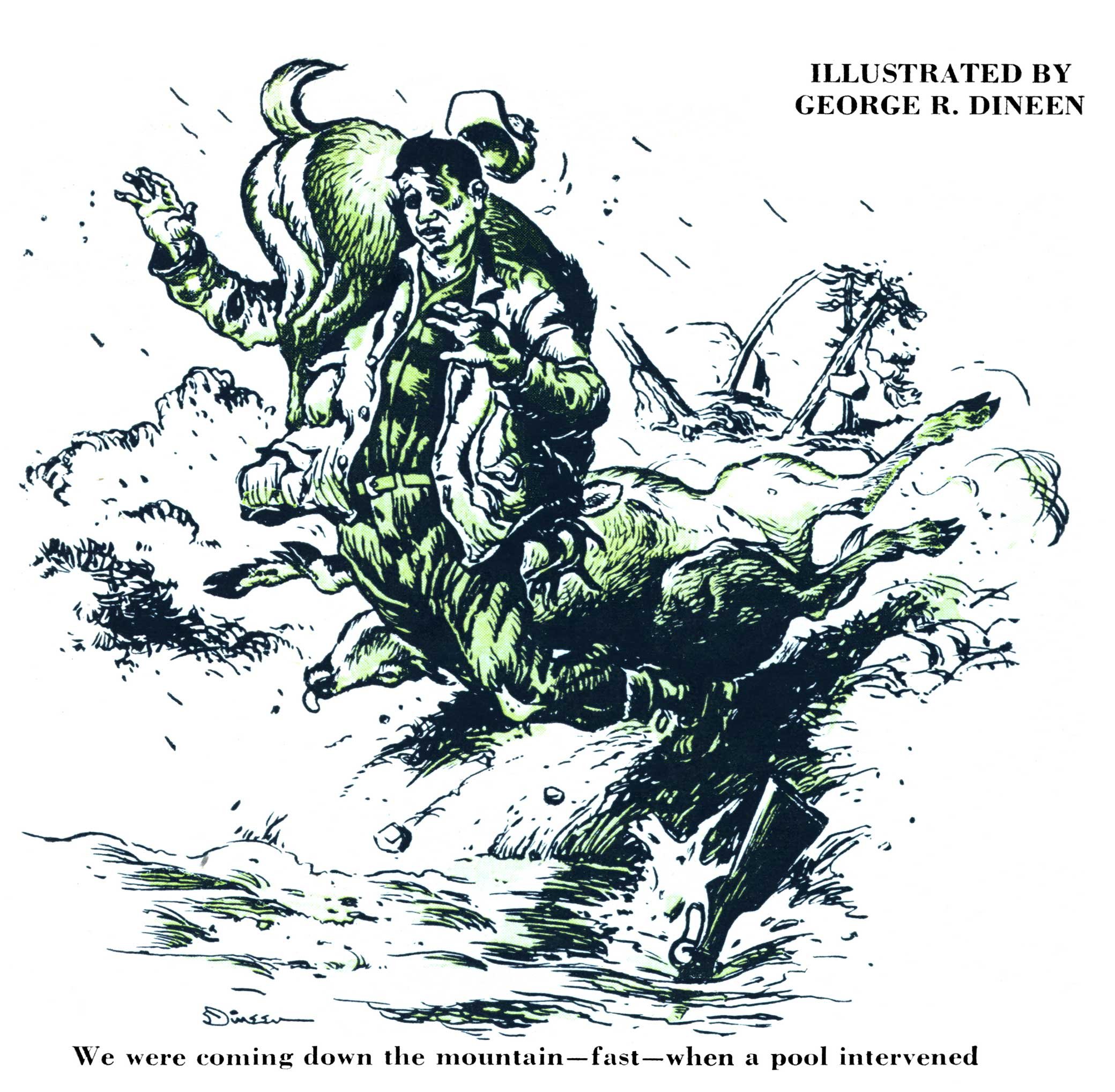
At the foot of the first steep slope there was a good-size pool. It helped to cushion the landing when my rubber legs gave out again. The rifle hit first, I was second, and the two bucks tied for third place. My memory of the rest of that march is pretty hazy. A swelling across the back of my head made me wonder if I was sprouting horns. It hardly seemed possible, as I already had an oversize set branching out of the small of my back. After a while the deer stubbornly refused to accompany me any farther. When I struggled to drag them they’d hold onto the trees and bushes. They both insisted upon riding double. Then I’d no sooner get them on my back than they’d start quarreling over the best seat. Finally, I lashed their feet together. Then I could hobble along, with one buck hanging from each shoulder, and the rifle serving as a yoke.
It seems to me now that I must have been partly stunned by the first fall and never recovered full consciousness until I was nearly to the beach. Then I found myself with my head in a puddle, the gun across my neck, and a badly bedraggled deer on each end of it. After a mighty effort (I thought it would be my last) I managed to get to my feet and reel to the boat. Somewhere along the line darkness had overtaken me.
It’s been said that body and brain, working together, can accomplish miracles. Body had brought me within sight of the lights sparkling across Tongass Narrows; I called on brain to finish the job. A psychology instructor had once taught me that everyone has inner reserves of energy that can be tapped in an emergency. Now I tapped my innermost reserve, rolled those monstrous brutes aboard the rowboat, and shoved off.
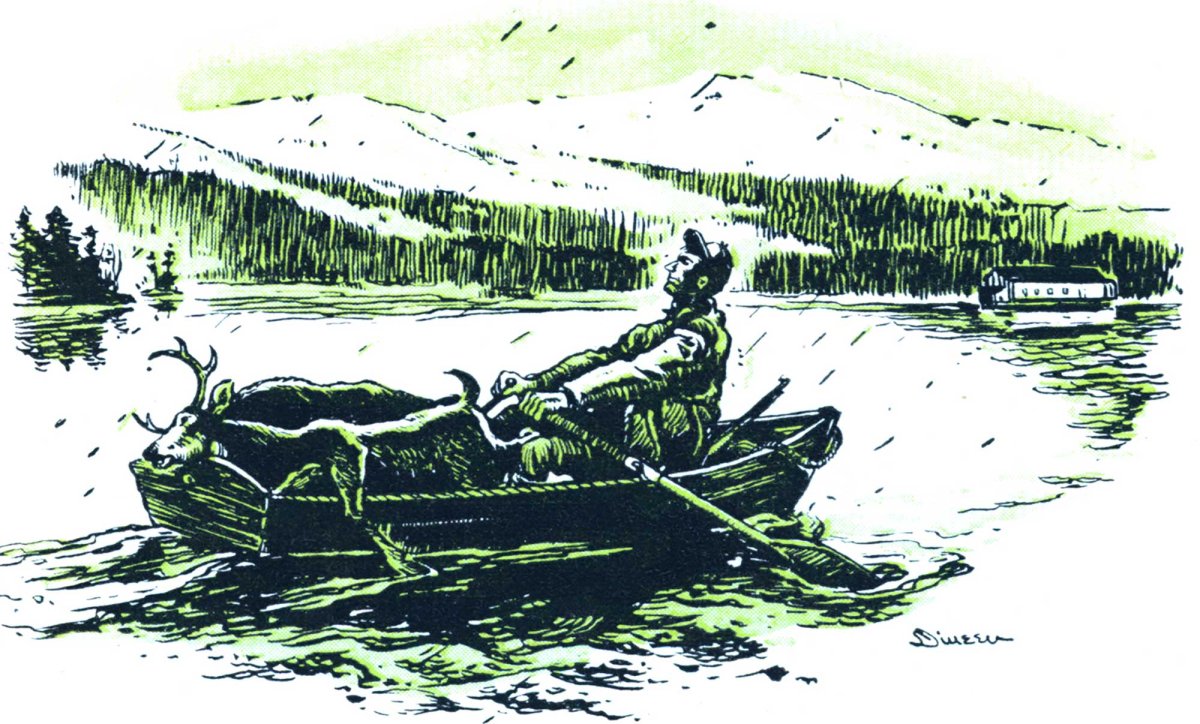
Rowing had many advantages over walking, crawling, rolling, or falling. I could sit in one place and I had those stinking deer off my neck. The high tide enabled me to work the skiff alongside the back porch of our float house. A greatly relieved wife watched me drift to a stop under the porch light.
Astonishment and then actual disbelief drove the worry from her face. In silence she stared at her tattered and torn husband and those bucks that looked so huge in the small boat. I leered back at her, struggling to appear normal in spite of an eye swollen shut and a doubt in my mind that I had enough strength left to clamber aboard. “Is supper ready, dear?” I croaked.
Read Next: Five Men Met Up for a Deer Hunt. Only Three of Us Survived
For the second time that day I was to drink the heady wine of triumph. The first sip had been that moment, high on the rocky ridge, when I ended the long chase. This time I raised the glass and drained it. The unadulterated admiration in my wife’s eyes was very sweet. “You know,” she said, “sometimes I think I underestimate you.”
I don’t know where we got the idea we could get four deer in our locker. Beth says we couldn’t get in another single pound.
This story was originally published in the August 1951 issue of Outdoor Life.
Read the full article here