
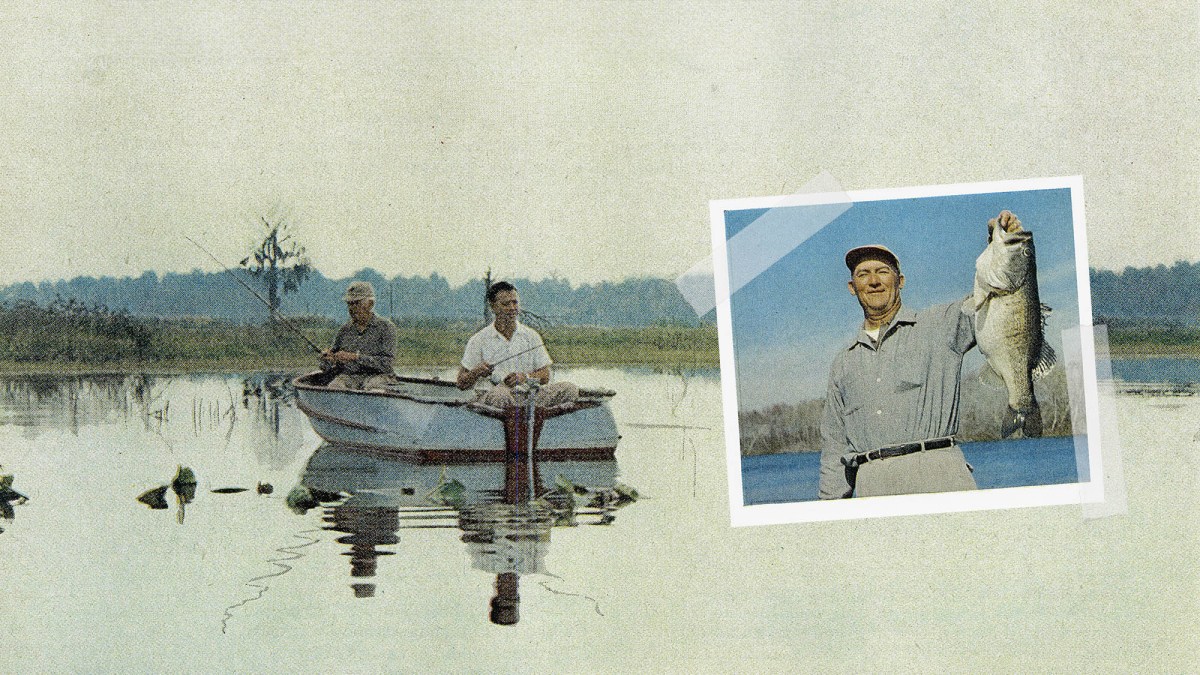
This story, “For Big Bass, Fish the Little Lakes,” appeared in the August 1962 issue.
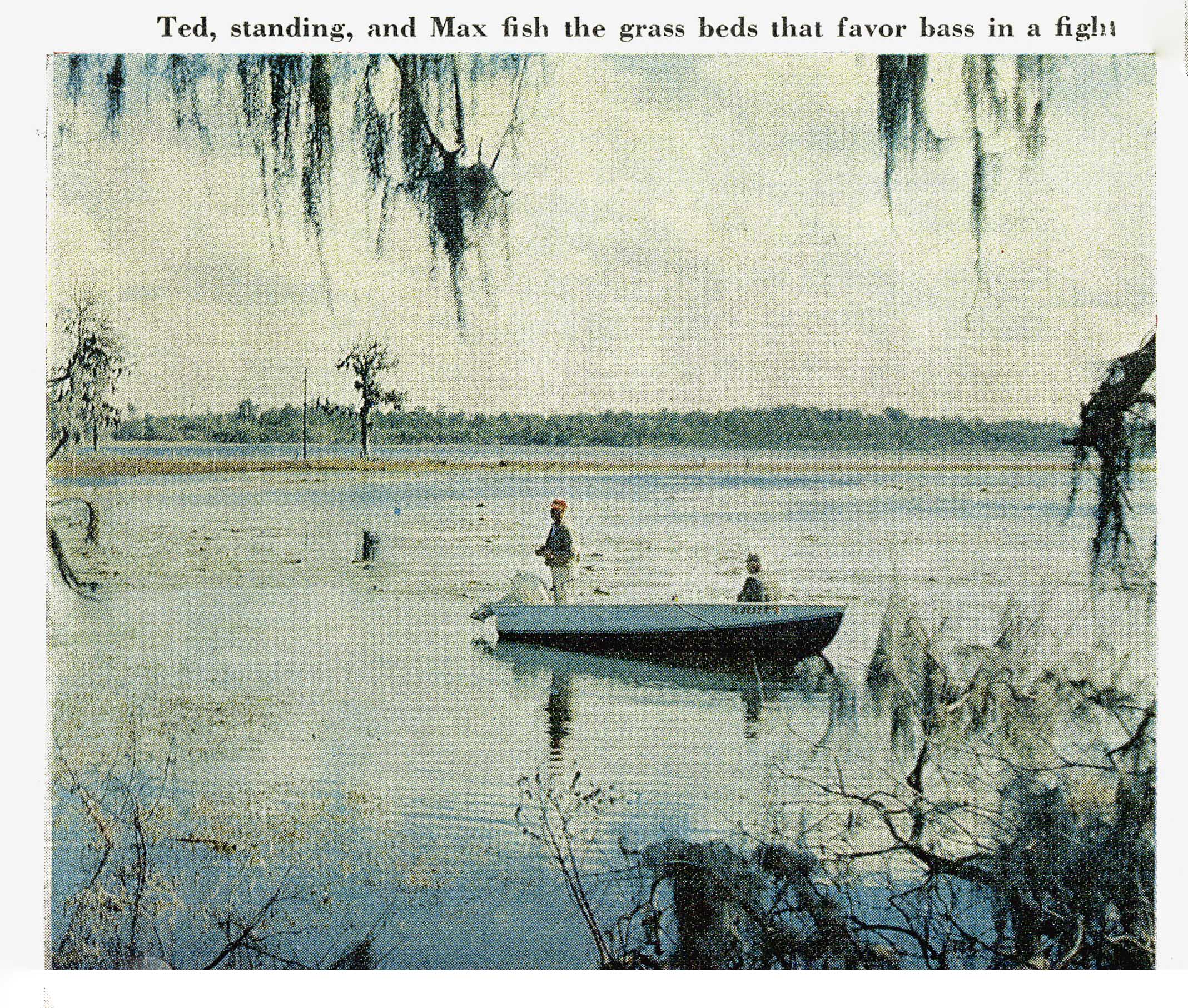
The lake wasn’t large or in the least attractive. So far as we knew, it didn’t even have a name. With one end of a barbed-wire fence running into it until the posts were completely submerged, it looked more like a flooded cow pasture than a fishing lake. I unhappily surveyed the shallow rim of the pond, with its grass beds, lily patches, and background of scrubby oaks draped with Spanish moss.
“It’s easy to see,” Ted Henson said, “that you don’t believe a word of it.”
“Oh well,” I shrugged, “I’ve wasted days with you before, and I’m sure this won’t be the last time.”
We’d passed up some of the finest lakes in central Florida for this scrubby pond which didn’t appear deep enough to float a keeper bass.
“I oughta have my head examined,” Ted declared, “for letting any guy as unappreciative as you are in on one of Florida’s top fishing secrets.”
“Thanks anyway,” I said, “but let’s get this over with, so we can go back to Johns Lake, Eustis, or Apopka, where we know some largemouths are waiting to smash a world record.”
I was only half serious, because I’d fished small waters before with T. B. Willard around his home at Lakeland, farther south. Willard and I concentrated on the phosphate pits, many of them deep and filled with spring water, and I remembered his observation that most experienced bassers in his part of the state bypassed the big lakes and devoted their angling hours to these potholes. From the scarcity of the usual signs left by anglers, and the apparently neglected largemouths Willard and I encountered in the phosphate pits, I could well believe the stories of terrific bass in the hidden waters.
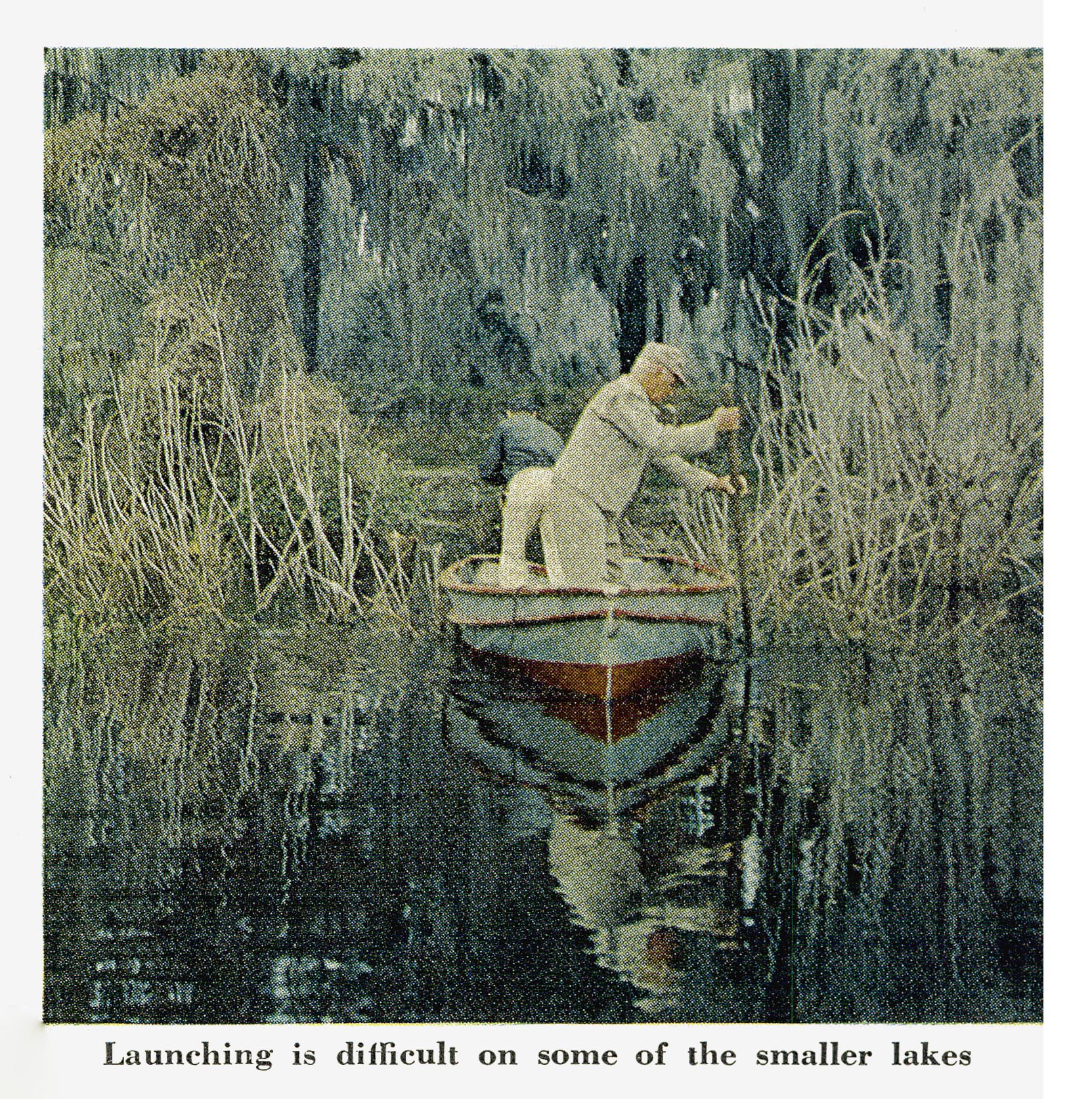
This lake of Ted’s promised the same brand of fishing, without the scenery, but I wouldn’t have admitted it to him. The rutted road we’d followed through the cow pasture came to an abrupt end at the edge of the pond. Dim tire tracks showed that at least once before a fisherman had launched a boat on the lake.
“He must have been after bullfrogs,” I commented. “This has all the qualifications of a mediocre frog pond.”
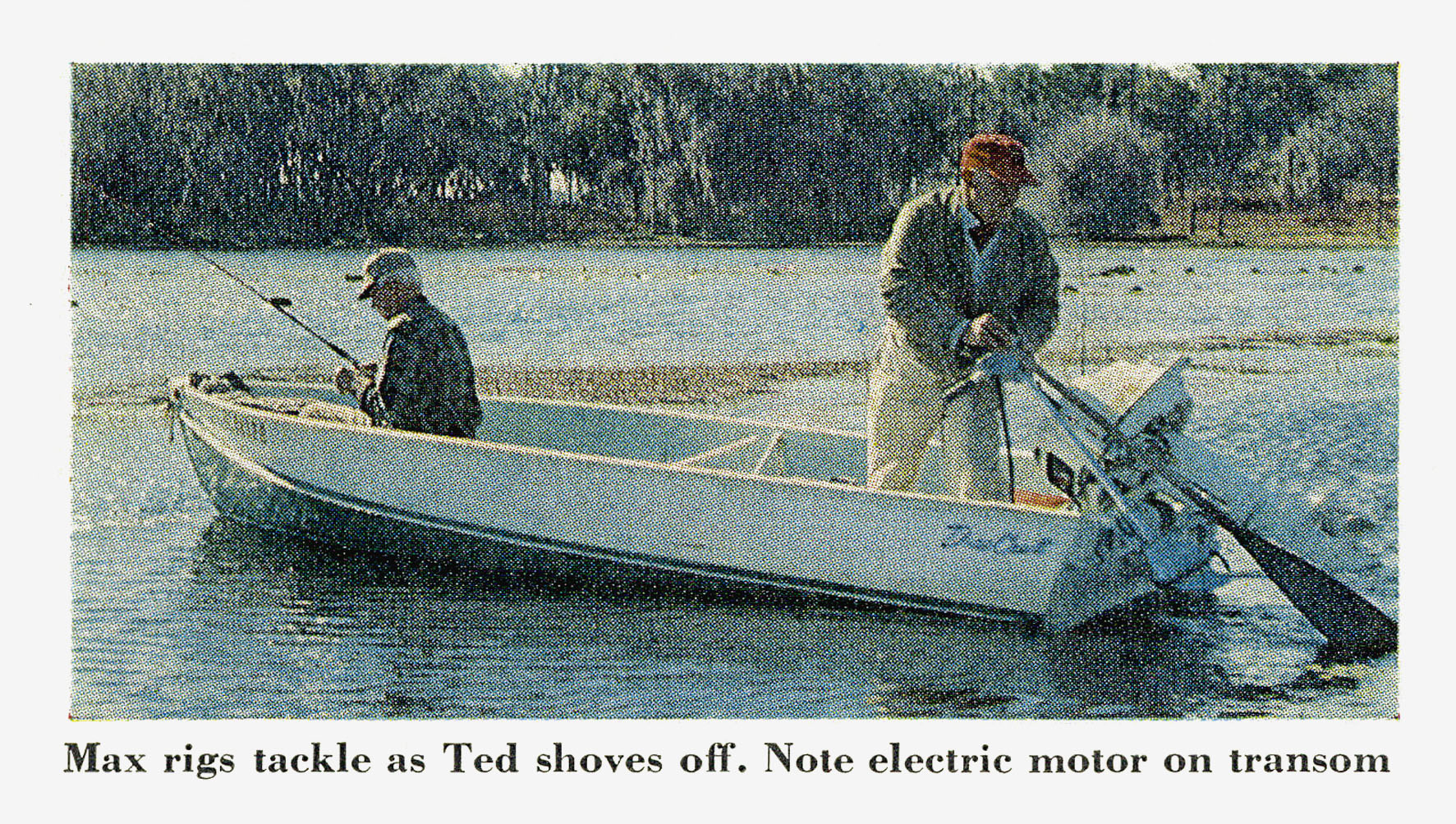
Ted didn’t rise to my needling, but calmly unhooked the plastic straps holding his boat on the trailer. I helped him slide the craft into shallow water, put in our gear, and then hook on his electric motor.
“What’s this for?” I asked.
“It appears,” he said, “that in more ways than one I am about to introduce a certain smart fellow to a brand-new kind of fishing.”
Related: Should Anglers Keep More Largemouth Bass to Improve Trophy Fisheries?
He made his promise good, too. That afternoon, on what I would have passed up as a scrubby, unproductive pond, he gave me some colorful moments in bass fishing.
My old angling partner, with whom I’ve covered a variety of trout streams, lakes, brackish bays, and briny estuaries all over the South, is a tackle salesman. He spends many hours testing lures, rods, reels, and rigs, and his experiences have made him one of the best fishermen in the business.
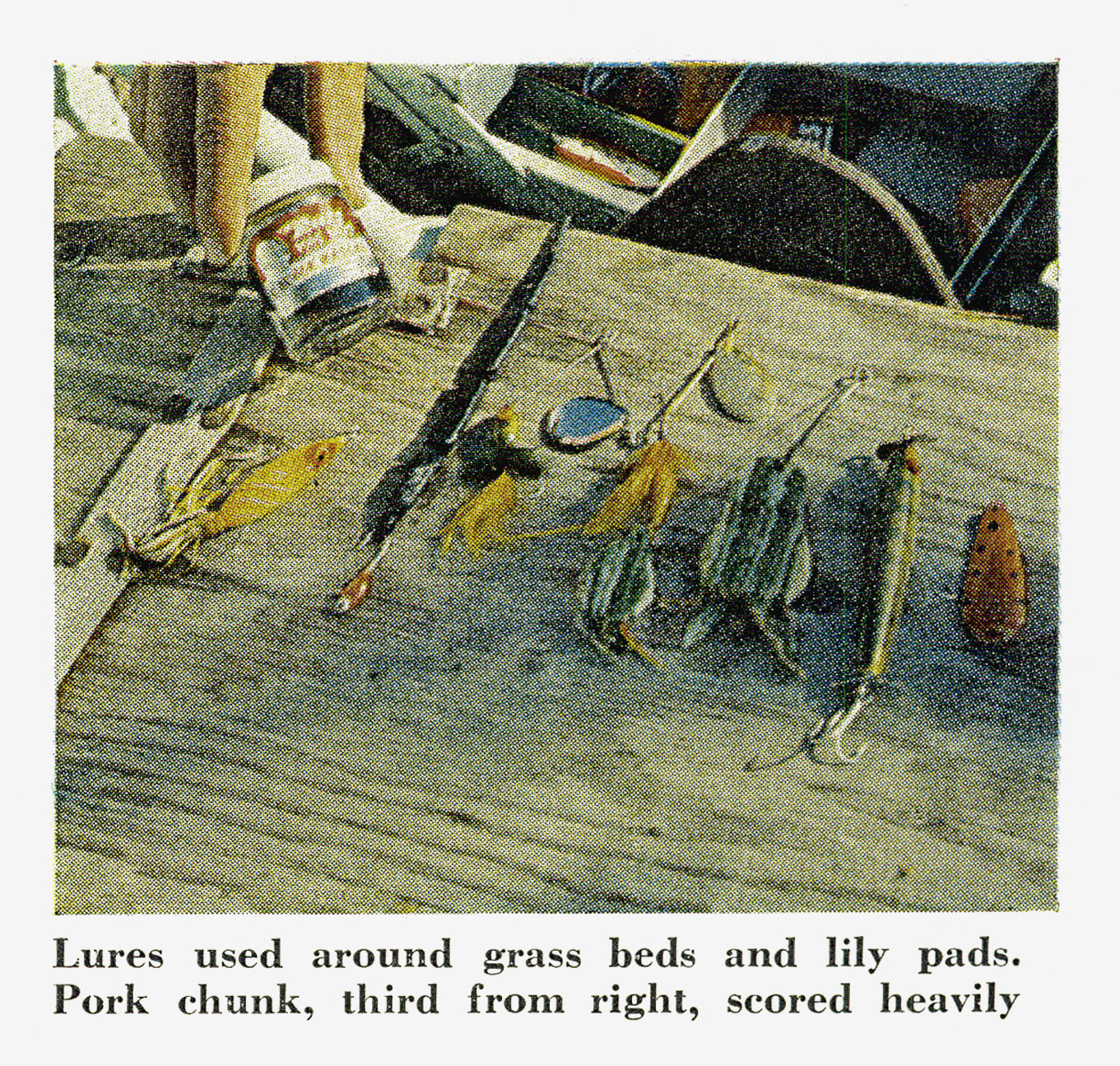
Ted laid out a dozen varieties of lures on the boat seat. “You may notice,” he said, “that all these plugs have one thing in common.”
“They are either top-water or weedless,” I observed. “What does that prove?”
“That the tackle-busters in these small lakes hide under the grass, and our best bet is to drag something over them that won’t hang up.”
Since the wind was making a heavy ripple on the water, we decided to confine our early afternoon casting to the weedless lures, fished through the grass beds, and save our top-water plugs for the hour or two just before sundown. I reached for what I considered the most interesting bait in my partner’s collection, an oversize pork chunk, several times larger than the regular green-and-white chunk, cut and colored to resemble a small frog.
For his own casting, Henson selected a weedless silver spoon. He added a sliver of white pork rind and tried a cast into the nearest grass bed. With an active rod tip, he skittered his spoon through the thick grass, making it look like a small minnow trying to escape. His lure was within a dozen yards of the boat when the grass bed boiled behind it.
Related: The Best Frog Lures
“I was fishing it too fast. But it’s good to know that something looked it over,” Ted said.
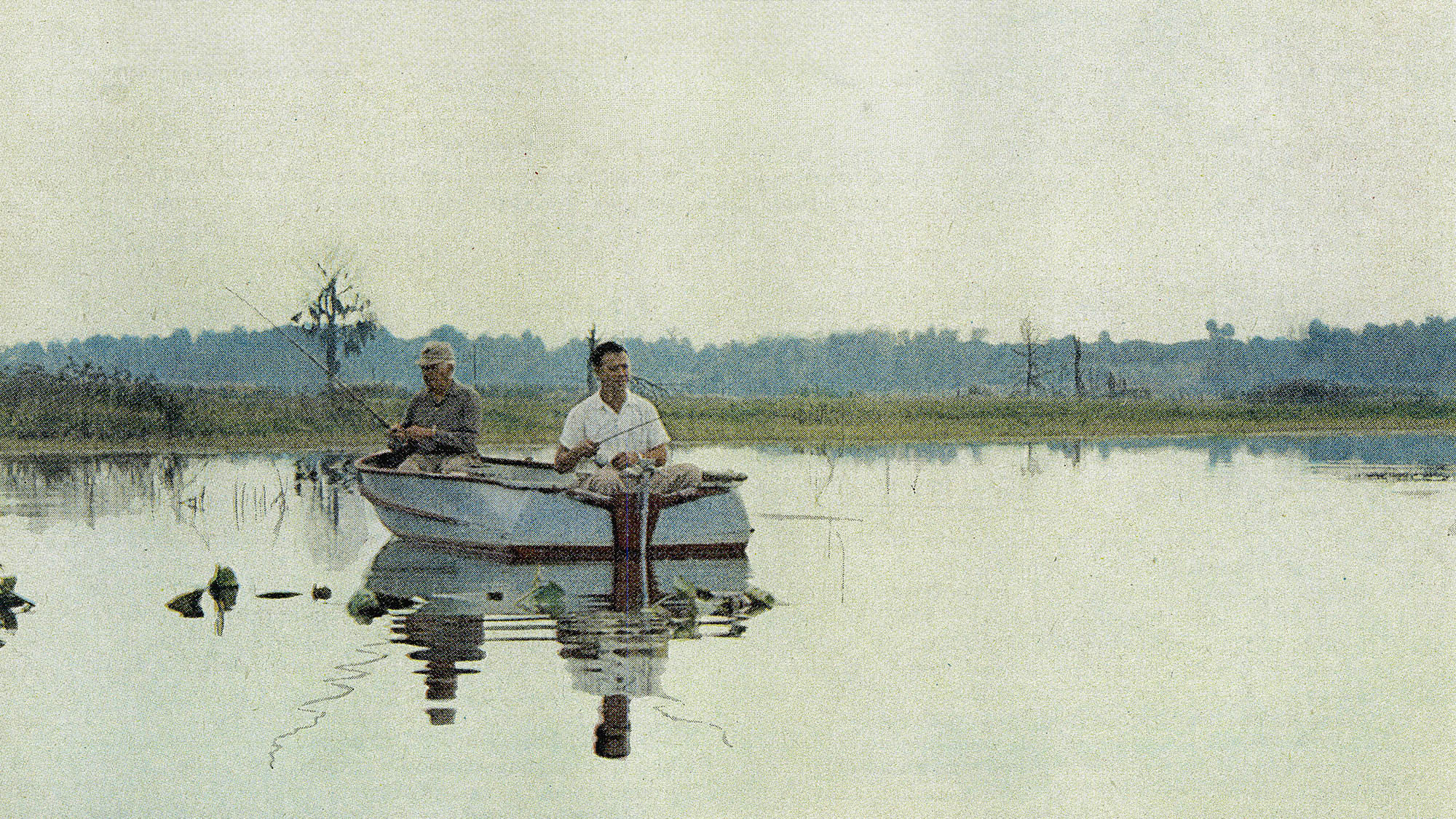
The entire shoreline of the lake wasn’t more than a couple of miles long, and the gasoline motor wasn’t needed. Ted cocked it on the transom at an angle and adjusted his electric motor.
“In pottering around these little lakes,” he said, “I’ve learned that this electric job is the best fishing arm a man can have. It sure beats a paddle 40 ways from payday. This afternoon you won’t have to paddle — both of us can cast.”
“Look, old pal,” I said, “if you even thought that I would jockey you around this spring hyla pond…”
“That,” Ted grinned, “is what I’m talking about.”
My boatmate turned his electric “arm” around in its bracket so that it would pull, or “lead” the boat by its stern, instead of pushing it. He declared that any boat handled much easier and with more accuracy by leading.
I waited until we were about 20 yards on the inside perimeter of the pond before I tossed out the pork chunk. I’ve followed Ted’s advice and selected a casting outfit with 20-pound-test monofilament as the most practical rig for the tough grass. He claimed he’d seen fish in this pond that would snap a six or eight-pound spinning strand as if it were sewing thread.
My casting rod had a fast tip and the reel was working like a fine watch as I laid the outsize piece of pork just where the shoreline tapered off into the water. I let it rest a moment, trying to simulate a frog that had just landed and was surveying its domain. Then, with a series of short jerks, I worked the chunk through the tops of the grass stems, allowing it to pause every three or four feet.
I opened my mouth to tell Ted the chubby green chunk was the closest thing I had seen to a live frog, but never got the words out. The grass stems around my fake shook violently. It must have been instinct that made me jump the chunk a foot, then let it lay. The shadow which had appeared under the frog lunged in a shower of spray and my lure disappeared into the middle of the grass bed.
I understood then why Ted had recommended the 20-pound line. It was strong enough to hold the bass until our electric motor pulled us over the spot where I could crank my catch to the surface. I was in the process of deciding that grass-bed fishing doesn’t allow the brand of spectacular action normally put on by a hooked largemouth when my bass hit the surface, made a splashing run away from the boat, jumped once, and then went down into another section of the bed. “Guess he wanted you to know who’s still boss,” Henson chortled.
He kicked the boat through the grass and once more we worked the bass to the top, but its strength was too far gone. This time the fish could only flounder beside the boat. I hefted him in, estimating my catch at four pounds. “Is this one of your brag lunkers?” I taunted. But the only rise I got out of my boatmate was a tolerant smile. Ted’s spoon survived a couple of hefty wallops, and on the third he hung a largemouth as big as the one I’d taken. He got his third strike where the grass was thin and his bass charged through the stems toward deep water. Out where the lake was free of lily pads and grass, the bass jumped three times.
All along the rim of the lake, where the water was too deep for grass, patches of the common water lily had taken over. They weren’t as productive as the grass, but where the lilies were massed in one deep corner of the lake, we got one bit of dramatics out of a hungry bass.
By this time we both had on pork chunks, which seemed to be getting most strikes. We had run through a list of weedless lures, including spoons, spinners, pork-rind eels, and the bush-whacker-type bait with a bright spinner on one of its V shanks and a yellow leadhead tipped with bright feathers on the other. We’d even tried a top-water lure or two, though we knew the wind and time of day were not yet right.
I was toying with my camera, hoping for a picture before the light be-gan to fade, and admiring the way Ted handled his rod. Years before, he’d won a national casting champion-ship, and was every bit as accurate as he had been in his younger days. In his hands, a casting rod is an artist’s tool, and he was placing his frog chunk on the rims of potholes where I would have had difficulty dropping it straight down out of my fingers.
With the electric motor purring along, the old maestro apparently had forgotten me and was giving his chunk a real workout. I watched him lay it gently in a niche where lily pads bunched against the grass. It rested until the ripples died, then in a couple of short jumps it landed on a pad, where it paused again for a few seconds. He crawled it slowly over a third floating leaf, then swooshed it through the water with the speed and agitation of a scared frog.
The bass didn’t come in and swirl at his lure, or even take it in a rush from underneath. The critter started somewhere out in the grass bed, as though it had watched the action all along, and simply couldn’t resist it any longer. It followed the course the frog had taken, and jumped completely over two lily pads to smash the chunk as it cavorted on the surface. Ted struck hard and the weedless hook went home.
They say a fish doesn’t feel pain. But a tight line must give it some idea its freedom is being limited. Following its dramatic strike, Ted’s fish simply disrupted that corner of the lake. Air-borne as much as it fought underwater, it tore the place apart, creating a maelstrom effect that set the wide emerald leaves askew. It was the kind of spectacular that makes any fisherman hang up all his other tackle and join the cult of exclusive dyed-in-the-nylon bassers.
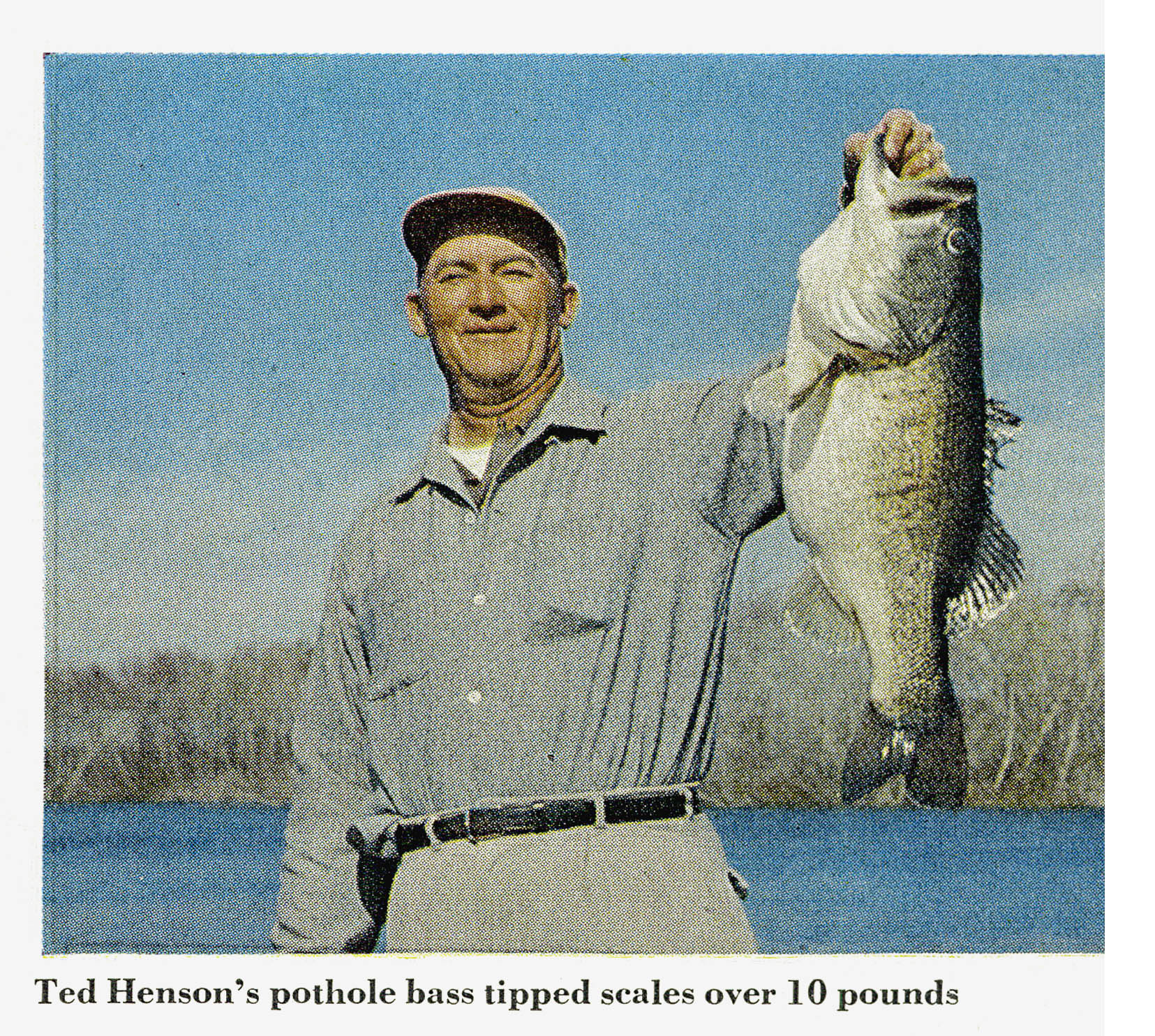
The old pro pulled his largemouth off balance half a dozen times, and when he finally led it to the side of the boat I was as exhausted as the fish. Ted caught its lower jaw in his fingers and held it up for me to admire.
“You’ve been looking for picture jumps,” he said. “I hope you got a dozen.”
I didn’t have the nerve to admit that I’d completely forgotten the camera in my hands.
After the bass had tipped the scales at a little over 10 pounds, my partner returned it gently to the lake. “Go get some meat on those old bones,” he said, “and we’ll make another date when you’re in better fighting trim.”
The wind died an hour before sundown. We took off our pork chunks and prepared to put on top-water lures. This is the finest fishing hour of the day, if any hour may be claimed as the finest. The hush of twilight, with occasional mysterious splashes, hung over the water. The suspense had grown with the fading light, and we knew the time had come when momentous things might happen.
We examined both tackle boxes. I pawed through poppers, chuggers, splashers, and plunkers and came up with a dark-green floater that rides the surface at an angle and darts this way and that when the rod tip is moved. Henson selected his favorite, a slim bit of silvery wood he called a stick. A spinner blade on each end made noisy little gurgles every time he took the slack out of his line and turned the bait at a new angle.
Top-water fishing of any kind has a fascination all its own. Working a lure in any spot where you can keep an eye on it has a tendency to build up the kind of tension you don’t feel when you are fishing underwater baits. Every time you move that bit of plastic, wood, or feathers you key yourself for an explosion.
I quickly learned that my own trigger was honed to a fine edge. I made my second cast to the end of an open slot between two carpets of pads. I allowed the wood to repose for the required time — until the ripples almost died — then touched the rod tip just enough to bob the head of the plug and turn it around. This is usually the moment of truth. When a lure hits the water, any curious bass in the vicinity will swim under it and study it. If it touch.es the water and chugs away with hesitation, the odds are he’ll let it go. But if it just lies there he may drift close enough for a look, and the first wiggle of the lure sets off his fuse. Each movement of the lure after that diminishes its chance of being walloped, and most good top-water fishermen I know simply reel in their lures for another cast after they have fished it a few feet away from the spot where it landed.
The electric motor, which Ted turned on slowest speed for about 10 seconds out of each minute, kept us moving just fast enough to properly fish out each cast. We caught six small bass, up to three pounds, without having to drive into the grass beds or lily patches to work them out. All seemed intent on getting to open water and each gave us a nice bit of action.
I changed top-water lures several times, looking for something hot. I tried an elongated plug shaped like a spindle, a mouse, a popper, a crawler, and a splasher. Ted stuck by his stick, and the number of fish we brought to the boat was about even, until he beat me by a fraction of a second to the crooked curve of an old log between a lily and grass patch. It was a perfect spot for a lunker.
His elongated lure floated quietly for a moment where the lake was high-lighted under the length of log. Ted had tightened his line and lifted his rod tip just as the pressure of the tight line turned his bait. We were close enough to see the back spinner whirl over twice and then the lure simply vanished. There wasn’t any smashing strike, such as we’d had from the little bass. The real Junkers in those waters seldom jump on a plug. They cruise almost nonchalantly up to it, extend the gill plates, and suck it in, leaving a swirl of water.
I heard Henson breathe hard. He reared back on his rod handle with enough power to break the back of an alligator. The hooks hit something solid, and his rod tip didn’t give an inch. Then the bass turned slowly and swam under the log, grinding monofilament off the star drag. When it stopped, Ted put on as much power as he dared. When he couldn’t budge the fish, we were certain the largemouth had gone in behind the log and either wrapped up a limb or bored into the grass. My partner cut on his electric and pulled our boat toward the log.
“Here’s one fish we gotta see,” he panted.
We were within a few feet of the log when the line went slack, then jerked toward the boat as the bass went under it. My boatmate had to do some fancy stepping to cut off his motor and keep his rod tip from being pulled down across the gunwale. He stripped off yards of line and finally got enough slack to move the end of his rod around the stern, while he kept a tight line. Then he put the pressure on again, and the bass jumped, giving us our first and only look at it.
The fading light and my own bugging eyes may have exaggerated its size, but that largemouth looked twice as big as the 10-pounder we’d put back earlier. Ted strained the guts of his rod in an effort to turn the fish away from the lilies and grass toward open water, but he would have had the same success trying to head a water buffalo. He bored into the mass and I snatched up the paddle, but already we were being kicked along by the electric.
Our combined efforts weren’t enough. The bass had gone down in the tough stuff, wrapped up in a tangle on the bottom, and against a line that would not give had straightened the slender hook that held him. Henson sat down and took off his fishing cap.
“Son,” he said, “there was a boss. You don’t get on one like that every week, even in these waters. I’d give a hundred bucks to have him on out in the middle of the lake.”
Until the light grew too dim to allow proper aim at the choice spots, we plugged the shoreline and patches. We caught five more bass, the largest about eight pounds.
“These little ponds have some tremendous largemouths in them,” Henson repeated, “but even when you tease one into hitting it’s hard to get out. Everything from its size and weight to the outlandish layout of vegetation favors the fish.
“Every one of these potholes,” he went on, referring to the hundreds of little lakes tucked away in the odd corners of Lake and Orange counties, “is every bit as productive as this. And some are hardly ever fished. Almost anywhere, we might tie into a critter as big, or bigger, than the one we missed.”
We spent the next day with Ed Bekemeyer on a sprawling shallow lake behind his house. A big chunk of those waters border the Bekemeyer Nursery, but a boat could be put in from several landings on adjoining property.
Max Wilde, our old Western big-game guide, was down on a visit from the winter snows around his Wyoming ranch, and he fished with Ed. Henson and I again shared the same boat.
Ed took the largest bass of the day on the same kind of perch-colored, top-water lure Ted was using, and we ,vere close enough to see the fine play between an expert angler and a largemouth. The fish weighed 9½ pounds. We saw some monsters moving on the flats at the head of the lake, and that set me on fire to get into Ed’s lake again. But my Florida friend had a lot of unfinished business elsewhere. He wanted to show us different waters. Fishing three in a boat, Ted, Max Wilde, and I made a tour of many bright, small lakes whose existence I never would have suspected by riding the highways. A few were set in orange groves that fringed the shores.
One of our most interesting afternoons was spent with Bud Lamb on a fairly large lake almost completely surrounded by his family’s property. A threat of rain was in the air, and the wind was blowing so hard that we used the electric to slow our speed as we pushed along an old dyke which had once been a road crossing the center of the lake.
In spite of the weather, we caught some fish by drifting down that dyke; and near a gap where one portion of the lake had broken through and spilled over into another larger part, we began to hit a bass on every cast. Ted dropped anchor and I tied our bow to a bush growing out of the water, and for an hour there wasn’t a five-minute period when Max, Ted, or I didn’t have a fish in the air. Many times we played three bass simultaneously. They weren’t lunker size — generally around two to four pounds — but in no large Florida waters have I found such action.
We worked the shoreline of Bud’s lake until almost dark. The grass beds on the lee shore produced largemouths up to six pounds.
Bud Lamb’s response to my question about allowing other fishermen on his lake was typical of the attitude I found among owners of many of these small private waters.
Related: We Canoed 200 Miles into the Bush for the Best Walleye and Pike Fishing of Our Lives
“It don’t hurt a lake to fish it, if a fella uses some sense,” he said. “We like to see him catch fish, and always want him to keep enough to eat. But any guy who comes out of here toting long strings of our bass doesn’t get permission to come back. We like to eat bass, too, but we’d rather have those big bass to hook and play and land.”
And when those Florida fishermen say “big bass,” they’re not talking about any insignificant eight or 10-pound fingerlings.
Read the full article here