

Outdoor Life staff and contributors spent all year testing the latest bowhunting gear. We put everything from mechanical broadheads to carbon fiber climbing sticks through structured head-to-head tests. The goal of our tests is to help you make the right gear choice and give the best product our coveted Editor’s Choice award.
Here are the best bowhunting products we tested and recommend.
Bows, Arrows, and Accessories
Hunting Gear
Optics
Bows, Arrows, and Accessories
Best Compound Bow: Elite Varos
See It
Specs
-
Price:
$1,300 -
ATA:
32 inches -
Draw Length:
25.5 to 31 inches -
Weight:
4.75 pounds -
Brace Height:
6 5/8 inches -
Speed (389 grain arrow/29.5-inch draw length):
285.8 fps -
Tested Draw Weight: 60 pounds
Features
-
Micro Splitters:
Adjust cam timing without a bow press -
R.A.C.:
Picatinny mounts for optional accessories -
S.E.T.:
Fine-tuning cam lean without a bow press -
Adjustable let-off -
1/4 inch draw length adjustments -
Picatinny sight mount and Integrate rest mount
The Best Compound Bow of 2026: We Tested them All
This year’s bow test was such a close race that after the initial round of scoring, less than one point separated the top three bows. Then, after accuracy testing, where three testers measured nine groups totaling 45 shots per bow, the average group size of the top three bows were within an inch of each other. At that point, the Varos was in the lead, but it was a narrow margin. Even the three testers were split on which of the top three bows they’d buy.
We did a final shootoff of 30 more shots per bow and the testers focused solely on comparing the Varos, ARC 34, and AX-3 33. When the dust settled, the Elite Varos was the clear winner in accuracy, scores, and the test team’s pick.
The Varos has a full suite of user-friendly tuning features, the best post-shot experience in this year’s test, and it’s not weak in any area of its design. Most importantly, it was the most accurate bow we tested.
Shooting a compound bow is difficult, especially under pressure, and the best bows make the hardest part of archery a little easier. The Varos did just that. Its standout performance was in the accuracy category where our three shooters averaged a 2.79-inch group at 50 yards. In the final 30-arrow shootoff the Varos’ groups were an average of 0.6-inch smaller than the other two bows. The testers all mentioned that it was the easiest bow to be accurate with, and it didn’t punish marginal shots as severely as other bows did.
The Varos won the features category outright because it comes fully loaded, and each of its features is exceptionally well-executed. Elite’s new Micro Splitters allows you to micro-adjust cam timing without a bow press. The Varos arrived with the top cam hitting slightly faster than the bottom. With a typical bow, a half twist in the cable would be too large an adjustment to fix the timing issue. You’d either be stuck accepting the slightly out-of-sync cams or spending an afternoon trying to find the right combination of twists. With the Micro Splitter, it was incredibly easy to even out the 1/16-inch timing difference by turning a single screw. This feature is excellent for getting cams even, but it can also be a benefit if you want to experiment with a slightly faster top cam to improve your aim.
The Varos also has ¼-inch draw length adjustment, S.E.T. (cam lean), a Picatinny sight mount, Picatinny mounts for optional bow hoist, bow stand, and sling, and an Integrate rest mount. All the tuning adjustments can be made without a bow press and are among the easiest to use.
In a field of vibration-free and quiet bows, the Varos was noticeably better. ‘That bow is quiet’ was a frequent comment throughout the three days of shooting. “It’s like the Artus and Exalt from last year had a baby,” test team member Connor Kaufhold says. “It has the speed and draw cycle of the Artus and the back wall and wonderful post shot of the Exalt.”
The Varos scored in the bottom three for the draw cycle category, not because it’s a difficult draw, but because of the severe dump into the valley. As you get the bow close to full draw, the pull weight suddenly drops until you hit the back wall. It’s an abrupt transition that causes sight movement, and it also makes the bow more difficult to let down. The good news is that it’s fixable. For the final shootoff, the testers were able to fully customize the bows to their preferences, and they adjusted the let-off from 90 to 80 percent, which dramatically smoothed out the transition into the valley.
The back wall is solid, and it’s easy to keep the bow at full draw — especially when set to 90 percent let-off. We shot the Varos at 60 pounds of draw weight, and its holding weight was only 7.8 pounds. If you ever have to draw and hold for an extended time, this is the bow you want in your hands.
The machined grip is comfortable and repeatable. It obviously lends itself to accurate shooting, but the testers found it slippery and suggested adding grip tape.
At 4.75 pounds, the Varos is among the heaviest bows we tested. The weight could be an issue if you’re trying to cut ounces for a backcountry hunt. But it’s a benefit for absorbing vibration and stabilizing the shot. “I think it (the Elite’s mass weight) really helps with having a good holding pattern on target and being a generally forgiving bow,” says Kaufhold.
The winner of the bow test is purely performance-based, but it is worth noting that the Elite Varos is the least expensive bow in this year’s lineup. Especially when you consider the depth of features and overall bow quality, it’s a great value.
Read Next: Best Compound Bows
Best Budget Compound Bow: Bear Alaskan Pro
Get It From Lancaster Archery Supply
Get It From Pyramyd AIR
Get It From Scheels
- ATA: 33 inches
- Brace Height: 6.25 inches
- Draw Length: 25.5 to 30 inches
- Draw Weight: 45-60 pounds or 55 to 70 pounds
- Let Off: 80 or 85 percent
- Price: $630 (bare bow) or $730 (ready to hunt) — ON SALE for $680 RTH at LAS

The Industry Doesn’t Want You to See This: Budget Bow vs Flagship Bow
Three different archers accuracy tested the Alaskan Pro at 50 yards, and they shot six, five-shot groups that averaged 3.75 inches. The testers noted that if they spent more time getting used to the Alaskan Pro, they could certainly improve their accuracy. The overall group average for the seven flagship bows tested was 3.7 inches. The Elite Varos rose to the top of this year’s bow test with a 2.7-inch group average, and even when the test team made a less-than-perfect shot, the arrows still hit pretty close to where they were aiming. The Alaskan Pro doesn’t possess that supernatural ability, so your overall effective range will likely be closer. How much that matters ultimately depends on your skill and how far you can ethically shoot an animal.
The Bear Alaskan Pro set to 60 pounds and a 30-inch draw length shot a 389-grain arrow at 292 fps. The Elite Varos, set to the exact same specs, also clocked in at 292 fps. That’s impressive performance. But you should keep in mind that if you shoot the Alaskan Pro on the lower end of its draw-length adjustment range, there will be more disparity compared to flagship bows. That’s especially true for bows like the Hoyt Alpha AX-3 and Mathews ARC, which use draw-length specific modules rather than a rotating one.
Where things tipped back in favor of the flagship bows is in the shooting experience. Every premium bow had a smoother draw and less hand shock than the Alaskan Pro. The draw on this budget bow starts with effort, levels out, requires another bit of effort, and then the cams sharply roll over into the valley. By comparison, the flagship bows require a more consistent effort and have a smoother transition into the valley. Nearly all the best bows have nearly no perceptible hand shock, but you will notice the Alaskan Pro’s jump.
Read Next: This Budget Compound Bow Is Shockingly Good
Best Mechanical Broadhead: SEVR Magneto Ti 1.75
See It
Pros
- Quiet in flight
- Easy to practice with
- Good entrance wound size
- Accurate at long ranges
Cons
- Not very sharp out of the box
Key Features
-
Weight:
100 or 125 grain -
Blade Width:
1.75 inches -
Grade-5 titanium ferrule -
Magnetic blade retention -
Blades swivel out of the way of bone -
Also available as a hybrid broadhead

The Best Mechanical Broadheads: Tested for Accuracy, Durability, Sharpness, Wound Size, and Noise
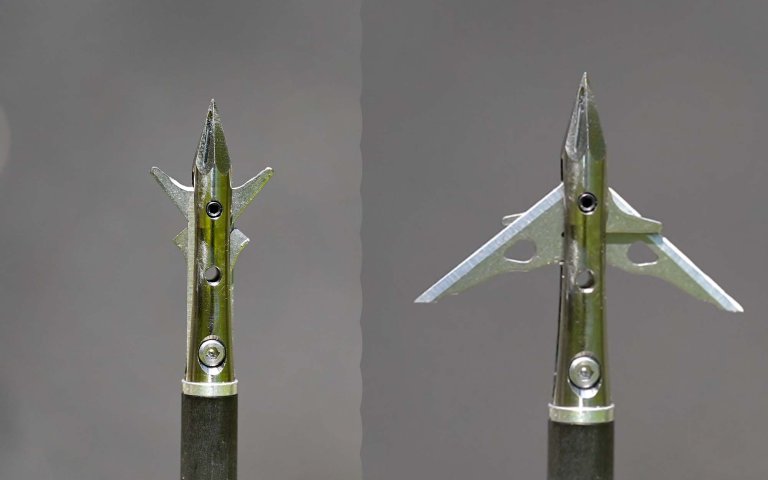
This broadhead test was a close race, and I’d hunt with nearly all of the broadheads I evaluated. There’s a good reason to use each of them, depending on your needs and setup. But if I were going to recommend one head universally, it would be the SEVR Magneto, for its overall performance and features.
Even though every broadhead I tested grouped with field points out to 50 yards with my setup, it’s still a good idea to confirm the same is true for yours. Confidence that your broadhead will hit where you’re aiming matters just as much as confidence that it will open and cut. The SEVR broadheads are easy to practice with, and you can shoot them as much as you want without dulling the blades. All you have to do is install a blade-locking screw, shoot until you’re happy, and remove the screw before you go hunting.
I’ve hunted with various SEVR broadheads, and I have a lot of faith in them. They’ve always performed for me. But one of the newest improvements is the removal of the O-ring that used to hold the blades closed, in favor of magnets. It’s a cleaner system, and you don’t have to worry about a dry-rotted O-ring ruining your day.
In the gel test, blades that didn’t securely lock open produced inconsistent wound channels. SEVR’s blades lock open securely but also swivel out of the way of bone. In testing, the SEVR cut a good wound channel and, for what it’s worth, penetrated the gel better than the other heads.
Most of the time, you’ll be able to reuse a SEVR after it passes through a deer, but the blades will need to be replaced. A pack of replacement blades runs about $18.
The main con of the SEVR Magneto is that, out of the box, the blades are sharp enough to cut but not as sharp as I’d like. I’d recommend giving them a light touch-up with a strop or a ceramic rod until they cut thin paper with ease.
Read Next: Best Mechanical Broadheads
Best Value Crossbow: Tenpoint Titan X
Get It From Lancaster Archery Supply
Get It From Bass Pro Shops

The 2 Best Crossbows You Can Actually Afford
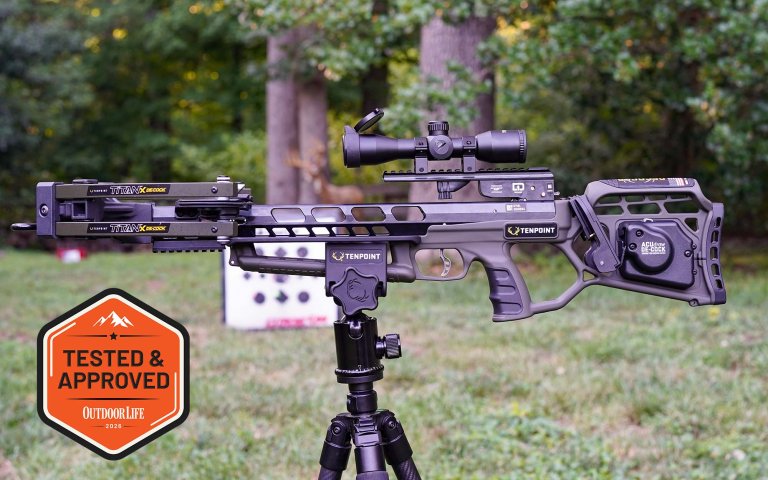
The Tenpoint Titan X does everything you’d want a hunting crossbow to do at ⅓ the price of the most expensive crossbow I tested this year. It shot the smallest 50-yard group average in this year’s test (1.43 inches), despite it having a very heavy trigger (4.4 pounds).
The Titan X is easy to cock and load, but the process is slower because it uses a retractable sled. The cocking effort is minimal and smooth. Decocking is also a simple operation, and you’ll never have to carry a bag target in your truck bed again. I can’t overstate the value you get from a crossbow that’s easy to cock and load. It makes practicing with your crossbow much more enjoyable, which means you’re going to shoot it more often. Even though these crossbows are accurate and flat shooting, practicing with them is still critical to good shot placement.
The trigger reach is pretty long; it measures 3.2 inches compared to the Ravin R10 Pro at 2 inches. I wear an XL glove, and the trigger reach just fits me, so this wouldn’t be the best option for a youth hunter. One workaround is to float your thumb instead of wrapping it around the pistol grip.
Overall, this is an affordable crossbow that’s accurate and is easy to load and unload. You can’t ask for much more than that.
Read Next: Best Affordable Crossbows
Best Limb-Driven Rest: Hamskea R7
Buy From Lancaster Archery Supply
Buy From Scheels
Pros
- Slimmer than other Hamskea rests
- Integrate-compatible version available
- Multiple micro-adjustable controls to customize this rest
Cons
- Expensive
- Hard to get due to demand
Key Features
-
Can be driven by upper or lower limb -
Micro-adjust elevation, windage and launcher position -
Rebound dampener included -
Fabric-covered launcher arm is quiet -
Simple lock to tighten control cord
-
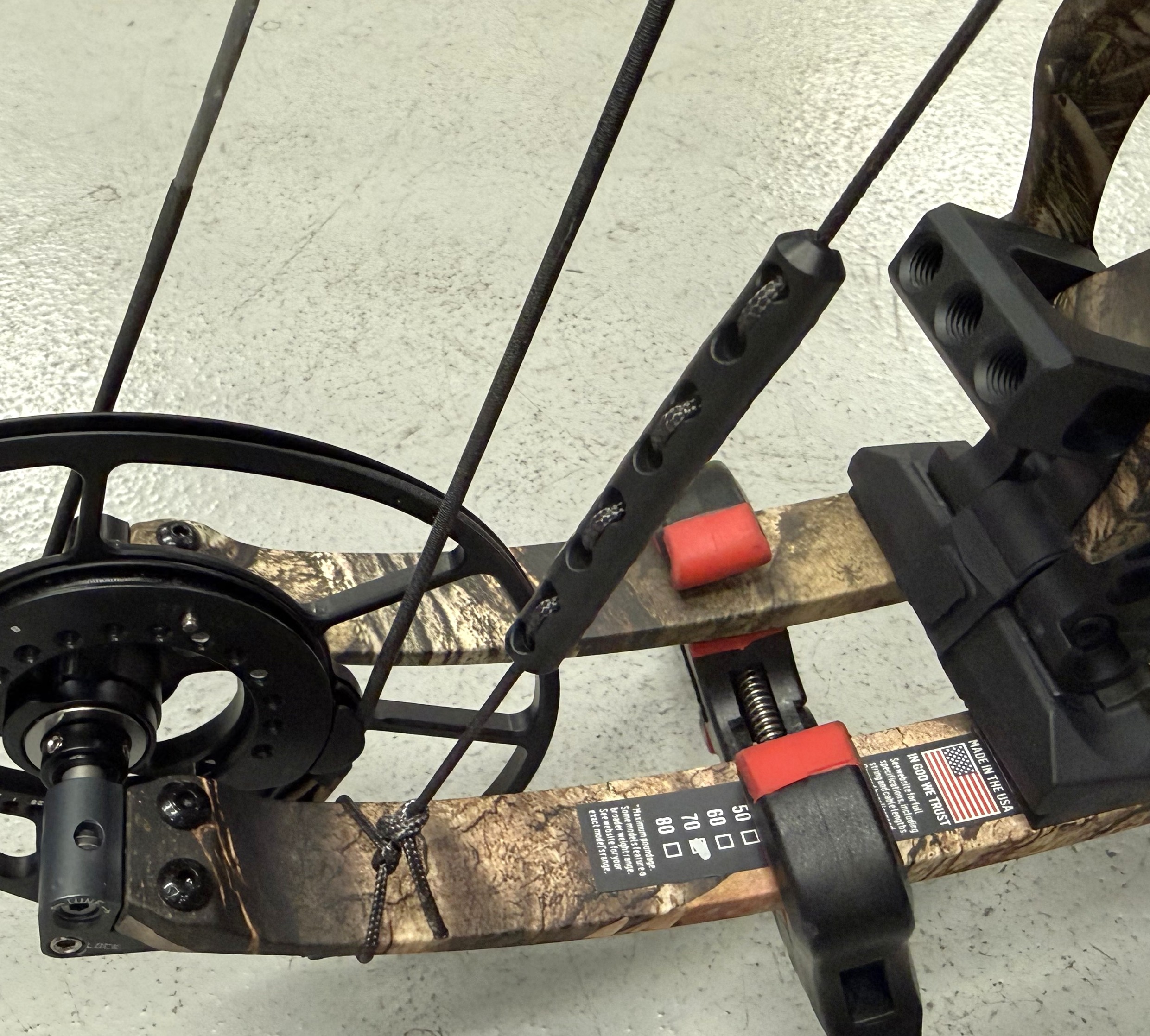
The Hamskea rebound dampener. -
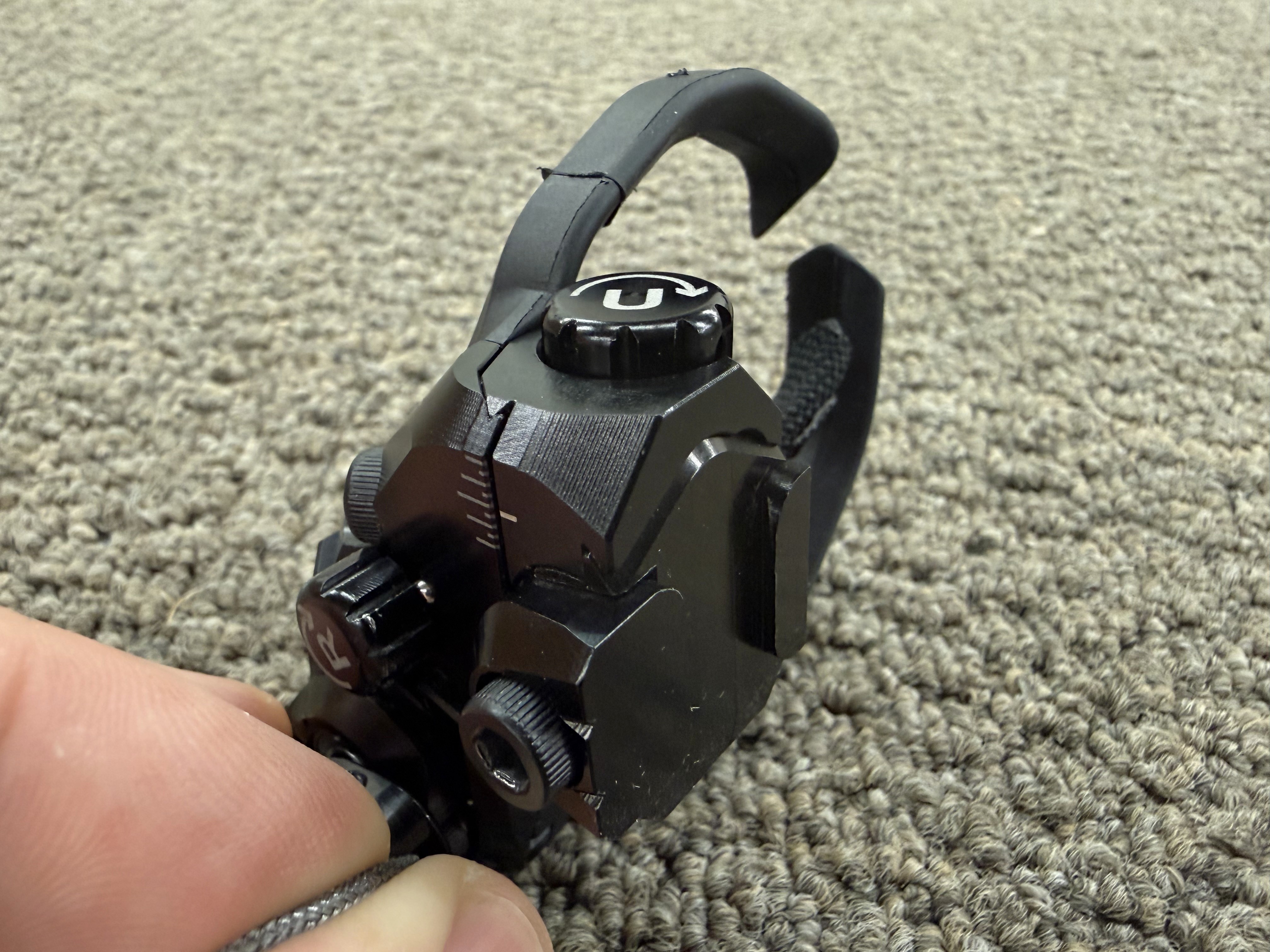
Micro adjustment knobs.
The R7 is the culmination of everything Hamskea has learned over the years with its previous limb-driven arrow rests. And they definitely checked all the boxes for the best features of limb-driven rests with the R7.
As a limb-driven rest, the R7’s launcher arm is held down flat against the bow’s shelf when the bow is at rest. It’s held down by a cord that runs from the rest to the upper or lower limb. When the bow is drawn, the limb flexes in, which allows the launcher to rise and lift the arrow so it’s level with the nock at full draw. When the bowstring is released, the limbs snap back out and pull the launcher arm away from the arrow.
The R7 is the most compact rest Hamskea has offered to date, yet it has micro-adjust controls for the launcher elevation and windage, as well as for setting the angle of the launcher when it’s raised. It’s also got the simplest connection for the cord at the rest, and the rebound dampener at the limb end is the best system I’ve seen for what it does.
The rebound dampener is a length of rubber that the control cord winds through. When you set up the rest, you can pull the cord extra tight, stretching the dampener just a bit, so there is some extra flex in the cord to make sure the launcher stays down when the bow is at rest. Hamskea used to use a spring, which always eventually stretched. With other limb-driven rests that have nothing similar, you’re constantly fighting cord stretch that allows the launcher to creep up, and not stay flat.
Kudos to Hamskea for making the R7 IMS compatible and doing away with their own unique mounting system that fit only a couple of bows. IMS compatible means the rest can be mounted to any bow that has a dovetail machined into the riser, just above the grip. Any company that makes such a rest has to pay QAD, which holds the patent on the technology, but it’s clearly the most popular mounting system, and Hamskea was hamstringing itself for years by not using it.
Read Next: Best Arrow Rests
Best Index Finger Release: TRU Ball Execute V2
Buy It From Lancaster Archery
Pros
- Super clean break on every shot
- Double sear is secure and not affected by draw weight
- Heavy head
- Spring keeps the jaw open before cocking
Cons
- One of the most expensive index finger releases on the market
Key Features
-
Double-sear firing mechanism is crisp, consistent, and secure -
Brass head -
Cerakote finish -
Single moving jaw -
Comfortable wrist strap

TRU Ball Execute V2: The Release We’ve Waited 4 Years For!!!!
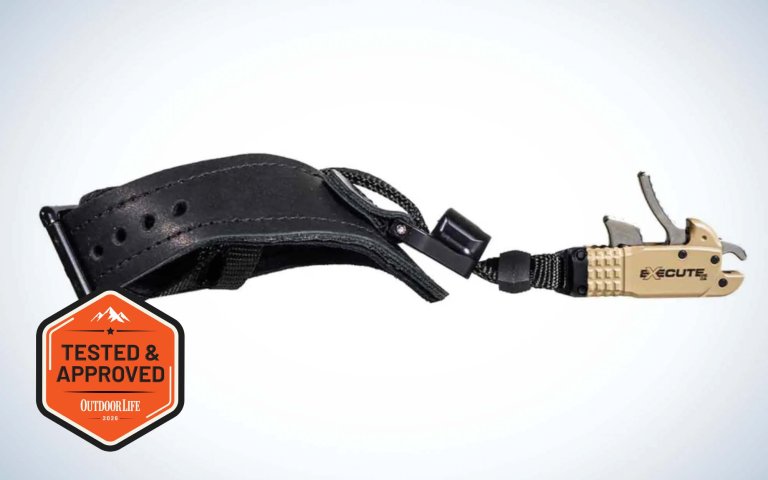
The Execute V2 is an index finger release from TRU Ball that is a revised version of TRU Ball’s wildly popular, but long-discontinued Execute release.
The Execute V2 employs two sears, which means you cock it with a button separate from the trigger. With this mechanism, the tension it takes to fire the release never changes, regardless of draw weight. The release will feel the same when you activate it across all bows.
It’s got a single moving jaw that locks against a solid post, which produces the most consistent D-loop release. And – different from the original – that jaw is held open by a spring until the release is cocked. Trust me, that’s a super helpful upgrade for when you’re trying to connect the release to the D-loop as a nice buck approaches your stand.
The brass head gives the release some heft, which is nice for knowing what it’s doing during the shot process. And that brass head is covered with a ceramic coating for protection.
The Execute V2 is suitable for bowhunting and target archery. The fact that target archers are so enamored with it should tell bowhunters just how precise this release is.
Read Next: Best Release Aids
Best Target: Delta McKenzie Big Daddy Buck
See It
Pros
- Super durable foam
- Suitable for field points and broadheads
- Realistic size for mature Virginia whitetail
- Very transportable
Cons
- Kind of heavy
- No replaceable core
Key Features
-
Solid, self-healing foam construction -
Easy arrow removal -
Easy assembly -
Measures 41 inches high at the back and is 48 inches long -
Mimics the size of a large whitetail -
Includes QuivAR chip, which allows virtual examination of vital impacts
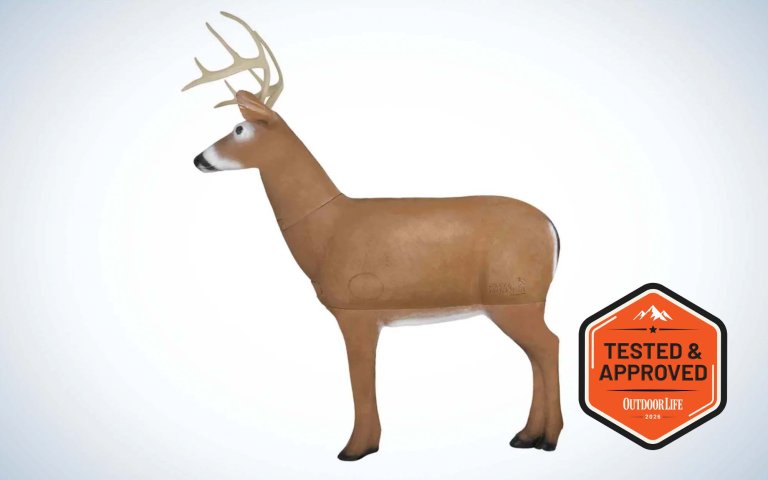
The Delta McKenzie Big Daddy Buck is a life-size, foam whitetail deer target that’s ideal for the backyard. It gets my nod as the best backyard 3-D target because it can take a beating. This one is the most durable 3-D target I’ve shot. You can shoot it over and over and over with field points and broadheads from a compound or recurve bow, and it takes forever before arrows start passing through. (I wouldn’t shoot crossbows over 350 fps into this one.)
Ultimately, durability is what I value most in a backyard target. I don’t want to spend one summer shooting at a 3-D deer, only to create a hole that allows my arrows to zip right through. And I’ve done that with other targets. The self-healing Dura-Flex foam Delta McKenzie uses for the Big Daddy is legit.
I also like the size of this target. The specs say it’s equivalent to a 250-pound whitetail, but I think that’s a stretch. I’d say more like 200 pounds, but that’s perfect for me. I’m not a fan of the little deer targets.
I mentioned there’s not a replaceable core with this target, but there is a replaceable mid-section. It’s not as cheap as a replaceable core, but it does cost a little bit less than a whole new target.
The Big Daddy includes a unique feature that’s especially ideal for developing hunters. It is QuivAR enabled, which means you can use an app on your phone to look at your arrows and see what vital organs you hit – or didn’t hit. When you hold your phone up to the target, the vital organs and bones appear on your phone as they’d look inside the target. From my experience hunting, it’s pretty accurate. With other 3-D targets, you’re guessing what vitals you might have hit. QuivAR shows you.
For experienced hunters, QuivAR might not be a feature you need. But for hunters who haven’t shot a lot of deer, QuivAR is the best simulation I’ve seen for shooting a real deer.
Read Next: Best Archery Targets
Best Hunting Arrow: Easton 5.0
Buy From Lancaster Archery Supply
Pros
- Ultralight
- Micro-diameter
- Unmatched consistency
- Has compatible components that allow for building lightweight, fast arrows, or high-FOC bone crunchers
Cons
- Not the very best option for shooting long distances
Key Features
-
.001 and .003 straightness versions -
Spines:
200, 250, 300, 340, 400, and 500 -
Compenents:
Halfouts or HIT inserts -
Made in USA -
Inside Diameter:
.204 inch -
Weight (340 spine):
7.4 grains per inch -
Price (.003):
$110 (6 fletched arrows), $170 (dozen shafts)
Easton finally built the ultimate arrow when they came out with the 5.0 late last year. Due to incredible demand, bowhunters are just starting to get them in their hands now.
The 5.0 is more than just an arrow – it’s an arrow system because you can build it the way you want. To start, it’s a 5mm arrow built using Easton’s Acu-Carbon process, which was made famous by the Axis series of arrows. Instead of rolling the carbon around a mandril to form the shaft, Easton weaves the carbon over the mandril in a continuous process.
This construction minimizes the effect of a “high spine,” which is a line of stiffer carbon running the length of the arrow commonly found when the carbon is rolled. Ideally, you want to identify that high spine and make sure it’s facing up when you load the arrow to shoot. Because of the 5.0’s construction, that orientation is less critical than it is with other shafts. Also, the continuous weave means the first arrow off the line will match the 387,000th arrow off the line, and every one in between. Buy a dozen this year, and the weights and straightness tolerances will match the dozen you buy three years from now.
Where Easton hit the 5.0 out of the park is in making the shaft super light. The 300-spine 5.0 weighs 8.4 grains per inch. That’s not the lightest arrow on the market, but it’s pretty light. So if you’re looking for a flat-shooting arrow, you can build the 5.0 to be super light. Put in the aluminum HIT inserts and some 2.5-inch fletchings, and you’ve got a real speed burner.
Easton has a series of components made for the 5.0 that allow you to add weight to the front to make the arrow hit like a sledgehammer while maintaining long-range accuracy. You can build a 5.0 arrow with 15 percent FOC that’s still a viable, long-range arrow, as opposed to one that weighs 700 grains.
Easton has a series of components that allow you to build the 5.0 arrow you want. There are inserts that weigh 16 grains, 25 grains, 50 grains, and 75 grains. You decide how much weight you want in the front of your arrow to get the performance you’re looking for.
Along with that, Easton offers the 5.0 in 200, 250, 300, 340, 400 and 500 spines. The varied spine offerings are critical for building high-FOC arrows that will still fly well. One of the common mistakes bowhunters make in building arrows with high FOC, is they don’t consider the effect that added weight has on the arrow spine.
The more weight you add to the front of an arrow, the weaker the spine gets. So a hunter shooting a 70-pound draw weight with a 29-inch arrow would want that arrow to be 300 spine with a 100-grain point. If the hunter adds 50-100 grains to the front of that arrow, the correct spine for solid arrow performance is going to change to 250 or even 200. But bowhunters don’t realize that, so they end up sticking with the now-weakened 300, which likely won’t always fly well – especially as the shooting distance increases.
Read Next: Best Hunting Arrows
Best Lighted Nock: Halo Nocks
See It
Pros
- Light
- Easy to turn off
- Excellent fit
Cons
- Not as bright as Nockturnal
Key Features
-
Weight:
14.6 grains -
Options for .233, .244, .246, .204, and .166/.165 inside diameter arrow shafts -
Battery Life:
20+ hours -
Three per pack -
Price:
$35

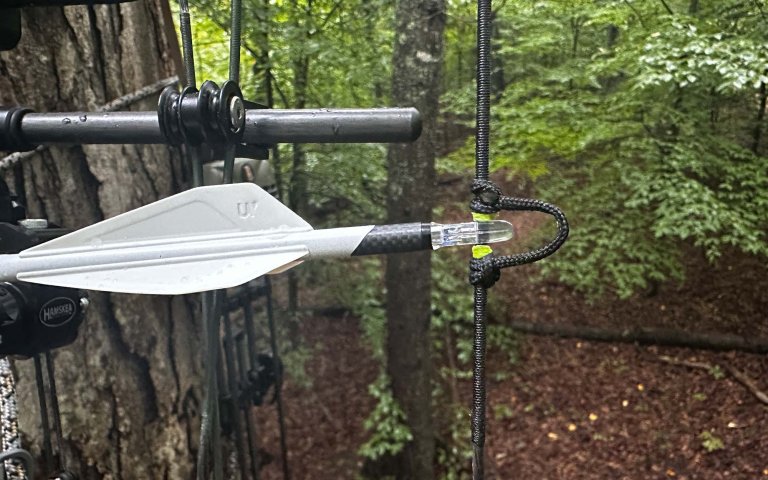
I value reliability, accuracy, and simplicity in my archery setups and the Halo Nock follows that ethos. They aren’t the brightest nock I’ve tested, but they do offer a lot of benefits. First they fit my string very similar to my standard nocks. They snap on and hold the string with similar tension, so no reserving is required for perfect nock fit. They also aren’t thick like most nocks, so the gap between my nocking points remains the same from standard to Halo nocks. That’s critical for avoiding tune and accuracy killing nock pinch. They’re easy to turn off, even easier than lighted nocks with switches. You simply nock them onto the string and then hold down the button. I also like that they only weigh 14.6 grains which is only 7 grains more than my AAE nocks and 10 grains lighter than other lighted nocks.
Best Value Lighted Nock: CosiComu Lighted Nock
See It
Pros
- Affordable
- Easy on/off
- Bright
Specs
-
Weight:
18.4 grains (measured) -
Battery Life:
More than 24 hours -
Price:
$19 for a six pack -
Switch to turn the nock off -
Sizes for .165, .204, .233, .244, .246 inside diameters -
Good fit on a 0.110-inch serving diameter
-
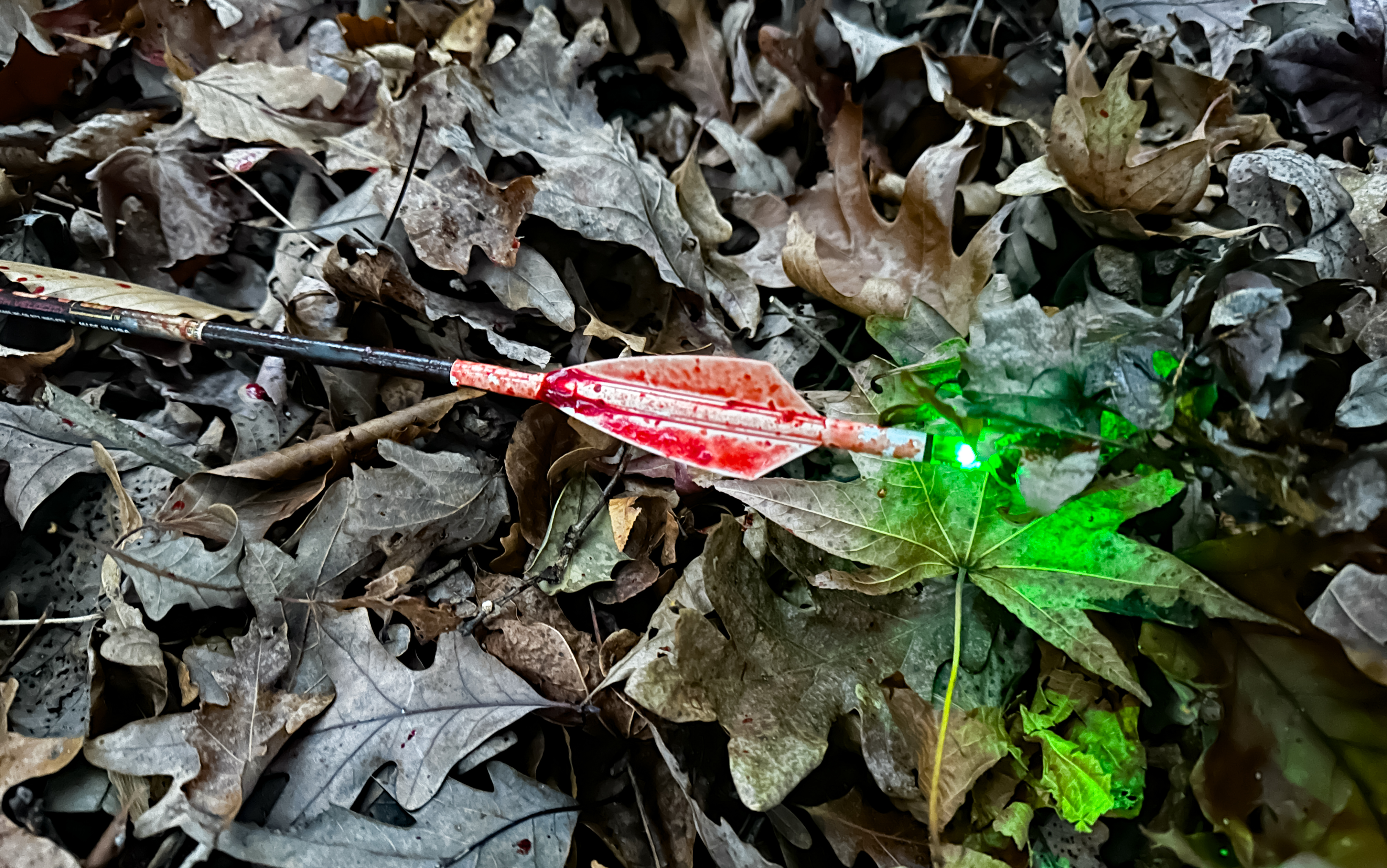
The bright green lighted nock was easy to find. -
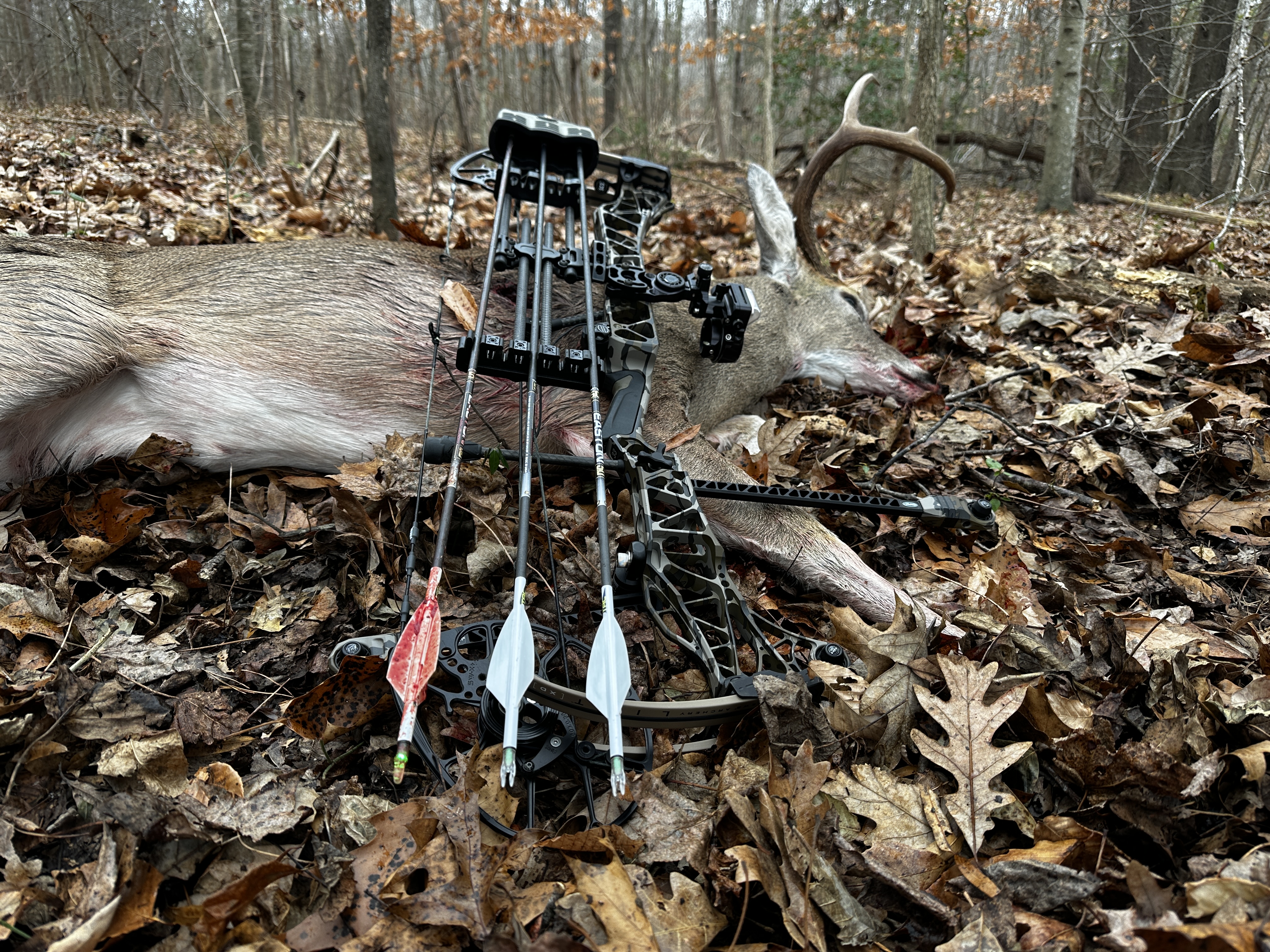
The lighted nock helped the author find the blood trail that led to his deer. -

I did a lot of backyard shooting with the CosiComu before taking them hunting and they consistently illuminated and easily switched off without a tool. I was happy with their brightness as well.
I shot a buck at 15 yards this fall. It was a slight quartering-to shot, which meant I had to hug the shoulder with my pin to get a favorable exit location. The shot felt good, I saw the green nock disappear right where I was aiming, and I heard a crash a few seconds later.
However, two weeks earlier, I misjudged a deer and hit it square in the shoulder blade and got almost no penetration. That seeded plenty of doubt as I waited to climb down this buck later in the season. I went to where I thought the deer had been standing at the shot, but didn’t find any blood or the arrow. I would normally do a grid search to find first blood, but as the deer ran off into a thick cut over, I thought I saw a flash of my green lighted nock.
I walked to where I saw that green flash and quickly found my arrow soaked in good blood from point to nock. I figured the flash of green I saw was the arrow working its way out the exit wound. Next to the arrow was an insane blood trail that led right to my deer. I backtracked and found that where I initially was looking for blood was only about five yards off.
Read Next: Best Lighted Nocks
Hunting Gear
Best Climbing Stick: Latitude Carbon Synergy
See It
Pros
- Lightweight (less than one pound per stick)
- Easy to pack together
- No noise while packing
- Plenty of attachment rope to get around even the biggest trees
- Aggressive climbing tread to avoid slips
- Roomy standoff distance
- Made in USA
-
Weight:
3 lbs. 11.6 oz. -
Length:
17” (step to step) -
Stackability Score:
5 -
Packed Dimensions:
18 1/2” long, 9 1/4” high, 9” wide -
Attachment:
93” of Amsteel rope -
Material:
Carbon fiber -
Noise Score:
5 -
Climbing Comfort Score:
5 -
Price:
$499.99 (4 sticks), $399.99 (3 sticks)
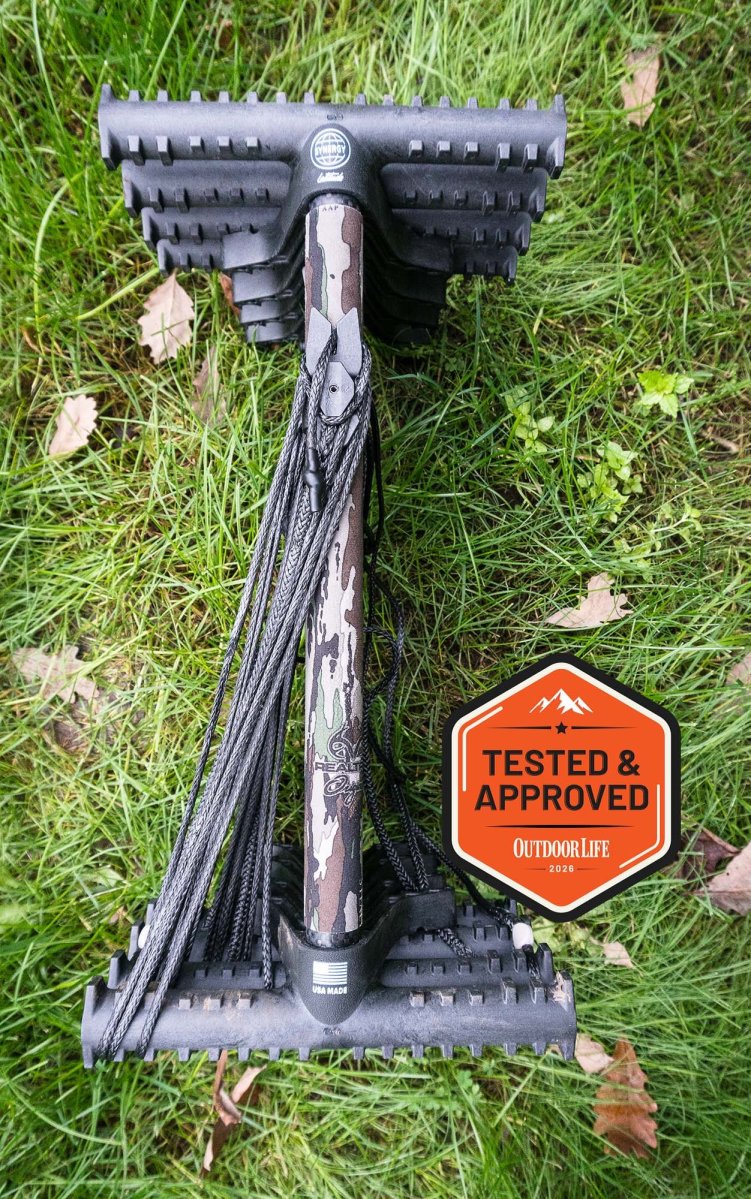
Latitude Outdoors acquired Tree Styx in 2025, and with a few intentional changes, the Carbon Synergy climbing sticks were born. At just 14.9 ounces per stick, Latitude’s Carbon Synergy is the lightest climbing stick in this year’s test. They’re not only lightweight but also pack together more effortlessly than any other climbing stick I’ve tried. I’ve noticed that “climbing confidence” tends to be a tradeoff as sticks get lighter, but the Synergy sticks made me rethink that assumption. For those reasons and more, Latitude’s Carbon Synergy climbing sticks earned the “best overall” ranking in this year’s test.
There’s absolutely no slop when the Carbon Synergy sticks are packed together. I shook them as hard as I could to try to produce even the slightest noise from the Amsteel rope contacting the stick, and it was barely audible, thanks to a rubberized, pre-installed silencing damper at the end of the rope.
The Synergy sticks use an aggressive tread on the steps to prevent slips, which I’ll especially appreciate later this season when I’m wearing insulated boots in frigid conditions. With a 4.21-inch standoff distance, my foot had plenty of room while climbing the tree. The integrated stacking system lets the post of each stick nest into the cleat on the bottom of the other, eliminating the need to align pins or nylon stoppers — you can pack them together with one hand. That’s not just convenient; it means you can attach all the sticks to one side of your saddle and deploy each as you climb, one-handed, instead of carrying a stick on each hip and a platform on your back. That makes the climb easier and makes it just as easy to pack up in the dark after an evening hunt.
As with any carbon-fiber product, the material has a slight sheen to it. If you’re particular about details like that, you can remedy it with Stealth Strips designed specifically for the Synergy sticks, available on Latitude’s website. You can also accessorize your Synergy sticks with a single-step aider that adds just 1 ounce and stows away cleanly when packing up, or with glow-in-the-dark illuminators that make climbing down in the dark easier.
Read Next: Best Climbing Sticks
Best Tree Saddle: Ninja Black Belt Ronin

See It
Pros
- Simple, minimalist design
- Integrated pockets eliminate extra bulk and potential noise
- Magnetic waist buckle is easy to operate
- Magnetic stick haulers quickly and easily attach sticks to the saddle while climbing
- Magnetic platform hauler eliminates the need for a DIY alternative
- Padded, breathable saddle body for added comfort in a single panel
Cons
- Wish pockets were slightly larger
-
Single-panel -
Weight:
1 pound, 3 ounces -
Integrated stretch side pockets -
MOLLE webbing:
1 row on waist belt -
Waist belt:
webbing with magnetic buckle -
Leg straps:
webbing strap with G-hook and retaining clip -
Special features:
magnetic platform holder, integrated stretch pockets and 4-way stretch padded “NinjaMesh” material -
Available in Military Green or Mossy Oak Bottomland -
Comfort:
5 -
Price:
$309.99
If you’re like me, you were drawn to saddle hunting to solve two problems: reduce weight and eliminate the bulky profile that comes with carrying a treestand into the woods. As saddle technology increased, so did the bells and whistles we attached to them — specifically pockets and systems for carrying more gear with your saddle. While this sounds great on the surface, before you know it your saddle is just as heavy — and arguably bulkier, with annoyingly overstuffed pockets — as a lightweight treestand. The Timber Ninja Black Belt Ronin solves this problem with a lightweight, comfortable saddle with the best integrated pocket system on the market. These features earned its spot as “best overall,” an award that goes to the best saddle in the lineup, regardless of style (single-panel, two-panel or hybrid).
I’ve run nearly every saddle on the market. My biggest frustration with them is oversized pockets that flip-flop around on your waist belt. They’re bulky — and when I need to turn into the tree for a weak-side shot, I’m reminded how loud they are when they brush against the tree. The Ronin uses two stretch side pockets (one on each hip) to store your tether and lineman’s rope. This solves the aforementioned issues and also makes the saddle easy to stow in your pack if you’d rather not wear it on a long walk in. Admittedly, the pockets are a bit on the tighter side (you’re not going to fit an 11mm rope in them). However, you can certainly fit an 8mm rope with a Kong and carabiner. I pared my setup down a bit more by switching to a 6mm lineman’s belt and 7.5mm tether, both from Arsenal. This created even more room, and they stowed away with ease.
You’ll find many of the same features in the Ronin as you’ll find in other Timber Ninja saddles, specifically its magnetic stick and platform haulers. These have become my favorite way of carrying my sticks and platform up the tree. Simply connect the stick haulers to your climbing sticks and loop your platform through the hauler on the back. The magnets easily find their way into place, and because the system has a tactile feel, it can be done without looking (which especially matters in the dark).
I didn’t experience a noticeable difference in comfort when sitting in the Ronin. It features Timber Ninja’s proprietary “NinjaMesh” 4-way stretch fabric, which is breathable and has a soft, spongy feel to it. Sure, two-panel designs may be a bit more comfortable for all-day sits, but you’re certainly not sacrificing comfort with the Ronin. Plus, the minimalistic design more than outweighs any creature comforts found in a two-panel. If you’re like me, all-day sits are few and far between. I certainly spend days in the woods from dark to dark, but often find myself moving locations (even if these are micro-adjustments of just 30 to 50 yards to get a better shot at a trail or scrape).
The Ronin accepts Timber Ninja’s accessory pockets, but in my opinion, adding them detracts from the spirit of its design. At $309.99, the Ronin’s features punch far above the price point.
Read Next: Best Tree Saddles
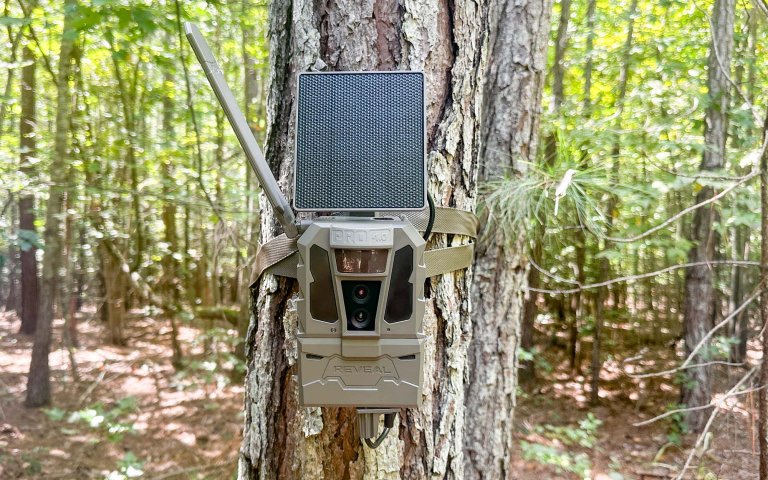
Tactacam REVEAL Pro 4.0 Solar
See It
Key Features
- Warranty: 1 year from activation date
- Photo Definition: 4K (UHD), 2.5K (WQHD)
- Flash Range: Low Glow – 96 feet; No Glow – 80 feet
- Memory: 8GB internal storage with optional SD card slot
- Power: 12 AA batteries (not included); optional external power source (5K External Battery Pack or solar panel included)
- External Power: DC 12V-2A input
- Live video
- Built-in monitor
- Built-in GPS
- Two-axis tree mount
- Includes: REVEAL Pro 4.0, solar panel and R5 battery
- Price: $200
I reviewed the REVEAL Pro 4.0 and conducted a walkthrough test, which evaluates trigger speed, night performance and detection range. The test involves walking from right to left, then left to right, at 10, 60, and 110 feet — day and night. The Pro 4.0 triggered with 100 percent reliability at 10 and 60 feet, catching me as I entered the frame from both directions during the day and at night. It did not trigger at 110 feet, day or night, which isn’t uncommon. With the camera set to Low Glow, it puts out a nice, even IR flash that illuminates a wide area out to about 100 feet. What I appreciate most is that it doesn’t blow out detail up close and still has plenty of brightness to clearly see animals at 60 feet. Like the 3.0, you can adjust between No Glow and Low Glow settings right in the app.
I wanted to see how the REVEAL Pro 4.0 performed when animals walked directly at it and directly away from it. Starting at 110 feet, I walked straight at the camera, and it captured me at about 10 feet. Starting from behind the camera, I walked straight past it, and it captured me again at about 10 feet.
In the Field
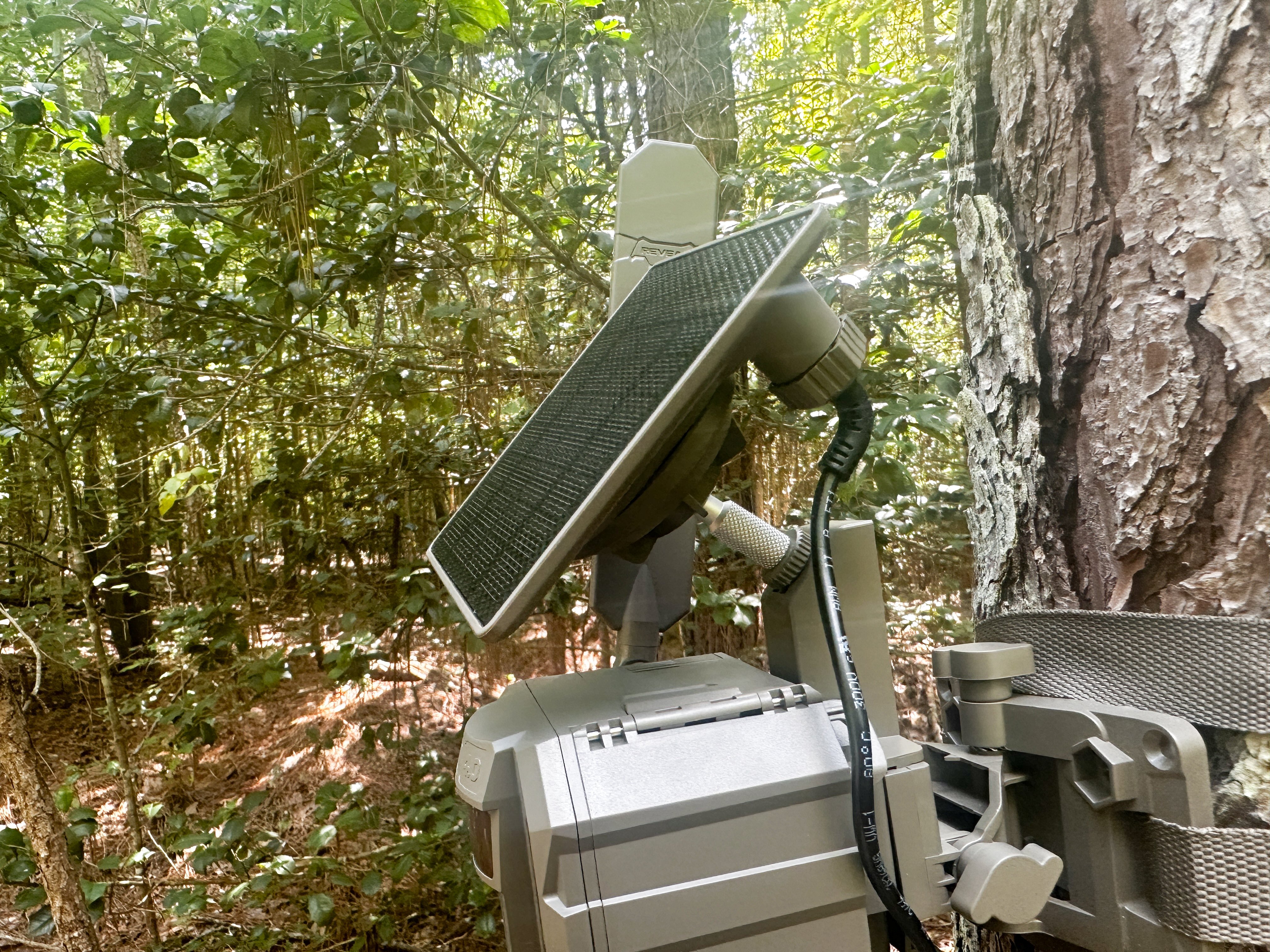
I deployed my REVEAL Pro 4.0 Solar on an old logging road, where it gets a few hours of sun per day, to see if that would be enough to maintain the battery. I’ve had success running the Tactacam Folding Solar Panel in the woods, so I wanted to see if the smaller panel that comes with the 4.0 Solar has similar capability.
I’m still early in my testing of the Pro 4.0 Solar, so it’s too soon to say how well the panel works with partial sunlight. I’d suggest giving it as much direct sun as possible and angling the solar panel toward the sun.
Best Hunting Knife: White River Knives Small Game Hunter
See It
Pros
- Sculpted handle
- Excellent for slicing and piercing
- Works well for small and big game
Cons
- Some hunters might want a slightly longer blade
Key Features
-
Blade Steel:
S35VN (58-60 HRC) or MagnaCut (62-64 HRC) -
Handle Materials:
Micarta -
Overall Length:
7.25 inches -
Blade Length:
2.62 inches -
Blade Thickness:
.130 inch -
Grind:
Flat -
Kydex Sheath -
Made in USA -
Price:
$160 (S35VN) or $180 (MagnaCut)
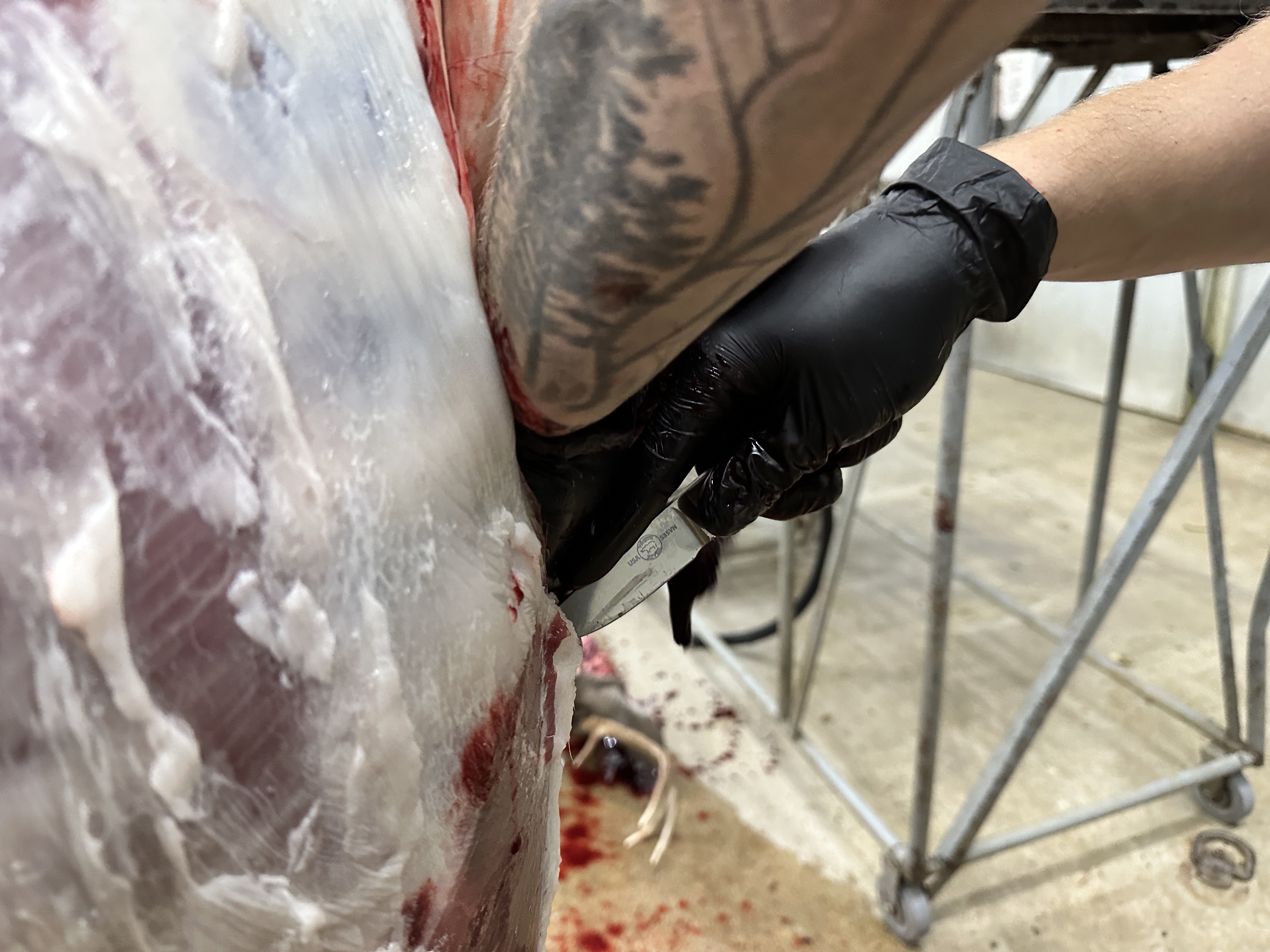
I have five things that I look for in a great hunting knife and of all the knives I tested, this is the one that ticks all those boxes. Its blade shape is perfect for field dressing, deboning, and caping. The knife is small enough to be easy to pack, but it has all the capability you need to process an animal in the field. The grind is slicey, which made it one of the top performers in my cut test. S35VN is a great steel because it has excellent corrosion resistance and strikes a nice balance of edge retention and toughness. The big handle allows a full grip and its coke-bottle shape makes for comfortable ergonomics. Its sculpted grip conforms to your hand with a hammer grip, thumb on the spine, or index finger on the spine. I like the ledge at the front of the handle, which is the perfect spot to place your thumb when using an index-finger-on-the-spine grip.
While this knife is called the Small Game Hunter, it by no means is limited to squirrels and rabbits. The 2.6-inch blade is all I need for field dressing and quartering a deer. This year, I lent it to a professional deer butcher who cuts up hundreds of animals per year, and he was impressed with this knife’s cutting ability and ergonomics. If you like the overall design, but want a larger blade I recommend looking at the 3.5-inch White River Hunter.

The Best Hunting Knives: 11 Blades from $30 to $300
See It
Pros
- Easy to replace blades
- Good blade shape
Cons
- Heavier than some replaceable blade knives
Key Features
-
Blade Length:
3.5 inches -
Blade Steel:
Japanese 420J2 Stainless -
Nylon pouch -
Weight:
6.4 ounces -
Price:
$40
A few years ago I found myself on the side of a mountain with five others trying to break down two elk as quickly as possible. We were hoping to get out of there before tempting the two grizzly bears just a ridge over. Everyone had different replaceable blade knives, but about halfway through the first elk it was obvious, which of the knives was the best — the RazorPro L. Its blades were the easiest to replace and the mounting system was trouble free. Other knives got gummed up and the blades came off, but the RazorPro L chugged through deboning the two elk flawlessly.
In my head-to-head test, the Outdoor Edge RazorPro L once again rose to the top. One of the most important tests I did with the replaceable blade knives was seeing how easy it was to replace the blades while they were all bloody and had meat bits wedged into the voids. I could change out the blades on the RazorPro L in a fraction of the time of the other knives.

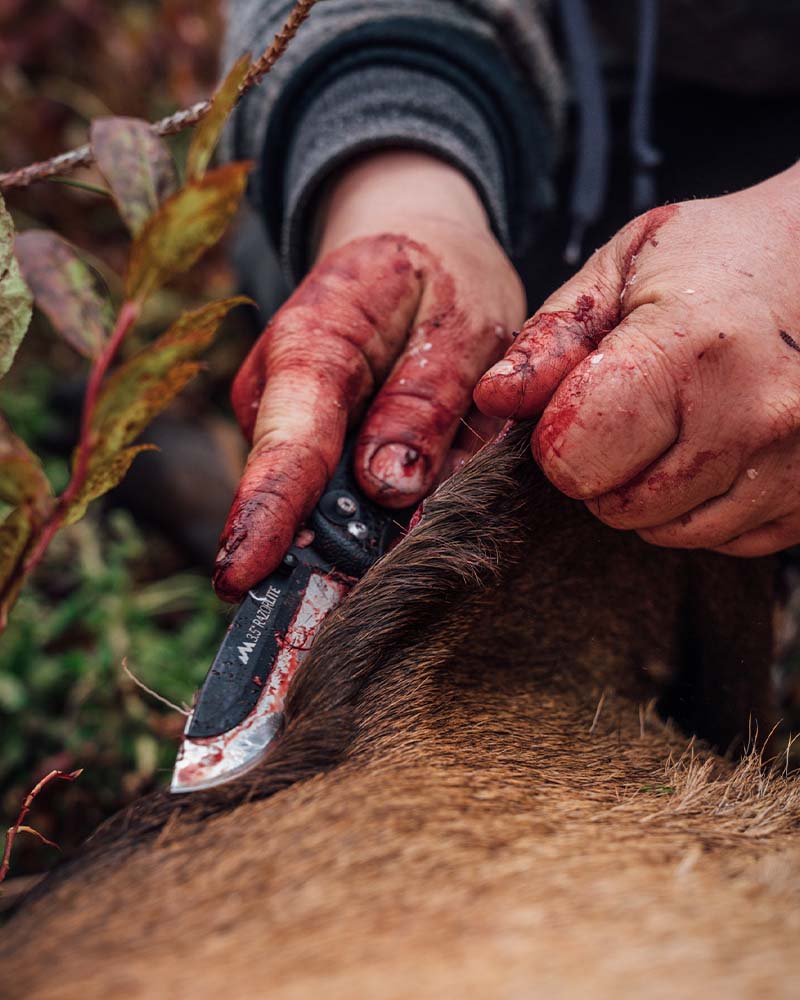
While the RazorPro L isn’t the lightest replaceable blade knife. It’s the most trouble-free design I’ve used. I don’t have blades pop off or break and can make it through an animal on one blade. When it’s time to swap a blade you just press the button, slide the blade out, and slide a new blade in. The rubberized handle stays grippy when your hands are covered in blood. The 3.5-inch blade is a good length for balancing maneuverability and cutting efficiency.
Read Next: Best Hunting Knives
Optics
Best New Binocular: Nikon Monarch M5 10×50
See It
Pros
- At 22.6 ounces, lightweight
- Fiberglass-reinforced polycarb chassis
- Excellent ED glass and premium coatings
- At $390, fairly priced
Cons
- Square eyecups don’t fit all faces
- Disappointing close focus
Key Features
-
Extra low-dispersion glass -
Closed-hinge design -
Right-barrel diopter -
¼-20 tripod adapter -
3-position eyecups -
Lifetime warranty -
Price:
$390

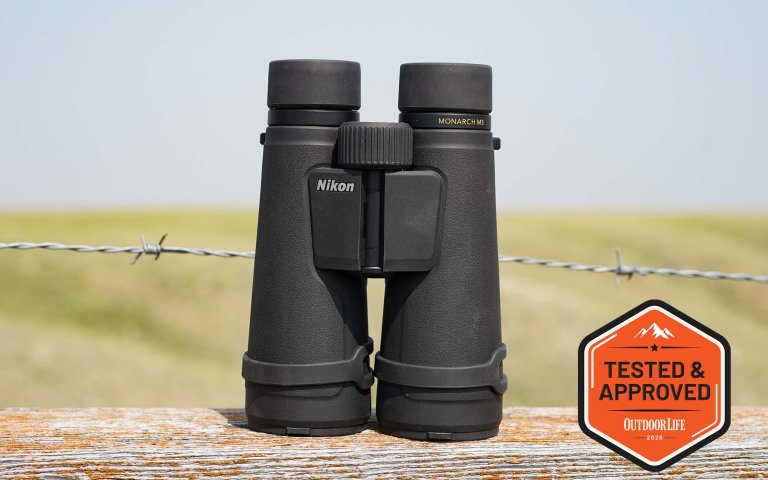
That there’s little to say about this binocular except its pretty good image and nice handling says everything about it. It’s not trying too hard to wow you with boutique glass, or seduce you with racy styling. It’s about as plain Jane as a binocular gets, and yet Nikon’s Monarch M5 won our Editor’s Choice award as the top binocular of 2026 by being reliable, bright and crisp enough, and affordable.
The 10×50 version we tested has a little more image brightness than a 10×42, and the 6 ½-inch tall chassis is a handful. But the image is crisp right to the edge with excellent color rendition and contrast, the controls are pleasingly responsive, and the ergonomics encourage you to glass all day. The 10×50 Monarch M5 sells for $390, which we think is a bargain.
By stacking performance, value, and utility in a durable package, Nikon topped 14 other new binoculars to take our top award.
Testers especially liked the image quality and solid hand feel, but wished for a locking diopter. The 3-position eyecups are a little too square for some testers’ faces, but the lightweight 22-ounce build — the chassis is fiberglass-reinforced polycarbonate — balances nicely in hand and in a chest harness.
“It’s an all-day hunting binocular,” noted tester Nate Ward. “The image quality is surprisingly good for the price.”
The Nikon fared poorly in our low-light test, despite its big 50mm objective lenses. That may be evidence of sub-par glass, but in daylight conditions we could find no flaring, optical aberrations, or color shifting.
For a workaday binocular that is durable, reliable, bright, and affordable, we can’t recommend Nikon’s Monarch 5 10×50 strongly enough. The consensus of our test team is that Nikon doesn’t charge enough for it.
Nikon Monarch M5 10×50 Specs
- Magnification: 10-power
- Objective Lens: 50mm
- Stated Light Transmission: N/A
- Exit Pupil Diameter: 5.0mm
- Twilight Factor: 22.36
- Field of View: 315 feet at 1,000 yards
- Close Focus: 14.8 feet
- Weight: 22.6 ounces
- Length: 6.5 inches
Read Next: Best Binoculars for Hunting
Budget Compact Bino: Hawke Vantage HD 8×34
See It
Pros
- Open-barrel design enhances one-hand operation
- Great travel optic
- Lightweight polycarb body
- At 15.2 ounces, very lightweight
- Tripod mountable
- At about $170, priced right
- Lifetime warranty with registration
Cons
- Some uncoated internal lens surfaces
- Spongy focus
Key Features
-
Dual-hinge, open-barrel design -
2-position eyecups -
Front-hinge tripod adapter
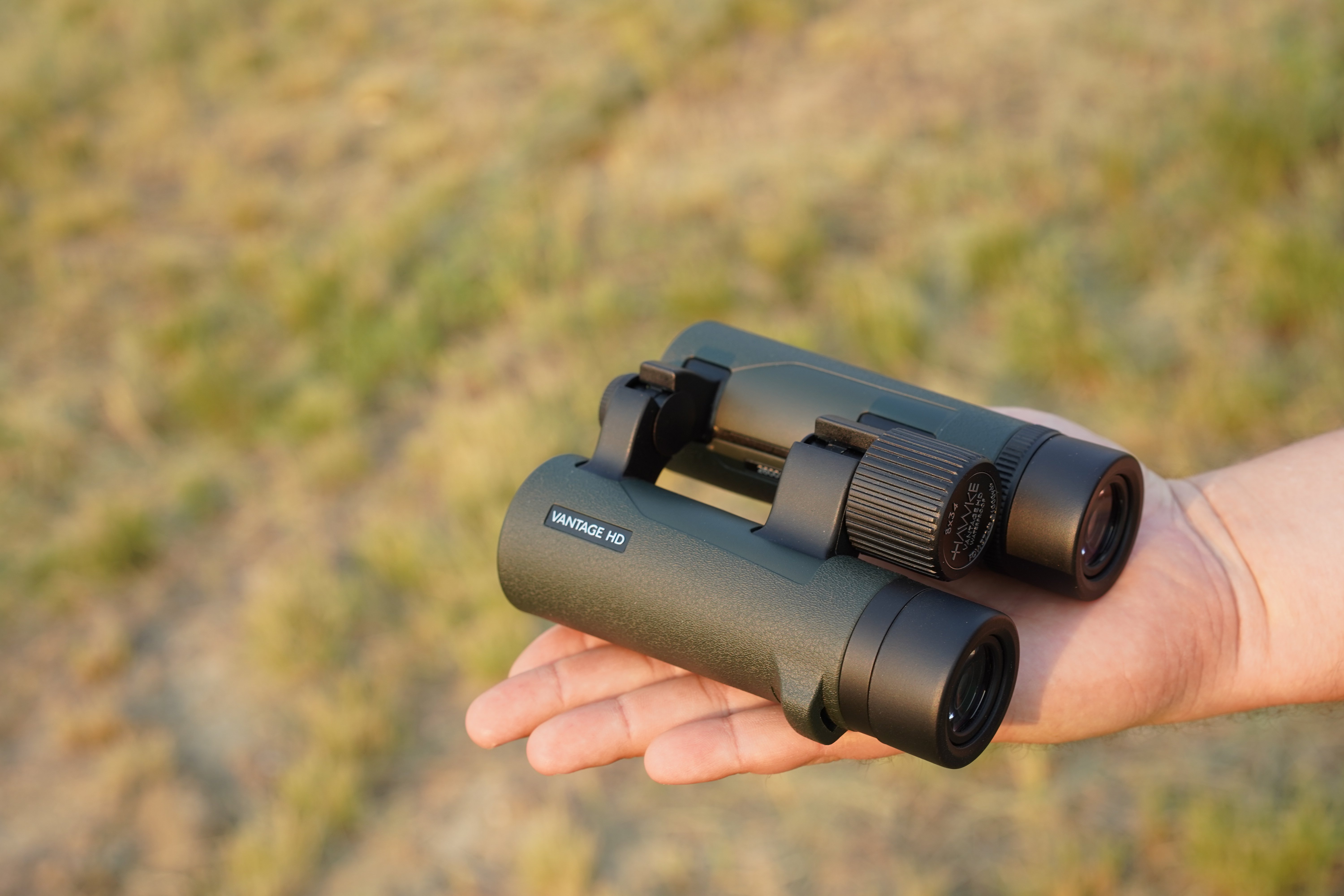
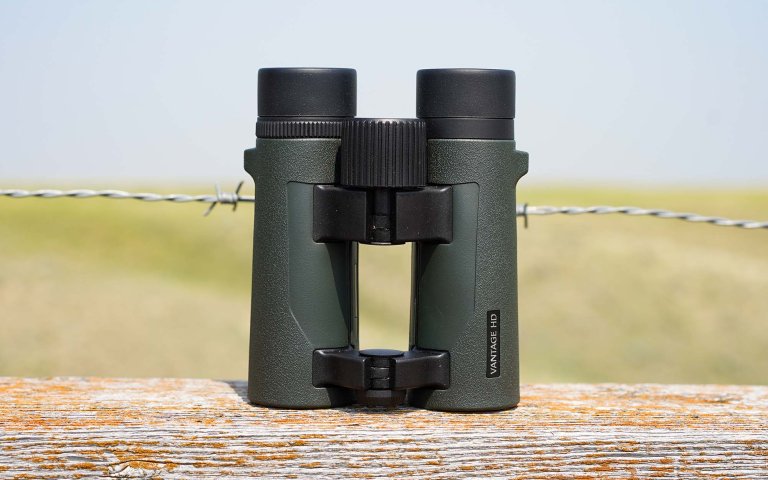
For walk-about bowhunters, a binocular that enables one-hand operation is a gift. The alternative of two-hand deployment means they have to set their bow down on the ground or place it in a belt rest or somehow free up their other hand.
Hawke’s new super-compact 8×34 Vantage HD is the ultimate one-hand binocular. Its open barrels allow users to confidently grip the bino, and it’s so lightweight (less than a pound) and compact that it’s easy to grab out of a harness or a jacket pocket. This little powerhouse might also be the ultimate travel optic, easy to pack and produce when you want to see the details of a gargoyle gracing a Medieval cathedral, for one instance.
I packed this binocular on an Argentine dove hunting expedition, and used it to identify birds that were similar to their North American cousins, but just different enough that I spent nearly as much time observing birds as I did shooting them.
Hawke has wisely noted that 8-power is the perfect magnification for this super-compact build. Many brands put 10-power magnification in this micro frame, but that’s wrong, since it produces a tiny exit pupil and it’s hard to hold the powerful magnification in a chassis that doesn’t have hand-filling heft.
We worried about the durability of the polycarbonate chassis and noted some uncoated internal lens surfaces, but at about $170, this binocular is priced right for its abundant utility and outrageous per-pound performance.
Hawke Vantage HD 8×34 Specs
- Length: 5.2 inches
- Magnification: 8-power
- Objective Lens: 34mm
- Light Transmission: Not available
- Exit Pupil Diameter: 4.25mm
- Twilight Factor: 16.5
- Field of View: 372 feet at 1,000 yards
- Close Focus: 9.8 feet
- Weight: 15.2 ounces
Best Rangefinder: Leupold RX-Fulldraw 5
See It
Pros
- Selectable reticles
- Customizable arrow dynamic inputs
- Compatible with low-velocity arrows
- 6- to 1,200-yard range
Cons
- No tripod mount
- Ballistics input process is tedious
Key Features
-
6x22mm monocular -
Customizable arrow ballistics -
Flightpath technology -
Archer’s Advantage
Why It Made the Cut
Leupold has adapted the ballistic inputs that long-range rifle shooters use to guide bullets to archers and their arrows. Both the company’s “Flightpath” technology and two modes that define arrow dynamics help archers make shots in just about any conditions or angle. This unit can be used for just about any other ranging requirement but is configured for precision archery.
Product Description
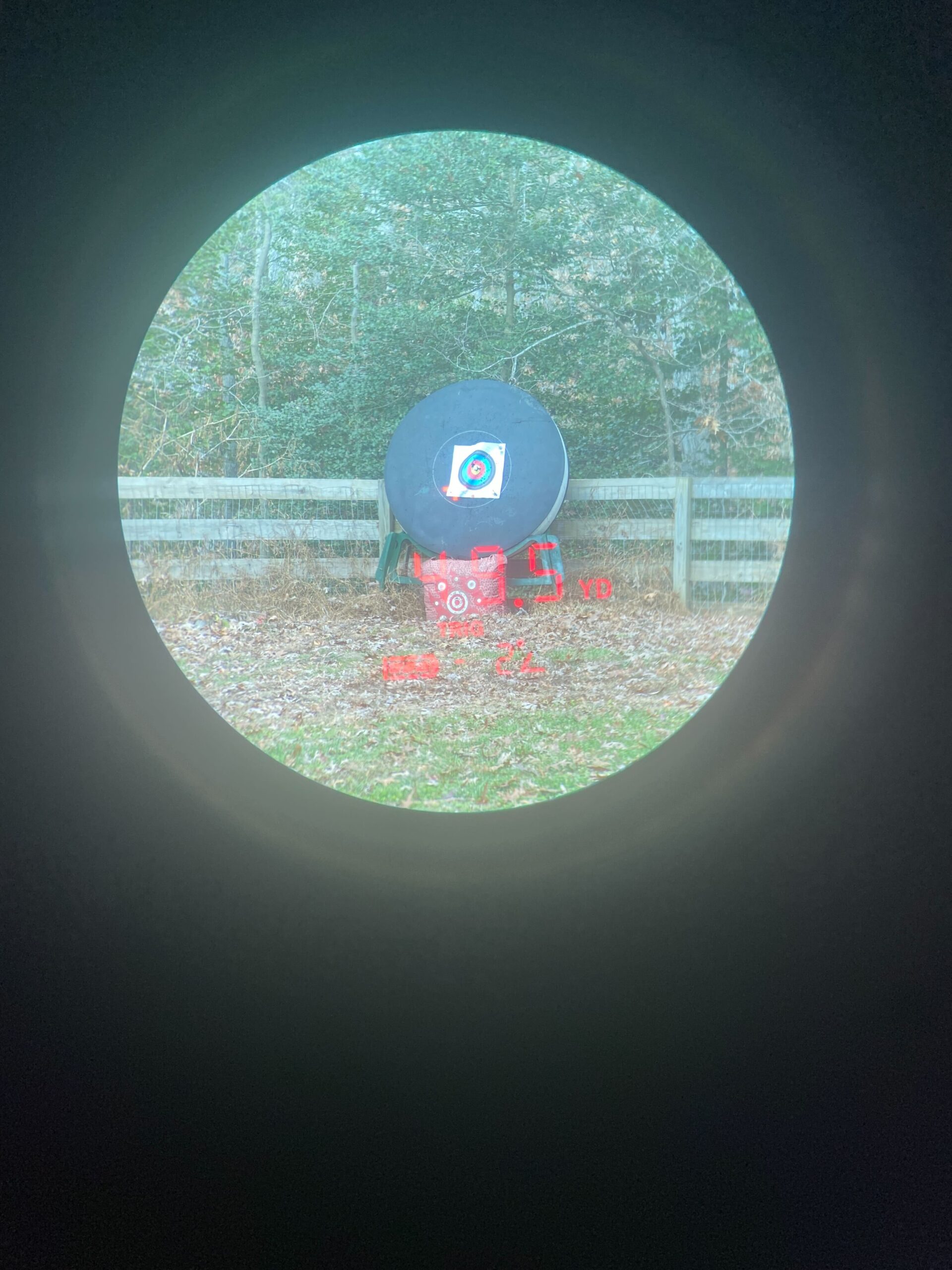

The most precise archery-specific rangefinder on the market, the new RX-FullDraw 5 builds on the attributes of the FullDraw 4, which introduced integrated Archer’s Advantage software that allows bowhunters to shoot a range and then compensate for limbs and other obstacles that might impede their arrow. It also removes the need for a cut chart when shooting extreme angles. The angle compensation makes this a must-have rangefinder for anyone hunting sheep, mule deer, or aoudad in the cliffs.
The FullDraw 5 has a 20-yard pin solution that improves the Flightpath technology, a rain/fog mode that enables close shots, Leupold’s excellent DNA ranging engine, and new ranging software that accounts for lower arrow velocities, a feature that will appeal to traditional archers or compounders trying heavy arrows.
Read our full review of the FullDraw 5 to learn more.
Best Bino Harness: Eberlestock Recon Modular Bino Pack
See It
Pros
- Extremely modular
- Elastic bino tethers
- Excellent adjustability
- Comfortable padded shoulder straps
- Useful MOLLE and Velcro rear panel
Cons
- Poor rangefinder protection
- No bottom magnet to hold open lid
Score Card
-
Protection/Accessibility:
Very Good -
Adjustability/Comfort:
Excellent -
Durability/Material/Style:
Very Good -
Modularity/Versatility:
Excellent -
Price/Value:
Excellent
Key Features
-
Magnetic forward pull bino pouch -
Large front zipper pocket -
Stretch side pockets -
MOLLE-compatible wings enable modularity -
Available in medium and large sizes and six colorways
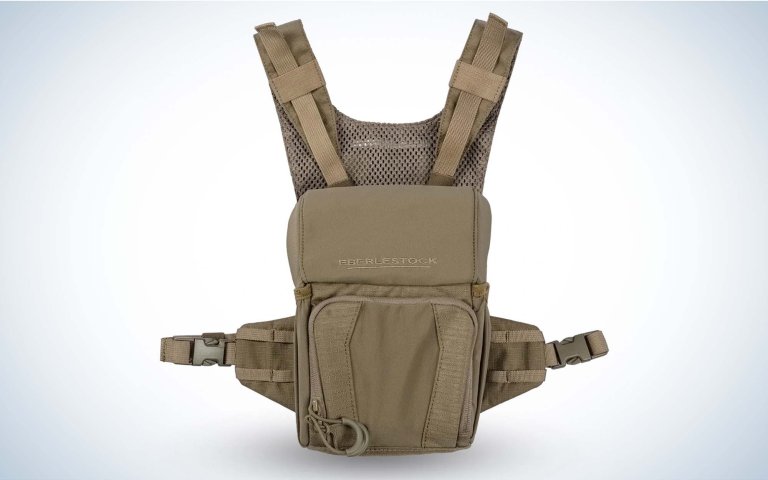
The consensus pick as the top binocular harness in our field, the Eberlestock Recon offers excellent binocular protection, but its main asset is the ease with which accessories attach to the base unit. We added a laser rangefinder pouch to one wing, a fleece-lined hand warmer pocket below the optic pouch, a bear-spray pouch, and an accessory pouch that would be useful for a knife, ammunition, or a communications device.

The Recon won high marks for its comfortable and extremely adjustable forward-pull shoulder harness, its durable material that has decent sound muffling, and its wide range of accessories. The strap system fit every test-team member, with enough strap extension to fit a puffy jacket for cold-weather hunting.
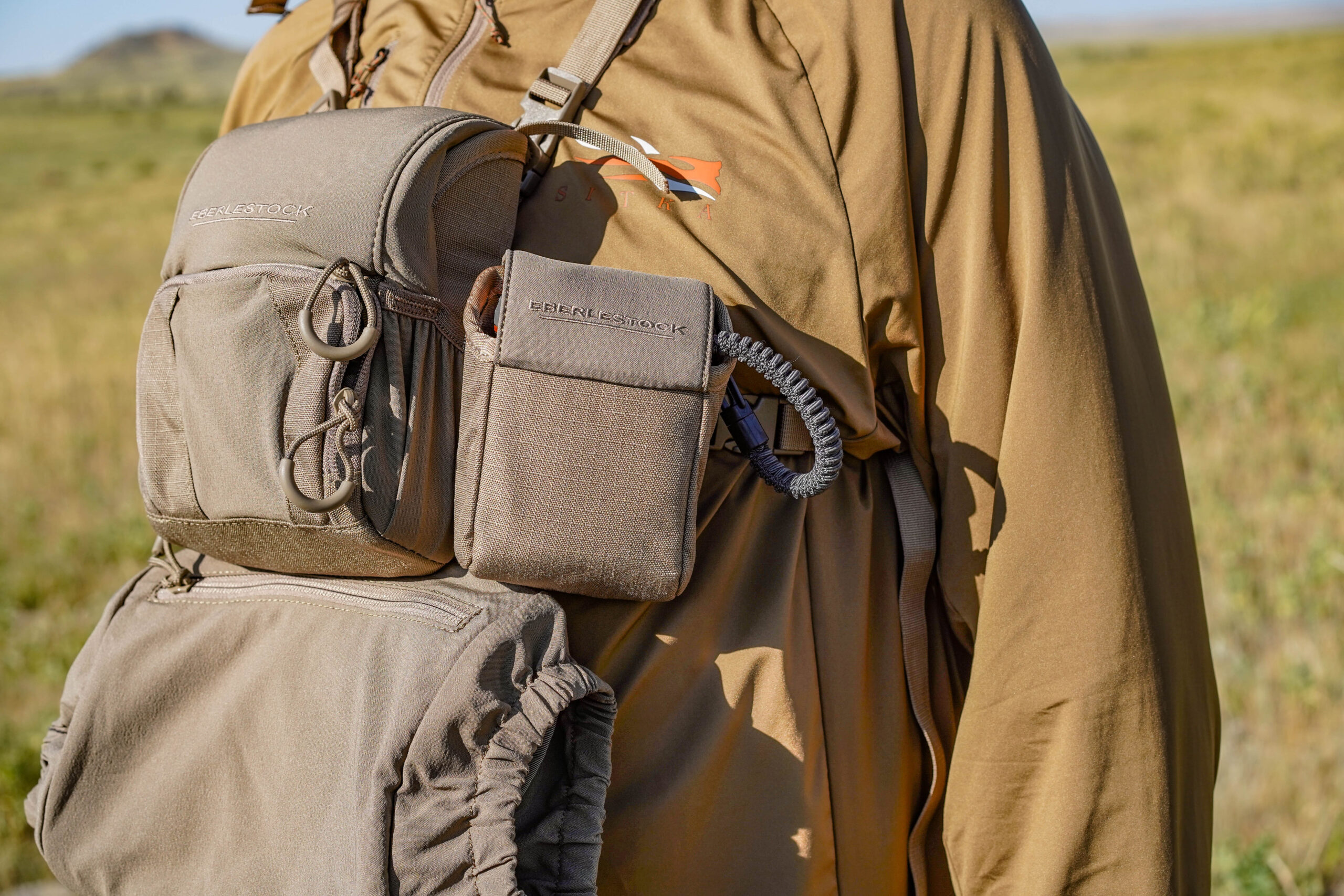
During our prone-shooting, crawling, and bounce testing, the Eberlestock did not sag or shift, and even with attachments, did not limit arm rotation. Testers liked the additional bear-spray pouch but wondered if it would fit large-diameter cans. The rangefinder pouch doesn’t add much protection, and testers want to see a better strap on the lid of the optics pouch. “The lift handle is not ergonomic,” says tester Luke Coccoli. “I found I had to twist my wrist in order to pinch the flap to open it.”
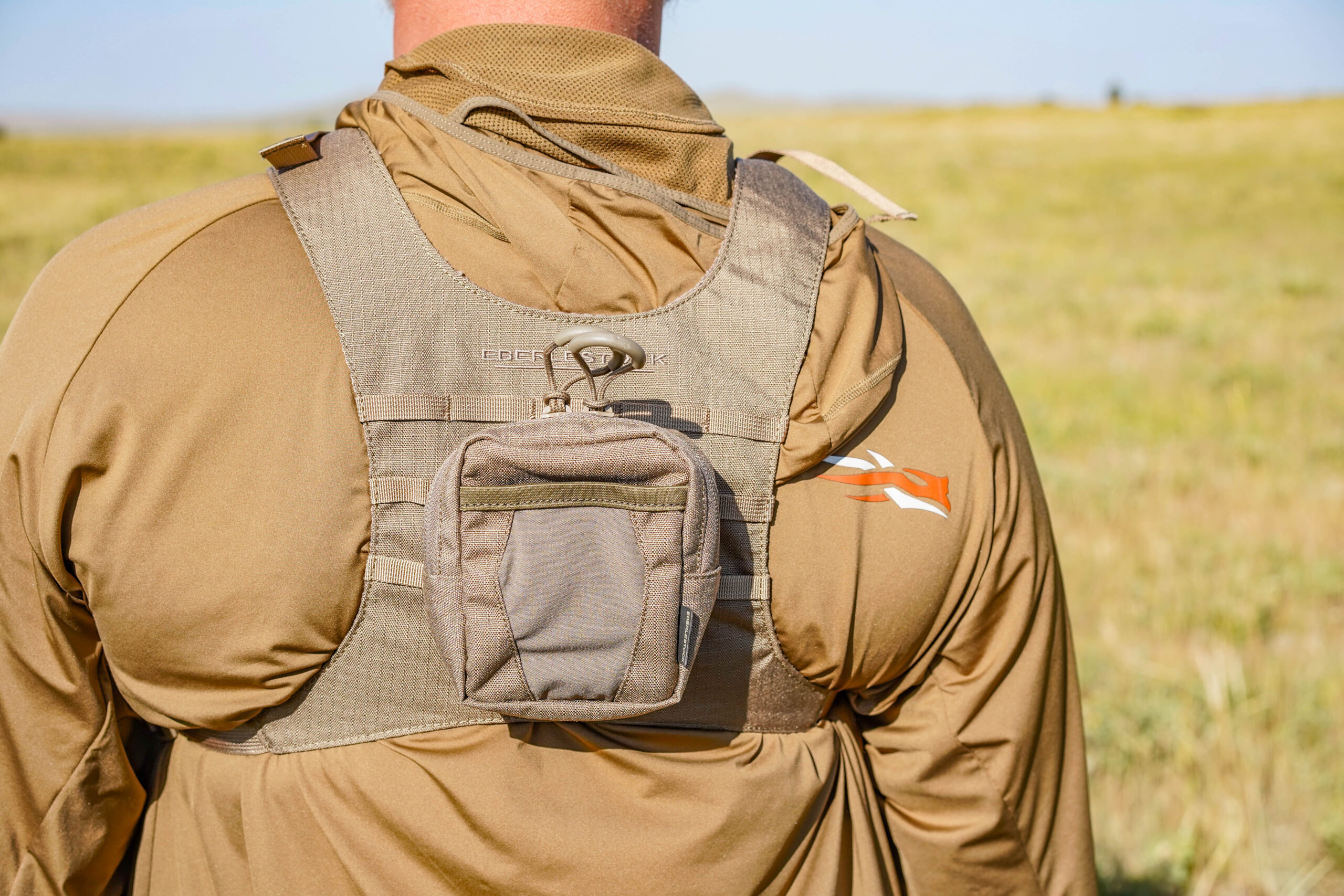
But those are fairly small quibbles. The base Recon does its job, carrying and protecting a binocular, with style and ease, and is one of the best all-around binocular harnesses our testers have ever encountered. And, at about $130, it’s a very good deal for an amazing amount of performance.
Read Next: Best Binoculars for Hunting
Best Value Bino Harness: Badlands Bino Mag2
See It
Pros
- Lid offers very good protection
- Magnetic closure is quick and durable
- Bow hook is extremely useful
- Updates venerable design
- Breathable suspension straps
Cons
- Magnetic closure can be loud
- Bottom attachment insufficient for bear spray
- Among the “bounciest” units
Score Card
-
Protection/Accessibility:
Very Good -
Adjustability/Comfort:
Very Good -
Durability/Material/Style:
Very Good -
Modularity/Versatility:
Good -
Price/Value:
Very Good
Key Features
-
Stay-open magnetic lid -
Rear magnetic-closure pocket -
Quick-release carabiner rings -
Bow hook -
Bottom accessory attachment points -
Three sizes and four colorways
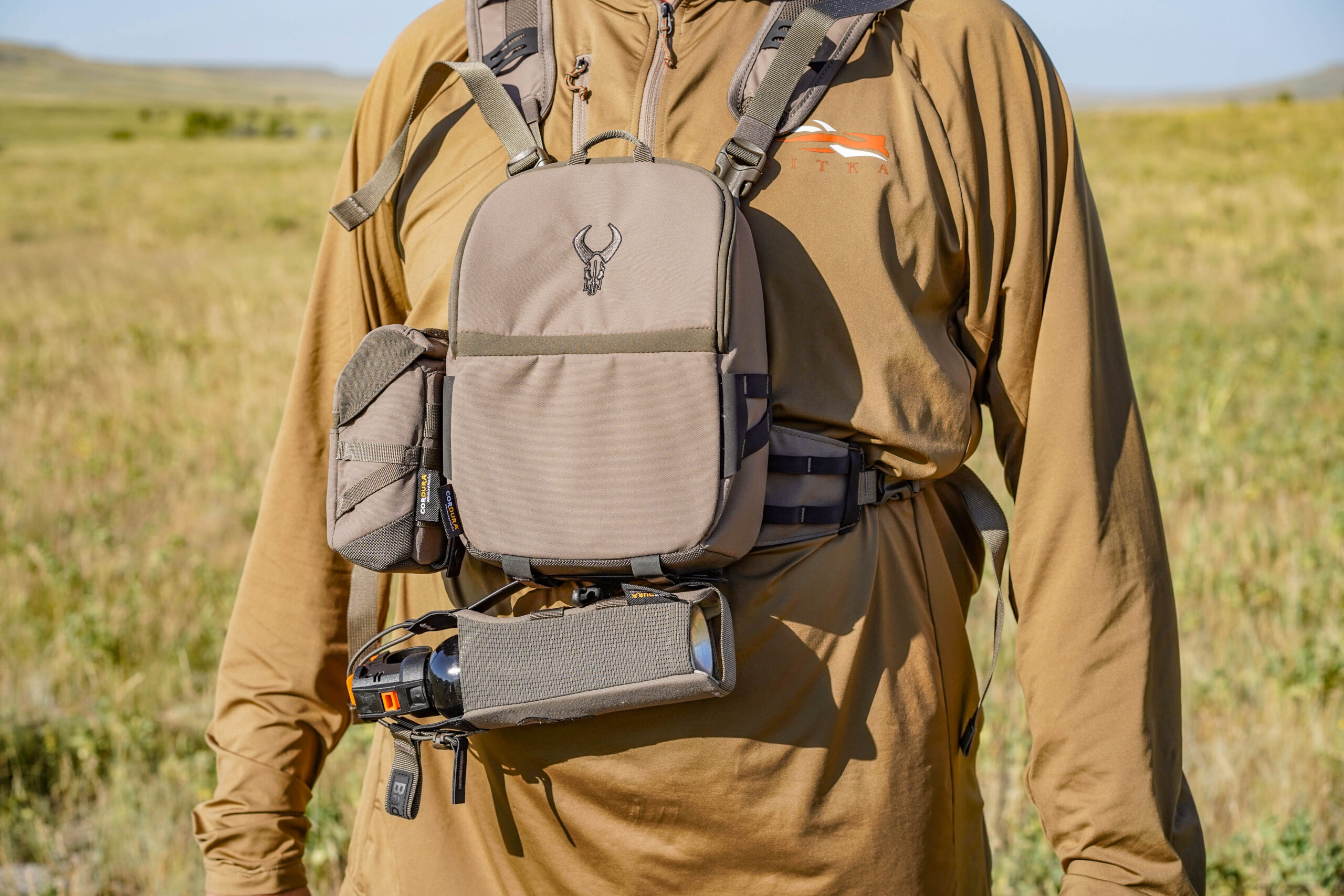
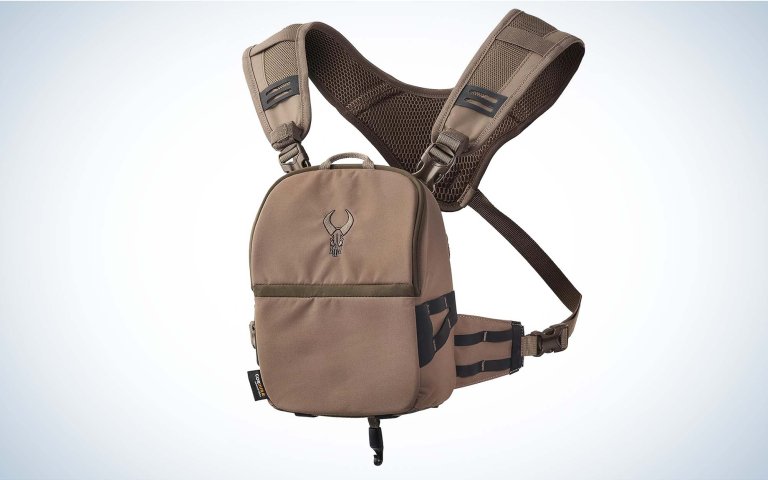
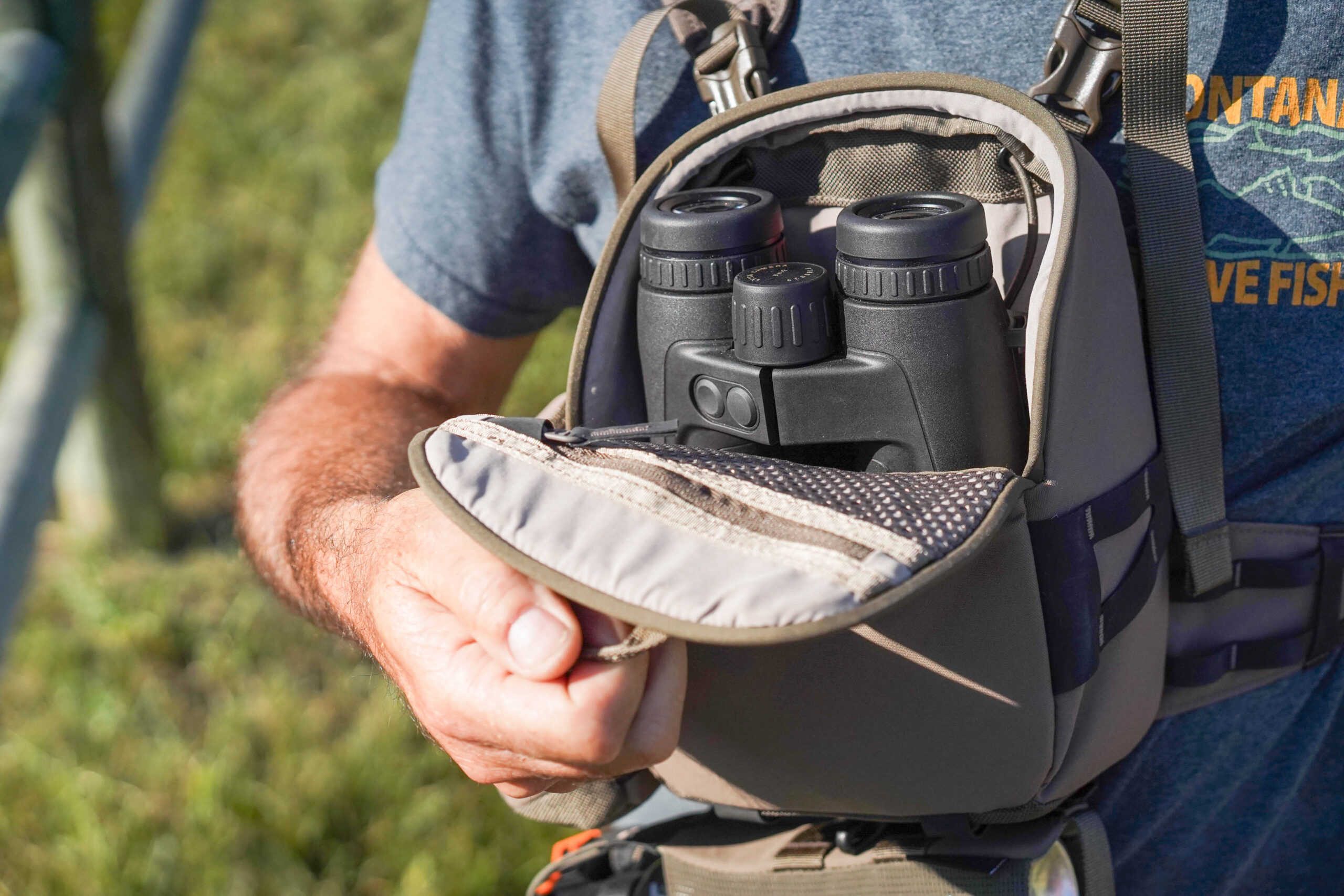
The original Badlands magnetic-closure bino harness has become an OG of the industry. It led the, um, pack in terms of inventing a useful, extremely portable and protective house for binos of just about any size. The new Mag2 brings some useful updates to its predecessor. A secondary magnet holds the lid open, and the buckled attachments enable Badlands to add a spacious rear pocket, also held closed with a magnet, behind the main optic compartment. This is a useful pouch for a phone, folded map, or a portable power pack.
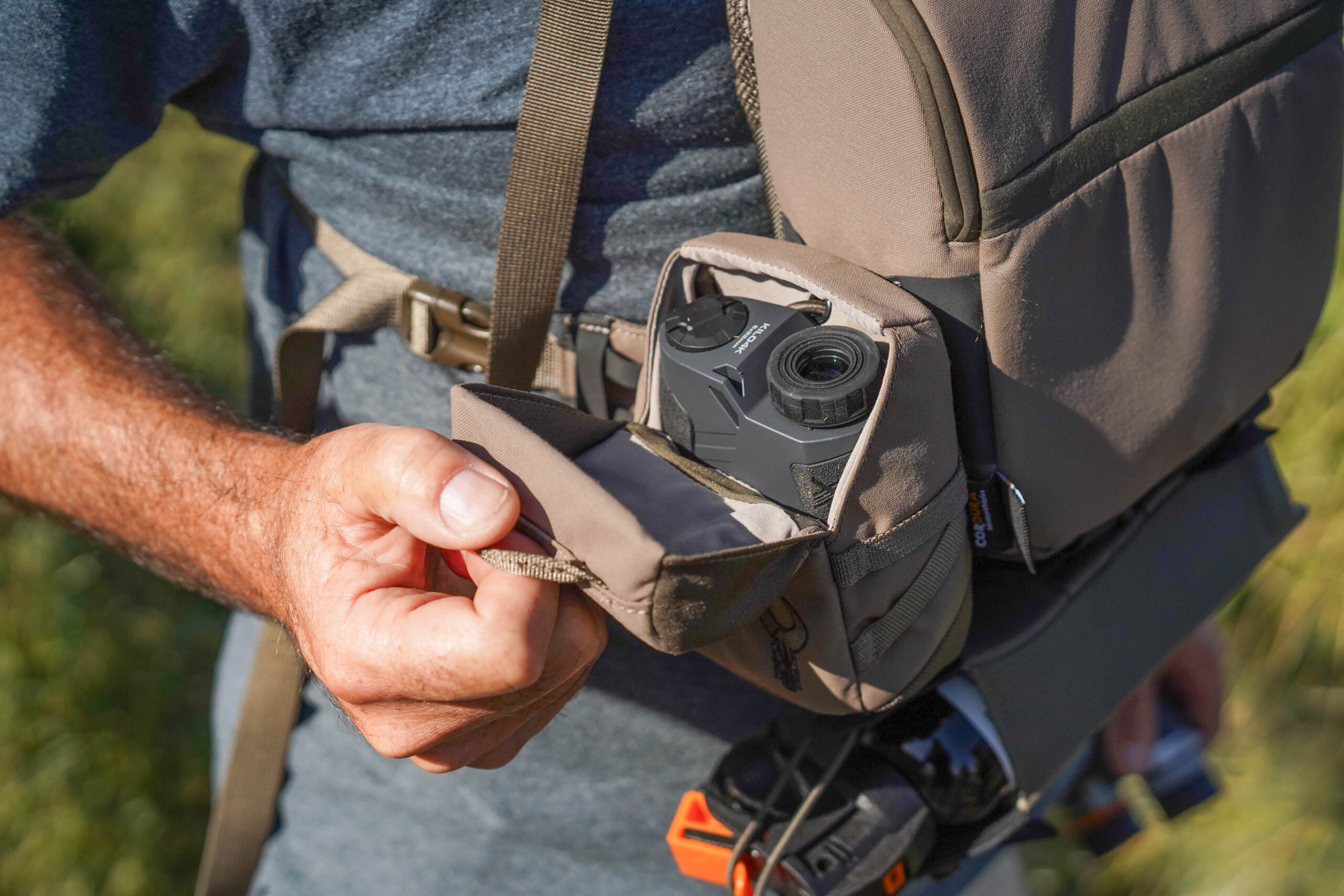
We like the breathable mesh that is sewn onto most surfaces that contact the body. And Badland’s bow hook, which enables archers to clip their bowstring right to the bottom of the pack, leaving hands free to glass, is genius and effective; we recommend other manufacturers consider this simple accessory. The main optics pouch has attachment points on either side, and wings as well as bottom connections allow for further attachments.
We played around with various configurations, attaching accessories both horizontally and vertically, and found the bear spray pouch wasn’t secure enough. That wasn’t due to a design defect, rather it was a failure to read the instructions. Instead of passing the strap straight through the webbing, we should have weaved it through and to secure it. In our defense, it’s not the most intuitive design.
Some testers felt the rangefinder pouch—which features the same double-magnetic closure that Badlands uses for its main optics pouch—was hard to reach in a sideways orientation. Happily, all pouches have enough attachment points that they can be configured just about any way a user wants, though getting them tight enough that they don’t flop is a challenge.
The test team had mixed reviews of the metal carabiner rings used to attach and detach optics quickly. Most felt they were overly heavy, others felt they were a very useful asset.
The Mag2 was one of the bounciest units in our test of the best binocular harnesses, probably because the straps tended to slip and move as a result of the breathable “AirTrack” suspension material. But given the level of optics protection and the ease of using the magnetic lid, the new Mag2 is an excellent update to an old favorite. And, at about $140, it’s a whale of a lot of value for the money.
Read the full article here