

“Remember the buffalo!” These words might well be added to America’s Conservation Pledge. And if American sportsmen ever have to demonstrate, especially for youngsters, the necessity of wise laws and decent self-restraint, let them tell the story of the American bison (to give the buffalo his true name), and how he was virtually exterminated by a horde of greedy, wasteful men.
Just the bare statistics are shocking. Wildlife authorities estimate that before the coming of the white man, not less than seventy-five million buffaloes probably roamed the length and breadth of this continent. That, brother, is a lot of game—roughly, the equivalent of one buffalo for every two persons now living in the United States. But by 1890 there weren’t more than 200 of them left!
The slaughter began almost as soon as the white man first set foot on these shores. The Indians, of course, had been hunting the buffalo for centuries, but they weren’t greedy or wasteful, and their bows and arrows made little dent in the bison population. But when the white explorers came, after the year 1500, and started to prowl around, how the story changed!
Curiously enough, the first European to lay eyes on a buffalo saw it in a menagerie! The man was Cortez, the Spanish conqueror of Mexico, and the menagerie was one that had been assembled by the famous Aztec emperor Montezuma. The Spaniards were quite startled by this new type of “cow.” One of them wrote learnedly that it was a “composite of several and divers animals,” since it had the lion’s mane, flanks, and tufted tail; the goat’s beard; the camel’s hump; and the cow’s hoofs.
But the Spaniards were in for a much greater shock when they first saw the buffalo on his native heath. Never in their lives had they come upon such an enormous concentration of animals. One little band of explorers made a dramatic report of their discovery. They were first attracted, they said, by a peculiar, reddish dust haze beyond a range of low hills. Climbing a hill to investigate, they were startled by the sight of a vast “brown sea,” a restless, moving mass of animals that stretched as far as the eye could see to the horizon itself. Buffaloes—hundreds of thousands of them. That was only the beginning. The explorers pushed onward for weeks and weeks, and never lost sight of the animals. They sent glowing accounts back to Spain, declaring the new “cattle” to be “plentiful as the fish in the sea,” and raving over the excellence of the meat.
Then—having proved that the new land had a treasure well worth the price of admission—the explorers turned on the buffaloes and began to slaughter them with almost insane enthusiasm. Why? Apparently just for the fun of it. And otherwise sensible Americans did exactly the same thing 400 years later!
The buffaloes were as easy to shoot as carp in a barrel, even for Spaniards carrying such clumsy, primitive firearms as the harquebus and the matchlock musket. These big weapons—as awkward as the modern bazooka—were often so heavy that two men were needed to aim and fire them. Reloading was a major operation. But those drawbacks didn’t matter a whit in buffalo shooting. The bulls were jammed shoulder to shoulder right out in front of you. If you missed one you were bound to hit another.
Even so, shooting the heavy weapons was tiring work. So one daring cavalier made a thrust at a buffalo with his pike (a spear carried by European soldiers) and was surprised to see it fall dead. From then on, the boys carried on the slaughter with renewed zest, beginning a campaign of cruelty and waste that wasn’t to end until almost the last buffalo on the continent was left dead on the plains.
Herds Ranged the Country
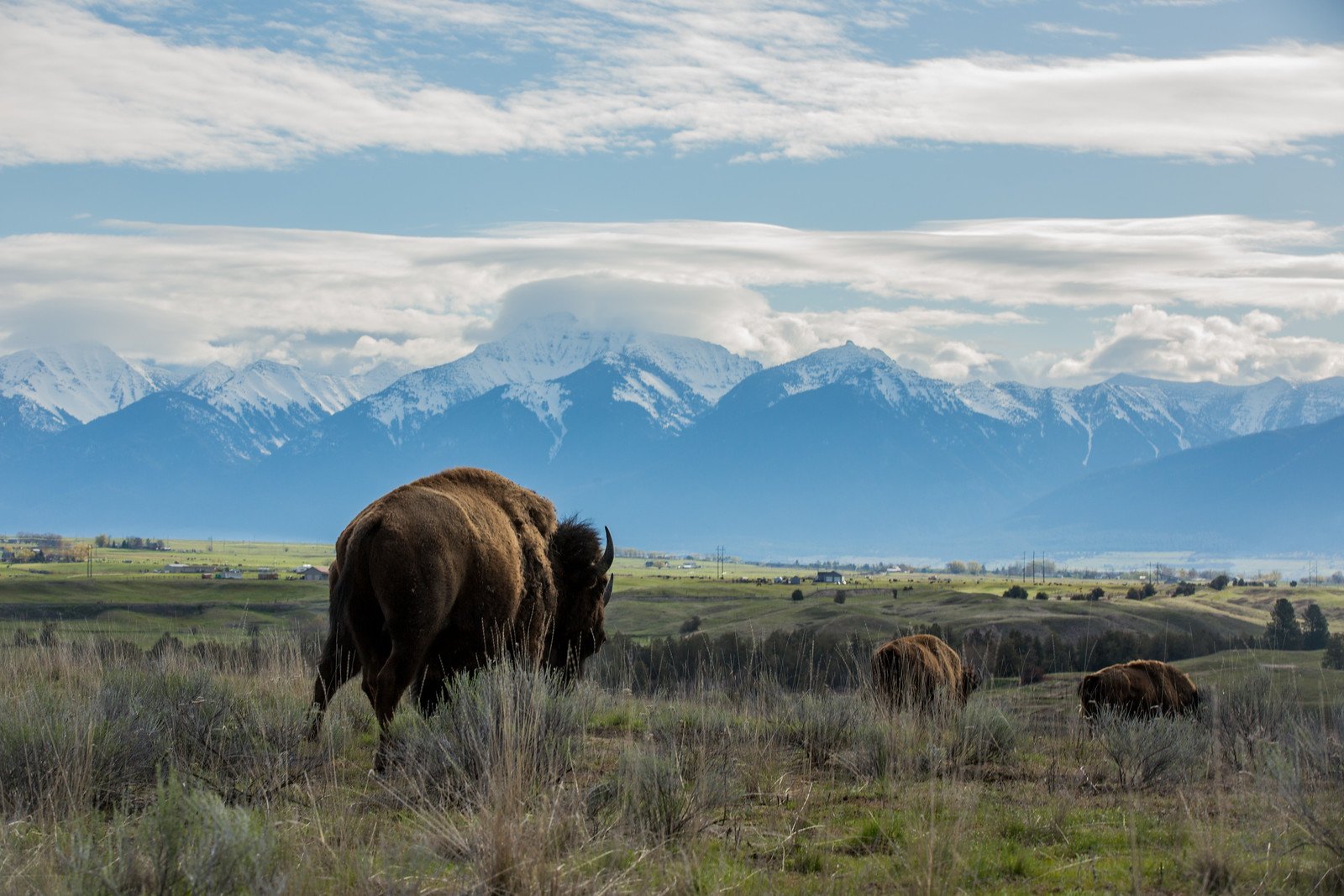
In early days, the herds ranged in practically every section of the country—from the Atlantic seaboard to the Rockies; from Mexico to the subarctic. Like the deer of different regions, they varied in size, color, and other characteristics. Biggest of all was the “woods buffalo” of the Canadian north, the Mackenzie–Great Slave Lake country. A somewhat smaller type roamed the western slopes of the Rockies; there weren’t so many of them and they disappeared quite early. The East had its coal-black, humpless “Pennsylvania buffalo,” which lived in the hardwood forests and grazed in the adjoining grasslands.
But the great granddaddy of them all was the magnificent “plains buffalo.” He ranged what scientists believe was the original buffalo country—the Midwestern and Western plains from the Mississippi to the Rockies. He was big, though not so big as the “woods” type. A typical, full-grown plains bull—about seven years old—stood 5½ or six feet high at the shoulder and weighed 1,700 or 1,800 pounds. That was the average weight—some of the bulls ran a ton or more.
The average bull sported horns fourteen or fifteen inches long—but again many had longer ones. The record horns—taken on a trophy Wyoming bull—have an outside length of 22½ inches and a maximum spread of 35½.
One fact is inescapable in the buffalo’s story—he and civilization couldn’t get along together. Even if it could have been accomplished, there would have been little practical value in attempting to domesticate him. Among other considerations, his meat was inferior to that of the domestic steer. Permitted to run wild, he was far too destructive to remain a neighbor of the farmer. Imagine what a herd of buffalo could do—and frequently did—to a farm or plantation! And there was one final fact: The buffalo occupied land the white man wanted and needed.
The eastern buffalo was the first to go, since the East was the first area to be fully developed. As farmers cleared away the forests the black bison gradually fell back before them. Finally he was driven by hunger into raiding the farms. Retaliation was swift and merciless. The settlers classed the bison with the gray wolf as a nuisance and hunted him accordingly. By 1800 there were only a few left east of the Mississippi; by 1820, none at all. On the other side of the continent, Spanish settlers were also busy exterminating the Rocky Mountain type.
By 1830 or thereabouts only the plains buffalo remained. But there were a lot of them—perhaps 50 million or more. A new factor, though, was rising to menace them: a demand in the East for warm, luxurious “buffalo robes,” so popular in the days of the horse-drawn carriage and sleigh. White traders moved out onto the plains and enlisted the Indians in the slaughter by offering them rotgut whisky, firearms, ammunition, and staples like flour and sugar in exchange for buffalo hides. They’d go as high as $1 for a skin that would bring $100 from the Eastern “carriage trade.”
Large numbers of Indians began roving the prairies—the braves killing buffaloes, the squaws skinning them out. By 1830 the carnage had reached terrific proportions. It was estimated then that at least three million buffaloes were being killed each year. That went on until the Civil War, when an enforced lull set in.
But when the war was over the final, dreadful climax in the slaughter of the buffalo was at hand. The plains herds then numbered somewhere around 20 million head, and they ranged from the Kansas and Oklahoma territories west to the Rockies, and from Texas up beyond the Canadian border.
The word had spread that a man could make his fortune killing buffaloes. “There are millions of them,” one Easterner would tell another. “They’re easy to kill, and their robes sell for $100. What are we waiting for?”
A horde of adventurers began to pour westward. There were newly discharged Civil War soldiers, carrying military muskets, ruined Southerners seeking a new start in life, boys from the farms, clerks from the cities, ne’er-do-wells from everywhere. They carried a weird variety of guns—old cap-and-ball pistols, smooth-bore muskets, Kentucky rifles, and big Colt revolvers. They speedily found, though, that they could not make a fortune killing buffaloes; in fact, most of them couldn’t earn enough to feed themselves. Buffalo hunting, they discovered, was a job for experts. But as fast as they quit, new recruits came to take their places. At the height of the slaughter it is probable that from 10,000 to 20,000 hunters were in the field.
“Sportsmen” Join the Slaughter
They included a number of so-called “sportsmen.” An Englishman, Sir George Gore, is a good example of the type. He arrived in the West in 1854 with an imposing retinue of servants, a private arsenal, and a burning desire to see how many buffaloes he could kill. Having hired Jim Bridger, noted frontiersman, as a guide, Gore swept into the Wyoming area for a protracted hunt which produced a bag of 2,500 buffaloes, forty grizzlies, and innumerable deer, antelope, and elk. Finally, the government intervened on behalf of the Wyoming Indians, whose food supply was being destroyed before their eyes. But it did nothing else to prevent the extermination of the bison. In fact, when important foreign personages indicated a desire to hunt in the West, the government assigned high-ranking Army officers and detachments of cavalry to assist them.
The competent professional hunters—men who had a considerable investment in equipment—despised the amateur invaders. And for good reason: they wanted to keep the buffalo-skin business for themselves rather than see it ruined by men who killed five buffaloes for every skin they managed to sell. The professionals usually shot only as many bulls as their skinners could handle. Why waste effort and ammunition—especially when factory-loaded cartridges sold for 25 cents apiece on the plains? The seasoned skin hunters were frugal; most of them reloaded their own cartridges, and were not likely to waste them. Some even cast their own bullets.
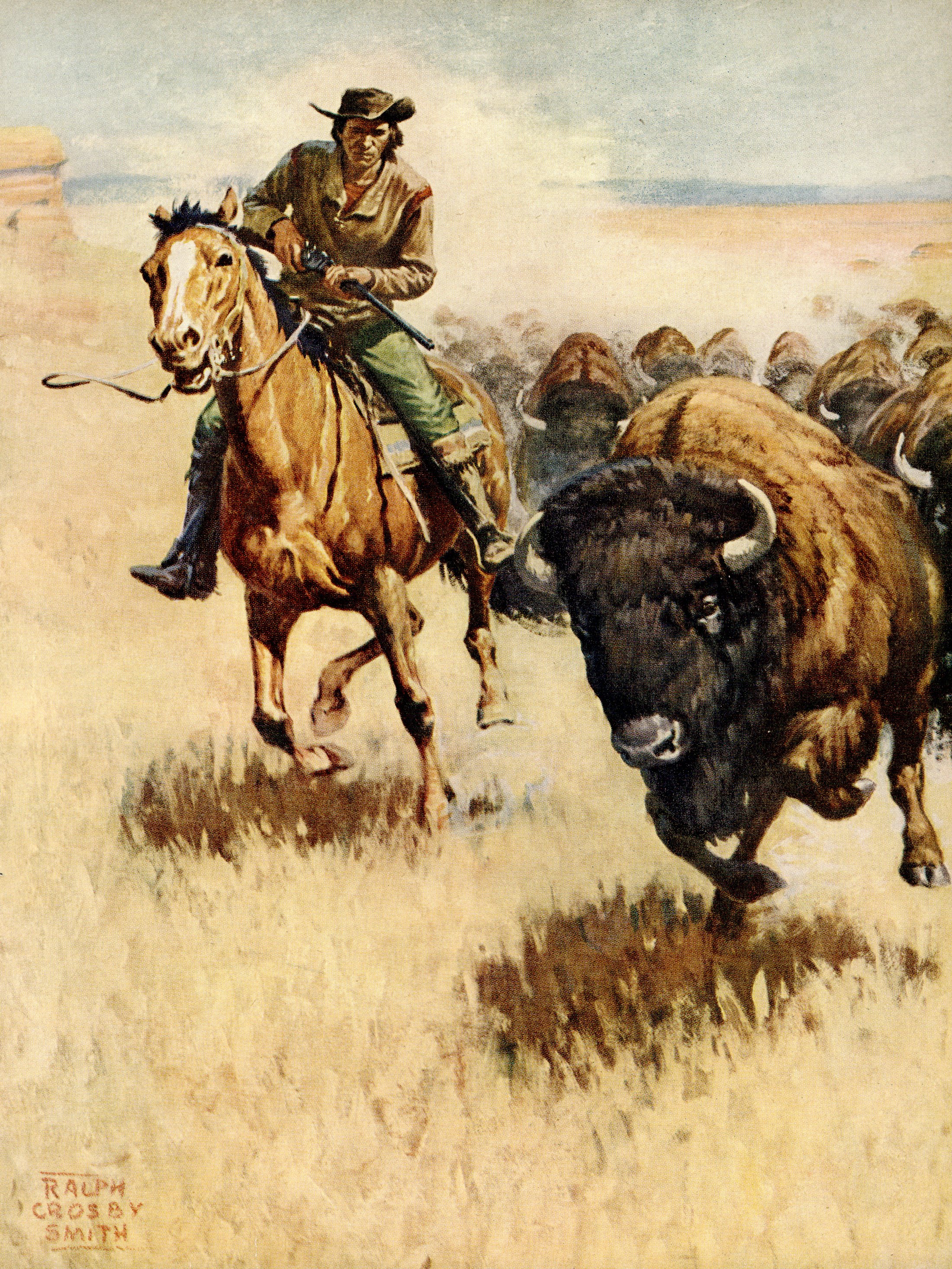
In general, there were two methods of killing buffaloes—“horse running” and still-hunting. Since horse running was highly spectacular, it was preferred by the sporting “dudes.” But it was also the method of some skin hunters, especially those who had weak, obsolete weapons that couldn’t “reach out” for kills.
The procedure was simple: The mounted hunter merely rode hell-for-leather toward a herd, stampeding it. Then he picked himself a good bull, galloped along beside it, and shot it in the neck or heart. The whole thing didn’t take much longer than the telling. The hunter then moved on after the herd and repeated the performance. A man could kill a vast number of bulls that way, if his horse didn’t stumble in a prairie dog’s hole and break his neck. But there was a hitch: the method scattered carcasses all over the countryside and made things tough for the skinners.
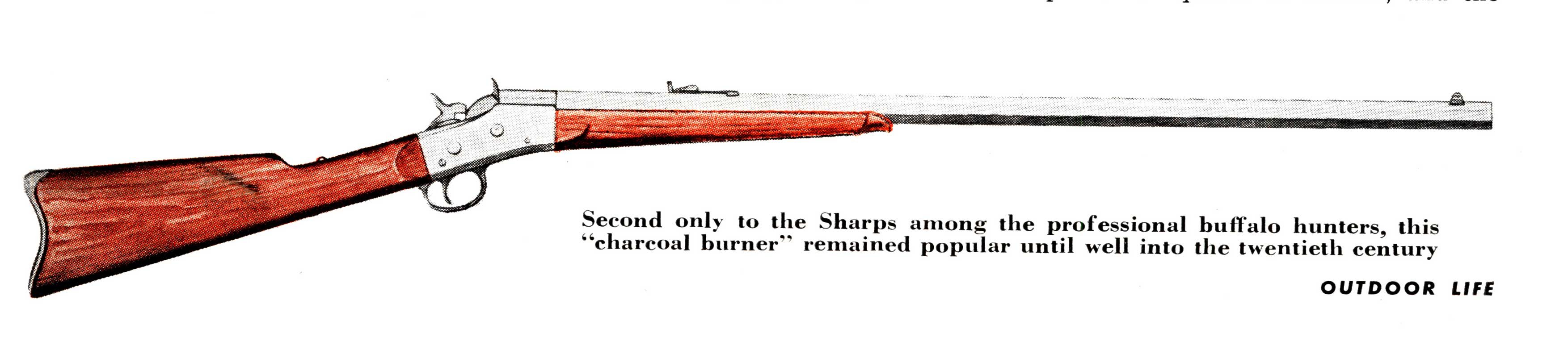
Experienced hunters (men who accounted for 90 percent of the skins) would not operate that way. They preferred to do all their killing in one spot. That way a man increased the efficiency of his “outfit.” Often the outfit was a good-size one. There might be two or three hunters; six or eight skinners; three or four men to peg out and dry the hides; and a cook. Equipment consisted of several wagons; cases of skinning knives and a grindstone to sharpen them; reloading tools and molds; kegs of powder; and the usual camping paraphernalia. The hunters carried the finest rifles they could buy. Sharps were first in popularity, Remingtons second. Nothing but the finest quality of powder would do for reloading; some of the hunters went to the trouble of importing their pet brands from England.
The hunters might set a daily quota of fifty bulls apiece, but if the skinners could handle more the ante was raised. A good man could usually fill his card within an hour. Each outfit kept fairly close to a big herd so that the hunters could reach it quickly on horseback. They’d dismount some distance away, then come in cautiously to avoid stampeding the buffaloes. Finally, they’d take up shooting stations downwind of the herd and about 300 yards from the nearest animal.
That was the favored range for a number of reasons. First, it decreased the chances of a stampede, for a nearby rifle shot almost always spooked the herd. Second, it gave the hunter a margin of safety in case a stampede broke his way. And third, the Remington and Sharps rifles did excellent work at that range and were generally sighted in for it.
Some hunters shot from the prone position, others sitting—often with crossed sticks as an aid to accuracy. The sticks were slender hickory rods fastened together near the top to form a shallow V. The other ends were sharpened like stakes. The hunter spread the sticks, pushed them firmly into the earth, then placed the muzzle of his rifle in the little V. The sticks were quite a help when you had to get off fifty or sixty fairly quick shots with a twelve-pound rifle.
Frank Mayer, one of the most successful of the skin hunters, was an adept with the crossed sticks. He expected and got a bull for every shot he fired. He was a Sharps enthusiast, although he conceded that the Remington was every bit as good a rifle. For most of his plains career (it lasted nine years) he used a .40/90 Sharps, but later switched to the famous “Buffalo Sharps,” the .45/120/550. He paid $200 for his rifle—a tremendous price in a day when a workingman earned $10 or $12 a week. But that weapon was sudden death even far beyond the range Mayer usually chose—300 yards. He estimated that its 120 grains of powder propelled the 550-grain slug at around 1,400 foot seconds, with a muzzle energy of about 2,300 foot pounds. When you recall that the 225-grain .30/06 bullet starts out with 2,310 foot pounds, you begin to realize the smacking power of that big Sharps slug.
When he was set at 300 yards, Mayer started the day’s work by shooting a cow through the lungs. She’d start wobbling around and coughing up gouts of blood. Then the bulls—excited by the blood scent—would move in and hook her viciously with their horns. While they were thus occupied, the hunter could pick them off one by one. Frequently Mayer shot down his entire daily quota of fifty from one spot. But if the herd stampeded he followed it patiently and started all over again.
When his fiftieth buffalo was down, Mayer summoned the wagon train. Then the skinners took over. Generally they found all their carcasses lying within an area 300 feet square. While they worked, the hunter cleaned his rifle, reloaded ammunition, and just loafed.
Collecting $2 or $3 apiece for his skins, Mayer probably earned as much in the long run as any other hunter. Yet at the end of nine years he found he’d made just $3,000 a year net. It cost a lot to maintain a wagon outfit and to pay skinners and other helpers. Some hunters declared they never netted more than $20 a week. If anyone got rich in the buffalo trade—and plenty did—it was the men who ran the big fur-trading houses.
They handled a prodigious number of skins. One St. Louis, Mo., firm shipped 250,000 hides to the East in a single year. In Fort Worth, Tex., 200,000 were sold in a one-day auction. A Dodge City, Kans., company shipped 200,000 the first year the railroad reached town; other local firms freighted hundreds of tons of hides that same year, plus 200 cars of hindquarters and several cars of tongues. Then the Army began opening new posts throughout the West, creating a new market for meat. The railroads, too, bought vast quantities for their construction crews; one contract hunter, the renowned William F. (Buffalo Bill) Cody, is reputed to have killed 4,280 bulls in 1868 and 1869. Most of the meat was wasted, for the laborers would eat only choice cuts!
Railroad Split the Herds
When the Union Pacific reached Cheyenne in 1867, its east-west lines cut the great plain in two, and divided the plains buffaloes into two mammoth herds—the “northern” and the “southern.” Big as it was, the southern herd was doomed for early extinction. The Santa Fe reached the heart of its summer range in 1871, thus providing greatly increased shipping facilities. The hunters worked feverishly: between 1871 and 1875 they killed 2½ million buffaloes a year in the Kansas territory alone. By 1875 the entire southern herd had been virtually exterminated.
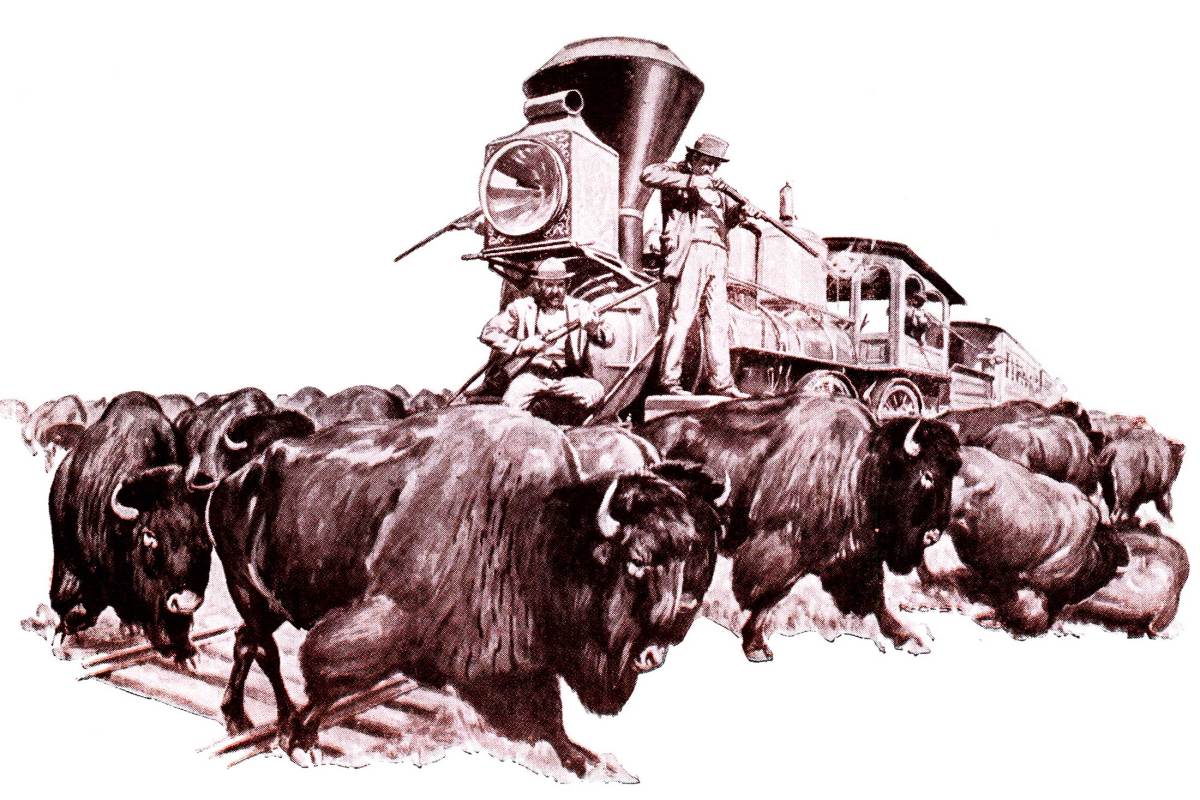
The railroads drove more than one nail into the buffalo’s coffin. But the bulls got in a few licks themselves. Great herds of them would saunter across the right-of-way, completely blocking traffic. A few foolhardy engineers charged the beasts with their locomotives, which were promptly derailed. After that, the train crews started carrying rifles. So did the passengers. If a train caught up with a herd, the engineer would obligingly stop. Then all hands would pile out of the cars and start to pepper the buffaloes. Hundreds of animals would be killed and left to rot; other hundreds would be grievously wounded. If the passengers had any ammunition left, they used it up by shooting from the windows of the moving train.
After the southern herd had been wiped out, the professional hunters moved north and began the final slaughter of the bison. On New Year’s Day, 1872, there were about seven million animals in the northern herd. By the end of the year, four million had been killed. In 1873, another million died. Still the slaughter went on, with the hunters trying to outdo each other in garnering the last few animals. By 1877 only 500,000 buffaloes remained in the northern herd, by 1885, only 75,000.
The curtain fell in 1889. With less than 200 buffaloes left, the government decided to “protect” them. Today the herds have increased somewhat; the bison is not quite extinct. But as America’s greatest game animal, the buffalo has gone forever.
Read Next: BLM Says American Prairie’s Bison Can No Longer Graze on Public Lands
Rifles Were Improved
The decline of the buffalo, in the years from 1840 to 1889, was paralleled by tremendous progress in rifle design. Improvements came thick and fast. The breech-loading rifle, invented by John H. Hall and greatly improved by Sharps, Remington, and other manufacturers, opened the door for the elongated bullet. That bullet, in turn, speeded the development of the modern cartridge. And the cartridge led to the development of the repeating rifle.
Until 1840, the overwhelming majority of riflemen used the muzzle-loader and the round ball. That combination had definite limitations, in both accuracy and striking power, and especially at ranges beyond 200 or 300 yards. Small balls were more accurate; big, heavy ones had more killing power. The problem was to combine the two virtues. And the solution was fairly obvious—some form of elongated bullet with small diameter yet plenty of weight.
The idea was not new, even in the ’40’s. But during that decade a number of men, working independently, came up with conical bullets which could be forced down the barrel of a muzzle-loader and, by one means or another, “upset” (expanded to fit). By this time, the muzzle-loading rifle was on its way out, but the new conical bullets were a natural for the breechloader.
The first Sharps really gave them their start. Since it was no longer necessary to load through the muzzle, a man could use a slightly oversize conical bullet that would engage the rifling in the barrel. The Sharps utilized such a bullet in a “cartridge,” a crude paper tube containing black powder in one end and the bullet in the other. When the action was closed, after loading, the ascending breechblock sheared the paper tail off the cartridge and exposed the powder for the percussion flash. Later, Sharps marketed a linen cartridge, which was more dependable.
Meanwhile, other men were experimenting with metallic cartridges. One was Dr. Edward Maynard, the dentist who had invented the tapelock percussion system. In 1851 he introduced a cartridge consisting of a small brass tube soldered to a flat base. Powder was poured in the open end and a bullet inserted. A pinhole in the side of the case conducted the percussion flash to the black powder. Another cartridge, the Burnside (which was destined to win fame in the Civil War) was somewhat similar to the Maynard, but it had its percussion hole in the base.
The first “complete” cartridge—one containing bullet, powder, and priming compound—was pioneered by Smith & Wesson in 1859. It was a rimfire, not unlike the one used in today’s .22 caliber rifles. S. & W. made the old percussion cap the base of its new cartridge: when the firing pin pinched the rim of the base it set off the primer—fulminate of mercury—which, in turn, fired the powder.
The S. & W. cartridge had a major defect—its case was made of soft copper. It was not safe with heavy loads. But another big improvement was on the way. In 1869, Col. Henry Berdan devised a practical method of “drawing” brass—that is, of forming strong, seamless cases from solid metal. Brass proved almost the ideal material for cartridge making. It was elastic, expanding just enough under an explosion to help seal in powder gases—up to that time quite a problem in breechloaders.
Soon after, Colonel Berdan teamed up with an inventive genius, Marcellus Hartley of the Union Metallic Cartridge Company. Working together they developed the center-fire cartridge. With hindsight, their method seems simple enough, but its development required long and patient experimentation. In the center of a cartridge base they placed a tiny cup filled with the priming mixture. Near it they set a piece of metal called the “anvil.” When the rifleman pulled the trigger, the firing pin drove the cup of compound against the anvil and exploded it. The flash then ignited the powder.
The modern cartridge had been born. Two other great firearms developments were to follow it in short order—the repeating rifle and smokeless powder.
This story was originally published in the October 1948 issue of Outdoor Life.
Read the full article here