

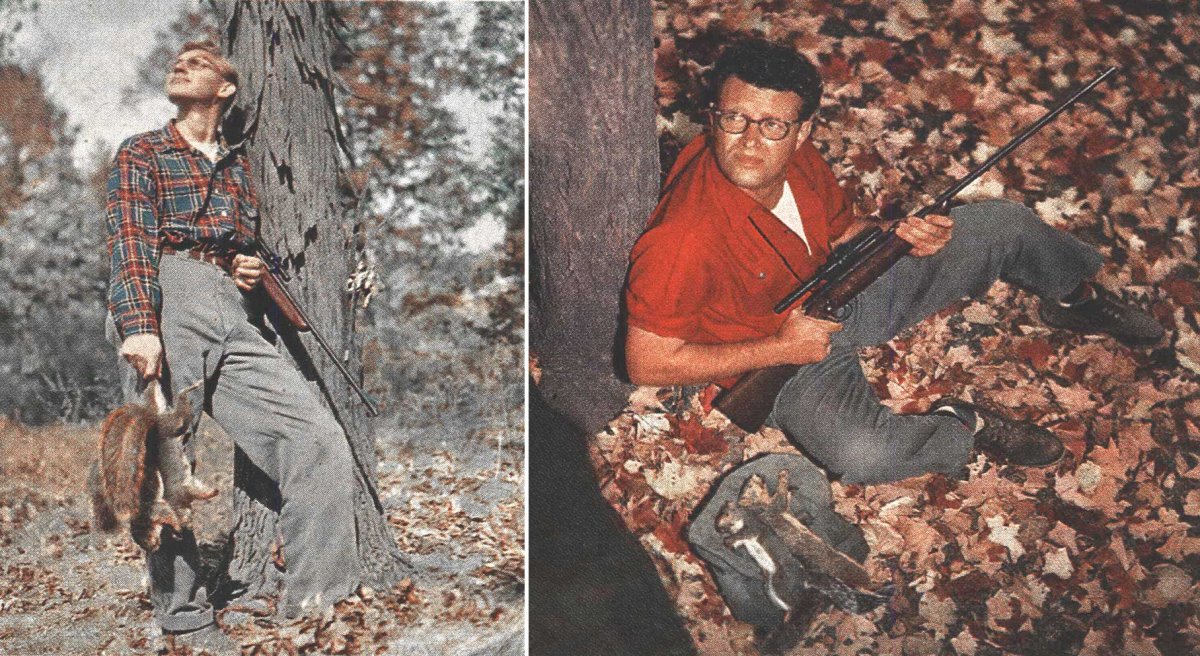
EVERYTHING WAS STILL and dry, and the forest floor crackled underfoot as I tried to move quietly along its edge. It was mid-October, and the last day of the Ohio squirrel season.
I followed an old trail that connected an abandoned pasture with a pond inside the woods, but walking quietly was so difficult I stopped. Around me were shagbark hickories and honey locusts, all good squirrel cafeterias, so I sat down among them. It was the kind of day to play a waiting game.
It was a comfortable spot. A shaft of sunlight gradually shifted until it focused on me, and its warmth penetrated deeply. The lovely yellow light of autumn filled the woods. I guess I dozed, for suddenly I realized that a gray squirrel was watching me from the trunk of a locust about 30 feet away. Still a little groggy, I lifted my rifle. That single movement was enough; the animal vanished.
Wide awake now, I sat erect and scanned the trees. But except for a pair of bluejays, nothing stirred. I’d decided to move on when I heard a rustle of leaves behind me.
For several seconds I couldn’t find the source of the noise; then another branch rustled, and I glimpsed a flash of gold in the sunlight—a fox squirrel. I turned slowly this time, stopped when the critter was in view, and resumed turning again when foliage separated us. Next time he appeared I was in shooting position. For a second I couldn’t find the target in my scope, but when I did I found the squirrel was facing away and completely unaware. I held the crosshairs on his head, squeezed, and scored. It was a fine, fat animal.
Nailing squirrels is old business with me, but few have given me as much satisfaction as that one. Most woods are hunted hard during Ohio’s month-long season, for in our state the sport is traditional. One of our volunteer regiments in the Civil War was known as the “squar’l hunters” because its members were just that. The animals were so numerous then that farmers hunted them from necessity. And in 1812, by an act of the legislature, squirrel scalps were made acceptable in lieu of taxes. But nowadays it’s different. Any squirrels that survive until the tag-end of the season are as wild and wary as any game anywhere, and it’s no easy trick to bag one.
It was my partner, Al Staffan, who had suggested we hunt in these woods. Only 15 minutes away from my home in Upper Arlington, a Columbus suburb, the area had been combed especially hard since opening day.
Local hunters had bagged a bumper crop of squirrels there, and had moved elsewhere because they considered it shot out. Still, when we made plans for our last fling, that was the place Al picked.
“Let’s hit the Franklin County woods,” he suggested, “but let’s be leisurely about it. No use getting up before daybreak.”
It sounded all wrong to me, and I said so. I mentioned the early hunting pressure, and reminded Al that the most action usually comes in the first few hours of morning.
“Agreed,” he said, “but we might be able to use that to advantage. First, we’ll probably have the woods to ourselves, and that’s a luxury. Second, the regulars have been pounding the woods hardest around daylight. Any squirrels left may now be in the habit of foraging later in the day. So let’s sleep late.”
It still didn’t sound good to me. But I couldn’t argue too much with the best squirrel hunter I’ve ever known in a part of the country that’s full of them.
This woods is a long and fairly narrow belt of timber. In the center is a woodland pond that once provided water for a large dairy herd, and which now divides the woods into two narrow sections.
“We’ll hunt each half separately, and from opposite ends,” Al said. “By hunting toward each other, we can get shots at feeding squirrels as well as those escaping ahead of the opposite hunter. The pasture on one side of the woods, and the pond on the other will sandwich them between us.”
It was a clever strategy, for soon after I’d picked up my first squirrel I heard Al’s .22 crack, once faintly, and then again louder and closer. There were no other hunters in the woods. When we met at noon, he had two squirrels and had located a third high in an old white oak. Al circled it slowly, but the critter was too well hidden in deep-red foliage. It’s an old trick for a squirrel to stay on the opposite side of a tree from the hunter. We tried to locate him by covering both sides, but it didn’t work.
Al put his rifle aside, and took a small roll of cord from his pocket. It’s an item he carries on every squirrel hunt. He tied one end of the line to a sassafrass bush near the big white oak, then sat down on the opposite side while keeping hold of the other end of the cord.
“Sit where you have a good view of the crown of the tree,” Al whispered. “We’ll be absolutely quiet for a few minutes, and then I’ll yank the cord and shake the bush. It’ll probably startle the squirrel and he’ll move.”
For perhaps five minutes we didn’t move a muscle, then Al jerked the cord vigorously. It worked; I caught a movement of the squirrel’s tail. Then, through the scope, I picked out the animal flattened against a limb far above us. He made No. 4 in the bag, exactly half of our two-man limit, thanks to a ruse that Al has used often to put meat in the pot.
As we walked back to the car for lunch, Al explained that a handful of nut shells or gravel would do the job just as well. “Just sit quietly for a few minutes after you’ve located a squirrel hiding like that,” he said. “Then throw the shells on the far side of the tree. The sudden rattle often will make him switch to your side, or at least move enough to give himself away.”
Staffan doesn’t look the part of an expert hunter. He’s no grizzled veteran with a lifetime of experience. A wildlife illustrator, he looks even younger than his 30 years. But he has unusual sight and hearing, and more than these, an intense desire to know about the creatures he puts on canvas.
Quiet and patient, Al gives an artist’s attention to detail. Walking in the woods, he’s a study in caution, which, he believes, is the first principle of squirrel hunting. That trick with cord sometimes will put game in the bag, he says, but for consistent results nothing beats careful, quiet, almost lazy travel through the forest.
Follow rocky ground, if you can, because it’s almost silent. So is the soggy edge of a pond or stream. Al hugged the bank of the pond to get within range of the first squirrels he bagged that morning. In one place he had to crawl on hands and knees through a sumac thicket.
Proper clothing also is an aid. Footgear isn’t too important when damp weather muffles the sounds of walking, but in dry weather it’s hard to beat moccasins or light tennis shoes. Green cotton twill or poplin pants, and light flannel shirts, are good; they’re soft and don’t reflect light. Some fabrics, like canvas duck, are noisy when brushed against trees and shrubs. Color isn’t too important.
No hunter can make better use of infantry tactics than the squirrel hunter, for his quarry is equipped with some of nature’s finest radar and sonar systems. Squirrels seldom are alarmed by a motionless hunter—Staffan often has had them approach to within a few yards of him—as long as he’s not silhouetted too conspicuously. I’ve learned from Al never to make sudden movements, such as turning to locate a sound, or raising a gun. You must move in the slowest of slow motion. When stalking, take advantage of terrain. Stay in the shadows, and use tree trunks to break your outline.
“There are far more squirrels than most of us believe,” Al said at lunch. “It’s just a case of finding them—or, rather, of hunting in a woods most likely to contain them.”
At first glance, one woods looks like any other, but they seldom are. A good squirrel hunter can make a quick pass through a woods and predict whether it’s good for squirrels or not. In the fall, look especially for these trees: oak, hickory, pignut, pecan, beech, hazel, honey locust, butternut, and, very late in the season, walnut. In the case of fox squirrels, an unpicked cornfield next to the woods certainly is worth checking.
Another giveaway is the number of leaf nests in a woods. As soon as young squirrels are old enough to shift for themselves in summer, they leave the home den and build nests high in the forks of trees. The number of nests in early fall is an excellent indication of the number of squirrels nearby.
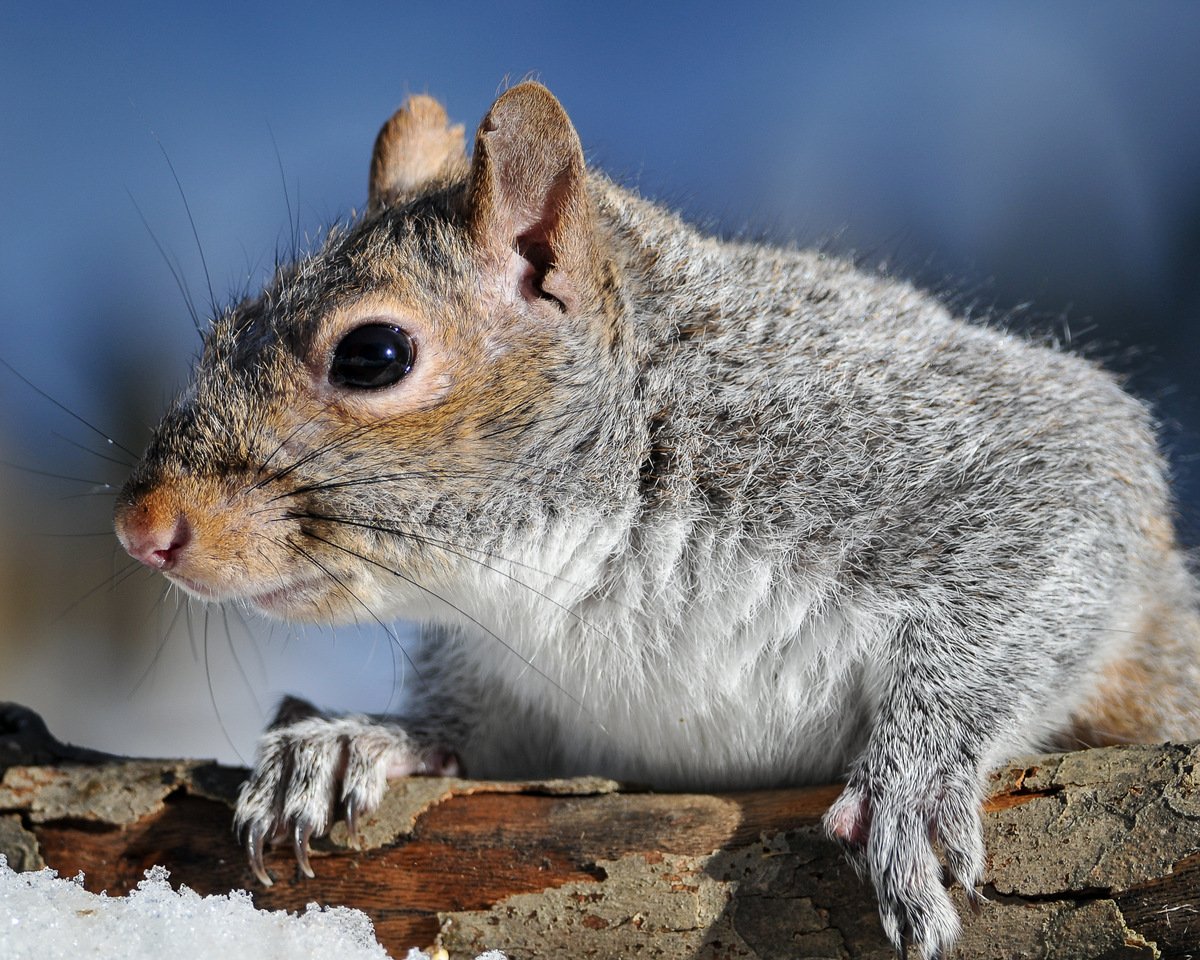
America’s sportsmen are concerned chiefly with two species—grays and fox squirrels. The smaller grays are natives of large, unbroken woods in the East and South. Fox squirrels once kept to prairie groves in the Midwest, but nowadays they’re abundant in farm wood lots all over the area. The range of the two species overlaps in Ohio, and both inhabit the same woods.
Staffan believes squirrels are more predictable than most game. “When discovered, grays always will try to escape, usually by climbing to the highest point nearby or by headlong flight. Fox squirrels usually will flatten out and remain motionless, for hours if necessary.”
But Al says that no matter which critter you’re after, it’s helpful to know their sounds. Next to the quiet approach, he depends on his ears the most—to pick up such sounds as a squirrel barking, the unusual rustling of leaves, squirrels grinding on nuts, or of hulls falling to the ground. Flickers, chipmunks, woodpeckers, and pine squirrels make similar noises, and it’s necessary to know which is which.
“To identify these sounds a little better,” Al said, “I used to wear a hearing aid in the woods, and it worked fine. It wouldn’t be a bad idea for anyone interested in serious squirrel hunting.”
Staffan is strictly a stillhunter; he travels as slowly as necessary, and stops frequently to look and listen. He believes it pays a hunter to sit down often, especially near den or nut trees.
He sums it up like this: “My thrill from squirrel hunting comes from spotting an animal late in the season, stalking within easy rifle range, and collecting the critter for the pot with a single shot.”
After lunch, we separated to hunt the other half of the woods.
I crossed a rusty barbed-wire fence, and entered the woods near the upper end of the pond. The going was tough in a brushy, second growth tangle. Dry leaves had windrowed beneath wild grape vines and, in a hurry to reach a stand of hickories just beyond, I made a noisy approach. As a result, I caught only a quick glimpse of a gray squirrel escaping in the other direction.
It was easier going in the taller timber. I found a strategic spot in the center of a hickory grove and sat down. Fresh cuttings were mixed with fallen leaves all around me; it looked like a popular place for squirrels. But nothing developed, and when I heard a squirrel bark some distance away, I moved on.
I’d traveled about 50 feet, leaned against a sugar maple to have another look around, when the squirrel barked again somewhere in Al’s direction. Then I heard the report of his .22, and there was no more barking.
I eased down a small rise to the pond’s edge where I could hunt more quietly. From the corner of my eye, I caught the barest flash of orange high in a hickory to my right. I backed against another tree, and scanned every inch of trunk and every limb near the place I’d seen the movement. I stared through my scope until my neck was stiff before I found my target. First, I spotted only the bushy tail; then I saw the entire animal blended into a crotch. It was a tough shot, for only a little of its head and front shoulders were exposed. I steadied my rifle against a trunk but hit low.
For a second the squirrel held tight, but the near miss had made him nervous, and he shifted positions. Now he was completely hidden, and I sat down to try the shell trick. But just then, in the other end of the woods, Al’s .22 cracked, and immediately the fox squirrel sat upright. It was an easy shot, and I rolled him off the perch.
For an hour or more there was no action. After a time I sat down on the stump of an oak. I was watching from a fairly open, parklike area of the forest when, almost 100 yards away, I caught a telltale movement.
The animal moved leisurely. I held the scope on him, trying to follow his progress, but it wasn’t so easy with such a small and agile target. He reached a hickory branch that bent far over under his weight, made a breathtaking leap into another tree, and I momentarily lost sight of him. When I spotted him again he was in a third tree, well in range, and coming closer.
The squirrel raced down a trunk, hit the ground at full speed, and started up a hickory. Halfway up he stopped to look around, and my first shot shattered a loose strip of bark. The squirrel hesitated, flattened, and I had him squarely in the crosshairs. He made my fourth one and only the second last-day limit I’ve ever taken.
Read Next: The Case for Squirrel Hunting, and Why It’s Completely Underrated
I was watching for some sign of action on the pond’s surface, when I spotted another squirrel. It was sitting in a tree, just a short distance from the water’s edge. It would have been an easy shot from my position, but for Al, who was stalking the squirrel, it was almost impossible. He had to pass through a thicket dense with poison ivy and blackberry briers. Dry, yellow leaves had collected all around its edge.
Al moved slowly through the heavy cover. He dropped down on all fours, and with one hand cleared a path through dry leaves ahead. He always tried to keep a bush or tree between him and the squirrel. It was a dramatic demonstration for me because the squirrel, a gray, kept cutting away, unaware.
Once through the thicket, Al had a small clearing to cross. Still taking advantage of the limited cover, he moved only inches at a time, stopping every foot or so to make sure the squirrel wasn’t alarmed. When he was 100 feet away, he slowly raised the rifle.
That gray filled Al’s limit. I’ve never been so pleased about a squirrel hunt before—and for still another reason: now it was time for stewed squirrel and dumplings, than which there’s nothing finer.
This story was originally published in the September 1957 issue of Outdoor Life.
Read the full article here