
Back in the 1930’s before I had wormed my way onto the OUTDOOR LIFE payroll, I used to ease the cruel pinch of want by doing pieces for general magazines. I wrote on subjects that ran all the way from tales of young love to travel pieces on the joy of warming one’s ancient and arthritic bones in southern Arizona’s salubrious winter sun.
One story I did for a noted men’s magazine was on sheep hunting. In it I said that hunting sheep was for young men and men of middle age who had kept themselves in top condition. When a man reached his middle 40’s, I wrote, he should hang up his sheep rifle and confine himself to quail and golf. At the time I wrote the piece, the only sheep hunting I had done was for desert bighorn in the Mexican state of Sonora.
The story brought in a good many bitter howls from outfitters who wrote that I was taking the bread and butter right out of their mouths. Young men, they said, didn’t have enough money to hire guides and pack outfits for sheep hunts. And they told me that most of their numerous middle-aged and even elderly sheep-hunting clients had been so busy sitting behind desks and making money that they couldn’t lace their shoes without breathing hard. They added that the judicious use of surefooted horses usually enabled them to get any dude within striking distance of rams.
I found that claim hard to believe. Horses can be used in few of the desert-sheep ranges where I have hunted. Most are so rough and so rocky that a horse would break his neck before climbing 50 feet, and in the few desert ranges where limited horseback hunting would otherwise be possible, there is no available water.
I shot my first Rocky Mountain bighorn when I was verging on middle age. I had a horse, but he was only for company. The country was so rough that an unmounted horse had all it could do to get around. Put a man on one, and both horse and man would tumble down and break their necks. I spent most of the day dragging my horse uphill and then dodging to keep him from rolling on me when I led him downhill. Just before I finally made the climb that produced a fine bighorn ram, my guide and I left our horses tied beside a little creek. We did, however, use our saddle horses to follow a roundabout trail back to camp, and we relied on a remarkably agile packhorse to bring in the sheep head and meat.
For a long time after that, I did my best to leave the horses in camp and hunt on foot.
When I made my first Stone-sheep hunt in the Prophet River country of northern British Columbia, I hunted sheep from dawn to dark while my horse munched the rich grass of the mountain meadows and congratulated himself on having it so good. On that 45-day trip, mostly for rams, I left camp only one day on horseback. On my first Yukon hunts, I always set out on foot except when I used a horse to get to the foot of a distant mountain.
Times change. As I accumulated years and avoirdupois, the stout legs of a mountain-raised horse came in handy indeed on Yukon hunts. In the Yukon in 1963 and in British Columbia in 1967, my wife and I actually used horses to get above the sheep and hunt down. We did some walking and climbing, but that was to get up into high sheep country and to go down slopes too steep and rocky for a burdened horse.
In 1967, I became convinced that I had made my last sheep hunt, and my wife was sure she had made her last one too. She didn’t object to the climbing so much as to the cold. For some reason, she attracts cold and snow. She shot her big Dall in 1963 in a freezing gale that howled right down from the North Pole. In 1967 she collected her Stone in a blinding snowstorm about 4,000 feet above timberline. In the spring of 1971, I began to feel sheepy.
I slept poorly and had spells of absentmindedness. My appetite lagged. And sometimes when I thought of big grassy sheep basins above timberline, the pungent fragrance of black spruce and alpine fir. the melody of horse bells, and the smell of wood smoke from the cook-tent stove, it was almost more than I could bear. If I thought about it too much. I got severe shooting pains in the trigger finger.
I had long been interested in the great sheep country of northern British Columbia where Frank Cooke outfits. The largest Stone-sheep heads taken in recent years have come from that area.
So I finally made my move. I arranged with Cooke for a hunt from August 1 to August 15. My wife refused to hunt with me.
“I have frozen to death on a sheep mountain for the last time!” she said. “If I ever freeze again, it will be for a better cause. Furthermore, a man of your age — a grandfather — has no business hunting sheep.”
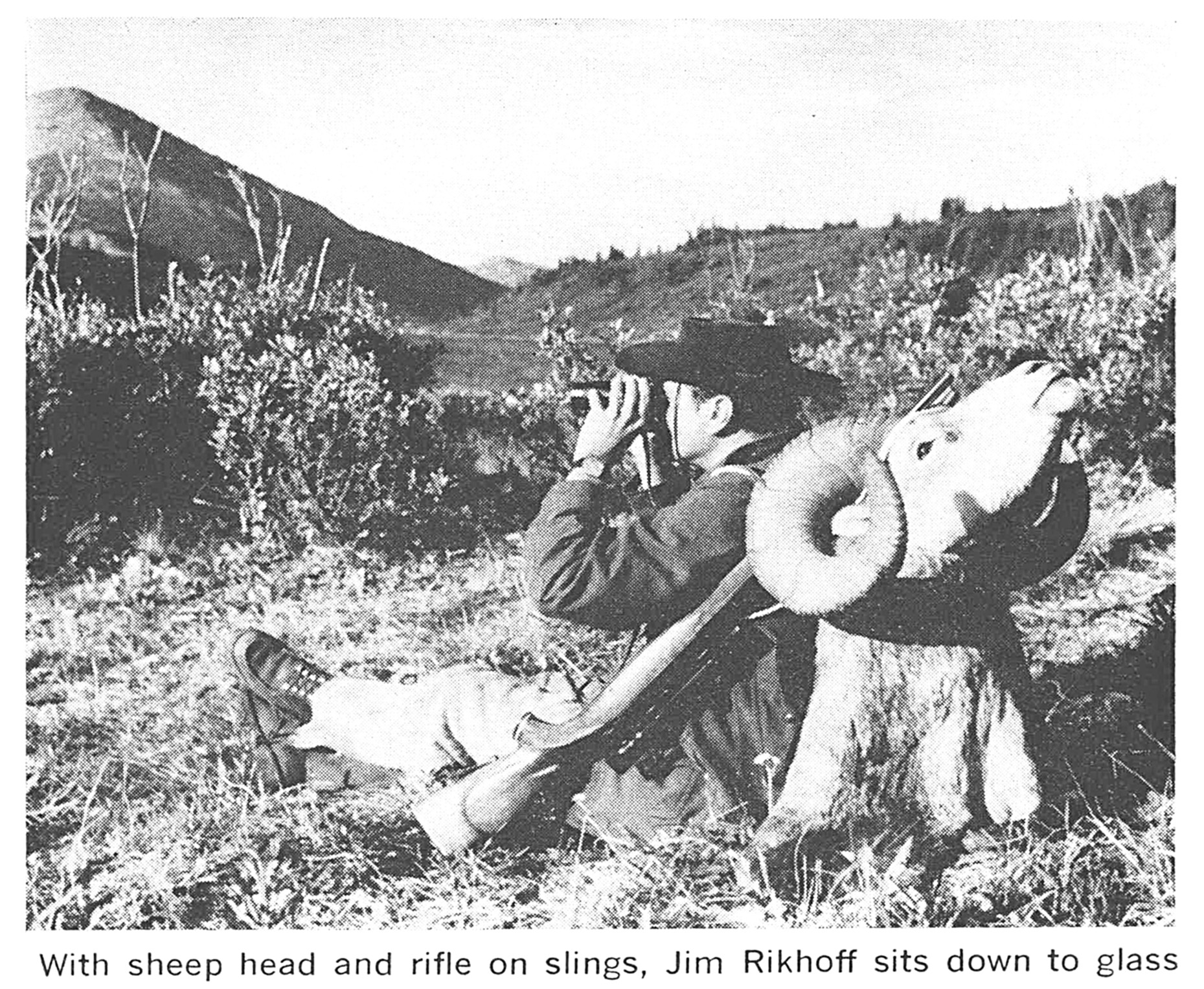
As it happened, my old friend Bill Ruger, president of the Sturm, Ruger Company, makers of fine handguns and rifles, was also beginning to itch with sheep fever. My wife and I had hunted with him in the Yukon. Jim Rikhoff, an old friend with whom I have hunted in such esoteric places as Spain and Scotland, was also feeling sheepy. Jim is a beamish boy of 40, hardly old enough to have good sense. He had hunted sheep and ibex in Iran; lions, buffalo, and gemsbok in Africa; but the poor lad had never hunted sheep in North America. Bill, on the other hand, has taken bighorn in Alberta as well as Dall. Jim works for Winchester.
All the signs and portents were against the trip from the start. My wife was mad at me. My two daughters wrote me sternly that I should act my age. My Brittany spaniel Dick had an attack of the melancholia and, until given a tranquilizer, howled for five straight nights at the moon. On a nearby Indian reservation, a woman 107 years old fell into a trance and spoke distinctly in seven languages, one of which was presumed to be Finno-Ugric and another Urdu. In Riggins, Idaho, a cow gave birth to a two-headed calf.
At the last minute trouble at his factory forced Bill Ruger to cancel his trip.
“See?” Eleanor gloated. “What did I tell you? The trip is jinxed. Better stay home. If you go you are tempting fate.”
It became unseasonably warm all over the Northwest, clear up into the Yukon and Alaska. A great forest fire broke out in the Rocky Mountain Trench between the northernmost peaks of the Rocky Mountains and the Cassiars. That’s where we intended to hunt.
My wife was going with me as far as Vancouver, B.C., where we were to meet Jim Rikhoff at a hotel. The three of us were to have dinner with friends. Then the next morning, Jim and I would arise early, go out to the airport, and hop a Canadian Pacific plane to Watson Lake, Yukon Territory. When my wife and I arrived in Vancouver from Seattle in the early afternoon, I checked two pack panniers, my bedroll, and a plastic case containing my rifle on to Watson Lake.
The signs and portents continued to be bad. My wife wanted to shop for British woolens in Vancouver, but the thermometer was hovering around 100c, and she fled the streets to the refuge of a cool bath. Ordinarily Vancouver has one of the most pleasant summer climates on earth. The next morning when I told my sleepy wife good-bye, the little thermometer on her bedside traveling clock registered a dripping 82°.
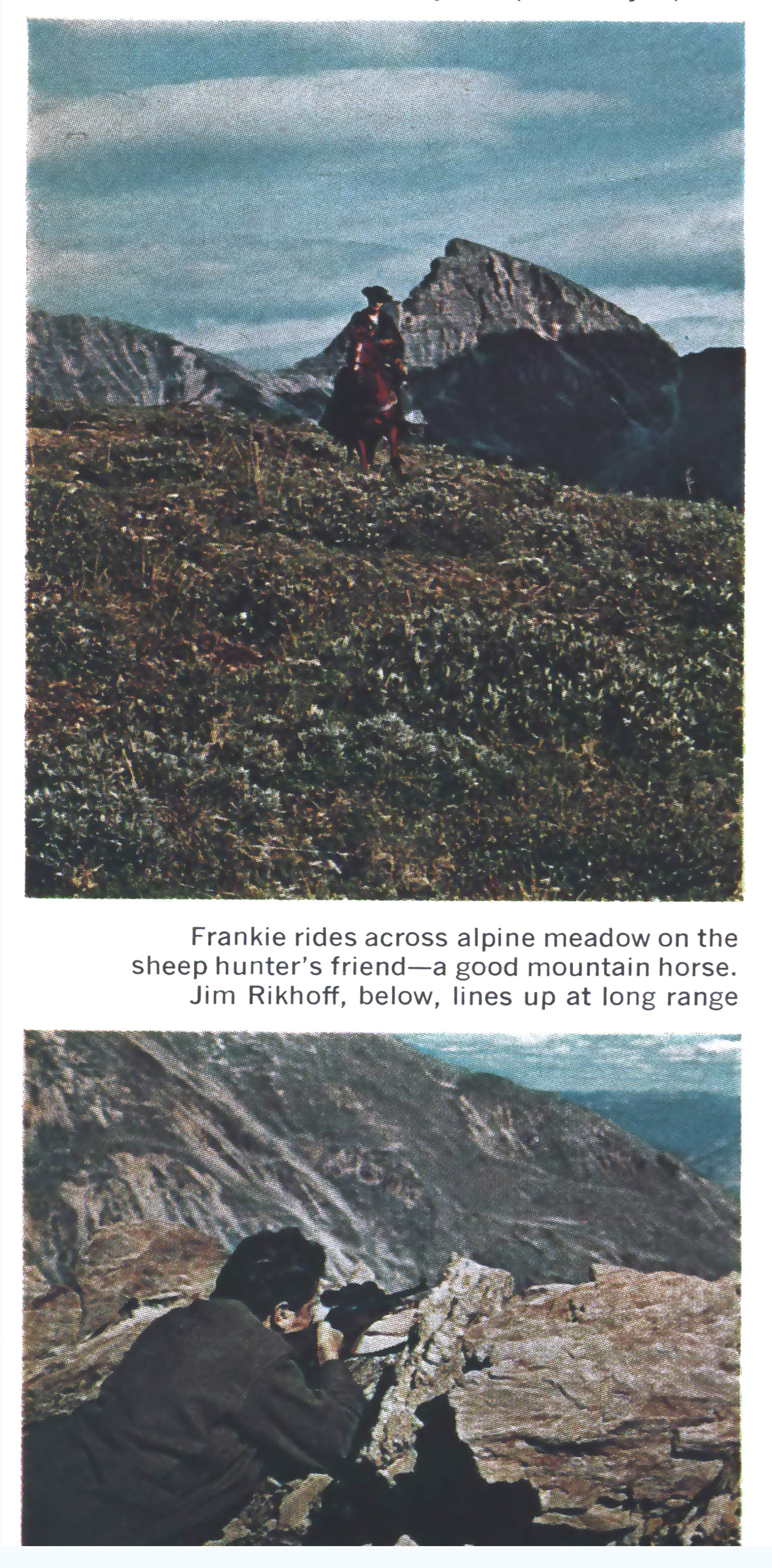
Jim and I flew over thousands of square miles of purple timber and silver streams. Then as we neared the Yukon border, we were over a world of lofty peaks capped and streaked with snow-sheep country.
When we got off the plane at Watson Lake we could smell the smoke of the forest fire and the sky was gray with haze. It was so hot that I was sweltering in my light summer suit. One of Frank Cooke’s sons was supposed to meet us, but he wasn’t there. Jim and I waited as the baggage was unloaded. Jim’s two canvas-and-leather alforjas (non-rigid pack panniers), his rifles, and his bedroll came off, but mine did not. For a panicky moment I thought the trip was doomed. What all the smoke would do to sheep movements I had no idea. It was too hot to hunt sheep in the woolen clothes I had brought, and there I was stranded in the subarctic without rifle, duffel, or bedroll.
But things cleared up quickly. I went into the freight department to report that my luggage had not arrived and almost fell over it. It had been sent ahead on a freight plane the previous night.
When I went outside again, one of the Cookes was talking to Jim. We went to a cafe where we ordered sandwiches to eat on the way. Before long all our gear was aboard a floatplane and we were winging our way to the camp at Colt Lake. It’s a narrow little lake in a valley between soaring mountains just long enough for the sturdy Canadian-built Beaver floatplane to put down on and take off from.
Outfitting for sheep hunting has changed considerably in far-northern British Columbia since I made my first Stone-sheep hunt back in 1946. The day of the long packtrip into wilderness country is about over. Today most of the outfitters trail their horses and equipment in well ahead of the opening of the hunting season and set up permanent camps at lakes large enough for float planes.
Colt Lake is about 100 miles south of the Yukon border. To go there from Alaska Highway by packtrain would take at least four days, maybe five. To come out would take the same amount of time. That would leave only four or five days of hunting on a 14-day trip. Jim and I flew in on July 31. We were out in the hills hunting on August 1, opening day.
Frank Cooke’s outfit is known as Frank Cooke & Sons. The address is Box 764, Dawson Creek, B. C. Frank has been in the northern Cassiars all his life. The Cookes are of Irish descent, but Frank was raised by Skook Davidson, a Scot, who is in his 80’s now. In Skook’s early years, when he was trapping, freighting with a packstring, and winning the Victoria Cross and many other decorations in the Canadian Army in World War I, his strength and courage were legends in the subarctic. “Skook,” his nickname, is an abbreviation for the Indian word skookum-strong.
The Colt Lake camp was pretty much a family affair. My guide was Frank Cooke Jr. or just plain Frankie. Dianne Cooke, Frankie’s very pretty red-headed sister, was the cook, and her helper was Dee-Dee, Frankie’s attractive blonde wife. Mack Cooke, who is only 16 but tough as a boot and wise in the ways of the mountains, was another guide. I gave Mack the nickname Wellington because he has precisely the same Irish nose that won Arthur Wellesly, another Irishman, the Duke of Wellington, the nickname Nosey. The only non-Cookes were Larry Beddel, Jim Rikhoff’s guide; and Clayton Reed, the wrangler.
Dianne Cooke is an excellent cook and a good companion, and she’s so pretty that she could make a living modeling junior-miss dresses in New York. She had to give us a lot of Spam until we started to bring in game, but she did her best.
Our first hunting day was long and hot. There must be a great number of moose in that part of the Cassiar Range. The whole country is criss-crossed with moose trails so wide and so regularly and logically laid out that they could well be taken for pack trails. The moose season was not open, but we saw moose almost every day. Some were enormously sleek and fat and looked as if their velvet-covered antlers would go 60 inches or better. The highlight of the day was running into a pack of wolves, the first I had seen for many years. Jim had never seen one before.
We saw no sheep until late in the afternoon when we were headed back to camp. On a lofty pasture of green and tender grass across a deep canyon about half a mile away, we saw a bunch of eight rams, the largest of which might have had a curl of 36 or 37 inches. It
was too late in the day to stalk them and too early in the hunt to take a ram of that quality.
Except for 20 minutes out to eat lunch we rode or walked from 7 a.m. until we pulled into camp at 8 p.m. My old joints and sinews were pretty stiff and creaky when I got off my horse.
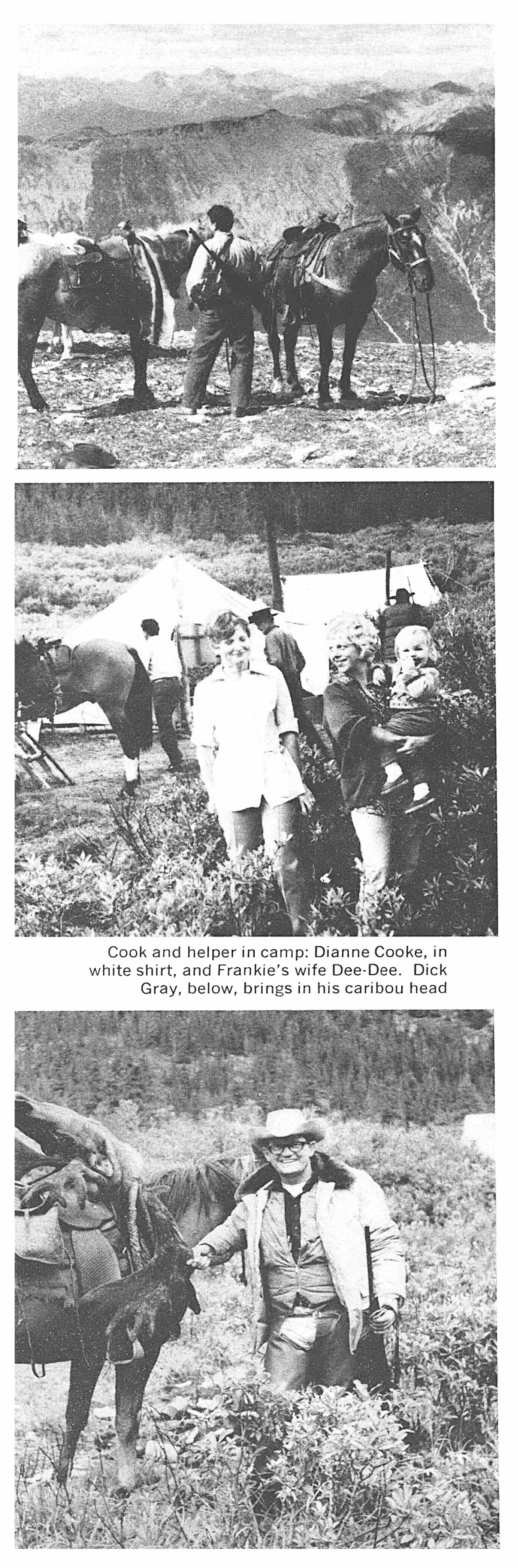
We had been told that another dude was coming in, and we met him that night at dinner. He was Dick Gray of Atlanta, Georgia, an apple-cheeked lad of 33, a real-estate developer, a graduate of the University of Georgia, and a member of the same college fraternity to which I belong.
As it turned out, Dick Gray brought luck. He, Jim, and I hit it off beautifully, and every night before we crawled into our sacks I regaled the youngsters with tales of mighty rams and of romances with maidens lovelier than Guinevere and Helen of Troy.
The next morning Jim, our guides, and I pushed our sweating horses up to a high ridge. On one side was a vast jumble of peaks, ridges, valleys, green meadows, and purple timber. From the opposite side of that ridge, we could see the Rocky Mountain Trench and beyond that the last peaks of the Rocky Mountains. The trench was pretty well filled with smoke, but now and then the wind would part it and we would see scarlet flames boiling up.
The bad luck held for a while. We had a big, light-colored ram located and were waiting for him to finish feeding and bed down. Then a helicopter owned by a big American corporation came threshing up the valley near the ram and over us, almost close enough to knock our hats off. The ram took off for parts unknown, and a herd of terrified ewes and lambs almost ran over us.
Presently a bearded, long-haired prospector that the helicopter had let off came strolling down the ridge, knocking off chunks of rock with a hammer. He was prospecting for copper. The pilot undoubtedly saw us and our horses. He probably saw the ram. He ruined a day’s hunting for us and probably cost one of us an outstanding trophy. Nice guy! It looked as though the jinx was still with us. After we left, Joan Leeds, a young woman hunting with her husband, shot a light-colored 43-inch ram in the same general area.
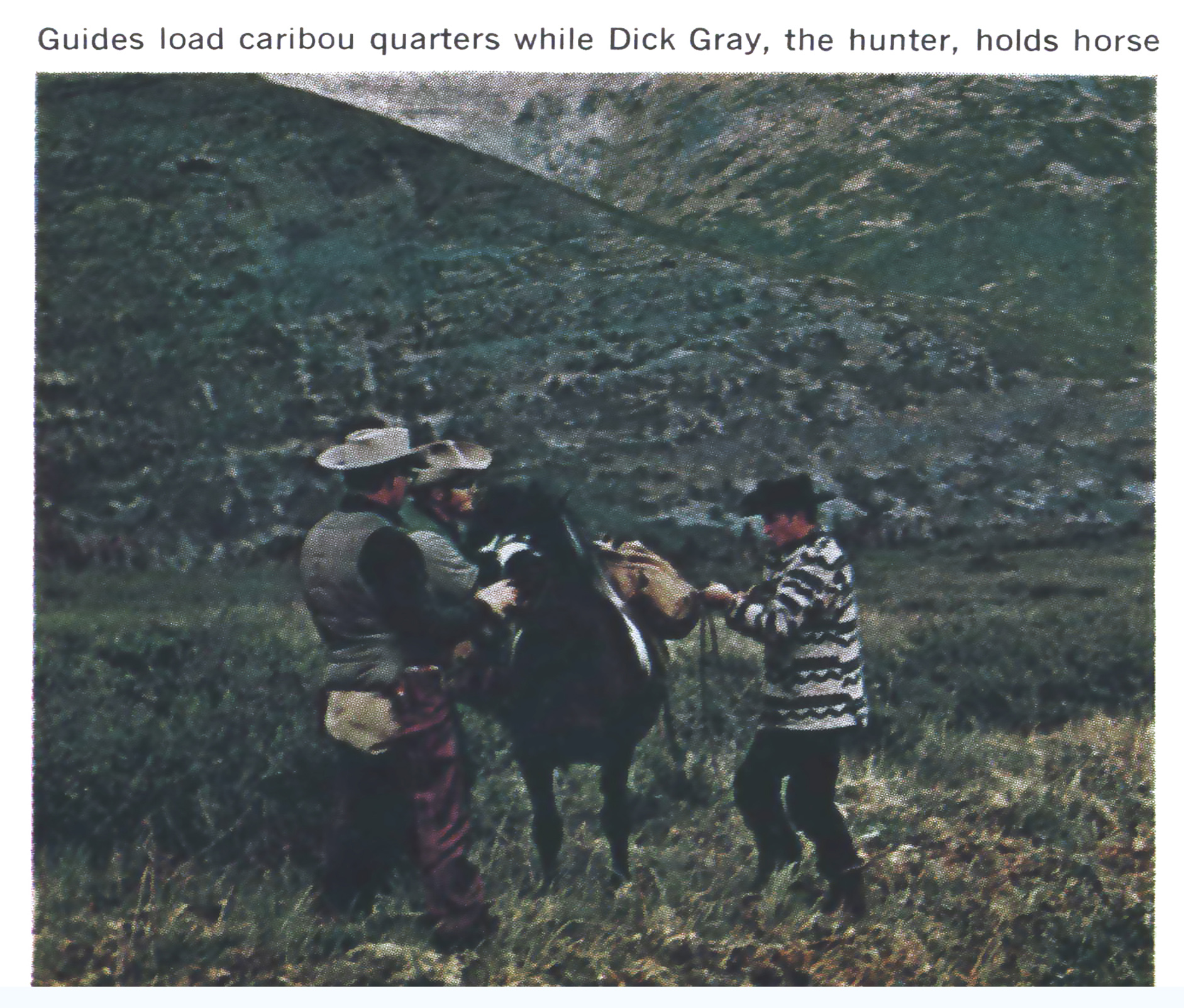
Although we didn’t know it at the time, our compadre Dick Gray had already had some luck. When we got to camp we found Dick had taken a good bull caribou. Dianne had liver and onions frying. We had eaten the last of our Spam.
It was oppressively warm when we turned in. But it cooled off, and presently I heard the patter of rain on the canvas. It rained hard all night and most of the next day. The rain cooled things off and put out the forest fire. Before the day was over Jim and his guide Larry took a quick circuit not far from camp and came in with another bull caribou. Dick and his guide Mack Cooke returned with a tale of a big basin full to overflowing with rams.
Mountain sheep have quite a few tricks up their sleeves. One is to place themselves where no hunter can approach them from any direction without being seen. For that, a big basin serves admirably.
The next day we went out to case the rams and the basin. It was a sight to gladden and sadden the sheep hunter’s heart. The basin must have been a half-mile in width and nearly a mile long, and the whole thing was dotted with rams. Some were in little bunches, others were alone — big old rams, middle-aged rams, young rams, rams almost white enough to be Dalls, rams with white heads and necks and saddles almost black, rams with gray heads and necks, dark bodies. Rams, rams everywhere — but try to get a shot. Stalking was impossible, driving exceedingly doubtful. About all we could do was to look at them through the spotting scope and drool.
I went off on a long ride with Frankie the next day to some wonderful country where he had always seen rams in past years. As we rode up a moose trail in a deep canyon, we saw three rams high above us and not far from the lofty basin. The spotting scope showed they were just fair. We did see eight or 10 moose, three of which were big bulls so fat they looked like enormous sausages. When I got back to camp about 7, I found old Dead Eye Dick had scored again. He had caught a 37-inch ram all alone in a smaller basin near the big one. He had made a long shot with a custom-grade Remington Model 700 in .270. It was a one-shot kill.
Rams, rams everywhere — but try to get a shot. Stalking was impossible, driving exceedingly doubtful. About all we could do was to look at them through the spotting scope and drool.
Then his guide Mack had spotted some goats about three miles away, and Dick collected a 10-inch nanny so ancient that she didn’t have a tooth left. Dick was riding high — a good caribou, a nice ram, and an excellent nanny, each with a single shot! It couldn’t have happened to a nicer guy.
The next day I had a grandstand seat while I watched Jim stalk his first North American sheep. His rifle was a Model
70 Winchester, Mannlicher-style .270. We had gone out together. There were still a few rams in the big basin, but for all practical purposes they might as well have been on the moon.
We all rode up the gentle slope to a ridge just outside the basin. With the aid of a spotting scope Frank saw two rams high on a ridge about three miles away. It looked as though they were stalkable. One had a good head as far as we could tell with the Weatherby variable-power spotting scope turned up to 62X.
Larry and Jim tied their horses and took off. Frank and I went to the end of the ridge to look down on the rams we had seen the day before just in case a larger ram had moved in with them. They were still just as we had seen them, so we came back and found a good vantage point in order to watch the stalk.
After some time, we saw Jim and Larry begin the climb up a big gray limestone cliff so they could get above and behind the rams. Even through the powerful spotting scope, they were tiny dots. Where we were, the cliff looked straight up and down, but of course it wasn’t or they couldn’t have made it. Larry made the climb in cowboy boots. Finally we saw guide and hunter top out, rest for a moment, and then disappear on the other side of the ridge. The rams were dozing, probably savoring their cuds.
About half an hour later,Frank, who had made exactly the same stalk the year before, went back to the spotting scope.
“It’s about time we should see a little action,” he said.
A moment later he turned.
“Take a look for a moment,” he said. “You can see them all.”
I could see sheep and hunters, tiny and fuzzy with mirage at three miles. As I moved away from the scope so that Frank could look, I heard a shot, then another.
“The ram’s down,” Frank said. “The other’s running like hell. Jim and Larry are looking at him now. Larry’s measuring him. I can’t tell too much, but I think it’s pretty good.” Afterward Jim told us that he fired the second shot because he was afraid the ram would fall off a cliff.
Frank and I rode back to camp. Jim and Larry arrived in a couple of hours. Jim’s sheep was a good one but not a record. The fine trophy had perfect points and a 38-inch curl. From that time on, Jim was a goat hunter.
The jinx was broken for everyone else, and time was running out. If Frank and I saw stalkable rams, they were not shootable. If they were shootable, they were far beyond reach. The last day came.
“Let’s go back to the basin,” Frank said. “We may not get anything, but I’m playing a hunch.”
We saw a fair ram in the basin where Dick had shot his, but we passed him up. We rode on, saw two rams bedded down in an opening in the bug brush below the ridge from which we had watched Jim’s stalk. One was mediocre, the other had a very white head and neck and horns of the “argali” type that pinched in close to the jaw, then flared out.
“Not too big, but a good trophy,” Frank said. “Maybe thirty-eight.”
“More like thirty-nine, maybe forty,” I said. “Heads like that usually measure better than they look at a distance.”
“Not always,” Frank said.
We rode around the trail toward the big basin. Three rams were lying just under the ridge we had taken our horses up when we watched the stalk. Two were small, but the third, a ram with a light-gray saddle, looked pretty good. We set up the spotting scope and watched him. The horns were reason-ably heavy and were broomed a bit.
“Between thirty-seven and thirty-nine,” I said.
“About thirty-eight,” Frank said. “Would you settle for him?”
“Yeah,” I said, “but we’d never get him.”
While the rams watched our every move, we ate our lunch.
Pretty soon Frank spoke: “You shoot pretty good sitting down?”
“Pretty good. In fact, not bad.” “You shoot pretty good standing?” “Not too bad,” I said. “I used to shoot targets offhand. I’ve won a few turkeys at Thanksgiving shoots. I have shot a few deer.”
“I figure we’ve got two chances,” Frank said. “We’ll leave the horses here for the rams to watch. I’ve been studying the ground. If we crawl and roll, we can rim around on the level with the rams. If we’re lucky, we can get over a couple of low ridges while they’re looking the other way. We may make it. If we are not lucky and spook them, we can go up on the ridge and come down above that white-necked ram with the flared horns. At best you’ll have to shoot sitting, at worst from your hind legs at a running sheep.”
We could keep behind a ridge until we were about 500 yards from the rams. Then we crawled and rolled. We edged forward on our elbows. We lay behind the little ridges, scampered over when the rams were looking away.
At 300 yards I wanted to shoot, but Frank shook his head.
“We can get closer,” he whispered.
We struggled along in the grass and lichens. It was like crawling up a hill on your belly in a featherbed.
At 200 yards I found a sweet place to shoot from prone. I could rest my hand on a soft hummock and the fore-end of the old .270 on my hand.
The rams had seen us. The gray one stood up and stared right at us. He was slightly quartering toward us. The crosswires in the 4X Leupold settled low on the neck just forward of the right shoulder. I started the squeeze, and then the 130-grain bullet sped on its way.
“He’s down!” Frank said. “He never moved. Boy, I don’t see many instantaneous kills like that!”
He scurried up to the dead ram. “Thirty-eight,” he said when I joined him. “A thirty-eight-incher in camp is worth three forty-fives on the other side of the mountain!”
For those interested in vital statistics, the rain’s horns showed nine annual rings — just old enough to become a good trophy. His teeth were in poor condition. Most of them were loose, and he had lost several. The condition is the same as pyorrhea in human beings. In sheep, the condition is termed lumpy jaw. Because of his bad teeth the ram had little fat on him.
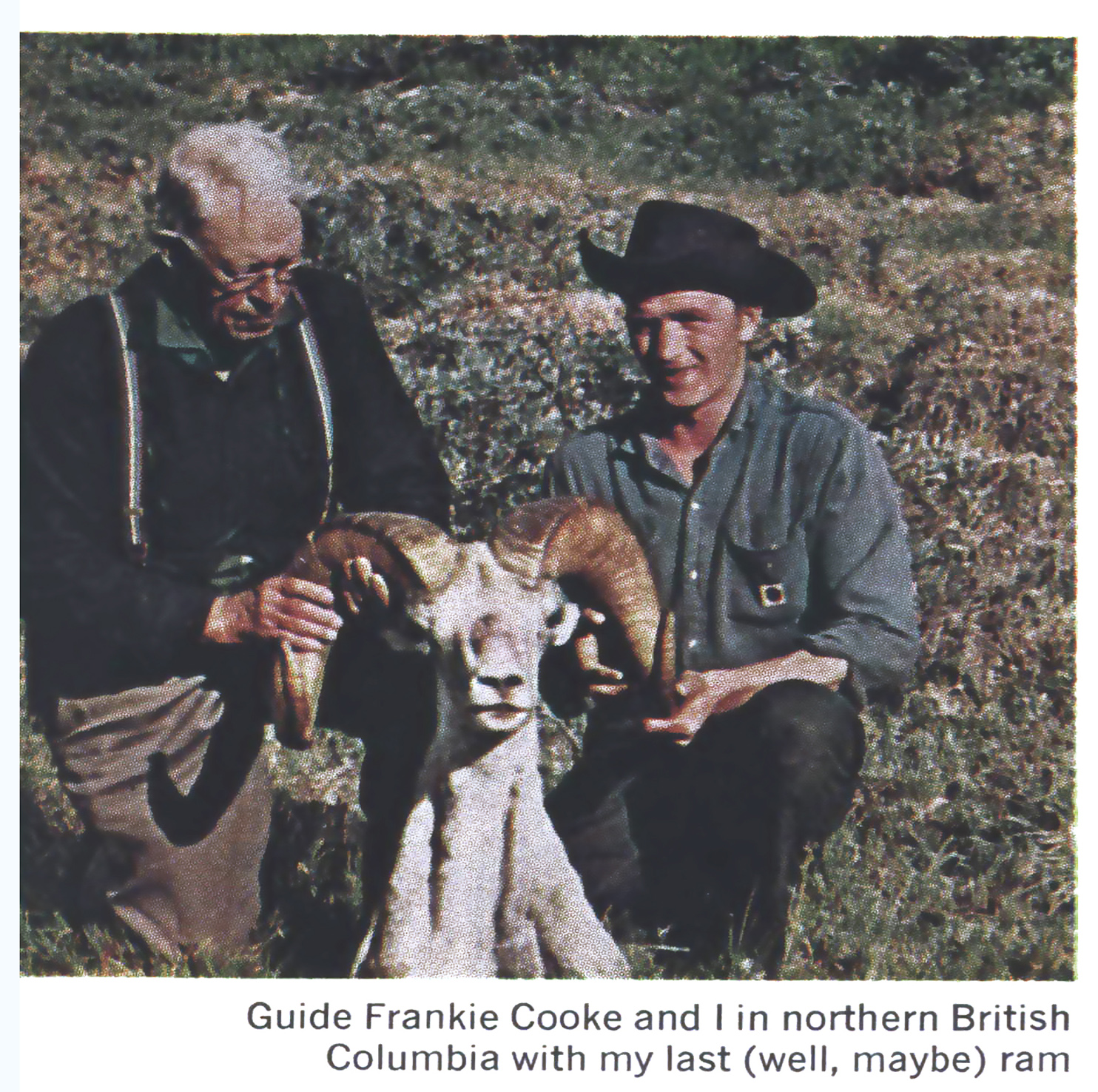
Frank got the horses. We took pictures. As we rode down the trail we saw the white-necked ram with the flared horns. He was on his feet feeding in the cool of late afternoon. Frank set up the spotting scope and looked him over again.
“Well,” he said presently, “you got the better ram. Tell me,” he asked, “is this your last?”
I thought for a moment.
“I’ll take that under advisement,” I said. “With a good horse a man can hunt for rams longer than you might think!”
Read the full article here