
A newcomer to Alaska, especially if he is a sportsman, gets an awful lot of kidding from the old-timers. No matter if he’s hunted and fished a lifetime in the States, he’s still a cheechako, or greenhorn, to the sourdoughs.
So I thought it was just another rib when Ed asked me if I had a deer call. We were making last-minute preparations for a deer-hunting trip—my first try for the little Sitka black-tail which inhabits the numberless islands and the coast country of southeastern Alaska. Our sleeping bags, guns, and other duffel were piled near the front door and we were checking to see that we hadn’t forgotten anything. That was when Ed brought up the subject of a deer call.
Now, I’ve used crow calls, duck calls, and turkey calls, and I’d read that down in Texas they lure bucks by rattling a couple of antlers together. But a real deer call I’d never heard of. Probably my voice expressed my skepticism. “O.K. I’ll bite. What’s a deer call?”
Ed reached in his pocket and came up with an odd-looking object. It was made of two thin pieces of wood about three inches long and three quarters of an inch wide. The ends were bound with surgical tape, the facing sides were slightly concave, and there was a length of silk ribbon lengthwise between them for a reed. A loop of leather was used to hang the call from the neck. Putting it harmonica-fashion to his mouth, Ed produced a noise like that of a lost lamb bleating for its mother. “Took me two days to get that tone just right,” he said with an air of satisfaction. “Now I’ll show you how to make one and you’ll be all set.”
I insisted that I had successfully hunted deer for years without a deer call, but I finally agreed to make one on the way. We had a seventeen-mile trip ahead of us in Ed’s 21-foot boat and I wanted to get started. For the first time since I had arrived in Ketchikan a month before, the waters of Tongass Narrows were placid as a millpond.
It took several trips to get our gear to the dock. As we cast off, the air was full of the raucous calls of sea gulls chasing a seine boat in the hope of filching a meal. A brisk breeze struck us as we drew out into the Narrows, and stayed with us as we rounded Mountain Point and headed up Georges Inlet.
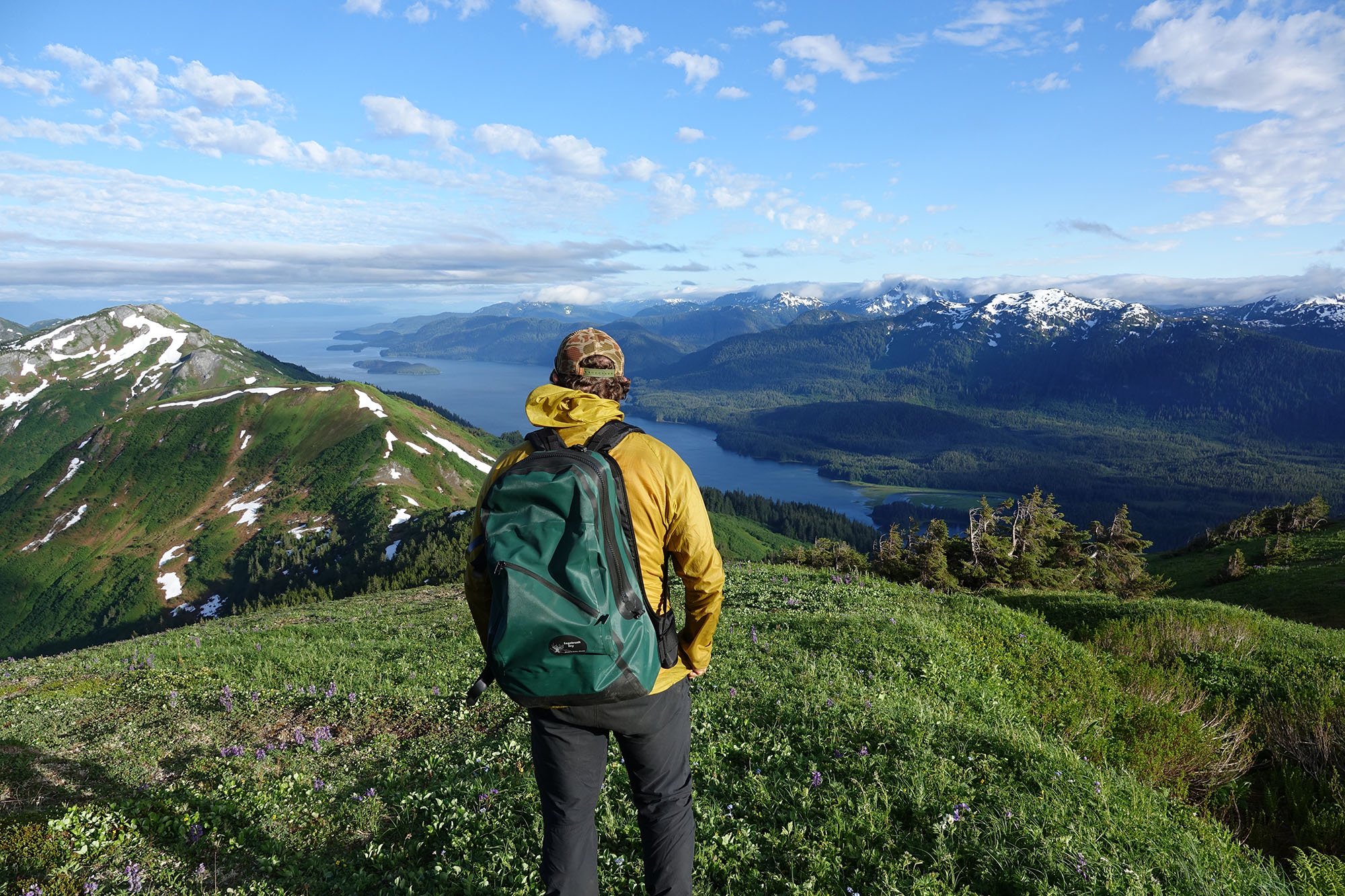
The view was breath-taking. Magnificent mountains rose around us. Innumerable bays and inlets dotted both shores. The dark-green slopes were interspersed now and then by what looked to be brown meadows, but Ed said they were muskeg areas, which are the places most favored by feeding deer.
A couple of hours later we pulled up to the big salmon cannery that was our destination. A short heavy figure in oilskins hailed us from the wharf, and soon I was being introduced with mock seriousness to the cannery caretaker, an old friend of Ed’s.
“John, meet a poor cheechako who says he’s a deer hunter—although he’s never heard of a deer call.”
“Too bad!” said John, shaking my hand with a grin. “Guess he’ll have to learn the hard way.”
“I suppose you’ve got a nice buck in the meat house,” Ed said nonchalantly. “Must be nice to have all winter to fish, hunt, and trap.”
John shook his head. “No sir! I’ve hunted back as far as the third ridge and I haven’t seen a buck. There are plenty of does and fawns, but there hasn’t been enough snow on the high places to drive the bucks down. But let’s go up and get supper. The old lady’s been fussing around all afternoon fixing something to eat.”
Edna met us at the door with the warm welcome I had found typical of Alaskans. Any misgivings I might have had about barging in on a couple of strangers were soon relieved. Besides, the appetizing aromas coming from the kitchen were whetting an appetite that had already been sharpened by our trip in the salt air.
After supper Ed and John tried out the deer call I’d made on the boat. After adjusting it to their mutual satisfaction they told me how to use it. I was to blow it three times—not loudly, but with a wavering quality ending on a rising wail—then wait at least fifteen minutes before blowing again.
I was still a little skeptical, but if they were playing a joke they were going to an awful lot of trouble. “All right, fellows,” I finally said, “I believe you. But have you ever actually heard a deer make a noise like that?” They admitted they hadn’t.
“What’s it supposed to represent?”
“I honestly don’t know,” said John. “All I know is that it works. And I’ve attracted does as well as bucks, so I don’t think it’s a mating call.”
“An old Indian told me it’s the cry of a fawn in mortal terror,” Ed put in. “Sounds logical.” John nodded his head. “That would account for either a doe or a buck answering on the run.”
That night, after tumbling into bed in our cabin, I went to sleep to the sound of water lapping under the floor.
Next morning as we were finishing our bacon and eggs, John came in to discuss our plans for the day. We decided that since there hadn’t been enough snow to drive the bucks anywhere near the beach, we’d better hunt back into the woods.
In my ignorance, I suggested we climb way up.
“Well,” John grinned, “if you feel like it after reaching the second or third ridge, it’s O.K. with me.”
At last, loaded down with guns, shells, lunch, and equipment, we plunged into the woods.
Up to then, the logged-off areas in the coastal ranges of Oregon and Washington were the toughest hunting country I had ever seen, but the alder, devil’s-club, and brush thickets that we were now fighting were every bit as bad—maybe worse. Starting from sea level, there was only one way to go, and that was up. The bottoms of my rubber shoepacs were worn smooth, and I literally slid back a step for every two I took forward.
When we finally stopped for a breather I sank gratefully on a log—but rose quickly, clutching the dripping seat of my pants. Sitting on that moss-covered log was like sitting on a wet sponge.
At the crest of the first ridge we found a game trail. As we followed it John, who had already topped the ridge, suddenly held his hand up in warning, then motioned us to come on. Feeding on some brush to our left and ahead was what I took to be a yearling, but Ed and John assured me it was a mature doe. She looked like a Pacific Coast black-tail, except that she was much smaller. We watched her awhile in the hope that there might be a buck near, but nothing else showed up.
We Decide on a Plan
We had almost surmounted the second ridge when John called a council of war. He said there was a large open muskeg, parallel to the beach and half a mile long, on the summit. We agreed that John would angle to the right, Ed would continue ahead, and I would drift left toward the west end of the muskeg. At its edge I was to take cover and use the deer call.
When I reached the designated spot I started to sit down on a log, changed my mind quickly, and found a rock that was fairly dry. Having seen quite a bit of fresh deer sign on this ridge, I began to scan the muskeg hopefully. I debated with myself whether to use the call. A few minutes later I noticed a movement in the brush opposite me and was glad I hadn’t.
The brush kept moving, and a minute later a doe moved into the open.
I never knew when the buck stepped out; all my attention had been riveted on the little doe. But suddenly I caught the flicker of movement out of the corner of my eye and there stood a four-point buck. I could see his head and the little rack of horns. He wasn’t more than seventy-five yards away and the wind was in my favor.
A clump of brush just in front of me, however, hid the rest of him from view. I waited until he and the doe were both facing the other way, then cautiously stood up. I eased off the safety of my Enfield, shifted my left foot forward, set my weight on it—and my slick-soled shoepac slid sideways as if somebody had jerked a carpet from under me. I got off one wild shot as the buck disappeared and cussed my stupidity, for I’d spooked every deer thereabouts.
I moved down and met Ed and John. Ed had spotted another doe, but John hadn’t seen a thing. After eating our sandwiches we worked out several more muskegs and ridges and saw does and fawns, but no bucks. So about 3 o’clock we decided to head for home.
Rehearsing the events of the day, after supper, the boys said they were disappointed that I hadn’t called up the buck, and when I intimated that I probably wouldn’t have seen him at all if I had been blowing the darned thing they were more than a little indignant.
John had the last word. “Well, son, you had a sample today of what this country’s like. Which is more sensible—to plow around through that brush, or to sit in comfort and call ’em to you?”
As I sat rubbing a cramp out of my aching calf I had to admit that the system had merit—if it worked.
When John rejoined us next morning we decided to split up and hunt individually. I was determined to give the deer call a try, so when I reached the first small muskeg I made myself as inconspicuous as possible, then blew on the call tentatively. I got an answer so fast it made me jump. “Squaa-wk, sqaw, squaa-wk!”
I snatched the safety off my Enfield and could feel my heart thump as I sat swiveling my head trying to see what had made that unearthly sound. It had seemed to come from behind and above me, but I could see no sign of movement. “Squawk!” I jerked my head up and saw a great black raven leave his perch atop a dead spruce.
Sure that the raven had warned away any game that might have been nearby, I started uphill again. I saw numerous deer tracks, but most of them were small and I judged they’d been made by does and fawns. Squatting down, I studied the fairly open slope above me and decided to try the call again. I blew three times and then waited fifteen minutes. I was just going to blow again when a movement at the edge of a little creek caught my eye. There was a flash of brown—and a big mink glided into view. He seemed to flow over the rocks like a snake.
As I stood up to stretch my cramped legs I heard the ka-pow of a rifle to my right. I waited, but there were no more shots. The shot sounded as if it had come from Ed’s Krag, and from not very far away. I called out to him and soon heard an answer drifting back.
The Call Had Worked—for Ed
By the time I reached him he had finished gutting out his buck. “The old deer call sure paid off,” he grinned.
“You did call him out?”
“Sure did. Been sitting right here for an hour. About the third time I called, this fellow came tearing out of the timber looking for a fight.”
I shook my head. “The only thing I’ve called out so far is a raven.”
I walked over and studied the buck. He was a three-pointer with perfect horns, but beside him an ordinary mule deer would have looked like an elk. “What will he weigh?” I asked.
“He’s fat and in good shape. I’d say about 125 pounds.”
Thinking of that thick tangle between us and the beach, I decided it’s just as well these Alaska deer aren’t any bigger. Ed, however, violently rejected my offer to help him pack the black-tail in. I was given to understand that sourdoughs don’t need help. Besides, this was our last day and I had better get busy and get me a buck.
I hunted hard the rest of the afternoon and used the deer call frequently, but I didn’t see a buck. It was getting late when I headed for the beach, angling down toward the muskeg where I’d seen the buck the day before. As I came into the upper edge of it I heard a low whistle and saw John.
I walked over to him. As I did I looked at my watch. “Guess I’m not going to carry home a buck today.”
John scratched his chin reflectively. “Tell you what let’s do. There’s another muskeg a little lower and to the left of this one. We’ll go down there and stay until we either get a buck or it gets too dark to shoot.”
I hesitated, thinking of the many places where a man might break his neck in the dark.
John guessed my thoughts. “I can find my way around with my eyes shut,” he remarked. Then he added as a clincher, “Now’s the best time of day to get a deer. They often drift down to the beach at night to get a little salt.”
I wanted a buck bad. “O.K., let’s go!” We still had good shooting light as we eased into hiding on the lower side of the little muskeg. The opening wasn’t large; maybe 100 yards wide and 300 yards long. Behind us the forest sloped steeply to the beach. There wasn’t a breath of wind—only a vast silence. Suddenly the thin wavering wail of John’s deer call rose eerily in the air. He used only about half the volume I did, and I was thinking that it couldn’t have been heard for more than a few yards, when suddenly from back of us the brush crackled.
We both eased around cautiously to face the down slope. The noise continued for a few minutes and then stopped. I was sure there were at least two animals, possibly three. John eased off the safety of his .35 Remington. I had my Enfield ready.
Read Next: Columbia Blacktails Are the Toughest Deer to Hunt
One Forkhorn—Then Two
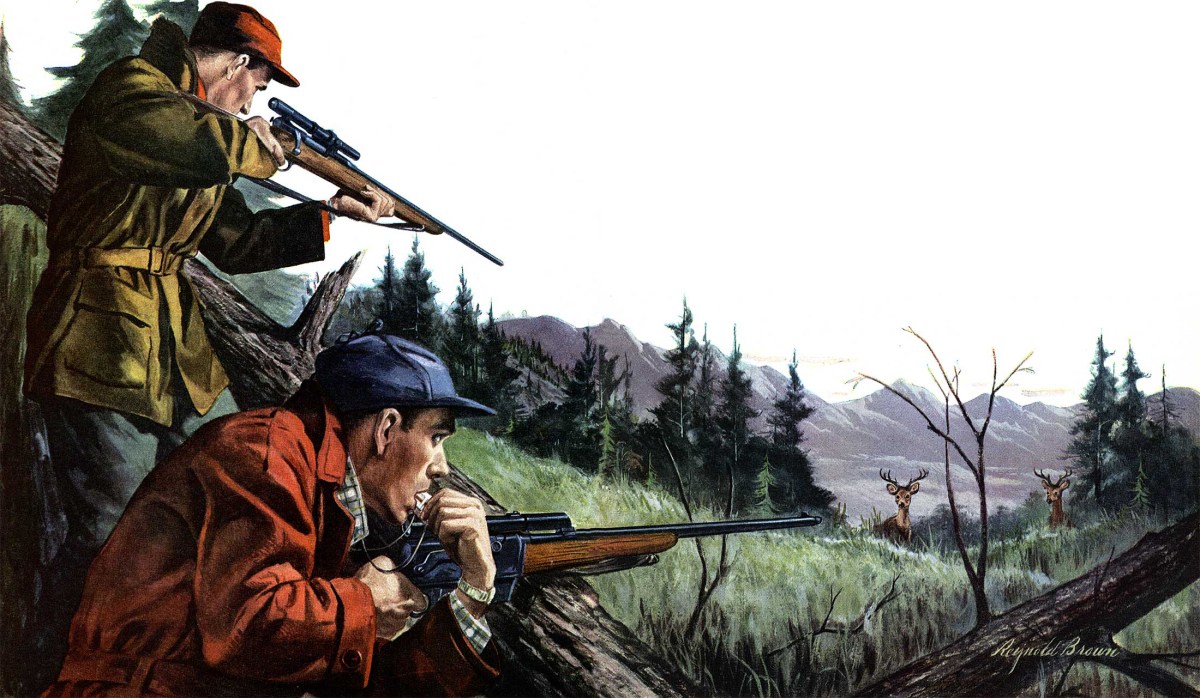
A twig cracked once and a forkhorn moved into view not fifty yards away. Head thrown up, he was looking directly at us. My rifle was at my shoulder but I signaled John desperately with my eyes to shoot—shoot. He only frowned, however, and put the deer call to his mouth. Then his eyes widened, and in the next instant I saw why. Another buck, a three-pointer, was standing there with the same air of expectancy as the other!
My .30/06 bucked and roared, and for a split second I wondered why John hadn’t shot. Then I felt a great wave of exultation. Both bucks were down, so we must have fired at once!
As we stood pounding each other on the back I suddenly realized that my knees were shaking. It wouldn’t do for a sourdough like John to know that I had been that excited about a buck. I wobbled over to a log and sank down gratefully. I was so engrossed in trying to maintain my composure that I almost missed what John was saying:
“… the only bad part of using a deer call. Those last few minutes of suspense, wondering if he’s coming, will make a man a nervous wreck. Boy, move over and let me sit down before my legs cave in on me!”
This story was originally published in the August 1949 issue of Outdoor Life.
Read the full article here