
To shoot or not to shoot, that was the question I had been mulling over in my mind since the small herd of pronghorn antelope had topped the ridge about a quarter mile away. The herd buck, now leisurely following the seven does and fawns toward the water hole, was a good one by any standards. I sat in my pit blind studying him closely with my binoculars—his horns were shiny black and heavy at the base, with wide prongs. I estimated the horns at 15 inches or maybe a tad more. I was having a one-sided mental discussion with myself, attempting to calmly decide whether or not I should try to take this buck.
I had been sitting patiently in the blind since before daylight and this was the first bunch of “goats” that I had seen. I knew from past years of hunting this particular water hole that it wasn’t the most popular pronghorn hangout, but the bucks that did come to it were always very respectable and some were downright huge. The buck that was getting closer and closer with each step was not in the huge category, but he would probably shade the one that I had gotten a year ago—which made him qualify for some serious consideration. The buck I had taken the previous year, and the largest I had taken with a bow and arrow to date, scored over 75 points.
My mental gymnastics were brought to a screeching halt when I caught a movement on the skyline, where the approaching herd had first appeared. I swung my glasses up to get a better look at what was obviously a good buck standing on the ridgetop. Even without the field glasses, I could make out its black horns and dark cheek patches, but when the antelope finally came into focus in the circle of my lenses, my heart gave a bit of a jump and my brainstorming started all over again. The herd buck, which, by this time, was standing some 35 yards away eyeing the water, was all but forgotten.
Over the past five weeks, I had glassed, scoped, and evaluated several thousand head of antelope and many hundred bucks, so it took something pretty much above the ordinary to quicken my heart rate, but this buck did. My first thought was that the buck was really odd looking and too skinny-horned to be a real trophy, but these horns had the height to make me forget about their shape.
By this time, the buck was headed my way, following in the exact footsteps of the antelope that were now quenching their thirst not 20 yards from me. I noticed, but only for an instant, that the first buck was broadside and in perfect position for a shot. My glasses followed the loner toward the water hole as my mind sized up the situation.
I have always been a hunter who would take an odd or unusual trophy over a typical one, and this critter seemed to fill that bill. His horns were so tall that they didn’t seem very heavy at the base, but the buck sported a good set of prongs and neither one of his horns were broken. If he gives me a chance, I thought, I am going to try and fill my Colorado license with this long-horned antelope and go after Mr. Big in Wyoming later on.
I put down my glasses while the buck was still 100 yards out, got myself into a comfortable drawing position—making sure that I had a clear lane to shoot—and continued to watch the buck’s approach. The closer that buck got, the more my evaluation of him began to change. He wasn’t all that odd-looking, but he sure was getting bigger with each step. By now, he was standing broadside on the tank dam 35 yards away and was eyeing the other buck and the does as they finished drinking.
The big buck was nervous and I had a gut feeling that, when the other pronghorns left the water hole, he would follow. Without giving myself time to do any more thinking, I eased into full draw for the moment of truth. My dream of taking a trophy antelope with a bow was coming to fruition.
To me, the pronghorn is the most beautiful of our North American big-game animals and one of bowhunting’s finest challenges.
I had taken my first buck antelope with a bow in this same area during the 1971 rifle season.
The northwestern corner of Colorado has long been one of my favorite areas because it has an abundance of big game, small game, and varmints. This rugged greasewood and sagebrush-covered country has good populations of cottontails, jackrabbits, prairie dogs, sage grouse, chukar, coyotes, deer, and pronghorns.
Antelope continually roamed this part of Colorado, but it wasn’t until the ranchers and the Bureau of Land Management combined forces and started putting water wells and stock dams throughout the area that the prairie goats really started to boom. Water is the key to survival in this semiarid country. There is an abundance of browse and food for the antelope but, without a year-round water supply, they couldn’t maintain much of a population.
The first bowhunting season opened in Colorado in November 1967, with a total statewide take of three antelope. In 1974, the Colorado Division of Wildlife opened an early season for antelope from August 1 to 5, and just four pronghorns were taken. I hunted several of the first November seasons and managed to take a couple of antelope but, in early November, the bucks start to shed the outer sheaths of their horns. With only horn cores remaining, they don’t make for much of a trophy.
In 1980, the division of wildlife decided to open the antelope bowhunting season two weeks earlier than the deer and elk bowhunting season, giving bowhunters a chance to hunt antelope without missing out on the opening of deer and elk bowhunting.
It was during this first early season that I really started getting an education in the art of hunting antelope with a bow. For the 1980 season, I and four other hunters went to the Maybell area a few days before the opening to scout out the terrain. I had hunted this area during the antelope gun seasons for a number of years while I was a wildlife conservation officer for the Colorado Division of Wildlife, and I knew plenty of good water holes that the antelope used regularly. We soon had some rather archaic pit blinds dug.
During the next 10 days, I missed too many antelope to count. I shot where they were going and where they had been, as well as over, under, and around them. I missed several good bucks that would have been well up in the record books and, when the hunt ended, I was the only person in camp who didn’t have a buck antelope to his credit. This fact made me even more determined to learn the tactics that would enable me, as well as my bowhunting clients, to consistently take trophy pronghorns with a bow and arrow.
During the next couple of summers, I spent several weeks at a time observing and photographing antelope in Wyoming and Colorado. And, when the seasons subsequently rolled around, I put this knowledge to work in stalking them with a bow instead of a camera.
The pronghorn has eyesight second to no other game animal. A pit blind on a water hole is the most effective method of arrowing an antelope, but you can’t just dig a hole, throw some brush around it, and expect a record-book buck to come waltzing in for a shot.
The pronghorn has eyesight second to no other game animal except, perhaps, the turkey. Some say that antelope can spot the tip of a bow poking over a ridge at 200 yards, so you can imagine what they can spot at 20 yards. I have also been told by many knowledgeable hunters that the antelope’s sense of smell is very poor because the animals don’t need it in the wide open spaces that they call home. Well don’t you believe it! They have a darn good nose, and a blind set on the wrong side of a water hole, windwise, will move the pronghorns out in short order. They do have a weakness when it comes to their sense of smell, however. They don’t spook and leave the country entirely when they smell human scent. I have had them wind me while I was in a blind 20 yards away and, not being able to locate me in the dark interior of the blind, they moved around to the upwind side of the water hole and gradually settled down and came into the water. In a situation such as this, your drawing movement should be slow and quiet or the antelope will likely disappear in a rush. The only difference between an antelope that’s calmly drinking water and one that’s running all out at 50 mph is a couple of steps.
My pit blinds are dug deep, with plenty of room to make them as comfortable as possible for an all-day stay. The less cover in the area around the tank, the deeper the pit blind should be and the shorter the brush used to camouflage. I build my blind so that I can comfortably shoot while sit- ting, leaning back in a semi-reclined position. This keeps my bow tip down below the brush background. I leave the front of the blind open but fill in the background and sides so that I can sit in the shadows. Black camouflage face paint or a headnet, and dark camouflage clothing will make you virtually invisible to an antelope looking from bright sunshine into the darkness of a blind. Often, I will put two pit blinds on a tank: one for morning hunting, with the brush keeping me in shadow and out of the morning sun, and another on the opposite side for afternoon hunting, when the sun is coming into the blind from the opposite direction. If I can only put in one blind, I dig deep enough and use enough cover to keep me in the shadows at all times.
It’s not easy pickaxing a four-foot-deep hole in a rock-hard clay pan, but I find that a handful of blisters is a worthwhile tradeoff for a trophy buck. When you’re through with using your pit blind, fill it in and leave the area as you found it. I would advise, however, that you don’t throw all the brush in the hole and then fill it in. You just might want to use that location again next fall and digging out that brush is difficult.
In 1983, I and several other hunters scouted and videotaped pronghorns for four weeks in Wyoming and Colorado. I decided that, from what 1 had seen of trophy bucks while working on the video production, I would try for a good antelope in Colorado. —a buck that would equal or better the nice 75 6/8-point pronghorn that I had taken the previous year. Then I would hold out for an 80-point or better buck in Wyoming. If I got skunked on the big one, it wouldn’t be the first time.
The week before, I had put a bow woman on a water hole near where I had seen a huge buck while we were videotaping. A good buck had come in to the water with some does, but she couldn’t get a shot at him. The next day, she killed a 70-pointer on another water hole.
The second morning, I took my hunting partner Jim Dougherty to a water hole that was being used by several fine bucks. I debated on where to go myself and, because I had plenty of time, I thought that I would give the big-buck water hole a day of my time.
One of the things that made this water hole a good big-buck hangout, in my estimation, was the fact that it bordered some rough canyon and arroyo country, where the bucks could hide and where the roadhunting gun hunters couldn’t get at them during the three-day season.
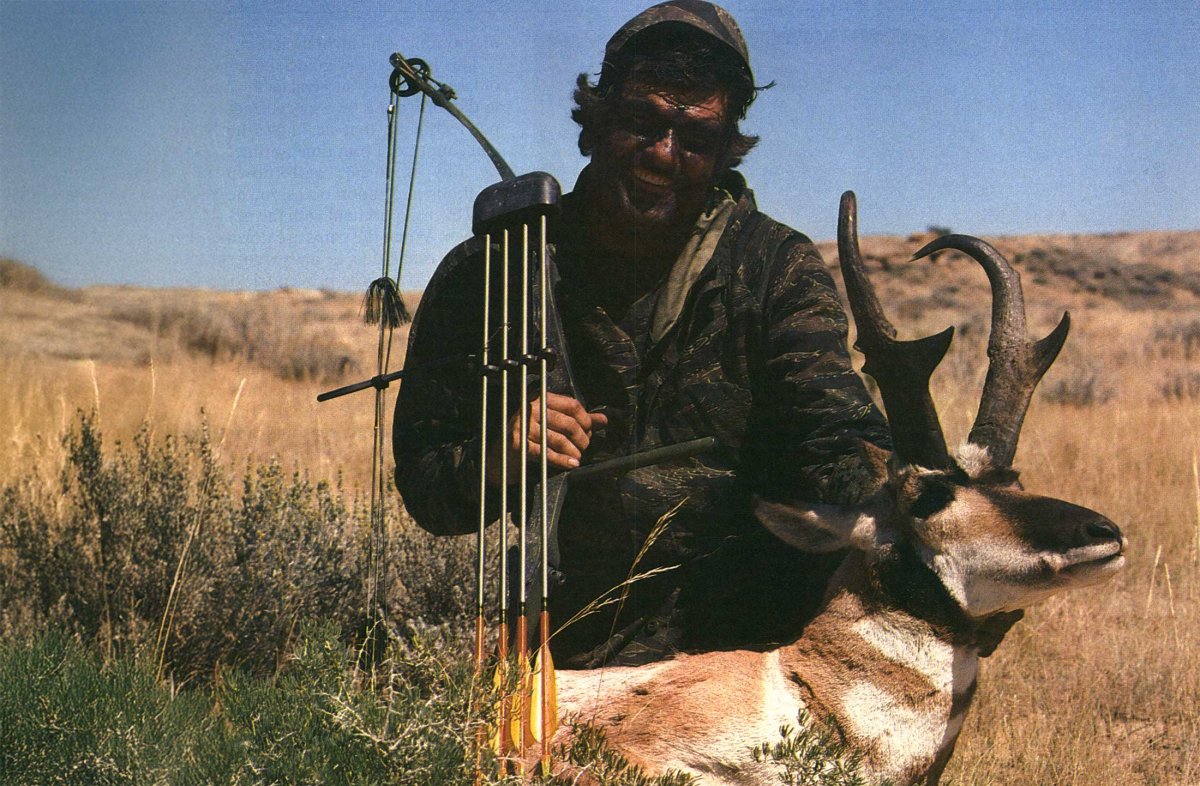
The morning dragged until I spotted the herd coming my way and, from then on, time zipped by. I was surprisingly calm as I drew my 75-pound Easton compound and sent an arrow toward the big buck. The fluorescent orange cresting and bright yellow vanes stopped just behind his front shoulder. The buck bolted off the dam and headed for the ridge. He lost momentum after 30 yards and piled up in the sagebrush. I felt that I had gotten a darn respectable buck until I walked up and got a close look at his horns. They were not only long but extremely massive, both below and above the prong. The upper horn tips seemed to extend forever above the prong, giving him the tall, skinny look. It was then that the realization of just how huge he was hit me, and I said a little prayer of thanks to the gods of the hunt and began to dress him out. I left him in the pit blind, in the shade, and headed out to pick up Jim. I ran into Tony Hoza, however, and a deer hunter who had already filled his tag. They came back and helped me to photograph the buck, then they took him on to camp.
I went to pick up Jim and, when I drove up, he was grinning from ear to ear—and rightly so. He showed me a good-looking buck that he had arrowed and that later scored 73 points. When he asked me how I had done, I told him that I had scored on a tall, spindly buck that wouldn’t score near what his would. He assumed that his was bigger and started ragging me pretty hard on the way to camp. When we arrived and he got a look at my buck, this soft-spoken soul proceeded to thoroughly cuss and congratulate me with the same amount of sincerity. This was indeed a unique experience but one I managed to grin all the way through.
Read Next: I Took a Pronghorn with My Flintlock After the Longest Stalk of My Life
A week or so later, we green scored the horns. While I measured, Jim did the scorekeeping. I hedged a bit on each measurement and mentally deducted 1/8 of an inch or so, just to stay on the safe side. The total came out to 84 6/8 points, which I was well satisfied with, knowing there was a good chance it would score at least that, or maybe higher, after the 60-day drying-out period. The final, official Pope and Young measurement was an even 85 points, tying my rack with Archie Malm’s North Dakota world-record pronghorn, which was taken in 1958.
Jim and I both scored on Wyoming bucks that measured more than 70 points, but my mind was really not on the hunt and I decided to take the first decent buck that I could hit. I felt that taking one tremendous trophy, as I had already done, was all one hunter had any right to do in a season. To try for another pronghorn like that, even though I knew they were there, would be sacrilegious. And besides, I plan on bowhunting for those beautiful prairie speedsters for a long time to come. Who knows, one of those 80-pointers might be over 86 by the time next season opens.
This story was originally published in the AUGUST 1985 issue of Outdoor Life.
Read the full article here