
This story, “Night of the Cottonmouth,” appeared in the July 1971 issue of Outdoor Life. You can read more about Paul E. Allen and his snake hunting background (including how his father died from a cobra bite) here.
The saw grass was eight feet high and very thick. I was hip-deep in the warm water of the roadside ditch, able to see only a step or two in any direction, and I was moving very cautiously. I knew that danger of the deadliest kind lurked in those green tangles.
I pushed aside the growth at the end of an old cypress log with my tongs, let my eyes run along the mossy trunk, and looked at death.
The log was thick and about 30 feet long. It had fallen across another at right angles so that it was tilted, with the far end five or six feet above the water. Tiny trees that had taken root in the decaying bark were a foot or so tall.
Halfway along that fallen giant and four or five steps from me, my eyes stopped on the biggest cottonmouth moccasin I had ever seen.
He was draped full length along the log, and his thick heavy body was slightly flattened to take full advantage of the afternoon sun. He looked six feet long, about as big as his kind ever gets. When we put a steel tape on him later, we found that he actually measured five feet three inches, a very big cottonmouth indeed.
Then I became aware that he wasn’t alone. Above the water and screened by saw grass those cypress logs were a sunning place for all the snakes in the neighborhood. In the next minute or two, I counted 13 snakes — all I could see. They were coiled or stretched out on the two trunks. Four were cottonmouths, nine were harmless water snakes. None of them was small, and I was soon to discover that there were two more cottonmouths, which were out of my sight just then.
If those mossy trunks and the snakes could have been moved intact to the reptile house of some zoo, they would have made a breathtaking exhibit.
My partner Hank Hall was out on the logging road only 30 feet away. He was carrying a box to hold the snakes I caught, but I couldn’t see him through the thick grass.
“Hank,” I said, “I’m looking at the biggest cottonmouth I’ve ever seen.”
Snakes “hear” by vibration through the ground, so I was fairly sure my softly spoken words would not disturb the snakes on the logs.
“Better use my tongs,” Hank told me. “They’re better for big snakes than yours.”
“OK,” I replied.
I closed the saw grass around the end of the log very carefully to screen my movements. Then I retreated, wading very carefully.
“Here they come,” Hank said, and his snake tongs sailed over the top of the tall grass. I caught them, tossed mine out to him, and began to stalk the big moccasin.
By coming in on him from the right side of the log, I would force him to flee in Hank’s direction in case I failed to catch him. I worked toward him step by slow step until I could make out the heavy mud-colored body through the thick vegetation. He was five feet away from me now. Because I was wading and the log was thick, he was at eye level. His head was just out of sight over the curve of the log.
I brought the tongs up very cautiously to avoid any commotion and tried not to tangle them in the tall grass. I was also careful not to move within range of one of the smaller moccasins. Much as I wanted that big specimen, he was not worth risking a bite. Some of his fellow sunners, although smaller than he was, were more than big enough to deliver a lethal dose of venom.
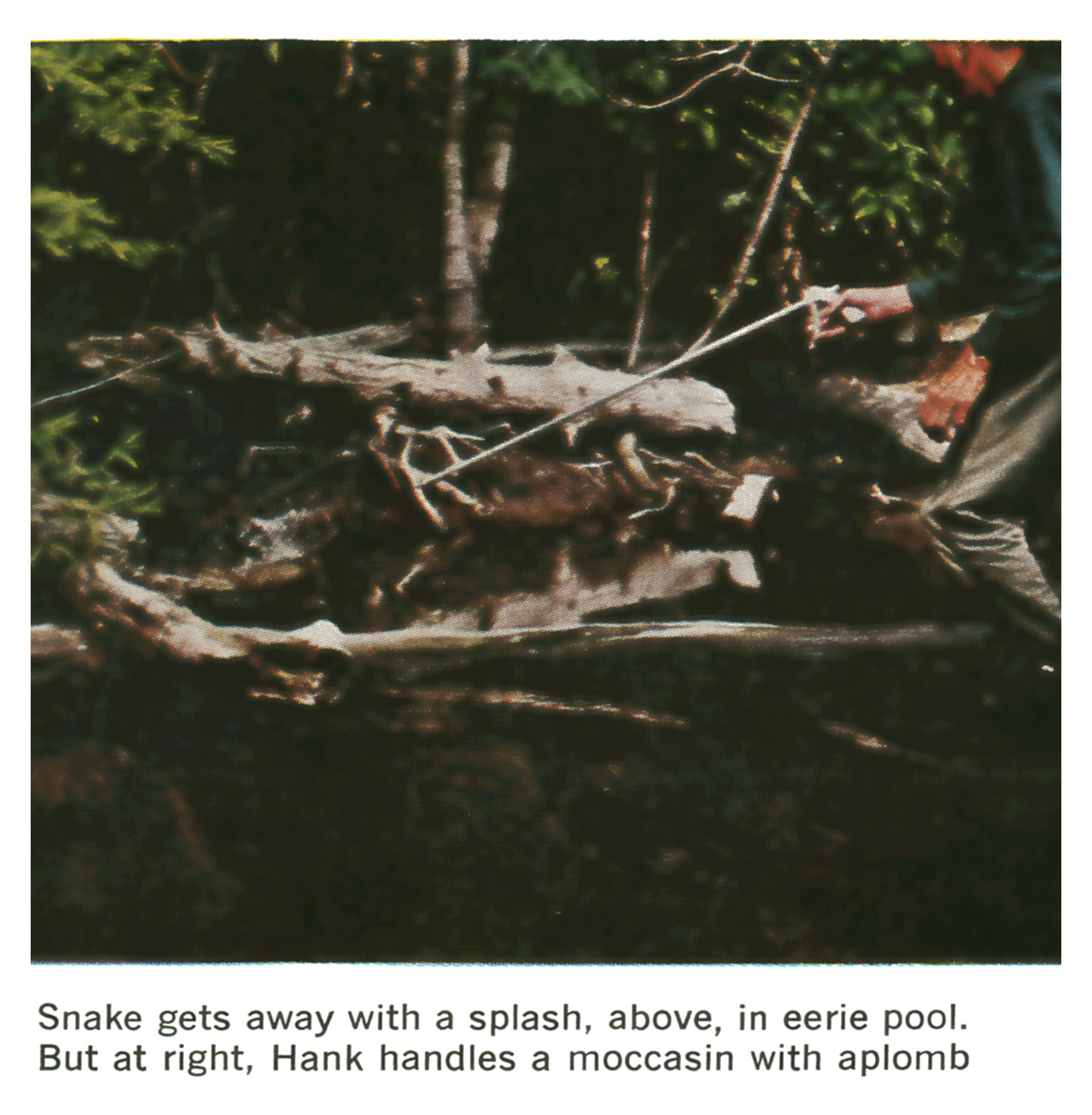
I was ready to grab with the tongs when a big water snake on the high end of the log noticed the movement in the grass. He shot off his perch in typical water-snake fashion and hit the water with a loud splash. The head of the big cottonmouth darted into view. His forked black tongue flicked out, and he dropped off the far side of the log. My tongs closed on empty air.
I waited just long enough to make sure the other moccasins had left the logs in the right direction — away from me. Then I scrambled up the tilted log to the place where the big one had been lying and yelled to Hank that the snake was headed his way.
I heard a splash as Hank jumped into the ditch. He was coming to meet the snake. Then I heard a smaller splash as he made a grab with the tongs.
“Missed him!” he shouted. “He’s going back to you.”
From my place on the log, I saw the moccasin slithering toward me. He was swimming gracefully and silently through the grass. He came within reach and stopped to size things up. I suppose he was wondering what had climbed out on his log.
I lunged with the tongs and caught him by the middle. His thick body flattened in helpless rage, and his head flashed at the metal clamps in a strike too fast for the eye to follow. I didn’t see the twin streams of deadly venom trickling into the water, but I knew they were there.
I stepped down to the lower log. There in front of my feet lay a smaller moccasin that had slept undisturbed through all the fuss. I waved one foot at him, and he slid into the water. Hank came out to meet me.
The snake I had grabbed was so heavy that I could hardly lift him with the tongs held away from my legs, but Hank gave me a hand, and we waded ashore with our prize. We had caught the best cottonmouth either of us had ever seen, and the capture had been as exciting as anything that has happened to me in 30 years of snake hunting.
I grew up with snakes. I’ve been hunting and handling them since I was six years old, and I’m 36 now. I started with the small harmless kinds such as garters. I caught them to feed to the big snakes in the sideshow my father and mother ran with the Beers and Barnes circus for many years.
When I was 19, I moved on to bigger things. That winter, I traveled from our home in Michigan to Florida with two experienced diamondback hunters. I caught my first real trophy on that hunt — a diamondback over 5½ feet long that weighed 8½ pounds.
By the winter of 1962, I had become fairly expert. I took 52 big rattlesnakes that season in the Sarasota-Bradenton area of Florida. I caught 13 in one day. By that time, I was completely addicted to snake hunting.
By the late 1950’s my dad, Paul T. Allen, and my mother were running two roadside serpentariums in Michigan, one near Pontiac, the other just south of the Straits bridge at Mackinaw City. Both of them were billed as Snakes Alive.
Dad was killed by a cobra at the Pontiac place in the summer of 1961. I told that story and described my experiences in hunting diamondbacks in “Never Drop Your Guard,” Outdoor Life, February 1963.
Mother and I continued to manage the Pontiac reptile house for four years after Dad’s death, but that tragedy changed our attitude toward displaying and handling dangerous snakes. Before Dad was killed, the Allen family had milked something like 12,000 rattlers for their venom. I had milked 4,000 myself.
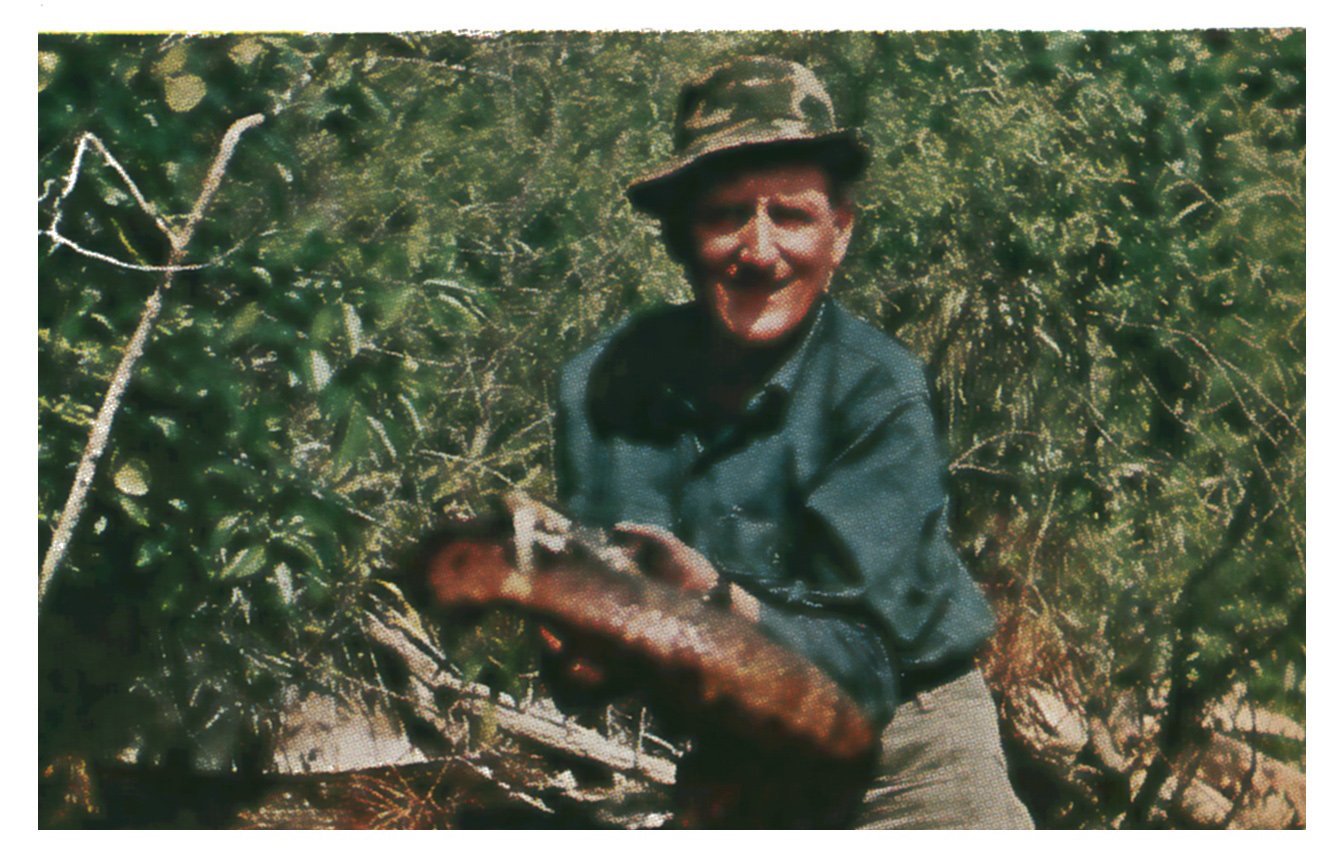
out of his daytime hiding place. OL Archive
I had one close call. It happened at Mackinaw City in July 1959 when a five-foot diamondback buried his fangs in my right hand. I was hospitalized for four days and disabled for two months. After Dad died in an hour from what appeared to be a very superficial bite from an Indian cobra, Mother and I stopped milking rattlers and no longer handled any dangerous snake unless it was absolutely necessary.
Mother closed Snakes Alive in 1965, and my whole family moved to Sarasota, where I now operate a bakery. Mother returned to Michigan after eight months, but I’m still living in Sarasota with my wife Sally and our children — Becky 12, Ross 10, and Leiana eight.
I like my present location because it’s top-notch snake country. I didn’t give up snake hunting when we closed the serpentarium, and I’m sure I never will.
No other sport offers so much action and excitement, and there’s enough danger in it to keep the hunter on his toes every minute.
In 1967 I found the perfect partner in Hank Hall. Hank, 48, is a custodian at the Sarasota High School. He’s just as interested in snakes as I am, and his enthusiasm for hunting the bad actors fully matches mine.
Every snake Hank and I take, whether it’s a harmless king three feet long or a six-foot diamondback, is caught alive. If we have no use for a snake, we let him go later, like a fisherman putting back trout he does not need. Most of our catch goes to zoos, private collectors, or establishments that buy the poisonous kinds as a source of venom. It’s no way to get rich, but we make enough to pay our expenses.
Snakes are often short-lived in captivity, especially those that are milked of their venom, but we know of some we have sent to private collectors that are doing well after many years. As for making any inroad in the snake population, we don’t catch enough for that.
Hank and I have hunted together for the last three years, most of the time for diamondbacks. But there’s a place east of Naples, about 100 miles south of Sarasota, that is prime country for cottonmouths. It’s Big Cypress Swamp, which takes in most of Collier County. Hunting moccasins there, chest-deep in the dark cypress-bordered pools and ditches, packs a very special thrill. We’re doing more and more of it.
We hunt a triangular area west of Florida Route 29, with the highway known as Alligator Alley on the north and the Tamiami Trail on the south.
It is Seminole country — an almost unspoiled jungle of water, cypress, and saw grass. It’s just about as wild as it was when the Seminoles made their final stand against white domination. In addition to having snakes of many kinds in unbelievable numbers, the area has deer, wild turkeys, raccoons, bobcats, otters, mink, alligators, and countless owls and water birds.
This remnant of nearly untouched swamp is under serious threat today. Canals are being dug through it. If the life-giving water is drained away, the marvelous abundance of wildlife will disappear.
It was on a logging road running deep into Big Cypress that Hank and I had our encounter with the record-size cottonmouth that I told about at the beginning of this story.
The time was April 1970. The weather in south Florida had turned warm enough for snake hunting, and other conditions seemed exactly right. We left Sarasota about noon on a Saturday, intending to spend the rest of the day and that night hunting in the swamp.
Once we had our big moccasin safely in the box, we went back to the roadside ditch for another look.
When lumbermen more than 30 years ago cut the big cypress trees in the swamp, they built their logging roads as many Florida roads are still built today. They dug ditches along the right-of-way and used the earth to form dikes on which the roads ran. Miles of those ditches still border the old logging roads, and they often hold the deepest water for miles around and are the last places to dry up in times of drought. Consequently, they attract many forms of swamp life.
I have pointed my headlamp into a clear pool at night and have seen thousands of tiny lights burning back at me from the eyes of fairy shrimp. There are many species of fish in those ditches. When the water gets low the abundance of life in the ditches becomes a thick, nourishing soup for birds, mammals, and reptiles. When the ditch finally turns to mud in a severe drought, buzzards gorge themselves on the last remnants, and all life seems gone. But when the water returns in the rainy season, life returns with it, and the cycle begins all over again.
Hank and I drove slowly down the logging road, one of us at the wheel, the other perched on the roof of the station wagon with his feet braced on the hood. That lookout provides a good view of the ditches.
It was my turn on the roof when I spotted a big water snake on a log and yelled for Hank to stop. My shoes were wet and slippery from wading. He hit the brake so hard that I slid the length of the hood and went off the front end of the station wagon like a ski jumper. We both had a good laugh, but when I went to look for the snake, he was gone.
We drove for a while after that without seeing more snakes, and we decided to go back to wading. We concluded that most of the snakes were hidden among the cypress logs, stumps, and water plants.
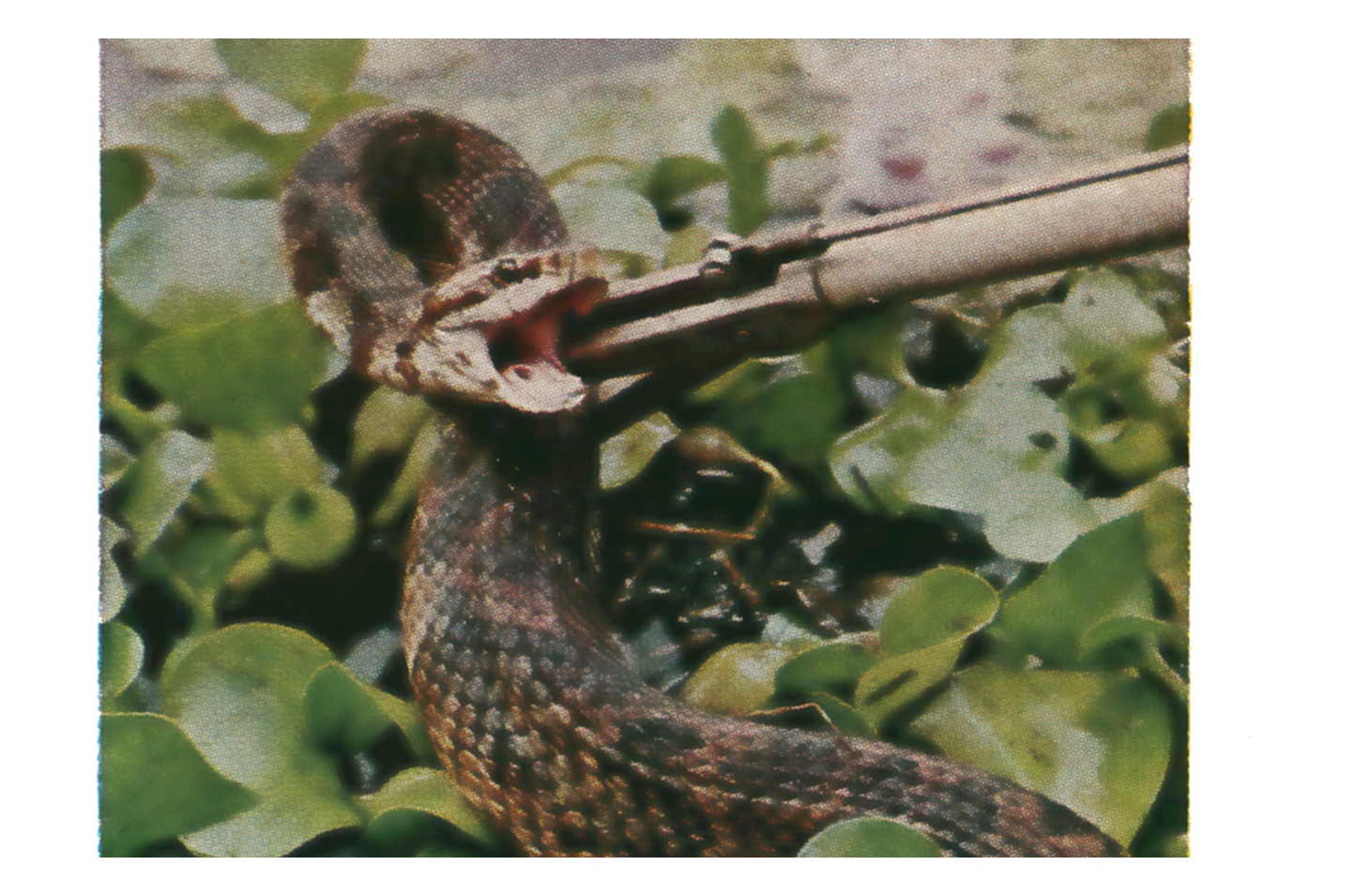
I had hardly eased into the water when a flash of something white drew my attention to the far side of the ditch. Looking closer, I made out the head of a four-foot cottonmouth. He had seen me and had opened his white-lined mouth for a second in alarm or anger. That habit accounts for the name of the snake, and also for the names “gapper” and “trapjaw” by which he is known in some parts of the rural South.
Actually, the inside of the snake’s mouth is no whiter than the mouth linings of many other snakes, but against the dark background of a swamp pool it looks almost pure white, and the threatening manner in which the reptile displays it heightens the effect. Many people believe the cottonmouth holds his head back and its mouth open in readiness to drive home its fangs more swiftly.
Like the rattlesnakes and the copperhead, the cottonmouth is a pit viper. In fact, the cottonmouth is closely related to the copperhead. Our two biggest rattlers, the Eastern and Western diamondbacks, are more deadly than the cottonmouth because of their large size and the quantity and toxic properties of their venom, but the cottonmouth is not far behind them. The coral snake’s venom is very deadly too, but the snake is small and rather inactive by comparison, and very few people are bitten by them.
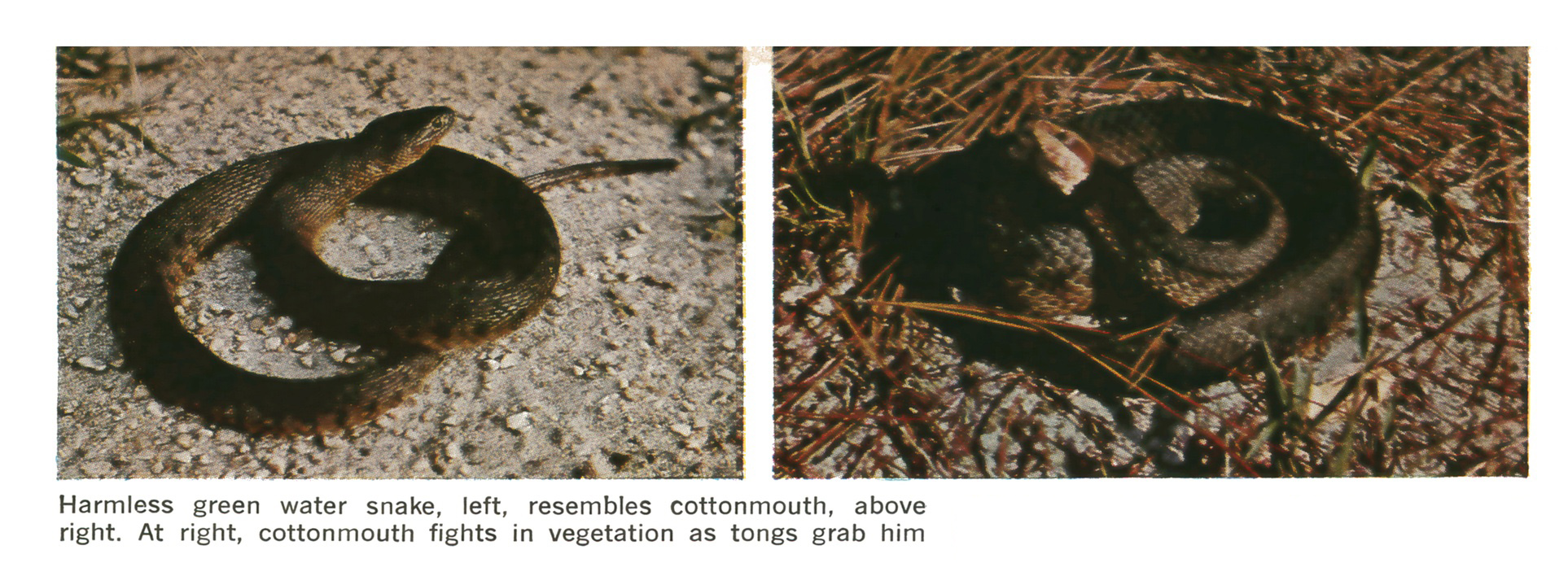
Although the cottonmouth is often called the water moccasin, that name is misleading, since it is also used for a number of large but harmless water snakes that resemble the cottonmouth closely enough to be easily mistaken for him. In the heavy cover of a swamp, it takes an expert to tell the two apart, and reptile authorities stress that the only safe rule in cottonmouth country is to be wary of any snake found in or near water.
The cottonmouth is brownish or dull black in color. In medium-size specimens, darker crossbands can usually be seen, but in large, old snakes, the body is a uniform muddy black. Many water snakes have the same coloration. The cottonmouth is heavy in build, and so are the harmless kinds. At birth (they are born alive) both are brightly marked. In fact, the newborn cottonmouth is almost a dead ringer for a copperhead of the same age.
As I approached the four-foot cottonmouth on the far side of the pool, he flattened his body and pulled himself into tightly coiled loops in readiness to strike. That is typical cottonmouth behavior. A water snake is likely to make a quick getaway or drop into the water with a splash, but the cottonmouth usually stands his ground. If he retreats at all he crawls off slowly, showing neither excitement nor fear, seemingly aware that he can defend himself against all comers.
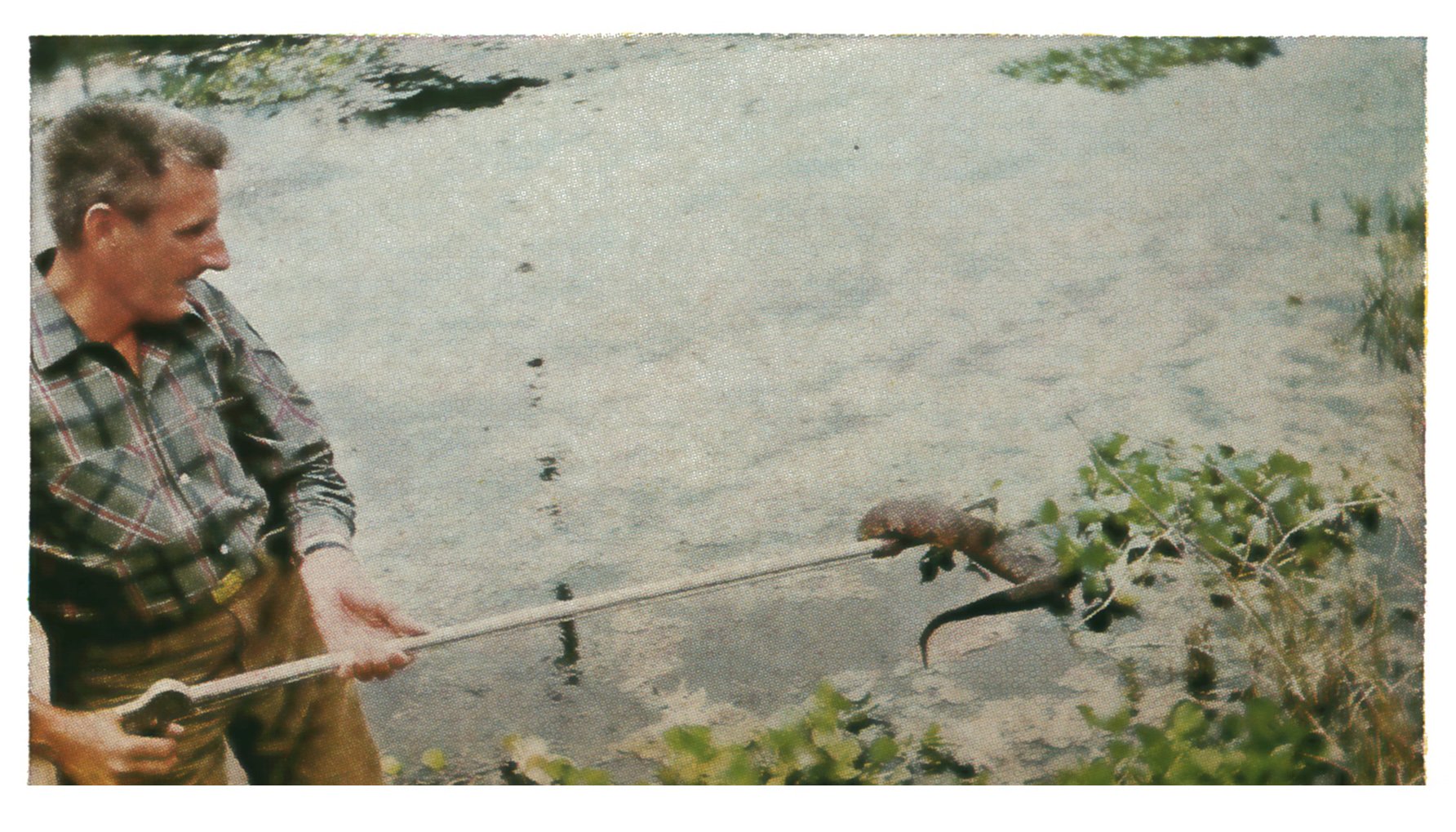
I was almost ready to grab the gapper with my tongs when I spotted a second, a bit larger, a few feet to my right. Hidden in thick vegetation, that one had made no move at all. This trait of lying quietly in wait and lashing out without warning makes the cottonmouth a very dangerous snake to hunt.
I reached with the tongs, clamped down on No. 2, lifted him clear of the vegetation, and backed out the way I had come. When Hank had him in the box, I went back after No. 1. He was still in the same spot, lying in a defensive coil with no intention of trying to escape. When I closed on him, he struck viciously, and that time I saw the jets of yellow venom run down the metal jaws of my tongs.
At the end of three or four hours of hunting that afternoon, Hank and I had taken a very satisfactory catch of cottonmouths and harmless water snakes, but we were confident that the best hunting was yet to come.
Like many other snakes, the cottonmouth does most of its foraging by night. He hides in grass and thick bushes during the day or suns himself, then goes on the prowl by night.
Nosee-ums swarmed over the swamp just before sundown, and they gave us a bad time for an hour or so. At dark, they disappeared. For once, there were no mosquitoes.
There was no moon, and darkness came quickly. The spring night was comfortable and pleasant. Half an hour after the last light faded, I adjusted my headlamp and eased into the chest-deep water of a small pond. The battery for the light was strapped between my shoulder blades — high enough, I hoped, for it to be above water.
We had caught two cottonmouths in the thick shore cover of that pool during the afternoon, but Hank and I were sure the place harbored more than that. Well, it wouldn’t take long to find out.
I realize that thousands of sportsmen could face an enraged grizzly or charging cape buffalo without the slightest fear but would not have waded into the inky black water of that pool for all the gold in Fort Knox. As Hank commented:
“For anybody who’s afraid of snakes, it would be a hell of a way to spend Saturday night.”
I can’t explain why, but he and I just don’t feel that way, nor do we consider our snake hunting foolhardy. We have the greatest respect for the dangerous reptiles we hunt, and we take no chances, but we are not afraid of them.
I waded out toward the middle of the dark pool, stopped, and swept my headlamp in a slow circle. I expected to see snakes, but I wasn’t prepared for what that moving light revealed.
I was almost surrounded by the greatest number of cottonmouths I had ever seen at one time. There were no really big ones, but most of them were three to four feet long, and that’s big enough. The pool was literally alive with them. I counted more than 20 snakes, most of them cottonmouths.
The stumps of cypress trees stood on three sides of the pool. Some of them were three feet in diameter, and there were small black openings in those gnarled stumps. It was easy to figure out that those stumps sheltered the snakes during daylight. Now they had come out to hunt.
My lamp did not seem to disturb them much, but when the beam of light settled on a snake, he stopped.
I picked out a three-footer, eased up to him, and clamped his middle with the tongs. He fought back, but once he was clear of the water, his struggles did nothing to excite the other snakes. I waded slowly to the place where I had entered the pond. Hank was waiting there on high ground. We transferred my catch to his tongs to be boxed, and I went back for another.
A few got away by swimming or crawling back among the cypress stumps, but when we left that pool an hour later, we had 12 cottonmouths and four or five big water snakes.
Spooky as that place was, we got into others that were far worse before the night was over. It’s hard to imagine the hellish tangles we encountered as we worked deeper into the swamp. We crossed some of the pools on fallen logs, but that tactic called for extreme caution because the logs were old, mossy, and slippery. Some were so rotten that they broke under us, others sank when we stepped on them, and still others rolled when we least expected it. Most of the time we waded in black and mucky water one to three feet deep, stepping over limbs and logs or pushing them aside, keenly aware that every spot beyond the range of our lights might harbor a cottonmouth.
We came to a ditch that was like a tunnel. There was impenetrably thick brush on both sides. It was open only at the ends, and hanging moss and branches closed it overhead. We were wading slowly through the tunnel in water to our belts when rotten limbs gave way under my feet and I fell headlong.
I fell on my right side across a small log and managed to check my fall by jamming my tongs into the bottom before the log could sink and dunk me and my battery. But my right ankle was hung up in submerged brush, and I could find no solid footing with my other leg. I was sprawled across the log, trying to regain my balance, with my lamp only a few inches above the water. As the light stabbed erratically along one side of the tunnel, I caught a split-second splash of white.
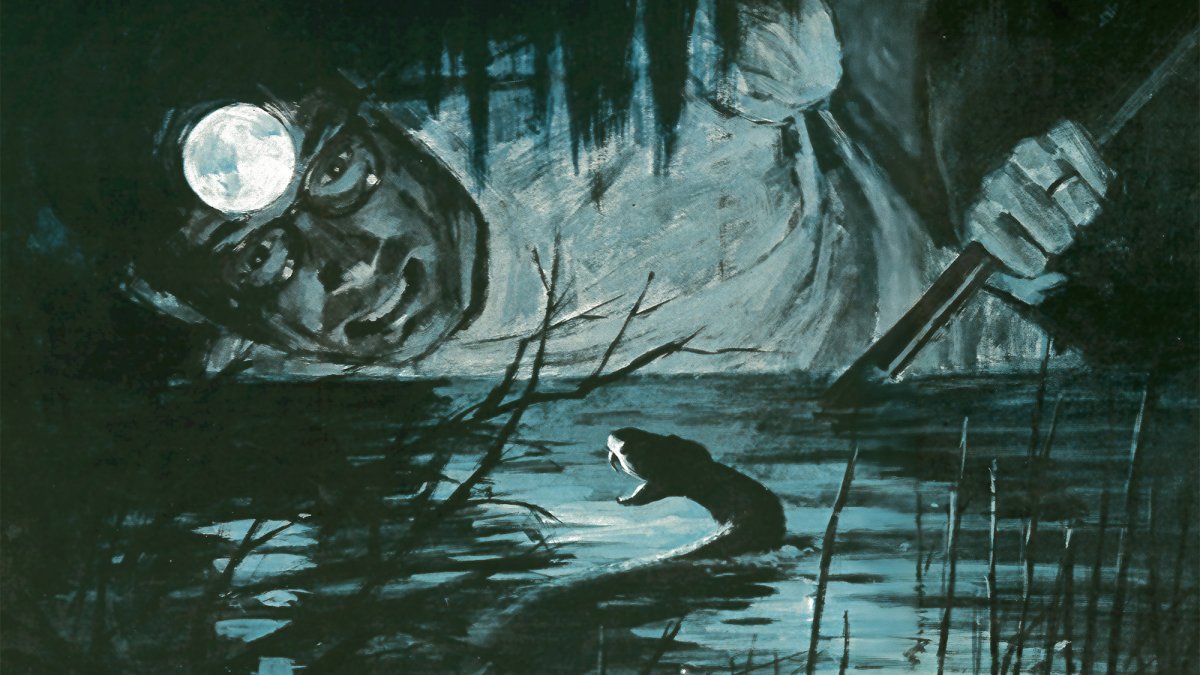
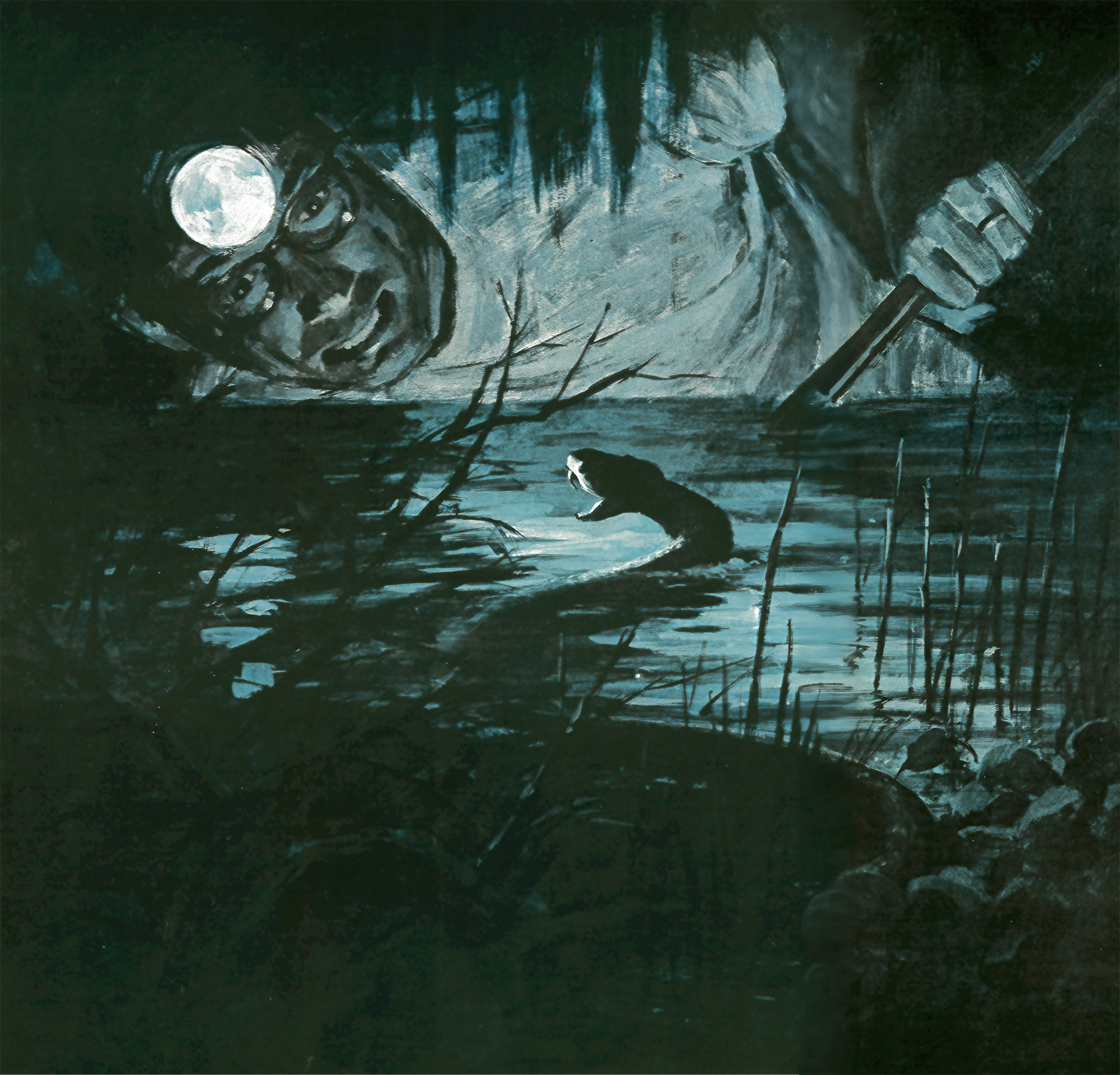
The hair rose on the back of my neck, and I brought the light back and looked again. A big cottonmouth was swimming straight for my face, no more than six feet away. The log on which I had fallen ended in the thick tangles along the ditch bank, and apparently it had moved enough to flush him out.
I knew he was not coming to attack me deliberately. Snakes, even the deadly ones, don’t do that, at least not the North American kinds. He had been disturbed and was moving off.
The 1911 Revenant Sticker
See It
The brush was too thick for me to swing the snake hook, and I had no time to untangle myself or yell for Hank. Almost before I realized what was happening, the snake was two feet from me, nearly level with my eyes, and still coming. Thoughts flashed through my mind like flickers of heat lightning:
Freeze! Don’t move! A turn of your head may bring a strike.
Maybe he’ll swing around me. Maybe he’ll even crawl over me. Anything, just don’t strike me in the face! His white chin is less than a foot away, and suddenly he senses me or feels the heat of the lamp. He stops swimming, and his head and neck whip back in a loop. Hold your breath! Will he lash out, or will he change direction and go his way?
I never learned the answer. A snake hook swung down from behind me and yanked him away.
He was 4½ feet long, one of the biggest we caught that night. We got both our tongs on him and together carried him out of the ditch and dropped him into a box.
“You were wallowing around like a hurt ‘gator,” Hank drawled then, “so I thought I’d better mosey over. That moccasin was a mite big to catch in your teeth, and we don’t want teeth marks in him.”
I don’t like to talk about close calls in snake hunting. Hank and I don’t have many, but no matter how careful you are, and we are mighty careful, unforeseen things do happen.
Hank and I quit hunting sometime after midnight. In all, we had spent about eight hours at it, half by daylight, half in the dark. Our total catch was hard to believe. When we drove back to Sarasota on Sunday, we had 69 cottonmouths and 44 big water snakes. It was by far our most successful hunt.
A catch of that kind is enough to make anybody continue snake hunting or quit it on the spot, depending on how you look at things. Hank and I intend to stay with it.
Read the full article here