

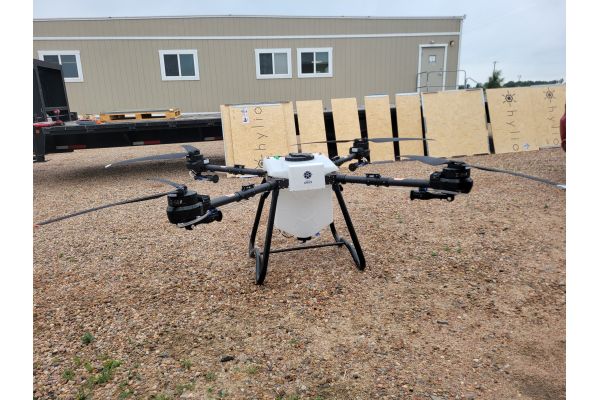
Thanks in part to an NWTF Colorado’s Hunting Heritage Super Fund grant, Pheasants Forever and Get Outdoors Colorado, Colorado Parks and Wildlife (CPW) has purchased the agency’s first-ever aerial spray drone system — a new tool that will help restore thousands of acres of wildlife habitat across eastern Colorado’s state wildlife areas.
At first glance, a spray drone may not sound like a wildlife conservation success story. But for the biologists and habitat managers responsible for caring for Colorado’s public lands, it represents a major leap forward in how they can restore habitat for wild turkeys and countless other wildlife species.
Across northeastern Colorado, invasive plants such as leafy spurge and Canada thistle have steadily crowded out native grasses and wildflowers, while dense cattail stands have overtaken valuable wetlands. These expanding species reduce the quality of nesting cover, brood habitat and food sources that wild turkeys rely on throughout the year. Many of the worst infestations occur in places that are nearly impossible to reach with tractors, UTVs or even hand crews, leaving habitat managers with few practical options for long-term treatment.
This new drone changes that equation.
Equipped with a 13-gallon spray tank and precision GPS technology capable of centimeter-level accuracy, the system can treat up to 50 acres per hour while applying herbicide only where it is needed. A companion mapping drone allows crews to survey treatment areas in advance and develops detailed spray plans, making habitat work more efficient while reducing overspray and unnecessary chemical use.
Just as importantly, the drone gives managers access to habitat they simply could not manage before. Wetlands that remain saturated year-round, river bottoms lined with mature cottonwoods and other difficult terrain can now receive the repeated treatments necessary to control invasive vegetation. Instead of relying on expensive helicopter applications or one-time treatments, CPW can return year after year to continue improving these landscapes, taking a critical step in restoring healthy native plant communities.
Those healthier plant communities translate directly into better wildlife habitat. Wild turkeys depend on diverse vegetation for nesting cover, abundant insects for growing poults and open areas where broods can move safely while foraging. As native grasses, wildflowers and shrubs recover, so too does the quality of habitat available to turkeys throughout the year. The same restoration efforts also benefit mule deer, white-tailed deer, pheasants, northern bobwhite, mourning doves, waterfowl, shorebirds, songbirds and countless pollinators that share these landscapes.
“Investing in a piece of equipment like this has lasting impacts,” said David Nikonow, NWTF district biologist for Montana, Wyoming and Colorado. “We’re not just contributing toward a one-time management activity but rather years of repeated and expanded treatments that will significantly benefit wildlife.”
The impact stretches across more than 2,000 acres of State Wildlife Areas in Morgan, Logan, Washington, Phillips, Sedgwick and Yuma counties, but the project’s influence extends even further. Because this is the first aerial spray drone in Colorado Parks and Wildlife’s fleet, it also serves as a model for how emerging technology can make habitat management more efficient, cost-effective and sustainable into the future.
Like many successful conservation projects, this one became possible through partnership. The Colorado NWTF Super Fund contributed $5,000 toward the approximately $65,000 project, joining investments from Colorado Parks and Wildlife, Great Outdoors Colorado and Pheasants Forever. Together, those partners purchased a conservation tool that will continue restoring habitat for years to come.
Although crews are still completing the specialized FAA certifications required to operate the system, habitat treatments are expected to begin in spring 2027. When that first flight takes off, it will represent much more than a new piece of equipment. It will be another example of how NWTF members’ investments in conservation help deliver lasting improvements to the landscape, creating healthier habitat for wild turkeys, better opportunities for hunters and stronger ecosystems for all wildlife.
Read the full article here