

The Iranians helped President Trump in more ways than one. Not only have they egged him into demolishing the biggest threat in the region and setting up the opportunity to lead a historic reshaping of the Middle East into a more stable and prosperous region, but the sad little fight they have fought has also validated much of the administration’s thinking on future needs for the armed forces. There are big lessons in the little war Trump calls “small potatoes.”
No Hubris Allowed
Even harsh critics acknowledge Trump has won his war. That said, like the stock market, “past performance is no guarantee of future results.” Let history judge. Long seasons of slumps followed the ticker-tape parade after V-J Day, with interminable quagmires in Korea and Vietnam. The Second Iraq War and Afghanistan were worse sequels than The Next Karate Kid.
So, sure, Trump decapitated the terrorist regime in Venezuela and flattened the Iranian military like unrecognizable roadkill, but that’s cold comfort for what might come next with everything from predictions of AI ending humanity before Gen Z can make a dent in their student loans to a showdown in the Taiwan Strait between itchy-fingered, nuclear-armed superpowers.
Hubris is the least valuable guide to lesson learning. After the Gulf War, for instance, a distinguished scholar and soldier, Robert Scales, penned Certain Victory (1993), the official U.S. Army history of the conflict. Not only did the Americans do everything right, but he predicted military dominance to the far horizon. Barely a decade later, soldiers were desperately fighting fanatical tribesmen barehanded for control of the same sand and rock, reminding us that reputation doesn’t stop bayonets and bullets any better than a camouflage jacket.
Mostly, the best lessons learned are what not to do in the next war. Mistakes and failures are the most profound and enduring educators.
War as a Tough Teacher
Both Iran’s and Russia’s war against Ukraine have demonstrated that in the modern world even mediocre middling powers can muster the wherewithal to block a quick decisive victory and fight a protracted war of attrition.
A U.S. Air Force F-22 Raptor waits to taxi on the flight line in Ceiba, Puerto Rico, Jan. 4, 2026. U.S. military forces are deployed to the Caribbean in support of the U.S. Southern Command mission, Department of War-directed operations, and the president’s priorities to disrupt illicit drug trafficking and protect the homeland. (U.S. Air Force photo)
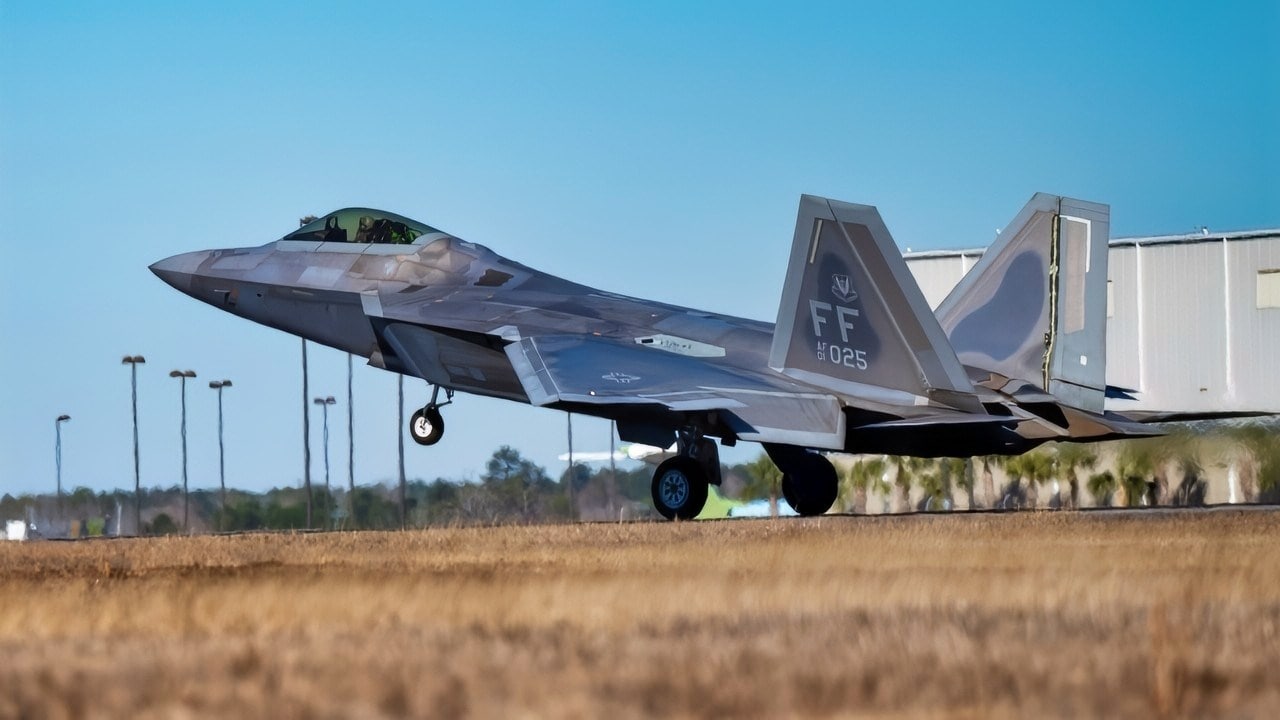
A U.S. Air Force F-22 Raptor aircraft assigned to the 1st Fighter Wing, Joint Base Langley-Eustis, lands on the runway during Sentry Savannah 25-1, at the Air Dominance Center, Savannah Air National Guard Base, Georgia, Jan. 17, 2025. Sentry Savannah is the Air National Guard’s premier fourth- and fifth-generation fighter integration exercise, with this year’s event involving more than 1,000 participants and 56 aircraft from eight flying units. (U.S. Air National Guard photo by Senior Airman Xaviera Stevens)
That said, while the Iranians and the Russians have demonstrated the capacity to take a tremendous beating without sending up the white flag, they have mustered this effort to virtually zero strategic benefit. Not only have the Iranians been whacked around like a lightweight in a heavyweight MMA match, even if there were a truce tomorrow and the Tehran regime was left alone to rebuild, but Biden’s presidential library will be erected before they could recover the power they had just a year ago.
The chief lesson is that while nations can fight these interminable, protracted conflicts of attrition, that’s about as smart a strategy as Cracker Barrel’s rebranding. Fighting limited conventional wars is likely going to be a declining preference.
Of course, competitors won’t stop competing. Like the world’s greatest philosopher, Jeff Goldblum, says about life, “war finds a way.” For those not interested in refighting the last battle, two competitive spheres will dominate. One will be on the high end, expanding strategic and conventional deterrence—sending the message, like the hedgehog, “don’t think any nation is easy pickings for a light lunch.” Second, there will be persistent animosity below the threshold of all-out armed conflict with endemic political, economic, and hybrid warfare. Delivering competent security and resilience will require juggling both spheres.
There are plenty of signs that Trump’s team has already incorporated both of these lessons. At the high end, an unprecedented $1.5 trillion request for the War Department reflects a clear intent to deliver strategic and conventional forces that would make an enemy think twice before picking a fight with the USA. As the 2026 Index of U.S. Military Strength noted, “[a]s currently postured, the United States military is at significant risk of being unable to defend America’s vital national interests.” Fixing these shortfalls is Trump’s top priority and perfectly matches the needs of the future strategic environment America will face.
On the other hand, Washington has adopted a strategy of expanding shared responsibility for security and societal resilience to meet the range of threats our friends and we face, from national defense to countering hybrid threats, including the “global intifada,” cyberattacks, terrorism, and transnational crime. U.S. strategy is a combination of demanding our partners do more coupled with the U.S. adding a measure of assistance and capability to backstop these efforts. The president’s Shield of the America’s is an exemplar of these initiatives.
Trump’s global approach to collective security spans both these spheres. Rather than traditionally thinking in terms of friends and allies, the U.S. strategy focuses on “stakeholders,” partnering with nations that share a common interest in expanding critical “free and open spaces,” secure commons, and growing zones of “arcs of stability.’ The Abraham Accords are an example of this approach.
Future Implications
Regional prioritization is passe. In the world’s new geography, regional competition is so interconnected that prioritizing one over the other is like going to a doctor who asks, “Do you want me to save your brain or your heart?” The U.S. must have the capacity to operate globally. Still, faced with limited resources, America, like everyone else, needs to prioritize defense needs. What makes more sense is to prioritize by domains, because it is the capacity to operate across domains that will allow the U.S. global reach to act with vigor from the high end to the low end.
Given the wars we have seen, this is what makes sense.
Dominate in space. Space capabilities are essential for deterrence, warfighting, and everything in between. With a projected capability of over 1,000 launches per year, the U.S. is going to be a beast in space. That said, space supremacy is likely an unachievable goal. It’s going to get crowded up there.
Competitive in the Electro-Magnetic Spectrum. No domain has more players. Every state and non-actor has a seat at the table. Capabilities and vulnerabilities emerge faster than trends on TikTok.
Competitive in the Human Dimension. We can’t child-proof America from every political and economic warfare threat. We have to acknowledge we live in a world where every day is flu season, and the latest vaccine missed a strain or two.
Supremacy in Air and Space. The U.S. ought to be able to own the air over any part of the planet whenever it wants. This ought to be a non-negotiable goal. If the U.S. can control airspace, our armed forces can split the domains like a layer cake, denying any adversary the means to fully operationalize across every layer of the battlespace.

X-37B. Image Credit: Creative Commons.
Competitive on the Surface. The world is too big. There are others with much bigger armies and navies. The U.S. needs quality forces and must have the capacity to surge into theaters, but it is unrealistic to think we will have global coverage on the scale of a Sydney Sweeney ad.
Supremacy undersea. This is nonnegotiable. Nobody else in the world can do what we can undersea. We need to keep it that way. If the U.S. maintains supremacy in air control and undersea operations, every potential competitor faces an enemy that will always be able to do things they can’t, no matter how much they try.
We may live in a world where nations can fight more Iran-like and Ukraine-like wars, if they want to, but America’s national interests will be secure because the Trump administration is focusing on the right mix of portfolio investments.
About the Author: Dr. James Jay Carafano
James Jay Carafano is a national security expert and a 25-year Army veteran. His most recent books are Cold Combat: Mountain Warfare in Italy and the Battle of San Pietro, 1943, and Digital Dominance: Winning in a Socially Networked World. He is a 19FortyFive Contributing Editor. Carafano is also a Senior Counselor to the President and E.W. Richardson Fellow at The Heritage Foundation.