
Sometime around midnight on Sunday, Donald Trump posted a video of Kharg Island burning, explosions rolling across an oil terminal, and what looked like a warship, captioned “Kharg Island being blown to smithereens!!!” There was no such strike. Reuters ran the clip through detection software; it was almost certainly AI-generated. A U.S. official said the military had not touched Kharg overnight.
Asked about it Monday, Vice President JD Vance did not deny any of that. He said the president was sending a message to the Iranians.
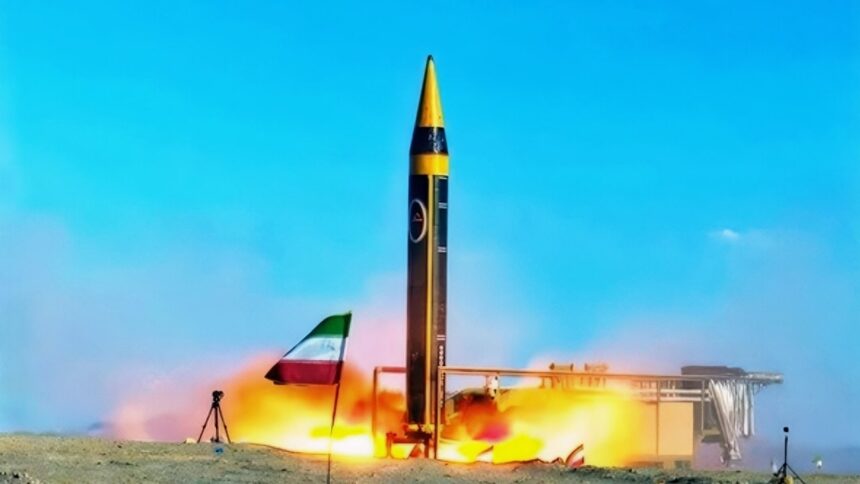
Iranian Kheibar Shekan “Fortress Buster” Ballistic Missile Creative Commons Image
Kharg has actually been hit before.
The United States struck military targets there in March and again on April 7. So the fake footage restaged a strike Iran knows Washington can carry out for real, leaving Tehran to wonder whether this was the sequel.
That message went out hours after a real strike. U.S. forces hit rocket launchers on Larak, in the Strait of Hormuz, that CENTCOM said Iran was positioning to lay mines. Iranian officials say two people died.
Tehran answered with missiles at American facilities in Jordan and a drone the UAE says it intercepted over its own waters, denying Iran’s claim the attack had reached Al Minhad Air Base outside Dubai.
By Monday afternoon, Trump had an answer for Fox News: “We’re going to hit them hard. There will be a response.”
And, today, both sides traded shots again.
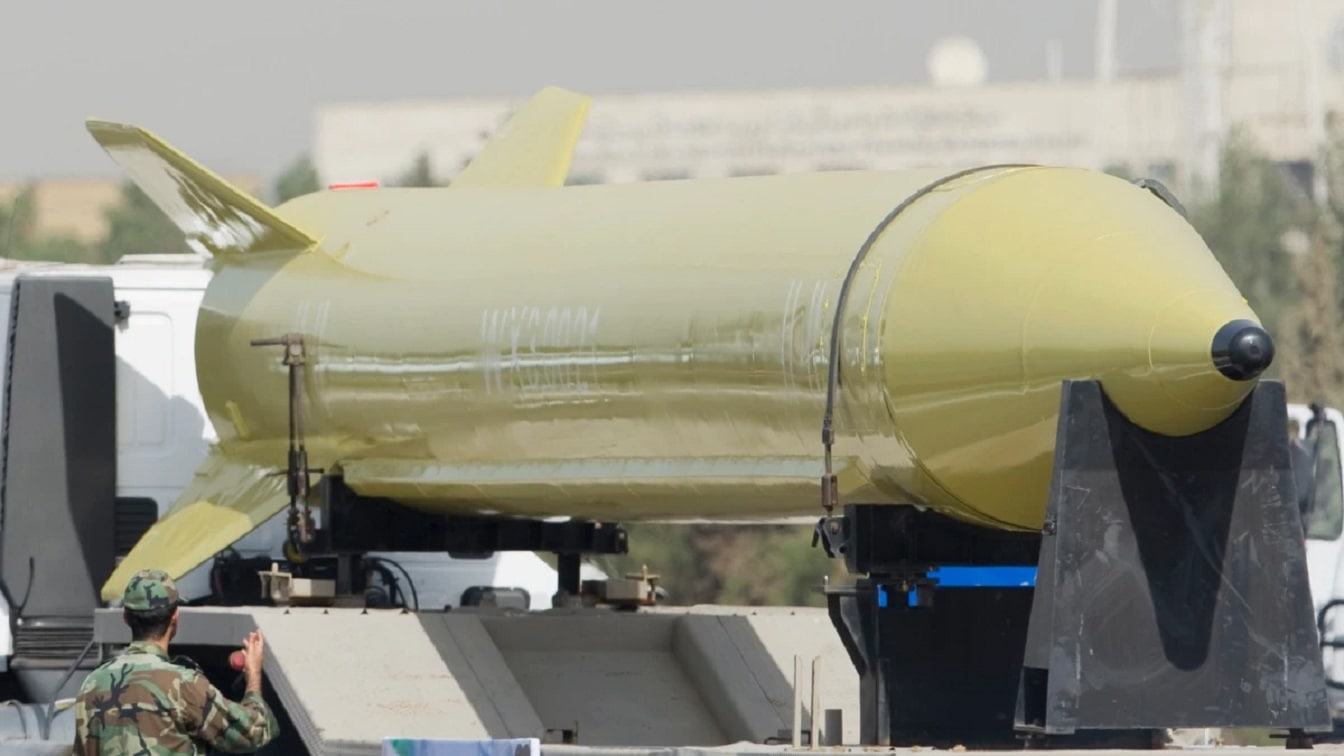
Iranian Ballistic Missile. Image Credit: Creative Commons.
For roughly a month before Sunday night, nothing like this had happened.
The war that began in late February, when American and Israeli strikes killed Ali Khamenei and opened six months of bombing, blockade, and stalled diplomacy, had settled into sanctions, a naval blockade, and talk of a deal that never arrived. Sunday broke that lull.
A CENTCOM plan exists to convert strikes like it into a standing campaign against Iran’s rebuilding, an approach officials call mowing the lawn, borrowing the phrase Israel once used for Gaza.
Hegseth backs the plan. Trump was reviewing it the week before Larak.
What none of that adds up to yet is a decision.
A Plan Waiting on a Decision
Give the reporting its due. According to Israeli television’s Channel 12, the Hormuz plan under review was not improvised over the weekend. It had been sitting in front of Trump, backed by the Pentagon, before Larak happened.
But the same reporting says Trump had not approved it. CENTCOM had already warned him and Hegseth that Iran was rebuilding its capabilities in the strait, and the White House had been inclined to reject the plan to avoid further escalation.
Iran’s retaliation changed that calculus. Iran’s missile attack on U.S. bases in Jordan is now prompting a reassessment of a plan Trump had been sitting on all week.
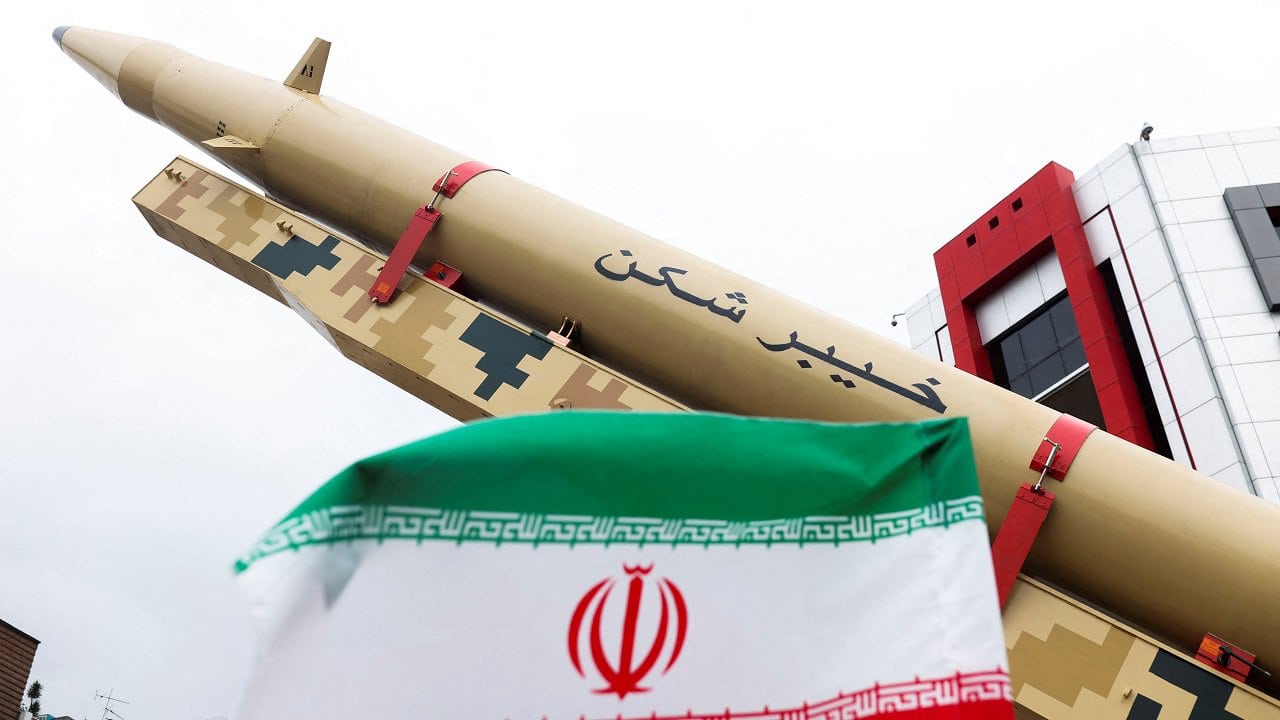
An Iranian missile is displayed during a rally marking the annual Quds Day, or Jerusalem Day, on the last Friday of the holy month of Ramadan in Tehran, Iran April 29, 2022. Majid Asgaripour/WANA (West Asia News Agency) via REUTERS
And, in fact, both sides are fighting again today.
That is an odd way to run a war. If Tehran’s response to a single strike tips Washington toward a standing campaign, Tehran, not the White House, effectively made the call.
What a Doctrine Actually Requires
Israel’s version of mowing the lawn, whatever its costs, was at least a doctrine.
It rested on a specific premise, that the conflict with Hamas could not be resolved politically, so recurring operations were meant to degrade its capabilities and buy another period of quiet rather than produce a final settlement.
That clarity let the policy survive a decade of intermittent violence.
Look for that clarity in the current Iran posture, and it is not there.
The same ten days that produced Sunday’s strike also produced Operation Economic Outcast, Bessent’s campaign to sever, in his words, every economic lifeline that sustains the regime until Tehran stands alone, a maximalist goal aimed at isolating the Islamic Republic entirely.
Beside it sits a kinetic plan scoped to something narrower: keeping the strait open.
Nobody has said how the two relate, or what happens if the narrow one succeeds while the broad one does not.
Somebody will object that this is simply what adapting to a live war looks like, responding to Iranian behavior in real time rather than executing a plan drafted in advance.
There is something to that.
But adaptation without a stated endpoint is not a strategy.
It is a habit that renews its own justification. Every mined tanker becomes the reason for the next strike, and no strike is ever declared enough.
The Gulf Pays for a Trigger It Never Saw
Jordan and the UAE are not new to this war.
The UAE detected two Iranian ballistic missiles targeting maritime navigation on August 18th, one of which fell inside its territorial waters, part of a pattern running through most of the conflict.
What changed this week is who generated the exposure. Larak was an American strike.
The retaliation it drew, on a base in Jordan and in UAE airspace, landed on governments given no public account of the rules governing such strikes.
That distinction matters more than it sounds.
Absorbing Iranian fire as a cost of the broader war is one thing.
Absorbing it as a cost of a specific, repeatable American operation with no published rule about what restarts it is different, and riskier to be enrolled in without consultation.
Amman and Abu Dhabi may have been briefed privately, but nothing in the public record says so.
The record shows they are taking return fire for a decision made in Washington.
Three Questions With No Public Answer
A real mowing-the-lawn doctrine, the kind Israel eventually arrived at, settles three questions before the first strike rather than after the fifth.
What triggers American action: mine-laying, a specific level of shipping disruption, or an attack on a flagged vessel. What each strike is supposed to restore or prevent, rather than simply punish.
And somebody has to decide when Iran has been degraded enough to stand down the campaign.
None of that means broadcasting operational detail to Tehran, only that Washington has settled the answers internally and shared enough with Amman, Abu Dhabi, and Manama that the next incoming fire is not a surprise to the governments closest to it.
The Strike That Doesn’t Happen
The temptation in Washington will be to treat the exchange as validation, proof that pressure works, that Iran gets hit and hits back and the cycle demonstrates resolve.
That reasoning mistakes motion for direction.
A deliberate campaign and an improvised one produce identical headlines in week one.
They diverge later, when a provocation arrives that the doctrine says does not warrant a response and the reactive version cannot help itself.
That is the test worth watching once this week’s exchange scrolls off the front page.
Not whether the United States hits Iran again, but whether it ever declines to do so.
A policy with a trigger also has a floor: some Iranian action is absorbed rather than answered, because answering it would cost more than it is worth.
Nothing since Sunday suggests Washington has found that floor. Today, in fact, shows problems lie ahead.
If there is no version of this in which the United States does not hit back, it is not a doctrine. It is a fight, running on a schedule Tehran sets.
About the Author: Dr. Andrew Latham
Andrew Latham is a professor of international relations and political theory at Macalester College in Saint Paul, MN. You can follow him on X: @aakatham.