

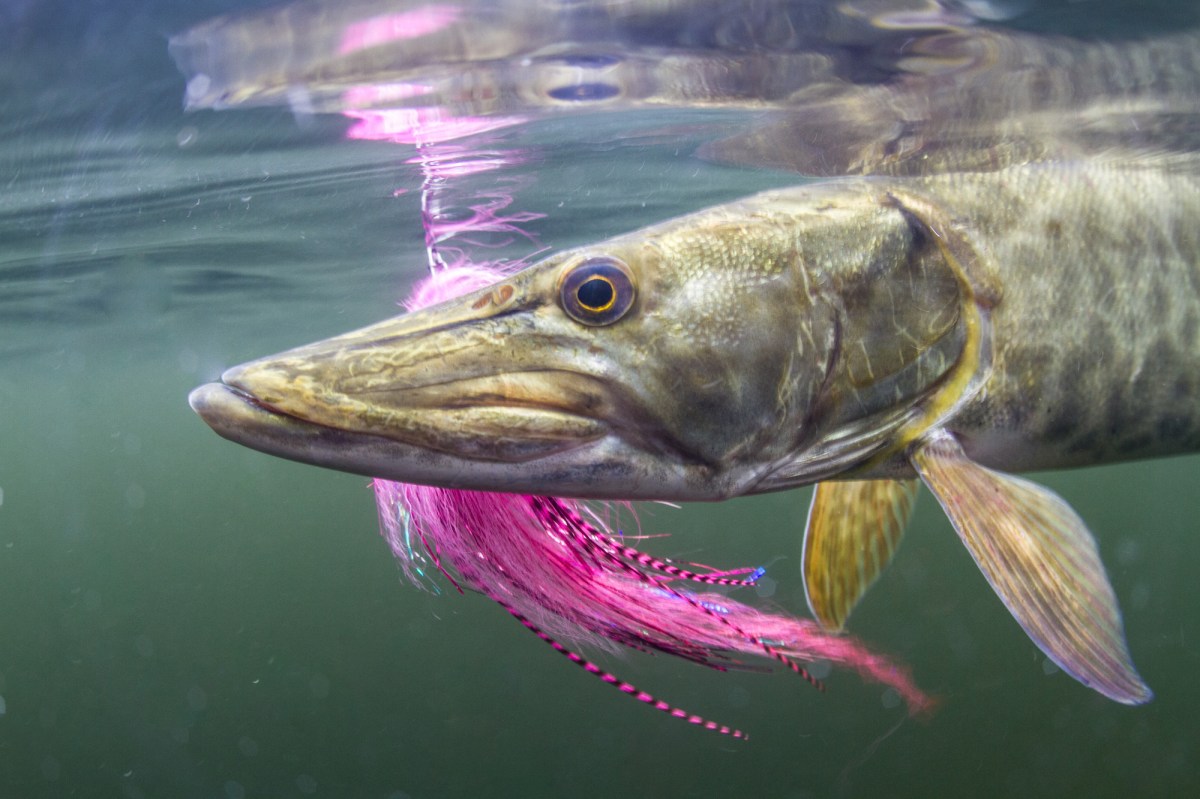
If you ever hear a Midwesterner mention the “fish of 10,000 casts,” you can be sure they’re talking about muskies. Every region in North America has its own fish species that represents the pinnacle of angling prowess, from permit in the Florida Keys to steelhead in the Pacific Northwest. These fish are almost always on the larger and rarer side of the spectrum, which is part of why they’ve become shrouded in mystery and idolized by anglers over the years. This is especially true of muskies, hence the nickname. But why are muskies so hard to catch?
A team of researchers at the University of Illinois recently came up with some definitive, science-based answers to that age-old question. They did this by studying a group of muskies in a laboratory setting and then fishing for them for 35 days straight in a controlled environment. Their results were published in the North American Journal of Fisheries Management.
How Researchers Tested Their Theories
This scientific inquiry into why muskies are known as the fish of 10,000 casts was led by University of Illinois graduate student John Bieber along with Bieber’s advisor, Dr. Cory Suski. Dr. Suski explains that the idea behind the experiment came from the Illinois Department of Natural Resources, which raises muskies in hatcheries and releases them in water bodies across the state. The DNR had been conducting netting surveys at one particular lake, and after seeing the sheer number of muskies that lived there, they were curious why catch rates weren’t higher.
So, the agency loaned 68 hatchery-raised muskies to Bieber and Suski, who spent the next several weeks studying these fish in a laboratory setting. Each fish was individually microchipped and placed in a tank, where the researchers ran experiments looking at four main behavioral traits: activity, aggression, boldness, and exploration.
“Fish do have personalities,” Suski explains, “just like other animals and people.”
After gauging and recording each muskie’s personality, the researchers then took the 68 fish and stocked them in an experimental pond. The pond was emptied of other aquatic species beforehand, and they filled it with minnows so that all the muskies were content and equally well-fed.
Then came the fun part. Bieber and Suski fished the experimental pond with conventional gear for 35 days straight. They covered every inch of water using every combination of lure and presentation they could think of. At the end of the 35 days, they had caught seven fish.
Read Next: The Best Musky Lures
Lessons Learned from Muskie Fishing for 35 Days Straight
Suski says the biggest takeaway from the experiment was that certain muskies were more “predisposed to capture” based on their personality traits. He explains that overall, the fish they caught were larger, less exploratory, and less aggressive than the others. This also falls in line with the species’ overall feeding habits. As solitary apex predators, muskies like to patiently lie in wait and then ambush their prey in an instant.
“They just prefer to live under a log by themselves,” Suski says. “We have to basically hunt for them and hit them in the face with a lure. And we tend to only hook them when they’re sitting still and quiet and are ready to clobber something.”
Read Next: The Greatest Day in Minnesota Muskie Fishing History
Another interesting lesson that most hardcore muskie anglers would echo is that muskies are extremely sensitive to angling pressure. Out of the seven fish that were landed over a 35-day period, four of them were caught during the first day of fishing. The muskies became less receptive to lures in each week that followed. Suski and Bieber never hooked more than one fish per day after that, and most days they walked away from the pond skunked.
None of the fish were caught more than once, either, which reinforces the idea that muskies smarten up and shut off pretty quickly when lures start flying in their direction.
“They wizen up for sure,” Suski says. “There could be a bunch of different things going on there, and the literature would say it’s the ‘noise of the angler’ they’re responding to. But [muskies] definitely become more wary and less receptive when pressured.”
Read Next: Catching Muskie and Pike in Warm Water Can Kill Them
Suski adds that the biggest takeaway for the DNR is that catch-and-release practices are essential to a strong muskie fishery. The idea here is that if some muskies are practically uncatchable, while others have personalities that make them more susceptible to capture, anglers will have more success in the long-term if they release the catchable fish back into the breeding population.
“If you catch a fish that has the right combination of personality traits to hit your lure, be gentle with it and put it back,” Suski says. “Because hopefully that fish will continue to have babies, and we can keep those vulnerable personality types in the population for longer.”
Read the full article here