
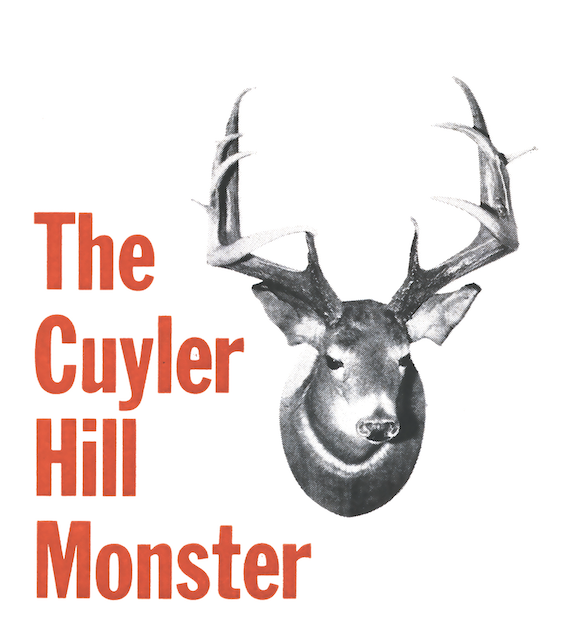
This story, “The Cuyler Hill Monster,” appeared in the May 1967 issue of Outdoor Life.
I’m one of 500,000 deer hunters in New York State who thrill to the thought of pursuing the wily whitetail. In 1933 I took my first buck in the Adirondacks.
In succeeding years I sometimes came home empty-handed but never lacked for a wonderful experience. The most wonderful of all occurred in 1938, even though the season did start in a frustrating manner.
I was the village mail carrier in Manlius, the town of my birth. I was 26, and I’d had the job since graduating from high school eight years earlier. I’d gotten to know the hunters in the area mainly by being a member of the Fayetteville-Manlius Rod & Gun Club.
The 1938 season in the Adirondacks opened in the midst of a prolonged drought. I was fortunate to be a member of a party of men who really knew their deer hunting. The others were Grover Pfieffer, chief engineer at the Onondaga County Penitentiary at Jamesville; Art Nash, a local farmer and my favorite hunting companion; Virgil Hunter of Theresa, a farmer and a cousin of Art’s; Truman White, farmer and storyteller extraordinary from Jamesville; and Claude Robbins of Theresa, an undertaker’s assistant who had assembled his own Savage Model 99 rifle while working at Savage Arms Corporation in Utica.
All of these men knew what a deer would do almost before the animal knew. As a greenhorn in their company, I had only to keep my ears open to learn the ways of the whitetail.
The Brandy Brook area of Cranberry Lake, in St. Lawrence County, was our hunting grounds. We were in this area for opening weekend, but the state’s conservation department closed the woods, and it was two weeks later before we had our annual week-long hunt.
After the tents were pitched and made shipshape, we started the hunt. The dry weather still hung on. The leaves were like corn flakes, and every chipmunk that moved in them sounded like a bear. Bucks were hard to see and harder to get shots at. We did manage to take a pair of eight-pointers by midweek, but I hadn’t seen even a hair.
On Friday morning, I was a watcher as the drive flanked a small swamp. From my lofty perch on a hemlock root, I could see just about across the swamp.
Suddenly I spotted three deer bounding through shoulder-high evergreens to my right. The first two were does, but the last one had a small rack. They slowed to a walk. The does passed through a small opening, but the buck stopped there. Now, I very carefully squeezed off a shot at his shoulder and then listened as all three deer ran away. I thought I’d missed but walked over to the spot just to make sure. To my surprise, the ground was covered with hair, and there were a few drops of blood.
My elation cooled, however, when I noticed a smudge of blood shoulder-high on a nearby sapling. This, I figured, plus the great amount of hair on the ground, meant that I’d only creased the buck.
We were unable to trail him in the dry leaves and finally gave up the search. I didn’t know it then, but the following fall I was to shoot what I’m sure was this same buck. He had a 1O-inch scar on his right shoulder.
I spent the evening of November 30 trying unsuccessfully to get someone to go hunting with me. Next day was the opening of the first deer season in Cortland County in more than 50 years, and few people believed there were enough deer in that part of the state to warrant a trip after one. George Burt, a car salesman for A. F. Ryan & Sons in Manlius, was one of these men. He could have gone but didn’t, and he has never ceased to regret it.
December 1 dawned clear and cold, with six to eight inches of snow on the ground.
The previous day had been sunny and warm, and the snow had been soft and wet. But now the snow had an icy crust, and this situation was to play an important role later that day. When my mother called me for the third and last time, I stirred under the covers, nearly wishing that I didn’t have to go deer hunting. But I mustered enough effort to get up and dress, and put away a substantial breakfast. My old Lefever double came down off the rack. It had been a gift from my grandmother on my 16th birthday and had cost $28 at Couden’s Hardware in Manlius. Five brand-new 12 gauge rifled slugs, plus 10 one-ounce ball loads, rested in the pocket of my red wool coat. I grabbed my lunch-sandwiches and a quart-size thermos of coffee — and was ready for the hunt.
My old Lefever double came down off the rack. It had been a gift from my grandmother on my 16th birthday and had cost $28 at Couden’s Hardware.
My ’32 Chevy took me along the icy road to Fabius and then on to Cuyler, abouit 20 miles from home. I stopped there at the hardware store operated by Elmer Randall, still trying to get someone to go with me. But his license supply had run out, and no one in the store was going hunting until the next day. I did find out where the Cortland-Onondaga County line was, so that I’d be sure to hunt in the right county.
It was nearly 8 a.m. by then, and I wasn’t in the woods. I headed back toward Fabius, looking for a place to park. But I couldn’t nurse the car up a small, ice-covered grade and had to turn around and go back toward Cuyler (another stroke of fate).
After passing the Cuyler turnoff, I found a good place to park.
With lunch in my coat and the old double under my arm, I started up a hill through thorn apples and brush whips. It was quite a steep grade, and I was soon damp with sweat.
Entering the woods at the brow of the hill, I noticed deer tracks everywhere. They had been made the day before, when the snow was soft. All were perfect prints, and their size amazed me. They were huge. I stopped to rest and look some more. This sign was something I hadn’t really expected — a sort of reward for coming out alone after others had refused to join me.
I’d need all of my recently acquired deer-hunting lore, I knew, to overcome the noisy, crunchy snow and get within sight of whatever had made those tracks.
I can’t say exactly how long I stood and watched – perhaps half an hour. Then chills began playing tag up and down my back. The heat generated by the climb was gone, and I had to move or freeze.
I tried stillhunting but soon realized that my footfalls were warning every living thing within half a mile. So I decided to ignore caution and walk normally until I found some fresh tracks. Then I’d stillhunt.
I started down the slope through hardwood whips, larger trees, and some berry-bush tangles. About 300 yards along, I was aware of movement behind a small hemlock directly in front of me. I froze and then made out the form of a deer getting up from its bed. Through the fringe of evergreen, I could see enough of those big antlers to know that the deer was legal.
I raised the old double, settled the bead on his shoulder, and let fly. One of the buck’s front legs buckled. As he stood there, trying to put that leg into use, I fired the second barrel, shattering his other front leg.
The buck was down but not out. He was looking around, trying to spot me. I tried a neck shot but missed, and then missed again. I tried sneaking up on him, but the first step gave my position away, and he bounded out of sight, jumping with his hind legs and landing on his belly.
Then buck fever took hold of me. I started to run, but my knees felt like jelly. I tried to reload and must have dropped a shell into the snow (my count later showed one missing).
I managed to shake it off, however, and cleared a clump of berry bushes. There he was. But before I could shoot, he leaped out of sight again.
I had seen tremendous antlers on that buck, and the thought struck me that if someone else saw him and took a shot, there might be a little difficulty. The buck had broken a path through the crusted snow, and I was able to sneak along it very quietly. After taking only a few steps, I could see him looking back at me. I aimed for his
neck and this time hit dead center.
I walked up, took a good look — and panicked. The only hoof I could see was as large as that of a yearling cow. The antlers seemed too big for a deer. Could this be an elk, caribou, or some other alien animal introduced quietly by the conservation department?
If so, it was an illegal kill, and I was in a mess. But after pushing him over onto his side, I saw three normal-size deer hoofs. Closer examination of the large one showed that it had apparently been hit by bird shot. Three or four holes had been licked until the hair was gone. The joint was badly swollen and full of matter.
I walked back to where I’d first spotted the buck and saw three beds in a small area. Because of the bad foot, he hadn’t been moving about, and that’s probably why he had stood there after my first shot. I wondered how anyone could have shot at such a magnificent animal with small-game loads.
After completing the field-dressing job, I tied my rope around the antlers, put on my coat, and started toward the top of the hill. But when the rope came taut, I couldn’t even budge him.
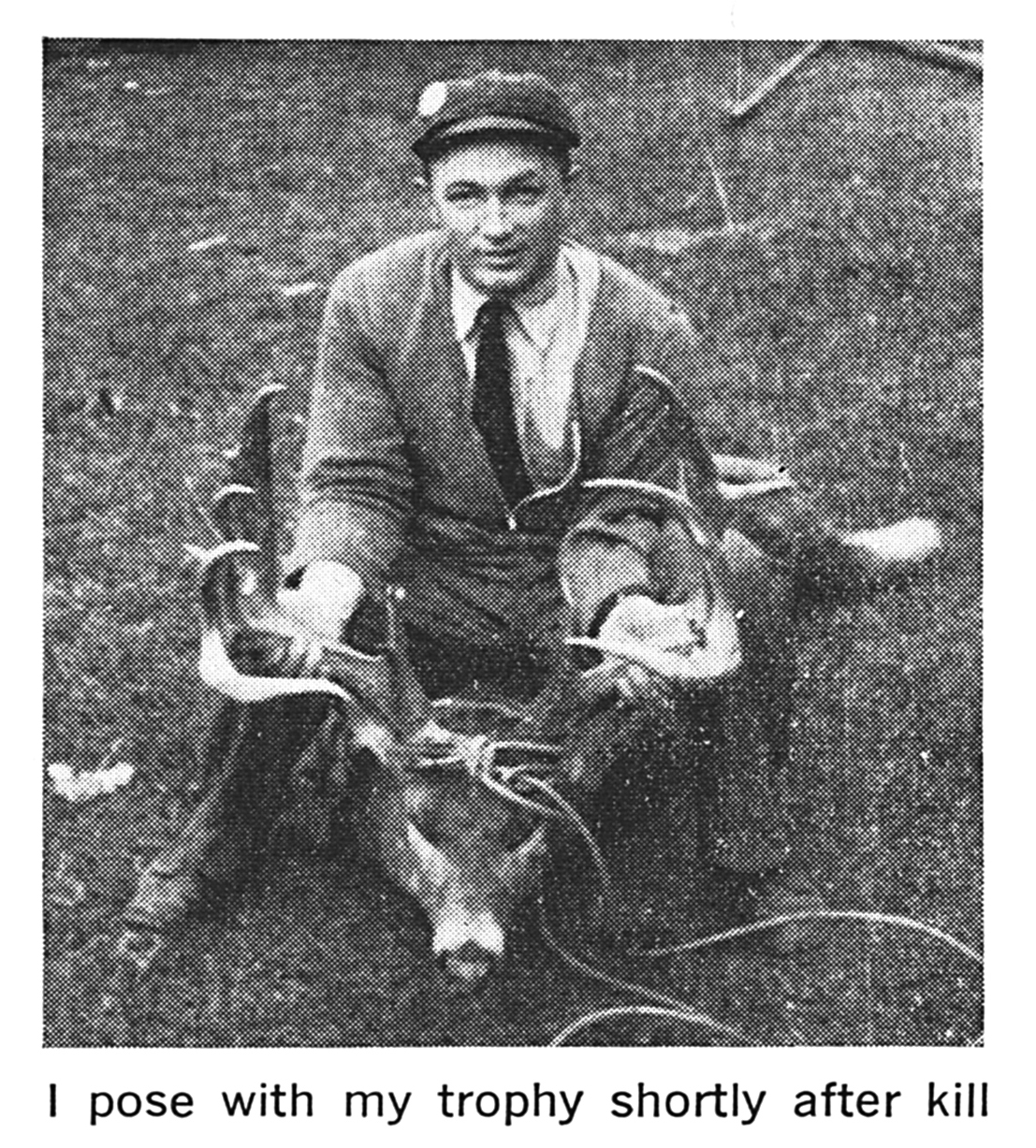
I took off my coat and left it and the gun by a tree. I put the rope around my midsection and found that I could move him that way. Then I went back to get the coat and gun, leapfrogged them ahead of the deer, moved the deer ahead, and so on.
After much backbreaking work, I reached the top of the hill and gave the buck a push, and he slid down toward the car. Now I had it made — or so I thought. When I got to the car and tried to lift him onto the fender, I found I could get no more than his neck and head off the ground. I tried pulling him inside through the back doors, but the antlers were too massive. I stood back, scratched my head, and hit upon another idea. I tied the huge buck to the back bumper and towed him to a nearby farmhouse, where Frank Feeler, the owner, helped me raise him onto the front fender.
Feeler remarked that he had seen this deer with his cows several times.
It was just about 11 a.m. when I drove up in front of Weber’s Department Store in Manlius. Francis Gates, owner of Gates Homestead Farms, a dairy operation in Chittenango, was across the street in front of the feed mill. He saw me and came over to take a good look at my trophy. He claimed that if there was ever a deer that weighed 200 pounds, this was it.
We all crowded around the feedmill scales, watching the bar as it began to balance. It stopped at 196 pounds and not another ounce. Francis couldn’t believe it, so he checked it again. But the scales read the same. Now I knew why that deer had dragged so hard — I weighed only 150.
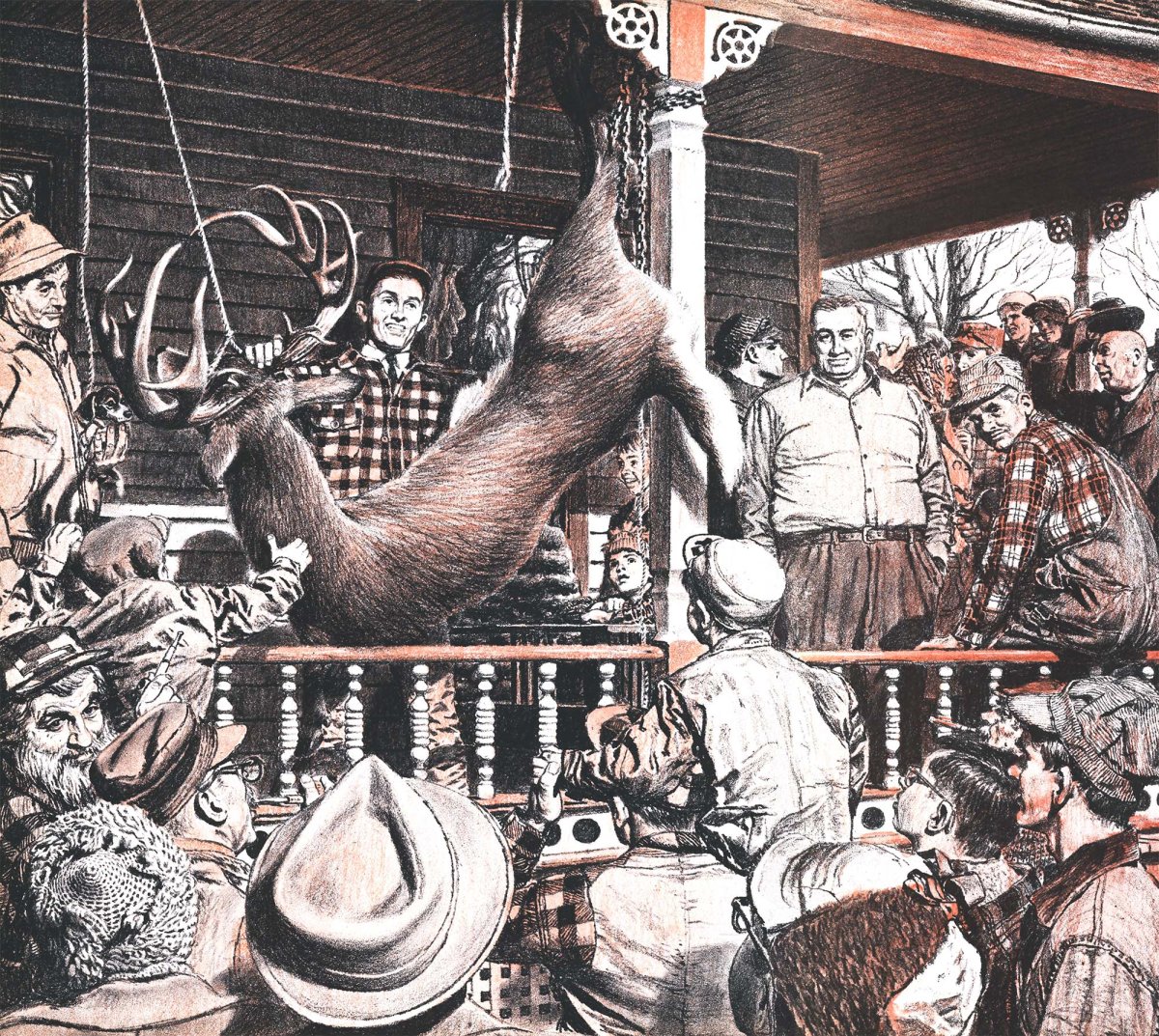
We were hanging the buck on a fire ladder in front of Davison’s barber shop when George Burt arrived back in town. I can still hear him kicking himself verbally for not going with me. The Herald-Journal in Syracuse sent out a photographer.
Many people stopped to look at the buck. In fact, the next two or three days around home were a lot like old home week or maybe calling hours at the funeral home.
Of course, I had the head mounted, by E. W. Wiggins of Antwerp, New York, who had done work for me before. He told me that he hadn’t seen anything like this rack in his 35 years of taxidermy. Wiggins gave me a first-class job — the best of everything. The total cost was $27.50. In due time, the head was hanging over the dining-room table in my parents’ home.
At about that same time, Ben Bradley, who now lives in Tully, became game manager in our region. I worked with Ben on many projects in connection with the local rod and gun club, and he knew about my trophy buck.
Eight years after the kill, the New York State Conservationist, in its October-November 1946 issue, listed the nine largest heads taken in the state. Ben saw the article and wondered whether my buck would qualify among them. He took preliminary measurements, under what was then called the Grancel Fitz scoring system, and sent them to Albany.
Then Pete Fosburgh, of the division of conservation education, and Earl McGurk, a conservation department photographer, came to make measurements. They scored my buck at 187.1, good enough for third place in the state. This was reported in a 1947 issue of the Conservationist.
In 1952 the conservation department decided to change over to the Boone and Crockett Club system of scoring. Known as the Official Scoring System, it had been devised by Grancel Fitz and Dr. James L. Clark and adopted by Boone and Crockett in 1950.
My buck’s antlers were again measured. Under this system, the score was lower — 183 7/8 — but put the head in second spot in New York State, where it still stands today.
My whitetail rates right behind a deer killed in Allegany County in 1939 by Roosevelt Luckey. Luckey’s buck, incidentally, is not only the best ever taken in New York State but was No.1 in all of North America for a time in the 1950’s.
The rack of my trophy is definitely considered typical in formation but is penalized heavily by the Official Scoring System for lack of uniformity. For example, an 11-inch prong on the right side is matched on the left by a prong of only two inches, resulting in a nine-inch penalty.
Read Next: I Shot a Limit of Mallards, then Tagged the No. 4 All-Time Record Buck
As I write this, I look at those tremendous antlers and think of the things that could have prevented me from encountering him: the buck I only creased near Cranberry Lake, the icy hill at Cuyler, a hunting companion who could have led me to another area, and a double-barreled shotgun that, I discovered, shot a foot low and a foot to the left.
Thus it was that I nevertheless succeeded in taking a trophy buck an hour’s drive from home on an icy morning more than a quarter of a century ago. It seems like yesterday.
Read the full article here