
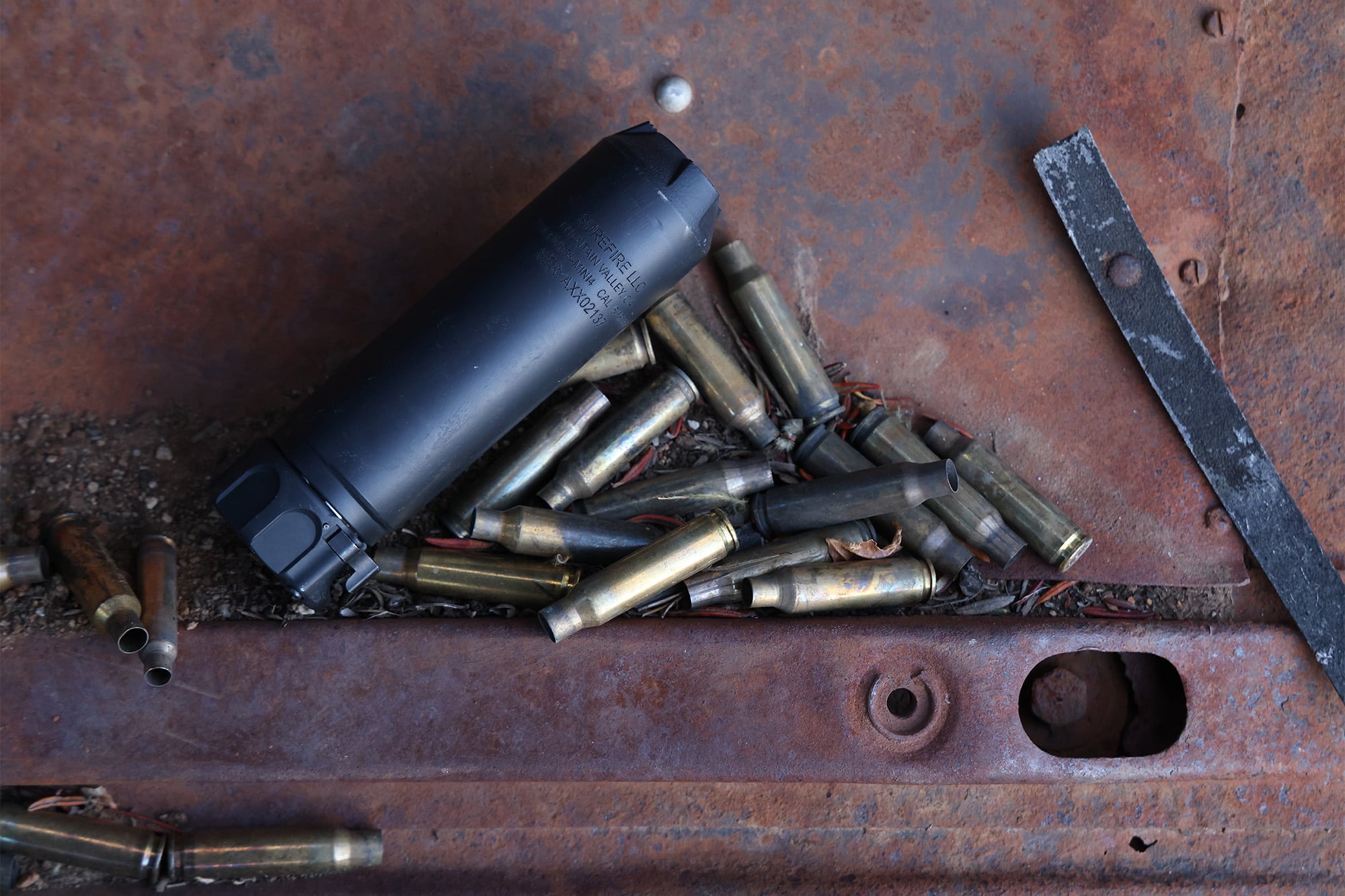
Two years ago, SureFire introduced the SOCOM556-RC3 suppressor — eight long years since the iconic SOCOM556-RC2 was launched. The bombproof RC2 set the benchmark for hard-use, duty cans, following on the original RC and SureFire’s hard-fought contract with United States Special Operations Command back in 2011.
We’ve grown accustomed to SureFire going through long gestation periods a la the eel-like frilled shark and its 3.5-year-long pregnancies — obsessively tweaking and iterating on improvements for many years. However, SureFire has just released its latest and greatest cans, the SOCOM-4 series, after just two years.
Designed as a fighting suppressor for hard use, the RC3 delivered a balance of low back pressure, sound reduction, compact form factor, and flash reduction in a familiar, utterly robust package. It wasn’t cheap, with a retail price of $1,799.
So, what then has SureFire updated in the SOCOM556-RC4, and why? Firstly, it achieves significantly better flash reduction, a key priority for the military and a source of some complaints about the RC3. The RC3 vents gasses out the center as well as the outer periphery of the front plate, releasing a donut of hot gasses. Therefore, SureFire revised the exit geometry to further reduce the flash signature and mitigate the visibility of internal flash ignition. In fact, SureFire completely redesigned the RC4’s core, with different baffles, bypass design, and front plate. The gasses now flow through the bypass in an S-curve pattern — toward the muzzle, back 180-degrees, then forward again before they mix in with gasses coming out of the bore. The new geometry results in a roughly four-fold improvement in flash signature over the RC3 while maintaining low back pressure and sound reduction. Best results will come from mounting it on open-tine flash hiders, especially on shorter barrels.
Generally, there’s no free lunch when it comes to suppressors. Improving one characteristic or another tends to affects other important characteristics. In addition to flash, back pressure has also become a key concern. It can affect the operation, reliability, and controllability of the host firearm, as well as causing additional wear and tear on parts. Those fumes coming back at the shooter are also potential health concerns. So walking that line of balancing and optimizing all the desired properties is very challenging.
Let’s take a moment to discuss suppressor design. Historically, companies have relied on a great deal of trial and error, with theory, experience, and intuition leading to design ideas that would be tested at the range. The advent of additive manufacturing (3D printing) has made it possible to create all manner of crazy geometry to route gasses that would be impossible or impractical to achieve with traditional machining. With the possibility of nearly infinite variations in designs, using computers to model the behavior of suppressors promises to make the development process much more manageable and to truly optimize geometry. However, the truth is that it’s extremely difficult to accurately model what actually happens, with the added complications of turbulent air with the energy of the propellant causing secondary flash as well as multiple shot strings.

SureFire invested heavily in computation flow dynamics modeling over the years, working closely with Oak Ridge National Labs and their scientists to come up with a system that could make reliable predictions that match up with actual results in the real world. This is how SureFire designed the RC3, and after countless more supercomputer hours, they were able to optimize the geometry needed to improve flash signature in the RC4.
The new front plate is also more durable, to protect against muzzles smashed into rocks and a never-ending list of stationary objects that soldiers find themselves colliding with.
The back end is unchanged, compatible with SureFire’s Fast-Attach family of muzzle devices. As a duty suppressor designed first and foremost for warfighters, SureFire deliberately eschewed the now-ubiquitous HUB mounting standard; they wanted to avoid threads that could loosen at inopportune times or that crayon-fueled troops might be able to screw up.

The SOCOM-4 cans are comprised entirely of Inconel, for durability and to handle high temperatures and sustained fire. It’ll get hot as you send rounds downrange, but it’s designed to keep gasses moving, so it doesn’t get as hot as some other cans, helping to mitigate mirage.
Many new silencers are manufactured entirely with additive manufacturing. Not so with the RC4, which is a combination of traditional and new to achieve SureFire’s desired levels of durability as well as geometry, with 3D printing, stamping, and laser welding all part of the manufacturing process.
The new SOCOM-4 suppressors are available in full-size and mini variants. The full-size SOCOM556-RC4 is 6.3 inches long, 1.5 inches in diameter, and 17 ounces in weight, adding 3.8 inches to the length of your weapon. The SOCOM556-MINI4 is just a bit shorter at 5.5 inches and 14.5 ounces. The Minis before it weren’t recommended for barrels shorter than 14.5 inches due to flash signature, but the new ones are good to go down to 10.3-inch barrels. So it doesn’t have any meaningful restrictions any more, boiling down to a lighter, shorter package that’s a little louder with a little more flash. They’ll be available in black and dark earth colors. There’s also a 6mm ARC version that’s a wee bit shorter than the full-size RC4, which SureFire built for a specific customer requirement; more on that later.
Notably, SureFire has also developed more efficient manufacturing methods, reducing their cost of goods. As a result, in this age of rampant inflation, SureFire has reduced the price of the new silencers. The MSRP for the full-size RC4 is $1,549, while the MINI4 is $1,449. It’s still unquestionably a premium product, but your wallet will scream a bit less.

We traveled out to Idaho to get time on the SOCOM-4 suppressors at Hat Creek Training, the mecca of long range and high angle shooting. With over 5,000 acres of uncompromising mountainous terrain, Bryan Morgan and his cadre teach the best of the best military and law enforcement units, with occasional open enrollment classes when a gap in the schedule presents itself. During our time there, Morgan and Bennie Cooley walked us through precision shooting in steep terrain, tricky wind, and difficult shooting positions.
They flooded us with expertise on setting up optics, such as the ATACR scopes from Nightforce that we used, positional shooting, and recoil management. We practiced setting up stable and durable shooting positions on structures and natural terrain features, with the help of shooting bags, like those from Armageddon Gear, backpacks like Eberlestock’s Freefall pack, bipods, and tripods. We set up our Kestrel weather meters and ballistic solvers to predict our elevation and windage adjustments at various engagement distances and angles, then trued them to our specific rifles and ammo.
We worked as a team with a shooter and spotter, identifying and acquiring targets, estimating distance, reading wind, spotting impacts and misses, and effectively communicating corrections. Adding the element of time pressure ramped it up even more — not just because the shooter might be in an operational engagement, hunting scenario, or competitive match, but because wind can change at any moment, so the valuable data you just gained from a miss to make a correction has an expiration date.

The test guns that we employed with the SOCOM-4 cans included 5.56mm rifles from BCM as well as the ICAR rifle from SureFire itself, chambered in 6mm ARC. SureFire’s been working on ARs for over a decade, and the ICAR incorporates all of their ideas and improvements on the AR platform. The ICAR made a quiet debut at the 2025 SHOT Show — not by SureFire but in the context of the dedicated 6ARC magazine they developed with Magpul. The ICAR still hasn’t been officially released by SureFire, so we can’t talk specifics about it. However, we can say that the ICAR (and the magazines) ran completely reliably, was very accurate, and felt like shooting a 5.56 gun. There wasn’t a single malfunction throughout the entire event. We can’t wait for it to hit the commercial market, because it’s a truly impressive rifle. It might be a little while, though — remember the frilled shark.
Speaking of 6ARC, the cartridge was developed by Hornady for the Department of Defense, intended to deliver M118-levels of terminal performance out to 500 meters or so. We ran Hornady’s 108-grain ELD match loads at Hat Creek. How well did it do in the ICAR? On one target at 490 meters, with Bennie Cooley’s expert guidance, after missing the first shot and making a correction, we put four rounds into just over three inches.

The SOCOM-4 suppressors performed very well. To check SureFire’s work on flash suppression, we compared the new cans against previous generations in the pitch-dark Idaho night. The RC4 was quite noticeably better at flash reduction, with flash signature barely visible to the naked eye. As expected, the MINI4 had a bit more flash than the full-size RC4. The 6ARC version was also good; of note, it was mounted on a muzzle brake, per the military customer’s request.
As for sound, these won’t be the quietest suppressors on the market, but they had a nice tone to them and were quiet enough. Under cover or in confined spaces such as several stages we shot in connex boxes, we wore hearing protection. Later, out in the open, we comfortably shot stages sans ears. On a Mk18, SureFire rates the RC4 at 139dB and the MINI4 at 142dB.
Gas blowback was well-controlled and not noticeable in either of the 5.56 or 6ARC guns. Both shot very soft with no malfunctions or issues. This is the kind of can that you’d happily run all the time.
So it’s better, and it’s cheaper. Yes, it’s still a lot of scratch and the Internet is giggling about its appearance, but if headed into harm’s way or for TEOTWAWKI, you can bet we’d reach for a SOCOM-4.

Since our founding in 2012, RECOIL remains the premier firearms lifestyle publication for the modern shooting enthusiast. We deliver cutting-edge coverage of guns, gear, accessories and technology. We go beyond basic reviews, providing no B.S. buyer’s guides, hands-on testing and expert analysis on everything from firearms and survival equipment to watches and vehicles.
Our reviewers are the backbone of our operation and come from diverse shooting backgrounds: Former law enforcement, military veterans, competitive shooters, seasoned hunters and plain old firearms enthusiasts. Furthermore, we’re not just gun experts, but dedicated journalists who adhere to the strictest standards of our profession.
At RECOIL, editorial independence is the foundation of everything we publish and the cornerstone of reader trust. Our editors, writers and content creators make all editorial decisions independently, free from outside influence. That boils down to: advertisers don’t dictate our coverage, the outcomes of our reviews or what we recommend in our buyer’s guides. First and always, our commitment is to our audience—ensuring every review and article is accurate, unbiased, and driven by real-world experience.
Whether you’re selecting your next firearm, upgrading your gear, or exploring the latest innovations in the shooting world, RECOIL provides the trusted insights you need to make informed decisions. Learn more about our Editorial Standards and how we review products.
NEXT STEP: Download Your Free Target Pack from RECOIL
For years, RECOIL magazine has treated its readers to a full-size (sometimes full color!) shooting target tucked into each big issue. Now we’ve compiled over 50 of our most popular targets into this one digital PDF download. From handgun drills to AR-15 practice, these 50+ targets have you covered. Print off as many as you like (ammo not included).
Get your pack of 50 Print-at-Home targets when you subscribe to the RECOIL email newsletter. We’ll send you weekly updates on guns, gear, industry news, and special offers from leading manufacturers – your guide to the firearms lifestyle.
You want this. Trust Us.
Read the full article here