
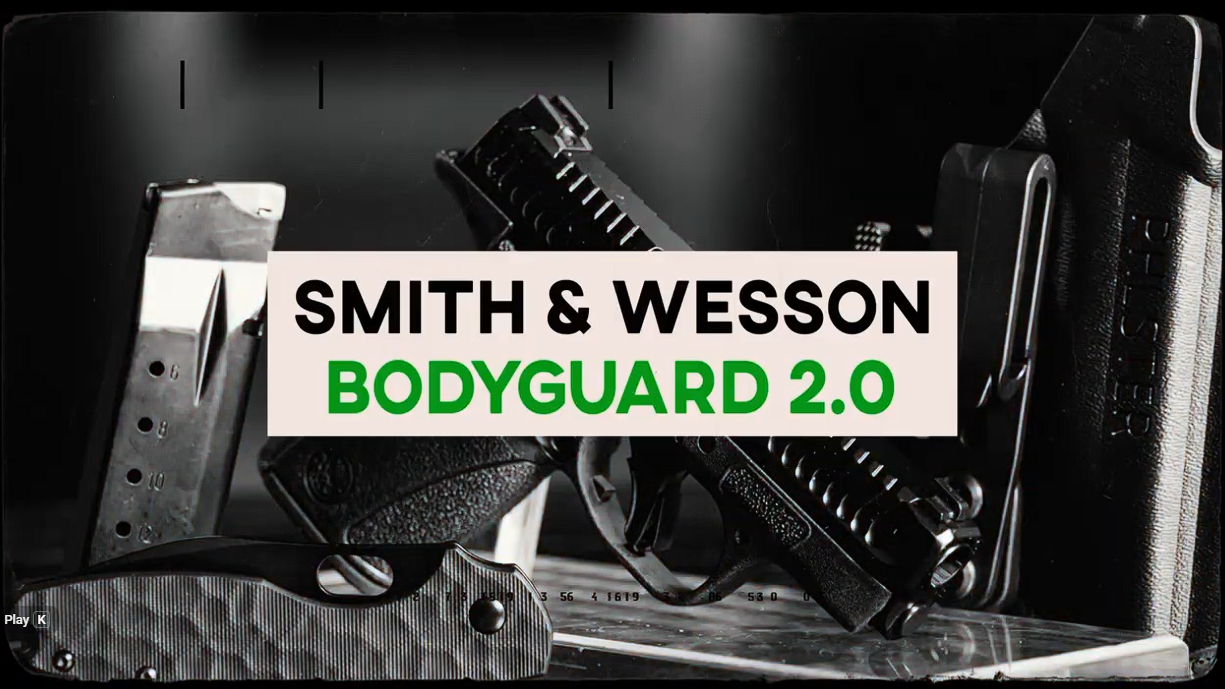
Hey everyone, this is Shooting Illustrated bringing you another episode of “I Carry.” In today’s feature, we’re taking another look at the Smith & Wesson Bodyguard 2.0 pistol in .380 ACP and some related gear. Let’s take a closer look at this setup:
Firearm: Smith & Wesson Bodyguard 2.0 (MSRP: $449)
Smith & Wesson’s updated Bodyguard 2.0 incorporates a lot of smart, useful upgrades that concealed-carry practitioners can appreciate, like the double-stack magazine with 10-round capacity, a tritium front sight and a flat-face trigger. Operation has changed from hammer-fired in the original Bodyguard to striker fired in this version, with a bladed-safety trigger added to protect against discharge should the pistol be dropped.
Size wise, the Bodyguard 2.0 is about the same size as its predecessor: 2.75-inch barrel, 5.5-inch overall length, 4-inch height and .9-inch width. Weight is 9.8 ounces, and capacity is 10 rounds in a flush-fit magazine and 12 with a slightly extended one—effectively doubling capacity over the original Bodyguard while still keeping to the same form factor. It should fit many of the same holsters as the original, given that the biggest change in size comes in a thicker grip to accommodate the double-stack magazine. Be aware, of course, that the original Bodyguard often came with an integral laser which does change the holster profile.
While the Bodyguard 2.0 doesn’t (yet) have provisions for powered optics capability from the factory, there are companies out there milling slides for small red-dot sights. If you’d prefer to wait for a factory offering, or are fine with the iron sights, the arrangement on the Bodyguard 2.0 is excellent as-is: the rear sight has a serrated black notch, while the front sight has a tritium vial surrounded by a bright-orange ring to quickly draw the eye to it. It’s quick, simple and effective; everything you want in a sighting arrangement. Since this size of pistol is most likely to wind up carried in a pocket, it’s the least-likely to get a powered optic anyways.
Without getting too heavy in the “9mm vs. .380 ACP” argument, there’s a definite place for the Bodyguard 2.0 in the concealed-carry world. When it comes to deep concealment or back-up-gun use, the small .380 ACP semi-automatic has been a mainstay for decades. It’s now more capacious than ever and easier to shoot, thanks to the better ergonomics, texturing and engineering that go into the Bodyguard 2.0.
Holster: PHLster Skeleton (MSRP: $59)
While the Bodyguard 2.0 is certainly an excellent candidate for pocket carry, it’s also super easy to carry inside-the-waistband. The same light weight that allows the Bodyguard 2.0 to ride in a pocket without undue hindrance means it’s basically going to disappear on a belt. It’s small enough that the 12-round extended magazine can be employed and still be easy to conceal. For that reason, we’ve opted for the excellent PHLster Skeleton holster in today’s kit.
Constructed of a single sheet of Kydex in a taco-style arrangement, the Skeleton is easily one of the best values in kydex holsters today. It is the very essence of simplicity, with a single polymer clip that allows the rig to be added to or taken off the belt quickly, while retention can be fine tuned using the twin clip-attachment screws. A wing attached with the belt clip helps tuck the Skeleton into the body to reduce printing, and the holster is compatible with PHLster’s deep-concealment Enigma system as well.
Accessory: CRKT Pilar III knife (MSRP: $70)
Rounding out today’s small-but-useful kit is the Pilar III pocketknife from Columbia River Knife & Tool. This frame-lock, thumbhole-opening knife has a 3-inch-long, 12C27-steel blade, G10 and stainless steel scales and a black-oxide finish. A steel pocket clip and a lanyard loop are available to secure the Pilar III, which weighs a scant 3.5 ounces. I generally prefer a flipper opening mechanism or a thumbstud to a simple hole for opening purposes, but the design on the Pilar III is excellent, especially with the proprietary IKBS ball-bearing pivot CRKT uses to help guide the blade while opening.
My standard complaint against frame or liner locks stands – you’re still putting a digit in the path of a closing blade – however, CRKT has avoided the larger pitfall of the frame lock. For a right-handed person opening a knife with a frame lock, some designs put your finger or fingers right against the actual frame lock. This puts pressure on the blade and makes it hard, if not impossible, to open; however, CRKT has designed the Pilar III to avoid this entirely. It’s a useful, affordable knife with excellent edge retention – just what you want in an EDC pocketknife.
Read the full article here