
The car is racing across the high Utah desert, your foot pressed to the gas, but someone else is steering and you’re blindfolded — like a high-speed trust exercise with an Abu Ghraib aesthetic.
As the hood is pulled from your head, you grab the wheel, scant feet and split seconds for quick decisions as the car speeds toward an obstacle course and makeshift checkpoint. One wrong move and you’ll spin out or end up in the scrub; in the real world, it would be a crash or worse.
It’s a drill meant to press your reaction time and test your mettle, simulating real-world stressors and putting you under stress. And it’s only midway through the first day. This is Jason Hanson’s Spy Driving Experience.
SPY RANCH
Like many spy stories, this one starts with a meet in a parking lot. The people congregating in cars outside the livestock market aren’t there to trade secret messages or plan covert coups, but instead to meet Jason Hanson and convoy to Spy Ranch for the Escape and Evasion Spy Driving Experience.
Hanson doesn’t look like a CIA agent — or rather, he doesn’t look like a spy from the movies. Hanson is the kind of man who melts into any quasi-Euro crowd; Daniel Craig wouldn’t play him in a movie, but Seth McFarlane might.
The other students aren’t those we mostly see in the other classes we attend, either. Shooting is still predominantly seen as a dude endeavor, and as such those courses are invariably full of men — despite women almost always benefitting more from the power upgrade given by guns. But, here, not only was there more diversity in gender and race, but also in age and occupation: a SWAT officer, a government employee attending to aid her anti-kidnapping measures for when she visits family in South America, and another a regular foreign adventurer.
It was also common to see pairs; more than one husband and wife, a father and son, and two friends out for fun. A testament to Hanson, a great many of the students were alums of his other courses.
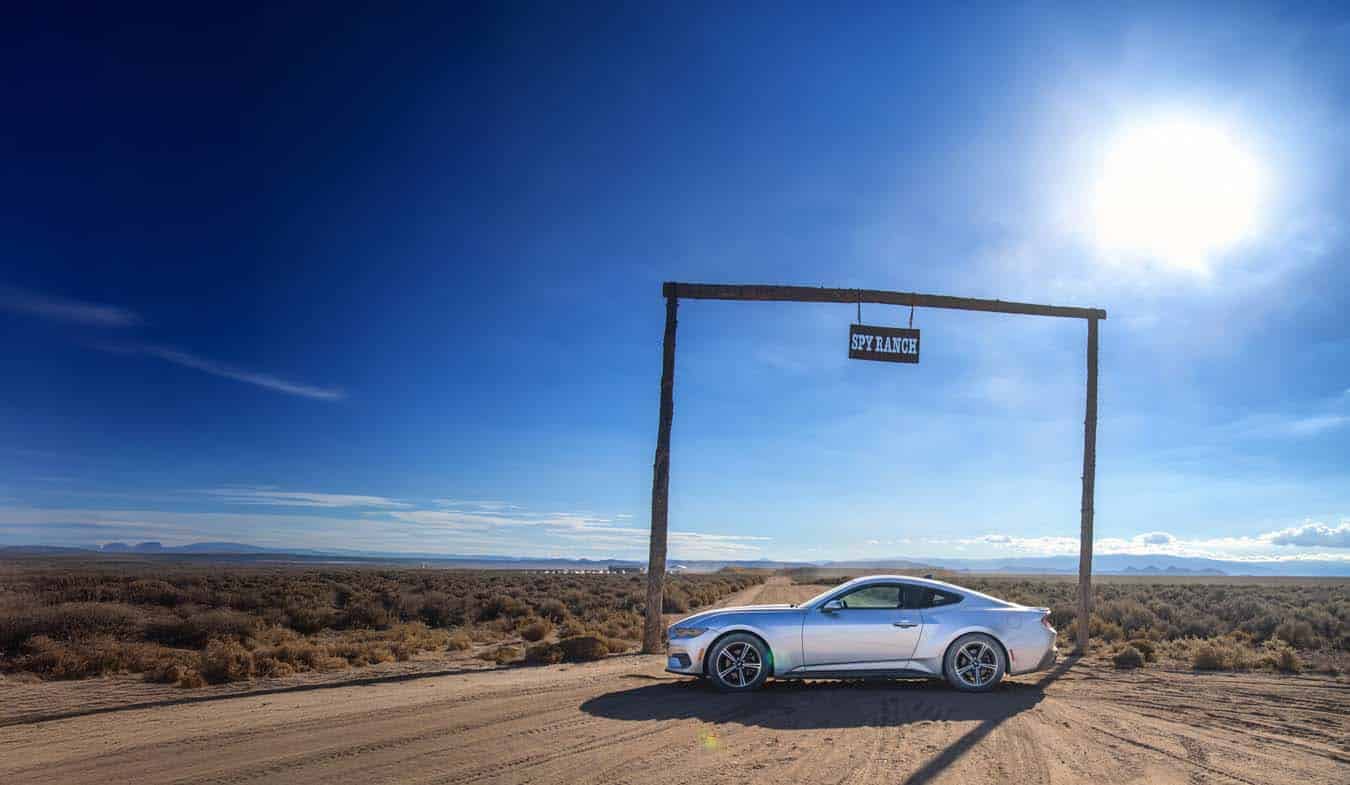
After a half-hour drive where the GPS loses track, we all found ourselves at Spy Ranch — a place way up in the high desert plateau of southwest Utah, a private 320-acre facility outside Cedar City that was actually partially funded on Shark Tank. There, under the dry azure sky, students learn the intricacies of shooting, driving, escape and evasion, and more — but with a Bond and Bourne twist.

The ranch is austere with dirt tracks, steel buildings, and a high-walled basin shooting range that allows near-360-degree fire. Numerous destroyed and shot vehicles line the sides like an ominous warning to our rental cars. This isn’t a pleasure cruise, and our cars are our classrooms, with Hanson being a big believer in immediately getting to the action.
Over just two days we covered a hands-on and behind-the-wheel rubric based on the CIA’s Intelligence Operator Driving Course. (So “based on” that every class Hanson teaches has to be first vetted by the CIA to ensure he’s not giving away any proprietary information.)
SO WHY A SPY?
There are very real and clear reasons why a spy would need to learn how to escape and evade, because their aim is to complete a covert mission while avoiding being kidnapped by bad actors (and how to escape if they are). And while most of us aren’t spies, here in America nearly all of us drive and thus many of the same lessons apply.

The AAA Foundation for Traffic Safety found that in 2022 there were 254.5 million drivers in the United States, each averaging more than an hour behind the wheel each day. In 2024, there were more than 6 million traffic accidents, with a fatality occurring every 13 minutes on average. And kidnapping? Adult kidnapping is not uncommon outside the United States, especially if someone is from the United States.
Everything on Spy Ranch takes place on loose dirt tracks, and there are a lot of orange cones. Sand is more forgiving than pavement for learning but still allows you to slide around; those with experience driving in winter climes will be familiar with the feel. In terms of driving, we’d cover everything from how to slalom and slide, avoid obstacles, move through kill zones, navigate roadblocks, perform reverse-180s, and how to ram other vehicles.
But the course was more than mere driving. There was shooting in/out/around vehicles, some old-school spycraft, and even how to escape from duct tape after being stuffed inside a trunk.
We couldn’t possibly distill it all down into one article, but we can give you some handy tips and takeaways to try out yourself.
DRIVER’S ED
The class started with timed drills slaloming around cones. Unless you know what you and your vehicle are capable of, you won’t be able to perform under pressure. Even the artificial pressure of time and competition adds to your own level of resiliency.
Hanson’s instructor cadre was both enthusiastic and gave instant feedback, and immediate improvement was seen on the timer. That slalom would be the baseline from that point forward — things would only stack on top from there. Vehicle checkpoints and roadblocks were added, not dissimilar to conditions seen in the immediate aftermath of war-torn nations. Competitions with prizes upped the ante. You had to learn how your vehicle reacted, how to anticipate, and how to see beyond the immediate obstacle. Later, we would cover how to plan routes, covertly picking up agents, how to take over from a downed driver, push through kill zones, spin cars, and Houdini trunk escapes.

But of all the driving drills, the hooded drill described at the beginning of this article was the one I found the most useful. After all, you could blind crash the damn car, and you didn’t know what was going to happen when that cloth came off your head. The unknown and having to react under pressure somehow beat the exhilaration of spinning a car from reverse through the dirt.
TENETS
Doing the mundane things right maximizes your chances of saving your life, even though they aren’t the most exciting.
We sometimes find ourselves behind the wheel of a strange car. Here almost all the students were using rental cars — spinning out in the desert isn’t necessarily something you want to do with your own wheels, though some did use their own rides. (As an aside, this sort of course is something to keep in mind if you ever find yourself considering purchasing a former rental in the future.)

Regardless of the reason, take the time to properly set yourself up for success even if the trip is supposed to be short.
- Adjust your mirrors to maximize coverage with as little overlap as possible. While all senses are important, vision is our strongest asset so don’t shortchange yourself.
- Hands at 10-and-2 or 9-and-3 matter less than ensuring you’re the right distance from the wheel to have proper leverage. Adjust the seat and steering column so when your arms are extended your wrists can hinge on the steering wheel.
- Familiarize yourself with the location of the basic controls like door locks, lights, and emergency brakes.
- Straight-line braking. Hit your brakes only when you’re moving straight, because it’s very easy to lose control and spin out if you brake during a turn. It’s essential to learn the feel of your vehicle and how you can push it.
- See the world in layers. Don’t get sucked in and stuck on the immediate obstacle in front of you, look beyond it to next.
SHOOTING
On the second day of the course, we put some time in on the range. This isn’t a shooting course, but guns are absolutely involved. What is and isn’t bulletproof on a car depends greatly on chance and the caliber, but generally speaking your doors don’t count. Your engine block? Yes. Here we fired through different components and also through windshields both from inside-out and outside-in.

The short story about laminated glass is that the bullet will deflect perpendicular to the angle of the glass itself. As in, fired from the outside it will deflect downward, fired from the inside it will deflect upward. However, the even shorter story is that it doesn’t matter that much — just let that first bullet make a port and fire the next right through.

(For a complete article on vehicle ballistics, see “Vehicle Cover & Concealment” in CONCEALMENT Issue 37.)
RAMMING MATH
You might think that if you have to ram a vehicle, you should go as fast as possible — but you’d be wrong. The idea is to get the other car out of the way and still be able to continue. Of course, it helps to have a much larger vehicle (mass is mass, after all), but these rules apply regardless of the size.

You want to impact the rear of the other car (because it’s lighter) with about the midline of your own between 18 and 25 mph. Don’t touch your brakes. That will worsen the impact — the idea isn’t to smash, but to push. Done properly, the other vehicle will spin around its heaviest point (the engine) and be out of your way.

Be forewarned that your airbags might go off when you do this; do your best to ignore them — if you’re in a situation where you’re ramming a vehicle to save your own life, the airbags are the least of your worries.
LOOSE ROUNDS
You aren’t going to be CIA-qualified in a weekend, but that isn’t really the point. Like any good course, you get a broad baseline of skills to work on and useful drills — there are definitely things you’ll learn. There was a lot more covered in this course than we could write about here, and really not all of it translates well to print.
For instance, if you want to learn how to rip off duct tape and escape from restraints, Steven Kuo details it well in RECOIL OFFGRID Issue 45, but it’s not the same as doing it after being tossed in a trunk while someone does donuts in the desert.

This course is as much about thinking as it as about driving or escaping. It’s about learning to react to rapidly changing conditions and anticipating next moves. Remaining flexible and thinking fast under pressure — and those aren’t skills you learn simply by thinking about them a lot or reading or watching videos, but by going out and doing the damned thing.
Since our founding in 2012, RECOIL remains the premier firearms lifestyle publication for the modern shooting enthusiast. We deliver cutting-edge coverage of guns, gear, accessories and technology. We go beyond basic reviews, providing no B.S. buyer’s guides, hands-on testing and expert analysis on everything from firearms and survival equipment to watches and vehicles.
Our reviewers are the backbone of our operation and come from diverse shooting backgrounds: Former law enforcement, military veterans, competitive shooters, seasoned hunters and plain old firearms enthusiasts. Furthermore, we’re not just gun experts, but dedicated journalists who adhere to the strictest standards of our profession.
At RECOIL, editorial independence is the foundation of everything we publish and the cornerstone of reader trust. Our editors, writers and content creators make all editorial decisions independently, free from outside influence. That boils down to: advertisers don’t dictate our coverage, the outcomes of our reviews or what we recommend in our buyer’s guides. First and always, our commitment is to our audience—ensuring every review and article is accurate, unbiased, and driven by real-world experience.
Whether you’re selecting your next firearm, upgrading your gear, or exploring the latest innovations in the shooting world, RECOIL provides the trusted insights you need to make informed decisions. Learn more about our Editorial Standards and how we review products.
NEXT STEP: Download Your Free Target Pack from RECOIL
For years, RECOIL magazine has treated its readers to a full-size (sometimes full color!) shooting target tucked into each big issue. Now we’ve compiled over 50 of our most popular targets into this one digital PDF download. From handgun drills to AR-15 practice, these 50+ targets have you covered. Print off as many as you like (ammo not included).
Get your pack of 50 Print-at-Home targets when you subscribe to the RECOIL email newsletter. We’ll send you weekly updates on guns, gear, industry news, and special offers from leading manufacturers – your guide to the firearms lifestyle.
You want this. Trust Us.
Read the full article here