
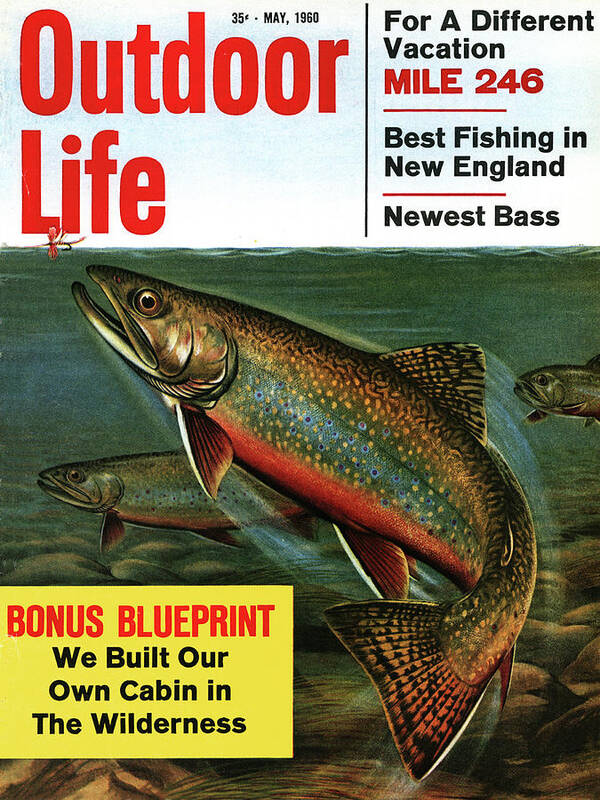
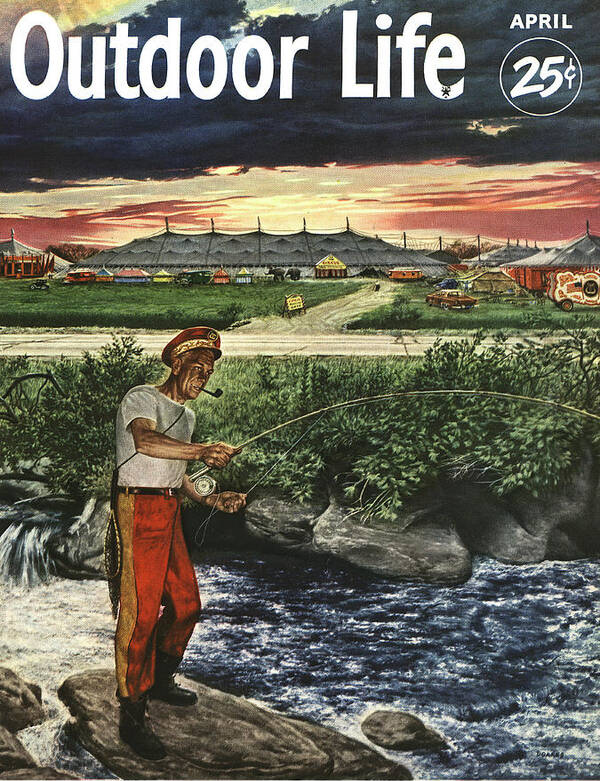
This story, “Fishing Off the Boom,” appeared in the April 1954 issue of Outdoor Life.
With deep misgivings, I watched Fred take off alone. His Rangeley boat with its three-horsepower outboard looked like an eggshell in the angry seas surging whitecapped across Maine’s Mooselookmeguntic Lake. First he’d be tossed high against the dark sky, then he’d disappear between waves.
I watched him as he headed straight into the gale toward Brandy Point, until at last he blended into the distance as a bird is swallowed up in the sky. Little did I realize that Fred’s departure was soon to lead me to one of the most exciting and dangerous experiences I’ve ever had in that wild country, and to my unforgettable initiation into what some natives call “fishing off the boom.”
We made the trip several years before the first guns announced the start of World War II, leaving on the second Saturday in May when dawn was still only a faint promise behind New York’s tall buildings. Twelve hours later we reached Mooselookmeguntic, largest of the Rangeley lakes. The sun, hanging low over the western evergreens, pointed a coppery finger across the lake to where we hoped the fish were waiting, hungry and eager for the lures we would offer.
There were eight of us. Fred Peters of Montclair, N. J., Ben Webster of the Eastern Shore of Maryland, Dick Saddler of Baltimore, Jimmy Lee of Long Island, N. Y., Ed Fox of Philadelphia, and I were old-time friends who’d been tramping up to Maine since we were no bigger than smelt. The other two, Billy Baldwin, a big, smiling Virginian, and Don Calvert, his brother-in-law from southern Pennsylvania, were at home on any trout stream from the Blue Ridge to the Catskills, but they’d never before been north of Connecticut.
We climbed out of the cars and stretched our badly cramped legs. Jimmy Lee checked us in at camp, and arranged for us to rent four outboards. Then he took off to make sure supplies for our week’s camping had been set aside at the little store up the road, and when he came back his broad grin told us everything was O.K.
A salmon rocketed into the air, the sun glistening on his fat, silvery sides as his nose touched his tail. Then he hit the water with a splash and was off, throttle wide open, for a 30-yard run.
Later we dropped in at Herb Welch’s sporting-goods store and stocked up on flies and spoons. Herb, one of the greatest fly casters in the country, told us where the bigger fish were being caught and what they were taking. Then we went back to camp and hit the sack.
After breakfast next morning we piled on gear into the boats and shoved off for the campsite on Student’s Island in the southwest part of Mooselookmeguntic. It was a cloudless, sparkling morning with a north breeze that kept the temperature down in the shivering 40’s. Straight ahead we could see New Hampshire’s snow-capped White Mountains marching single file into the pale horizon.
We landed on the island after a 45-minute run, and Dick Saddler was first ashore. Dick, who has trekked through much of northwestern Canada, supervised the pitching of camp, and made certain we’d be sound enough to weather any of the big blows that sometimes sweep Mooselookmeguntic in May.
There were a dozen or so anglers camping there, among them a young bride and groom on a fishing honeymoon. Susan, the blue-eyed bride, had never been in the north woods or camped in a tent before, and she sparkled as she told how she’d caught her first fish, a small salmon. About 22 and not an inch over five feet five, she looked more like a china doll than an outdoor girl.
After we’d met she introduced us to Jerry, her husband, a big fellow with blue eyes and close-cropped blond hair. He was as proud as any young husband could be, and it didn’t take long to find out why. Besides being a beauty, Susan was a splendid sportsman. She never spoke a word of criticism or complaint, and believe me things went plenty bad before the week was over.
By the time we were ready for some trolling, the lake was as flat and uninteresting as the bottom of a frying pan. Our take for the day was one discouragingly small landlocked salmon which Ben called “the spotted smelt.” There was no sign of trout. It might seem odd that we were interested in trout while fishing salmon water. The reason was that we had a pool on squaretails. It amounted to $80, which was real money in those days, and each of us was out to win it.
But as day followed day it began to dawn on us that the fishing was definitely off. Ben Webster, who’d been born with a fly rod in his hands, was as gloomy as the Jersey flats in a November fog. “Might as well go home,” he growled. “Too late for salmon, too early for trout. The moon isn’t right, and the water’s too cold.”
But while we lingered over coffee that morning a breeze rose from the southwest, and in no time it was building sizable whitecaps on the lake.
“Look at that,” Fred cried. “Might be making up good salmon water.” He turned to me, his eyes sparkling. “Let’s run up to Stony Batter and troll.”
At Fred’s words every face came out from behind its cloud of gloom, and we took off as soon as the dishes were done. Fred and I, rigged for salmon with Gray Ghost streamers, took the lead boat and headed into the heavy seas. Cold spray ran down our slickers like rain, and we had to bail hard all the way.
We were on our second troll between Stony Batter and Bowley’s Rock when my reel started to yowl. A salmon rocketed into the air, the sun glistening on his fat, silvery sides as his nose touched his tail. Then he hit the water with a splash and was off, throttle wide open, for a 30-yard run. He burst out of the water again and waltzed on his tail for 10 feet across the spume. Once more in the drink, he charged the boat and I nearly wore out my wrist trying to reel in line. Fred shut off the motor and stood ready with the net as the little boat rolled and pitched.
But my salmon wasn’t going to throw in the sponge so long as he could move a fin. I brought him alongside four times, and four times he power-dived just before Fred could net him. Finally my 9-foot, 5½-ounce fly rod wore him out and Fred scooped him up. He weighed a little over seven pounds.
Soon we heard a yell from Billy’s boat and saw a salmon doing acrobatics off the stern. Then Fred’s reel began to wail, and we were tangled in another fight. Our luck seemed to have changed.
Soon we heard a yell from Billy’s boat and saw a salmon doing acrobatics off the stern. Then Fred’s reel began to wail, and we were tangled in another fight. Our luck seemed to have changed.
But by noon the wind that had brought us our good fortune began to overdo it. Soon our little boats were literally standing on end, with each wave and coasting down like sleds on a hill. Water crashed over our bows and poured in at our sterns. We had to go ashore or drown, and on the run back we bailed like fury. Mooselookmeguntic can get as nasty as any water I’ve seen, and can do it quicker than you’d think was possible.
Battered, cold, and wet, we got the boats in safely and carried our fish to the icebox. We’d taken eight fine salmon and released three. Not bad, but not good either.
It began to rain before we went to bed that night, and as we lay in our sleeping bags listening to the storm we tried to reconcile ourselves to a quiet tomorrow, so far as fishing was concerned. But by morning the rain stopped. Low clouds raced like grey-hounds across the dark sky, however, and the wind was building green mountains on the lake. After one look, all of us decided we needed a day’s rest in camp. All but Fred, that is. He insisted on taking a boat to try his luck off Brandy Point. I worried about him all morning.
By early afternoon the skies cleared and the wind died to a whisper. The boys eagerly climbed into their boats and took off, certain now that the big squaretails, stirred up by the blow, would be on the rise along the shorelines. I was stranded, since Fred had our boat, but I took my rod and walked along the rocky shore to flip a cast wherever I could. It was rough going until I reached a big cove where there was enough back room for decent casting. The trout were there, and were on the rise, but the biggest I got was only nine inches. I caught and released a dozen, then moved on.
When I reached the far side of the cove I noticed a series of small wavelets coming out of grass that grew in only a few inches of water. I stopped to investigate, and a sense of excitement swept over me. A big fish was feeding on something there. I saw a large dorsal fin sticking up through the surface, and made out the dark, broad back of a trout.
I had several Gray Ghost streamers with me, and one Black Ghost and a Ninety-Three. Stuck in my hat was one badly beaten wet No. 8 Gold-rib Hare’s Ear. Nothing suitable. But this was no time to go back to camp for a better choice. I decided to risk the wet fly. I tied it on with nervous fingers, took a deep breath, and set it down within a few inches of the trout. I tensed for the rise, but the fish ignored my offering. I gave the line a slight twitch — just enough, it developed, to get the leader tangled in the grass.
Standing by helpless, I saw the trout turn and swim lazily toward the fly. He advanced almost in slow motion, then picked up the feathers.
Thinking the tangled leader would certainly snap, I set the hook. It’s hard to believe, but the trout, startled by the sting of steel, leaped straight into the air in the only way that could possibly have freed the leader. Then he really gave me a run for my money — up, down, sideways, and on the bias. But he made one mistake.
Related: The Best Trout Lures of 2026, Tested and Reviewed
He went into deep water, where I had plenty of room to play him, and before long he was in my net. He weighed a good 3% pounds. All the boys, except Fred, were in camp when I got back. They’d picked up some nice trout, but none as heavy as mine and I figured the $80 pot was as good as won. We were just finishing supper when we heard Fred’s outboard and went down to meet him.
“Where’ve you been?” Billy demanded as Fred beached the boat.
“Fishing,” Fred taunted. “Fishing while you loafers have been bumming around camp.”
“That’s what you think,” Ed Fox put in. “We’ve been fishing while you’ve been playing Columbus. And looks like Wynn won the pool.”
Fred walked to the icebox, flicked on his flashlight, and examined our catches. “Fair,” he grunted, “but I think I can beat all of you.”
Flashlights in hand, we scrambled to Fred’s boat. “Holy mackerel,” Don yelled as he held up a trout.
“It’s 6¾ pounds,” Fred said casually. “You should have seen the ones that got away.” Our eyes popped when he showed us what else he had-a six-pound squaretail, a five-pounder, and a seven-pound salmon.
“Where’d you get those fish?” I shouted.
Fred’s eyes sparkled. “Now, now, that’s like asking for my girl’s phone number. What’s the matter with you guys? Must I always show you where and how to catch trout?”
“O.K.,” I said, “we’ll shadow you tomorrow.”
“I’ll rent the speedboat,” he threatened. “You’ll never keep up with it.”
Fred kept us on the hook all night, but he woke us early in the morning. “If you guys can tear yourselves loose from those sleeping bags, I might take you along,” he said. “Might even show you how.”
At breakfast he told us about the day before. He’d headed straight for Brandy Point, figuring to work down the lee shore and beach his boat at the Upper Dam House so he could fish the big pool below. But as he rounded Brandy Point he ran into a winch boat hauling a boom of pulp logs. Afraid the logs might ram the boat, he headed for the other side of the lake and came ashore at the edge of some thick woods. Then he walked along shore and across the dam to the path leading to the pool where the Mooselookmeguntic pours into Richardson Lake.
If you’ve never walked out on a narrow, wet, slippery sluice boom and tried to balance yourself on it while black water raced by, inches below your feet, you can’t know how I felt that morning. I thought my time had come.
On his way he met two anglers from Rumford, Maine, who told him they were going to fish off the boom when it came in, and they invited him to join them. Fred agreed, not knowing what he was letting himself in for, and followed them. out onto the flimsy sluice booms. Soon some logs floated by, and almost at once the three of them began catching the largest squaretails Fred had ever seen in Maine. They caught salmon, too. The fish, Fred said, followed the wood down out of Mooselookmeguntic, and maybe even Cupsuptic Lake, and rose from the depths in furious swirls to feed off insect grubs that dropped from the rotting bark.
“What did you use?” Jimmy asked.
“The trick,” Fred replied, “is to lake a big bushy pipe cleaner, wind it around a hook for about half an inch, and then clip it off. It makes a fly that looks just like a wood grub. You cast it so it strikes a floating log, then slips off into the water. If a trout or salmon is around, he’ll smash that fly like a terrierr does a rat.”
Fortunately there were plenty of pipe cleaners and hooks in camp, so we made ourselves a 1ness of grubs. We were just about to take off when Susan, the bride, ran down to ask if she and Jerry could come with us. “Sure,” Fred grinned.
The morning was bright, and there was just enough breeze to ruffle the lake’s surface. Before we got halfway to Brandy Point we saw a winch boat working among rafts of pulpwood. It was fascinating to watch, and I’m glad I did, for winch boats no longer help herd logs clown the Rangeley lakes for sluicing through the dams. Today trucks haul the timber out of the woods and dump it in the Androscoggin River, which carries it swiftly to the paper mills.
We went ahead and beached the boats opposite the Upper Dam House. Clouds of hungry black flies followed us as we took our rods and nets and walked along the shore. There we ran into the fellows from Rumford, who were waiting for the winch boat to work nearer, and when she did we all went down to the dam. Then came my introduction to fishing off the boom.
The boom was a sluice boom, consisting of three or four 15 to 20-foot logs fastened together and linked to similar lengths of logs at each end. One such boom was placed on each side of the channel leading from the dam to the upper reaches of the lake, and their function was to guide free-floating pulpwood downstream to the open gates in the dam through which it was sluiced.
If you’ve never walked out on a narrow, wet, slippery sluice boom and tried to balance yourself on it while black water raced by, inches below your feet, you can’t know how I felt that morning. I thought my time had come. I knew that if I took one false step I’d be a goner, and the thought made me a little sick. I almost turned back.
But there was no time to turn back. The winch boat had maneuvered itself into position off the head of the dam and had begun to loosen the rafts of pulpwood. Already logs were floating by us, and almost at once the place became alive. Every few seconds a huge trout or salmon boiled up alongside a bobbing log to snatch a grub. It was so fantastic I just stood there with my mouth open, scarcely believing what I saw.
Then I heard Fred yell, and when I turned I saw he was fast to a fish that was burning up his reel.
The sight snapped me out of my trance. I cast my pipe-cleaner fly toward a nearby log. It hit the bark, dropped off into the water, and sank slowly.
Then I saw a dark shape rise from below — a squaretail, and a big one. It snapped the fly in its jaws, turned, and dived. I don’t think I was breathing, and I know I never set the hook. My rod jerked down so suddenly and with such force I felt sure it would snap in two.
But it didn’t. The tip just bent right down to the water. Gripping the cork handle with both hands, I held the rod as high as I could and let the bamboo get in its deadly work.
Then, without the slightest warning, the trout turned, zoomed to the surface, and burnt into the air as if shot from a submarine. It smacked down on a raft of logs and flopped around for a second or two before finding the water. When it did it charged off under the logs, ripping out line so fast I could scarcely see it go. Now I was in real trouble.
Things happened so fast in the next few minutes I can’t remember exactly what took place. All I know is that fish, logs, and line were all mixed up, and I was tottering on the boom like a tipsy tightrope walker. Twice I slipped and almost toppled into the current. How I kept my footing and hung on to that fish I’ll never know, but somehow I got him in an open patch of water and fought him to a finish. When he finally gave up I was almost as far gone as he, and I could barely lift him in the net. But what a trout — seven pounds four ounces.
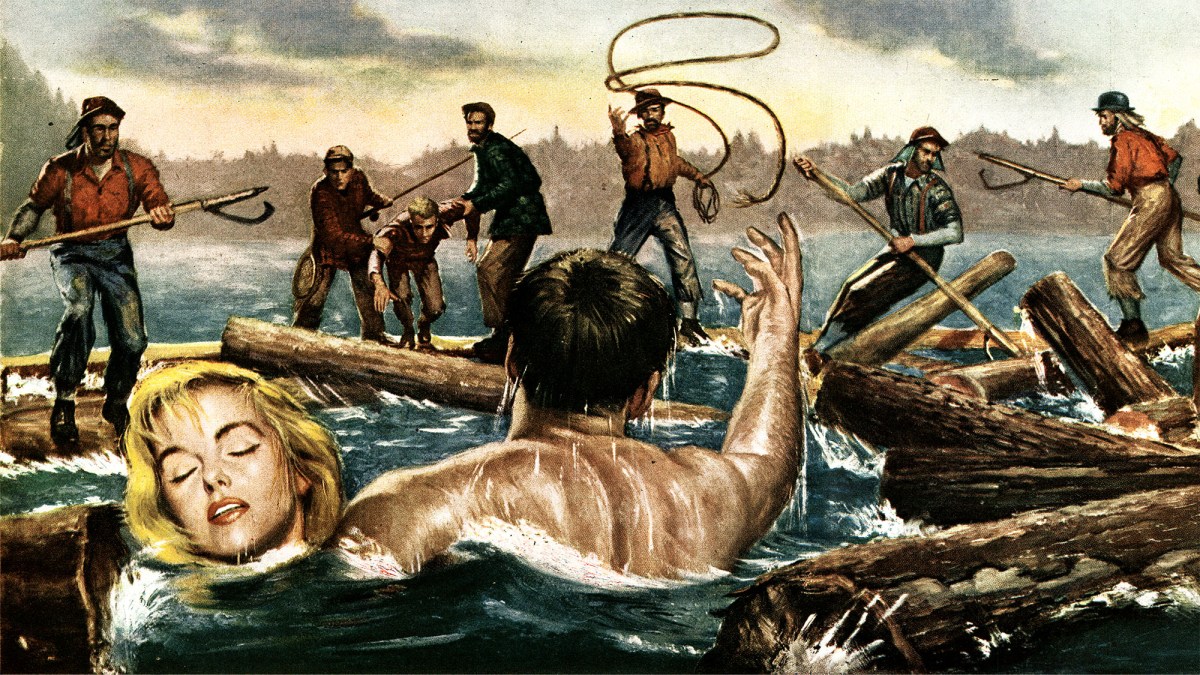
Just as he started his powerful run a scream, full of horror, jerked my attention away from him. I snapped my head around in time to see Susan disappearing into the dark, swirling waters.
As soon as I got back in casting position I saw a trout boil alongside a log not 10 feet away. I dropped my fly. Wham! The trout leaped high, and I saw he was still larger than the first. Maybe I would have landed that fish, maybe not, but I’ll never know. For just as he started his powerful run a scream, full of horror, jerked my attention away from him. I snapped my head around in time to see Susan disappearing into the dark, swirling waters. Apparently she’d slipped off the boom and fallen forward. In that awful second of paralyzing shock the trout yanked my rod from my hands. It hit my feet and slid awkwardly into the water.
We’d spaced ourselves out on the boom at intervals of about 15 feet, and I found myself much too far away from where Susan had slipped to be of any help. But Ed Fox and Dick Saddler grabbed Jerry, who’d told us before he couldn’t swim, and held him from jumping after his bride. Billy Baldwin stripped off his clothes the way you’d peel a banana, and plunged into the icy water.
It was a horrible moment. Though I knew Billy was a powerful swimmer, he stayed under for what seemed like a long, long time. Then suddenly his head and shoulders broke through the surface. With him was Susan, hanging limp in his arms. By that time some of the loggers who’d been working farther up on the sluice boom arrived on the scene. Though traditionally nonswimmers, the men fearlessly skipped along the boom and pushed the floating logs out of harm’s way. One expertly tossed Billy a rope and quickly hauled the two of them to safety.
We carried Susan to a tent belonging to the Rumford anglers, and a doctor who was vacationing at the Upper Dam House soon revived her. She told us she’d hooked a salmon that lunged and dived with such power it tipped her off balance before she knew what was happening.
Meanwhile Billy, who’d lost all his clothes in the water, stood outside as naked as a plucked chicken and tried vainly to beat off a swarm of blackflies. We got him wrapped in blankets in no time, and one of us went off to borrow an outfit he could wear.
We did no more booming that day, of course, but while it lasted it was just about the best trout fishing any of us ever had. Fred won the pool with an eight-pound two-ounce squaretail. We all had big fish except Ben, who’d hung a large salmon but had only a broken rod to show for it.
Read Next: It Took Rescuers Days to Find Us in a Remote Canyon. It Took Even Longer to Figure Out How to Get Us Out
Since then I’ve fished other log drives in the northland — in the Androscoggin River near Errol, N.H., the South Branch of the Dead River, the Kennebec, Penobscot, and Diamond Rivers, all in Maine — and tangled with more outsize trout. Last spring Fred had some wonderful fishing among floating logs in the Saranac River in New York’s Adirondack Mountains. Try it for excitement, whenever you’re in logging country during a spring drive. Just one caution, though. Be sure you’re a strong swimmer.
Read the full article here