

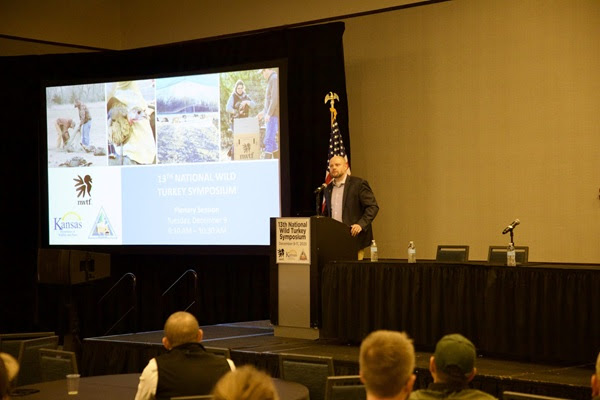
EDGEFIELD, S.C. — State and federal biologists, academic researchers, land managers and NWTF conservation leaders gathered Monday for the opening day of the 13th National Wild Turkey Symposium, setting a collaborative tone for a pivotal week focused on the science, data and partnerships shaping the future of wild turkey conservation.
The day opened with remarks from NWTF co-CEO Kurt Dyroff, who reminded the room that the wild turkey’s future will be shaped not by isolated efforts but by collective ones.
“This room represents decades of commitment, millions of acres of restoration and countless hours in the field, the lab and the woods,” Dyroff said. “It is a privilege to stand among you as a colleague and friend.”
His call to “listen deeply, collaborate fully and think boldly” framed the rest of the day’s discussions, which included past conservation efforts, today’s challenges and opportunities for the future.
Remarks also followed from leaders with the Missouri Department of Conservation and the Kansas Department of Wildlife and Parks, grounding the symposium in the realities of the Midwest, which is home to historic wild turkey restoration successes.
Looking Back to Understand the Road Ahead
The plenary session began with Eric Kurzejeski, who provided a historical narrative of wild turkey restoration in Missouri. He reminded attendees that restoration was not only wildly successful, it exceeded all expectations, expanding turkeys to their historic range and beyond through partnerships, public support and relentless field efforts.
But his central question lingered: “Are we making the most of the historical information before us to make decisions?”
Kurzejeski emphasized that wild turkey populations have always fluctuated, and part of today’s work is helping hunters understand the natural variability of the species they care so deeply about. He explained that a shared sentiment among individuals key to early wild turkey management was to serve the needs of the average hunter as public servants of conservation. He called for improved interpretation of brood survey data, deeper public engagement and a renewed spirit of service.
Present Challenges and Future Needs
Building on that foundation, Bret Collier, Ph.D., delivered a forward-looking examination of the current research landscape, raising a set of urgent questions for the next generation of turkey scientists and managers:
- How do we support the diverse needs of all state agencies?
- How do we create space for innovation while maintaining social trust?
- How do we ensure scientific information moves accurately from researchers to managers to the public?
- And how do we prevent outside noise from distorting the science that guides decisions?
Collier underscored a central tension in the profession: academics push boundaries of innovation, while agencies need practical, defensible management strategies. Strengthening the bridge between those cultures, he noted, is essential.
The morning closed with Texas Wildlife and Parks Department Turkey Program Leader Jason Hardin, who delivered a stark picture of the Great Plains, an ecosystem losing well over 1 million acres of grassland each year.
Hardin identified woody encroachment as a major driver, one that has accelerated dramatically in the last century and now threatens habitat connectivity, elevates wildfire risk and isolates turkey populations across the plains.
Solutions, he emphasized, must include large-scale grassland and savanna restoration, transparent communication with the public, collaboration with pollinator, songbird and threatened species programs and permanent conservation of critical landscapes. Hardin lauded the NWTF’s Waterways for Wildlife Initiative in his presentation as a productive effort driving positive change for American’s Great Plains.
Status, Productivity and the First Real Look at Standardized Brood Data
Afternoon sessions shifted to population status and productivity.
Collier returned with his research on status and wild turkey distribution across the U.S., which continues the tradition of the 5-year survey, offering updated results provided by state agency biologists on perceived wild turkey abundance, estimated hunter participation and estimated harvest through the 2024 spring and fall seasons.
Zak Danks followed Collier with a presentation highlighting the first six-year analysis of the national standardized brood survey, which was made possible by analyzing more than 321,000 summer wild turkey observations that were contributed by 38 states. The effort used a standardized protocol for data collection, cleaning, analysis and reporting. Danks noted this is a positive step forward made possible by the NWTF’s National Wild Turkey Technical Committee and broad state agency adoption.
Wild Turkey Genetics
The next topic of research focused on wild turkey genetics.
Presentations included the role of kinship in female social behavior, in which Mike Chamberlain, Ph.D., NWTF Distinguished Professor at the University of Georgia, demonstrated how winter flocks of hens dissolved as they transitioned to pre-laying harems and subsequently, into laying and incubation ranges. Chamberlain noted that the project found that 67% of all contacts between females within a social group occurred when they were in the pre-laying phase, 29% were between females who did not attempt a nest, but only 2.9% occurred during the laying phase.
Other interesting presentations included fine-scale genetic structure within flocks by Sarah Watkins, Ph.D. student, and the widespread legacy of management-driven hybridization across subspecies by Amanda Beckman, Ph.D.
Disease Ecology and Predation
Disease ecology presentations focused heavily on Lymphoproliferative Disease Virus (LPDV). LPDV is caused by a retrovirus and was first documented in domestic turkeys in Europe and Israel in the 1970s. In 2009, the disease was documented for the first time in wild turkeys in Arkansas and has since been observed in at least 29 states as well as Canada.
Some infected birds form tumors in their internal organs and skin and may exhibit many other side effects, like weakness and lethargy, while some infected birds display no noticeable clinical signs but may experience more insidious effects, such as decreased immune system health and secondary infections (such as with poxvirus). Though the disease can be detrimental to individual birds and many basic questions about the disease still remain, even less is known about its effect on wild turkeys at a population level.
Despite high prevalence and frequent coinfections, early data suggest LPDV may not meaningfully affect nesting success, reproductive effort or incubation survival.
Still, researchers stressed that critical questions remain, particularly regarding transmission, immune impacts and effects across other periods of the life cycle.
Sessions also highlighted the widespread presence of aflatoxins in supplemental wildlife feed. Additionally, it was asserted that wild pigs are not primary nest predators of wild turkeys.
For a deeper look at the research shared from day one of the 13th National Wild Turkey Symposium and what’s to come throughout the week, explore the full list of published works.
As day one closed, a clear themed emerged: wild turkey science is wide-ranging, datasets are larger than ever, and the questions are harder, highlighting that creating open access to long-term datasets will transform the way researchers validate, or overturn, long-held assumptions.
The message that began the morning carried through every presentation: Progress will only come through shared data, shared knowledge and shared responsibility. As Dyroff said, “If there is one message I want us all to leave with, it is this: The future of the wild turkey will be shaped by our unity.”
About the National Wild Turkey Federation
Since 1973, the National Wild Turkey Federation has invested over half a billion dollars into wildlife conservation and has positively impacted over 24 million acres of critical wildlife habitat. The NWTF has also invested over $10 million into wild turkey research to guide the management of the wild turkey population and to ensure sustainable populations into perpetuity. The organization continues to deliver its mission by working across boundaries on a landscape scale through its Four Shared Values: clean and abundant water, healthy forests and wildlife habitat, resilient communities, and robust recreational opportunities. With the help of its dedicated members, partners and staff, the NWTF continues its work to provide Healthy Habitats. and Healthy Harvests. for future generations.
Read the full article here