
The Trump administration and members of Congress are working in tandem to dismantle protections for the Boundary Waters that were implemented during the Biden administration in 2023.
Rep. Pete Stauber (R-Minn.) filed a joint resolution in the House of Representatives late Monday night that aims to repeal the Biden-era mineral withdrawal, which placed a 20-year moratorium on mining in a watershed neighboring the Boundary Waters Canoe Area Wilderness. The current administration had already signaled that they would roll back those protections in June, and the Department of the Interior paved the way for Stauber’s resolution on Dec. 6, when it transferred the 2023 Public Lands Order to Congress.
The end goal is to grant mining leases to Twin Metals, which is owned by a foreign corporation, while also preventing any future mining bans within the Rainy River watershed. This would further the administration’s push to make mining and resource extraction the primary uses of our public lands and waters. Congressional action would also have a more permanent effect than an executive order, which can be undone by a future administration.
This approach could also impact public lands across the country by establishing a new precedent in Congress, according to conservation groups who are following these actions closely.
“[This] is an unprecedented maneuver that threatens the future of the Boundary Waters,” says Lukas Leaf, executive director of Sportsmen for the Boundary Waters. “A decision to allow this to move forward could have dangerous implications not only for the BWCA but also for similar protections for wild landscapes across the country.”
By transferring the Public Lands Order that was signed in 2023 to Congress, the administration is purporting that the Biden-era mineral withdrawal was filed improperly, and that it should now be subject to revision under the Congressional Review Act. This would be an unusual use of the CRA, which, until recently, has been invoked sporadically in Congress.
These complicated legislative maneuvers could now hinge around a pending decision by Senate Parliamentarian Elizabeth MacDonough, a nonpartisan and seldom-seen member of the chamber who is often referred to as the “Senate referee.” MacDonough recently thwarted an attempt to include a Boundary Waters provision in a budget reconciliation package.
It’s unclear how MacDonough will rule in this case. If she disapproves of the measure, the Senate could introduce its own resolution anyway — as it did recently when Congress rolled back rules around the Clean Air Act. And it’s possible that Stauber’s resolution will come to a vote on the House floor as early as next week.
Asking the Ref for Review – with the Ball Still in Play
The Department of the Interior on Jan. 6 notified both chambers of Congress that it was submitting the Biden-era mineral withdrawal into the Congressional Record, according to Reuters. This submission opened the door to the mineral withdrawal being subject to the Congressional Review Act, which gives Congress the power to evaluate and overturn rules made by federal agencies.
“This was a letter pertaining to the Public Lands Order that Biden and [former Interior Secretary] Deb Haaland signed in 2023,” says Ingrid Lyons, executive director of Save the Boundary Waters. “And, in theory, you can use the CRA to evaluate past agency actions, even if they’re from a different administration.”
In a typical situation, Lyons explains, Congress’ ability to use the CRA would be granted or denied by the Government Accountability Office. In this instance, though, the DOI sent the notice directly to MacDonough, the Senate parliamentarian.
“That’s what’s unusual and unprecedented in this case. The Senate parliamentarian is not meant to be an entity that rules on whether or not something is subject to the Congressional Review Act,” Lyons says. “And that’s where precedent is so important. Because the Boundary Waters mineral withdrawal has never been considered a rule under the CRA by the Government Accountability Office.”
That decision from MacDonough is expected soon, but it had not been made public as of press time. If she approves the Jan. 6 notice from the DOI, and if a companion resolution is introduced in the Senate, Congress would then have 60 working days to vote on the joint resolution. (Only a simple majority is required and there are no filibusters.) It could then reject the 2023 mineral withdrawal that protects 225,504 acres of public land in the Superior National Forest.
This would also prevent similar mineral withdrawals from being enacted by future administrations, due to the CRA’s “substantially similar” provision. And it would be a major win for Republican members of Congress like Stauber, who represents northern Minnesota and has for years worked to greenlight Twin Metals’ proposed copper-nickel mine.
Wielding the CRA in New Ways
Stauber cheered the move in a statement on Jan. 8 and commended the Trump administration. He also referred to the Biden-era mineral withdrawal as an “illegal mining ban,” even though it was enacted legally and filed under the Federal Land Policy Management Act. That’s according to Robert Anderson, a legal expert and visiting professor at Harvard Law who served as solicitor of the Interior during the Biden administration. In that role, Anderson worked with a team of lawyers to establish the mineral withdrawal that Haaland signed in 2023.
“Section 204 of FLPMA authorizes these mineral withdrawals of up to 20 years if there’s a certain process that’s followed,” says Anderson, who signed dozens of other, similar withdrawals during his time as Interior solicitor. “It’s a pretty straightforward process … and that’s exactly what we followed.”
Under this process, the U.S. Forest Service conducted a full environmental review of the area and held a public comment period, in which 98 percent of respondents said they wanted the BWCA permanently protected from copper-nickel mining.
The USFS’ environmental review was completed in 2022. It concluded that hard-rock mining in the Rainy River watershed could pose a real environmental threat to the neighboring BWCA, and it pointed to water quality as being particularly vulnerable.

“Now, this CRA business — there are very specific time limits as to when Congress can invoke the CRA. And it’s my view that we are way past that time,” Anderson says. “Moreover, I think there’s a fair question of whether the CRA even applies to this situation.”
He explains that FLPMA already provides a mechanism for congressional review of mineral withdrawals. He says Congress could’ve used that mechanism in 2023, “and they don’t get a second bite at the apple” when they failed to act years ago.
Anderson also notes that while Stauber’s approach is a new one, it wouldn’t be the first time that Congress used the CRA as a blunt instrument to reshape federal public lands management. In September and October, the House and Senate used the congressional tool to rescind the BLM’s resource management plans for Alaska, Montana, and North Dakota, paving the way for more energy development there as well as potential litigation in the future.
This is part of a larger trend in a Congress that seems eager to wield the CRA. According to the GAO’s accounting, the CRA’s disapproval process was invoked 20 times between 1996 (when the CRA itself was enacted) and 2024. It’s been used 22 times in the last 10 months alone.
“I actually wrote a letter to [Capitol] Hill during my last week in office about the inability to use the CRA for BLM land-use management plans … So this is all very unusual,” Anderson says. “And even if this does get approved by the President, then it will have to be tested in court. And there’s been plenty of litigation around the Boundary Waters.”
Overturning the 2023 mineral withdrawal does not mean that Twin Metals’ mining permits would be approved right away. That permitting process would still be led by the USFS, and there would still have to be some sort of environmental review involved. However, a separate bill that Stauber introduced in February would expedite that review by requiring Twin Metals to receive mining permits “no later than 18 months” after a Mine Plan of Operations is submitted.
“Some sort of review would still have to happen,” Lyons explains. “But NEPA [the National Environmental Policy Act] is out the window for all intents and purposes. So who knows what that environmental review would even look like by the time we get to that point — which, hopefully, we won’t.”
Mining would also have to be permitted by the state. Minnesota Governor Tim Walz has not come out against the mine directly, but he told the Star Tribune last year that there should be a higher bar for approving copper-nickel mines near the Boundary Waters Canoe Area Wilderness compared with other areas.
America’s Most Popular Wilderness Area

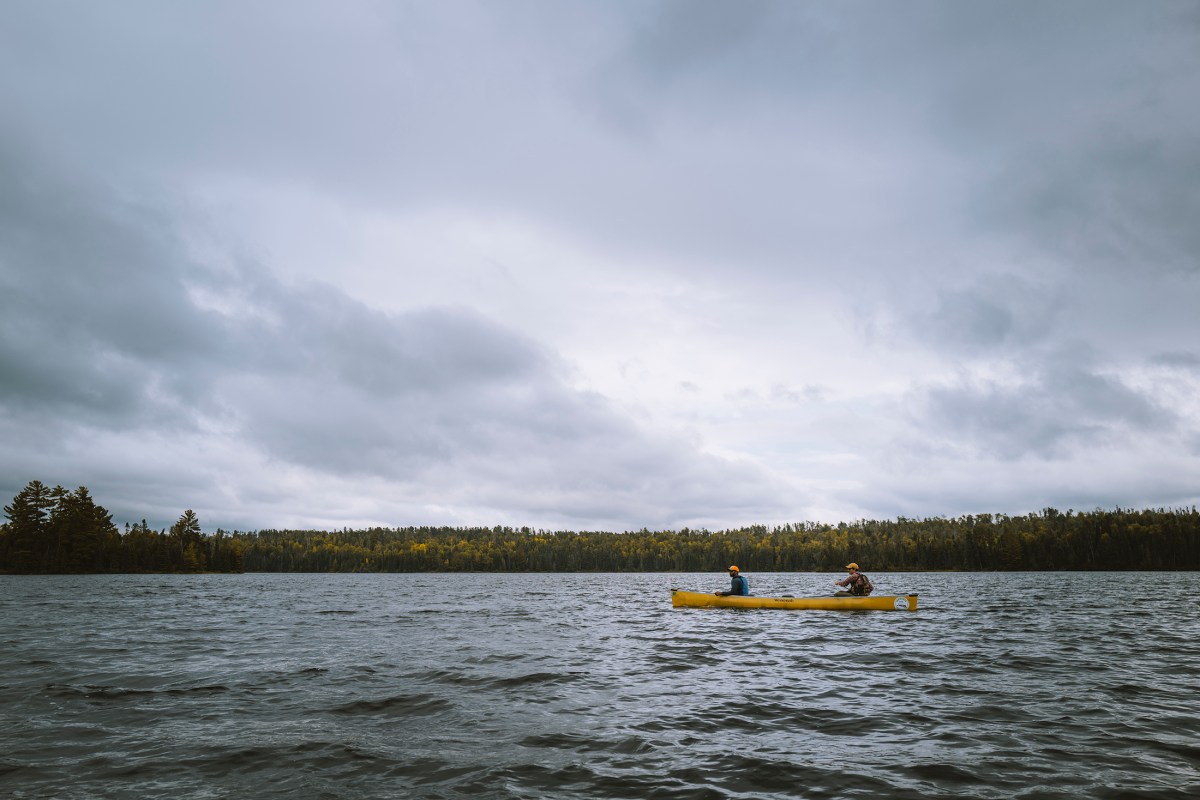
Located along Minnesota’s Canadian border, the BWCA consists of more than 1 million acres of glacial lakes and mixed North Woods forests. Motorized use is restricted here, making it the singular destination for traditional canoe trips through unspoiled North Country habitat in the Midwest. More than 150,000 paddlers, anglers, and hunters visit the BWCA each year. It’s a critical aspect of Minnesota culture and its economy. One 2016 study found the BWCA generated a total economic output of $78 million and 1,100 full- and part-time jobs (those numbers are likely higher today).
But this region also holds one of the largest untapped copper reserves in the world. The valuable mineral is used in everything from cell phones to AI data centers to electric vehicles. Known as the “Iron Range,” this area of Minnesota has a long history of mining. And many locals see the proposed mine as a way to bring more jobs to their small-town economies, even if the parent company, Antofagasta, is based in Chile. Twin Metals says the mine would create 750 full-time jobs, however a Harvard economic study found that the mine would likely create a net loss in jobs over a 20-year period due to lost tourism and recreation.
“[The Twin Metals Mine] leads to a boom-bust cycle in all the scenarios we examined, in which the region is in the end left worse off economically than it would be under the withdrawal,” Harvard economics professor James Stock wrote in a letter to the Forest Service in 2018.
Other proponents of the Twin Metals mine say that this type of resource extraction is critical if America is going to dominate a competitive global economy.
“Northern Minnesota mined the iron ore that won this nation two World Wars and we will mine the copper, nickel, and other critical minerals that will allow the United States to compete and win in the 21st Century,” Stauber said in a statement to Minnesota Public Radio.
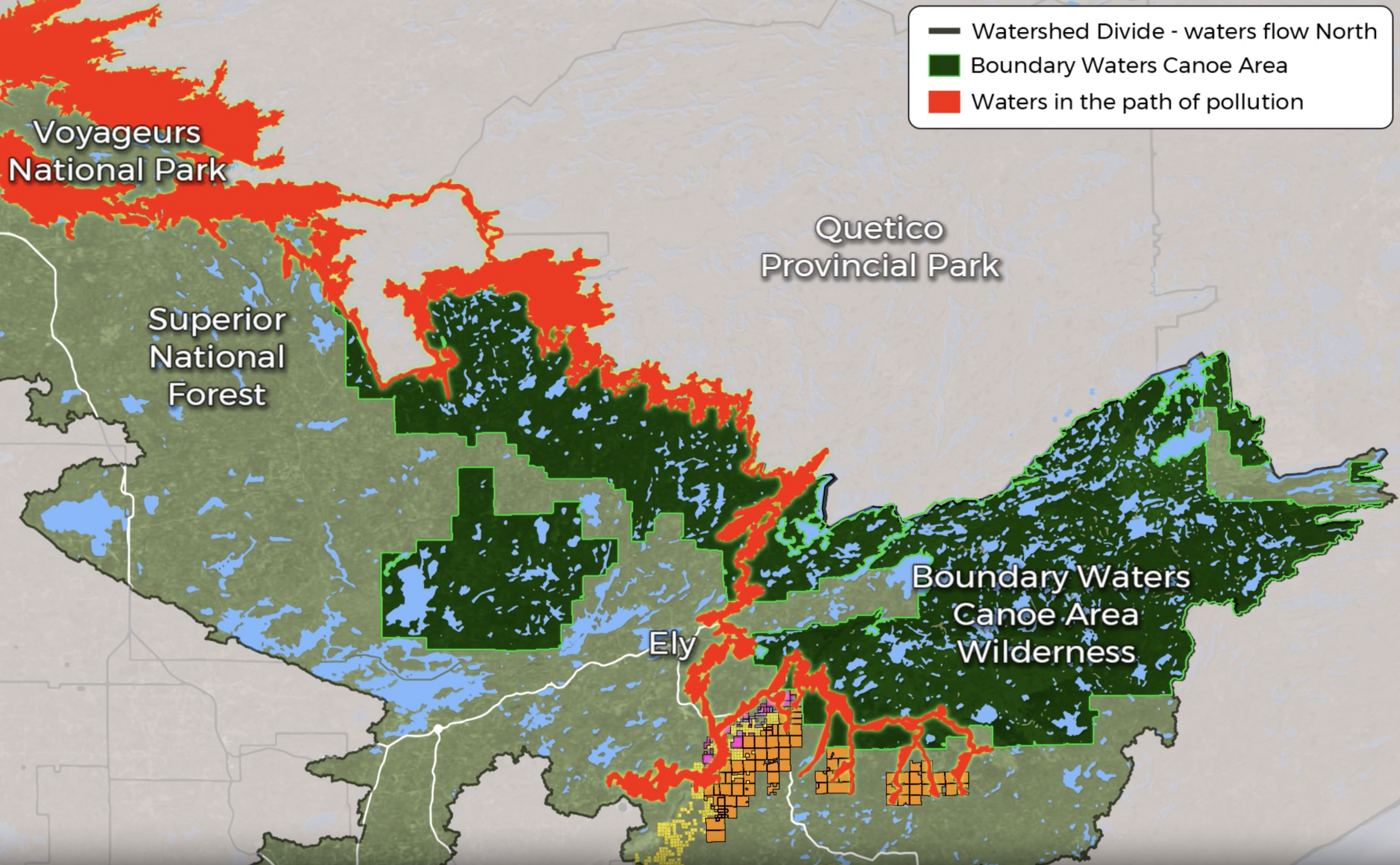
Conservationists oppose the mine because of the large-scale environmental damage it could cause. This type of mine has never been dug in Minnesota before, and conservation groups say that a mine like this has never been built without creating pollution in some form. And they argue that, without question, there will be damage done to the wilderness area if the mine were to go through. Because of the mine’s location — at the headwaters of the BWCA — any potential pollution or acid mine drainage would likely flow into the wilderness area, Voyageurs National Park, and Canada’s Quetico Provincial Park.
Read Next: “This Type of Mine Has Not Been Done Without Polluting.” Why the Boundary Waters Mine Is a Bad Trade
Twin Metals skeptics also question where the copper would be processed, and how the millions of tons of mine tailings would be stored safely. Currently the U.S. has only two major smelting locations, which are both operating at capacity. That’s why the U.S. ends up exporting approximately 50 percent of our raw copper to countries like China, Canada, and Mexico, only to buy it back after smelting.
Those are just a few of the many concerns swirling around the BWCA this week. Leaf is encouraging all outdoorsmen and women to learn more, and to oppose the mine by contacting elected officials here.
“The outdoor community nationwide should take note,” Leaf says. “Hunters, anglers, and paddlers, despite their political affiliation, should absolutely work together to stop this action immediately. It’s time to hold Congress accountable and urge all House members to vote no on this resolution. Call your elected officials now and send a message through a conservation organization working to stop this in its tracks.”
Read the full article here