
This story, “Black Bear Turns Man-Eater,” appeared in the June 1963 issue of Outdoor Life.
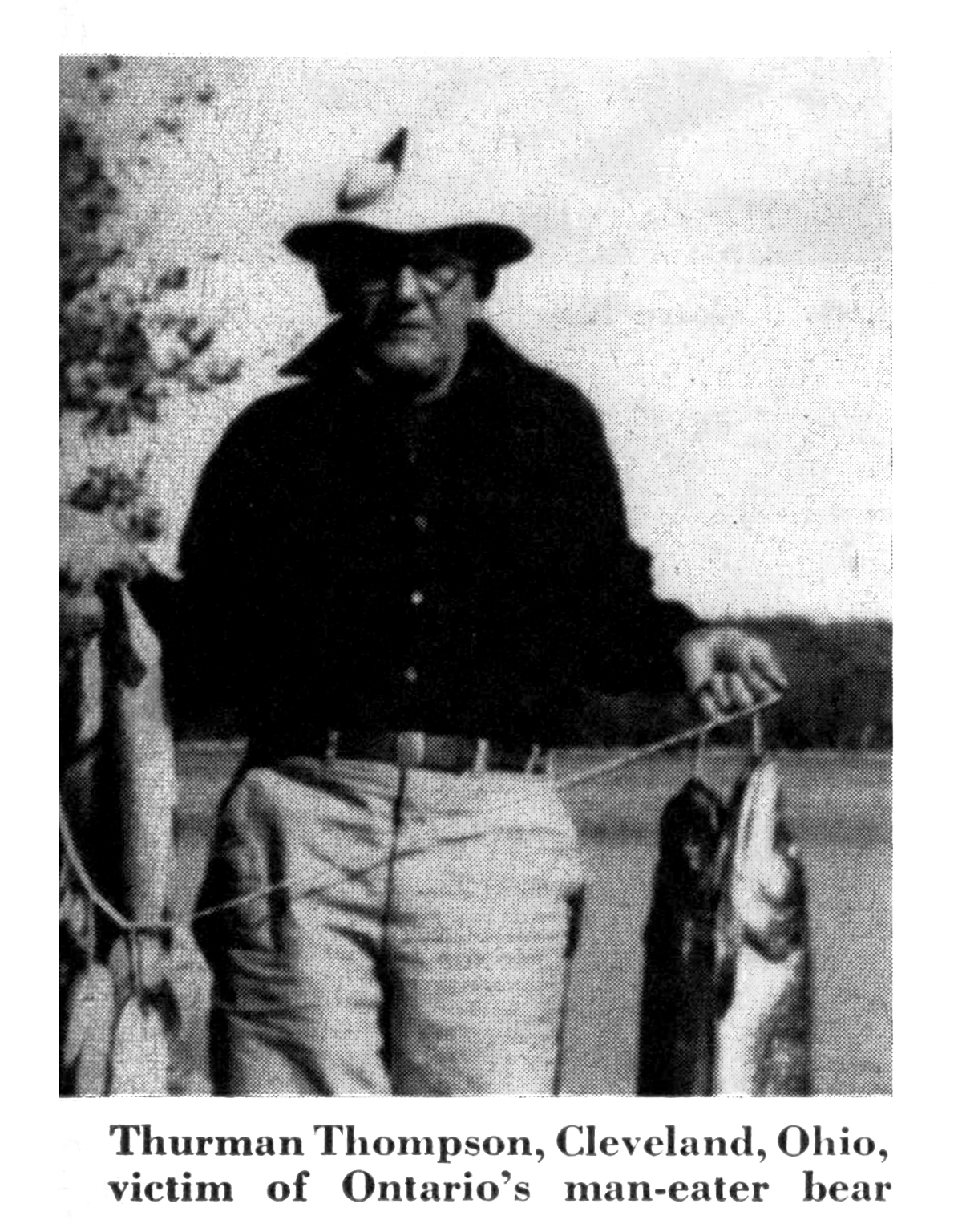
It never entered my mind on that September day that I was seeing my friend Thurman Thompson alive for the last time.
He had come into Biscotasing, a village on the Canadian Pacific Railway about 100 miles northwest of Sudbury, Ontario, from his cabin on Biscotasi Lake six miles or so to the south. Thompson was making a few last-minute purchases at the one general store before closing his place for the winter and returning to his home in Cleveland, Ohio.
I met him on the store steps, and we chatted for a few minutes about his plans and his pending departure. Then the talk switched to bears. The berry crop had been almost a total failure that summer of 1961, and the bears had grown unusually bold in their search for food. Thompson had seen two or three around his place, and he remarked that they were showing less and less caution, coming close to the cabin to poke around for garbage.
Wildlife photography was one of his hobbies, and he had hoped for years to get a chance to make some good close-up movies of a bear.
“I’m taking more film back to camp with me,” he said. “I’ll have some real bear pictures to show you next summer.”
“Don’t get too close,” I warned him. “They’re short of food and pretty hungry. You might run into one that’s looking for a fight.”
The bear population in our part of Ontario had been building up to troublesome levels for years. More and more often they were breaking into hunting camps and cabins, smashing out windows, ransacking cupboards, and making off with anything edible. Even in hunting season, when the camps were occupied, they had several times broken in during daylight, while the hunters were out in the woods, to get at food supplies. And any moose left hanging within their reach overnight was almost sure to be worked on.
Nobody expected any serious trouble, but I’ve lived in the woods most of my life and seen enough bear behavior to know that they are completely unpredictable. Wary and shy most of the time but now and then amazingly bold, they’re quick to shake their fear of man once they get used to him, clowning one minute and flying into a red rage the next. Nobody knows what to expect of them. I doubt even the bear himself knows. A hungry one is likely to be mean, and if he’s crowded or crossed, he can turn downright vicious quicker than you can tell it. It was with those things in mind that I urged Thompson to be careful.
He nodded agreement, but I could see that he didn’t take my warning too seriously.
“Any bear I’ve ever met,” he said with a chuckle, “was a lot more afraid of me than I was of him.”
A few minutes later he walked down to the dock with his supplies, cranked up his 25-horsepower outboard, and waved goodbye. He swung away and headed down the lake, gathering speed. I hope he had no inkling of what was in store for him.
I run two hunting and fishing camps in the roadless Ontario bush along the Canadian Pacific Railway northwest of Sudbury, one at Metagama, the other at Biscotasing, both whistle-stop villages.
Thompson, an apartment-house manager in Shaker Heights, a suburb of Cleveland, had started coming to my Metagama camp several years before. He had a strong urge to get away from the city as often as he could, and delighted in fishing, camping, and living in the woods. Because of our location, in unspoiled country well away from any highway, the fishing for northern pike, walleyes, and trout is exceptionally good, and he found exactly what he was looking for. His wife Jo enjoyed the bush as much as he did.
After a number of annual visits, the two of them decided to pick a spot on Biscotasi Lake and build a cabin of their own. They chose a secluded location on Descheney Bay about six miles from the village and equally far from the nearest neighbors, and put up a comfortable cabin, set among pines and birches, with a fine view and good fishing literally in their front yard.
He knocked again and when there was still no answer he shouted a few times. Finally, he pushed the door open and looked in.
By 1961, although he was only 62, Thurman had retired because of ill health, and he had spent most of that summer at the cabin. He and his wife had stayed three or four weeks and returned to Cleveland, and then he came back by himself for a six-week stay that would extend into the early fall.
It was on Wednesday, September 27, that I saw him in the village. Moose season was due to open on Saturday, and I had a number of hunting parties coming in. By way of having everything ready, and also to avoid overloading the boats at the last minute, I make it a practice to send heavy supplies, such as food and gas, to my hunting camps back in the bush a day or so ahead of time.
On Friday morning, one of my guides, Baldy St. Denis, left Biscotasing with a boatload of supplies for a party that would hunt on Indian Lake. Baldy had guided Thompson on several trips, and they had become good friends. With 10 miles still to go to his destination, he stopped in at Thompson’s place for the usual cup of coffee and a brief chat.
No one answered his knock. The wooden shutters were nailed in place over the windows, ready for winter, but Thompson’s boat was tied at the dock, so the guide was sure he wasn’t far away. The door stood unlatched and partly ajar, and that puzzled St. Denis. He began to feel a vague sense of concern. He knocked again and when there was still no answer he shouted a few times. Finally, he pushed the door open and looked in.
There was no sign of Thompson. The table was set but dishes hadn’t been used. The fire was out and the stove cold, with a half-cooked breakfast of bacon and eggs still on it. Sure now that something was wrong, Baldy went back into the yard to look around.
A bright object on the ground a few feet from the cabin caught his eye. It was Thompson’s movie camera, smashed, with the film ripped out and strewn around in loops. Next, the guide saw a pair of glasses lying nearby, also broken.
Thoroughly alarmed, and convinced that his friend had been hurt or killed in a fight with something, most likely a bear, the guide decided the situation was one for official investigation, and he did not wait to check further. He ran to the dock, unloaded his boat, and raced back to the village. Less than an hour after he’d walked into the deserted cabin, he was telling the story to W. P. (Bill) O’Donnel, chief ranger of the Ontario Department of Lands and Forests at Biscotasing.
O’Donnel lost no time. In a matter of minutes he had his deputy chief ranger, Walter Punstel, and Conrad Phillips, a fire ranger, on the way to the Thompson place in a fast boat, carrying a walkie-talkie.
A bright object on the ground caught his eye. It was Thompson’s camera, smashed, with the film ripped out and strewn around in loops. A pair of glasses lay nearby, also broken.
It took only a brief check for them to find bloodstains on the ground near the broken glasses and camera, and a blood trail leading off into the woods. The trail indicated that something heavy had been dragged away from the cabin. The two rangers did not have to follow it far. In a thicket only 150 feet back in the woods, they came onto Thompson’s body, dressed in pajamas and slippers, and badly torn and mangled.
Investigation revealed later that he had been dead for a day or more, likely since Thursday morning, killed by a series of blows at the throat and neck. His neck was broken and the jugular vein torn open. In addition, the body had been bitten and clawed in many places, and bruises showed where the bear had pummeled him in a savage, mauling attack that apparently had lasted even after the victim was dead. And to their amazement and horror, Punstel and Phillips knew after one look that they were dealing with an almost unheard-of rarity, a true man-eater. The bear had dragged Thompson into the brush not out of blind rage but for a meal, and had fed heavily before leaving its mutilated kill.
Authentic instances of bears turning man-eater are so rare, occurring so infrequently, that many experienced woodsmen laugh off such reports as outright fabrications. But say what you will, it happens now and then. At least three times, prior to the Thompson affair, cases have been recorded in the United States and Canada where bears are known to have killed humans and fed on them.
Curiously enough, in all of these instances, the offender was a black bear, not a grizzly or Alaska brown, and not always an unusually big black, either.
The wildlife writer Ernest Thompson Seton records the first two cases. One happened in northwestern Ontario, seven miles from English River station almost 40 years ago. A large black bear whose face and neck were stuck full of porcupine quills, which may have accounted for the episode, attacked and killed a trapper. The trapper’s rifle had been fired once and then jammed. Exactly what happened was never learned, and it is not known to this day whether he provoked the bear with a shot first, or shot and missed it as it was coming for him. In any event, the animal returned to its kill and was shot while gnawing at the body.
The man’s two companions threw lard cans and other objects at it, whereupon it dragged its victim away another 100 yards into thick cover, and resumed its meal.
Before that, in 1906, a lumber-camp cook in northern Alberta was chased and overtaken just outside the door of his cook shanty by a medium-size black bear that swam a nearby river and charged three men without provocation the instant it reached dry land. It killed the cook with a hard blow on the neck, much as Thurman Thompson was killed, picked him up, carried him a few yards into the brush, and started to feed.
The man’s two companions threw lard cans and other objects at it, whereupon it dragged its victim away another 100 yards into thick cover, and resumed its meal. Shots from a revolver and rifle finally drove the animal off, but it was not killed then or later.
The third instance of man-eating, and perhaps most shocking of all, involved a three-year-old child, the daughter of a forest ranger in the Marquette National Forest in the upper peninsula of Michigan, in the summer of 1948. The ranger and his family were living in a remote fire-tower cabin set deep in the woods west of the town of Brimley. He was away from home, on duty, and the little girl was playing in the yard of the cabin the hot afternoon when the attack took place. The mother, at work inside, heard the youngster scream and looked out to see her running for the back door, chased by a small bear.
As the child scrambled up the steps and reached for the screen door, the bear grabbed her, killed her before her mother’s eyes with a single bite through the neck and ran off into the woods with her. In a thicket only a quarter of a mile away, it put her down and fed.
That bear was hunted down by Alex Van Luven, one of Michigan’s foremost bear hunters, who tracked it to the place where it had left the girl, posted a man on watch there with a rifle, and followed the track with his best bear dog. The killer came brazenly back to its victim and was shot before Van Luven got out of hearing. It weighed only 150 pounds.
Now, at least for the fourth time since the United States and Canada were settled and white men began to have dealings with bears, a black had turned man-eater, attacking and killing a human and carrying the victim off to feed on the body. The evidence that Punstel and Phillips had found was beyond dispute.
How the trouble started between Thompson and the bear will never be known, of course. But from the evidence found near the cabin and inside, we pieced together what seems the most likely version of the affair. We concluded that the bear had paid an early morning visit while Thompson was cooking breakfast, perhaps lured in by the smell of food, as frequently happens when bears are made bold by hunger. Or maybe the man had put scraps of food out the night before, intending to bait, for pictures, any bear that happened along. In any case, he had heard or seen the animal outside, grabbed up his camera, and had run out, not even taking time to latch the door behind him.
That much seems obvious. The rest is conjecture. Thompson had no gun with him and so could not have provoked the bear with a shot. Did he toss food to it to bring it close? I doubt it. I think he knew bears too well for that. Bill O’Donnel believes he may have brought on the attack by stumbling in front of the bear, or that, sighting through the finder of his movie camera, he may have approached too close and provoked it into rushing him.
Thompson’s widow has a different theory. She was told by a local guide that two or more bears had been seen around the cabin, a fact that Thompson had mentioned to me in our brief talk on the store steps. Mrs. Thompson believes that while her husband was filming one bear, a second stalked him silently from behind and made the kill.
From what I know of bears and their ways, however, I doubt that. I think the man was struck down in swift frontal attack, and my own guess is that the bear came for him the instant he stepped outside, as it would have done with a sheep or deer, its normal fear overcome by hunger when it saw a chance to make a kill.
Whatever happened, there was no sign of a struggle, no evidence that Thompson had had time to run or try to defend himself. I suspect that the bear clubbed him to the ground almost before he knew what was happening and that he never felt the blow that killed him.
Punstel and Phillips were still going over the evidence in the thicket, shocked and hardly able to believe their own eyes, when they heard brush break in a dense tangle about 50 feet away, followed by an angry squealing sound.
Punstel and Phillips were still going over the evidence in the thicket, shocked and hardly able to believe their own eyes, when they heard brush break in a dense tangle about 50 feet away, followed by an angry squealing sound. Astonishingly, the bear was coming back to its kill!
Because there had never been an authentic case of a bear or any other wild animal attacking a human in our part of Canada, it had not even occurred to the two rangers to take a gun along when they started off in a hurry to investigate the report that St. Denis had brought back to Biscotasing. In consequence, they were now unarmed and empty-handed, facing a bear that had killed and fed on a man not many hours before.
They did not catch sight of the animal but they could hear it moving toward them through the brush, still uttering strange piglike squeals of rage.
Reluctant as they were to abandon Thompson’s body, even temporarily, they had no choice. They got clear of the brush and ran for their boat. Almost certainly, had they stood their ground, the bear would have attacked and killed one or both of them. An animal that turns rogue and discovers how easy it is to do away with a man is not likely to hesitate about repeating. On top of that, any bear laying claim to its kill — as this one was — is something to avoid.
Back at the boat, Punstel and Phillips radioed to the ranger station at Biscotasing and asked for a gun. O’Donnel rushed two more men, George Wright and Morris Daybutch, to the scene with a .303 Lee-Enfield.
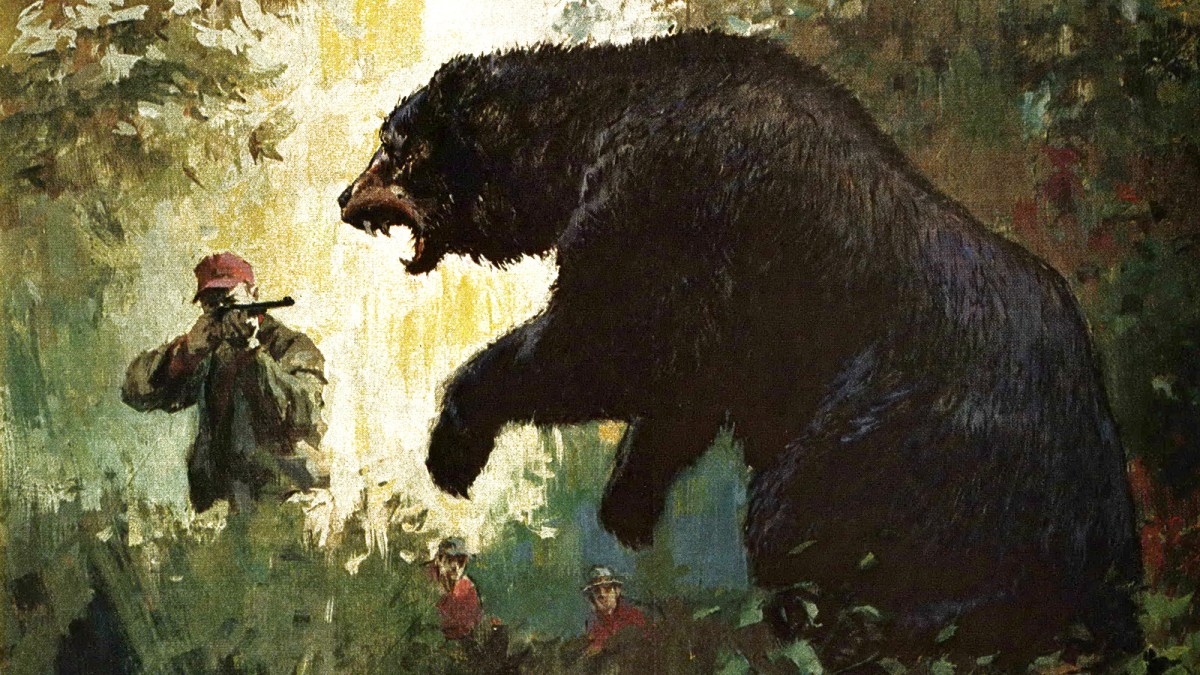
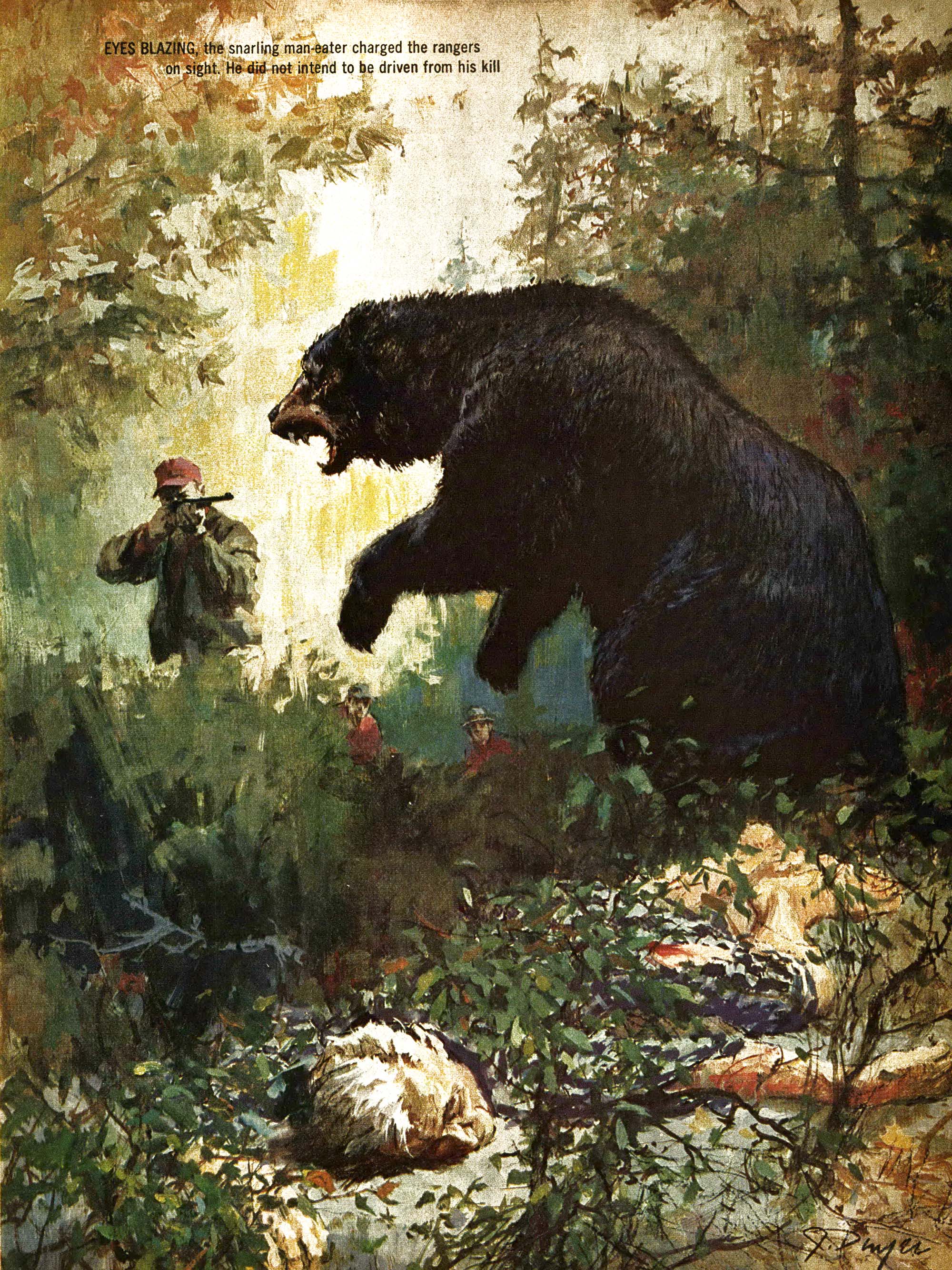
Punstel took the rifle, and the group moved warily in on the bear. There was no need to hunt for him. They found him standing over his kill, with a paw on the body. He had not fed, perhaps because of the presence of Punstel and Phillips nearby, but he showed plainly that he did not intend to be driven off. At the first sound of the men approaching, he greeted them with growls and squeals. The instant they came within sight, he started an angry rush at them, eyes blazing, face wrinkled in a snarl that left no doubt of his intent.
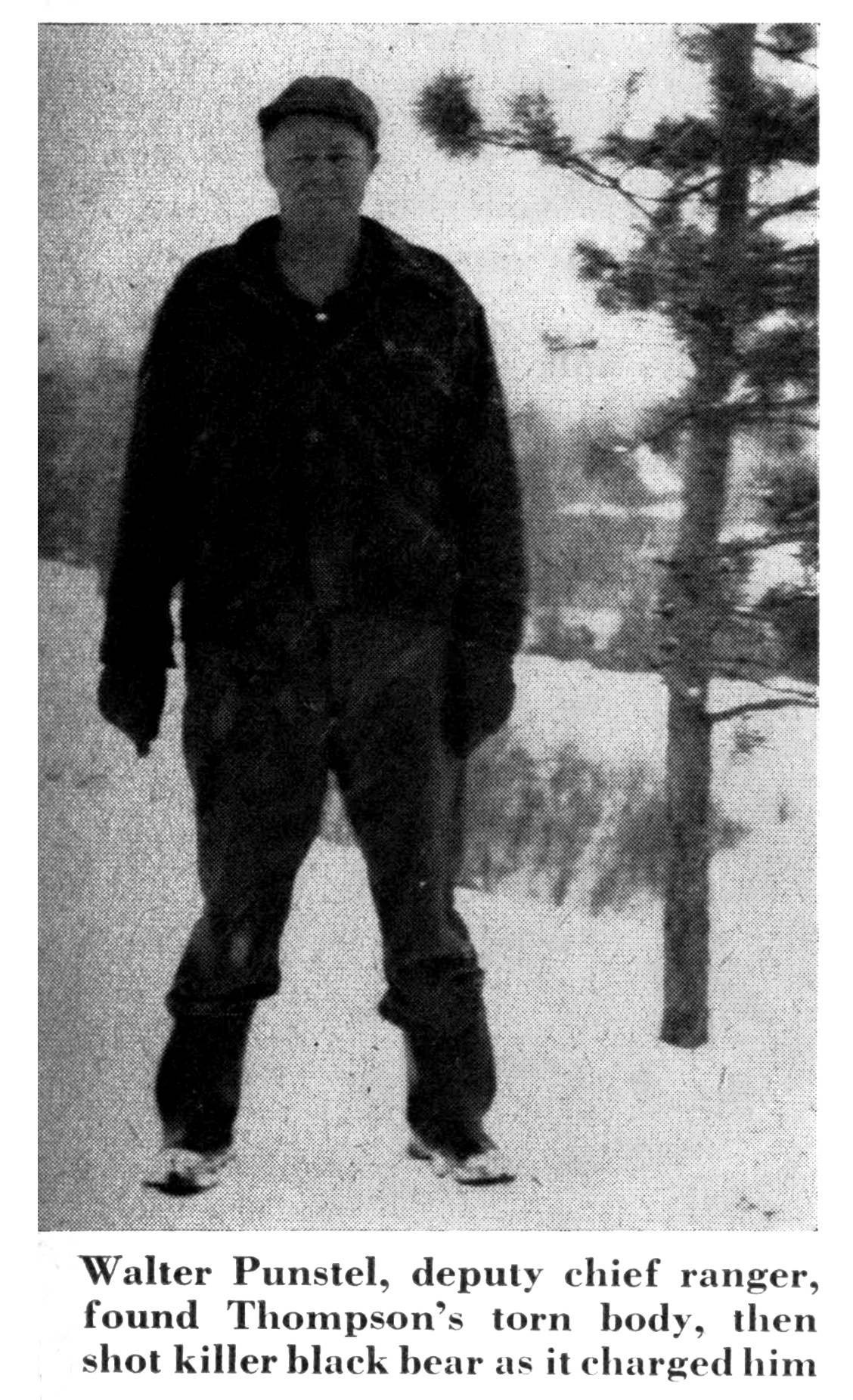
Punstel gave him no chance to finish it; he slammed in a shot at about 10 yards. It broke the bear’s back, and he went down, thrashing and bawling. The ranger ran up to within five feet and ended the affair with three more shots in the head and neck.
To the surprise of everyone, the man-eater turned out to be only a medium-size black, weighing a little over 200 pounds. He was thin and in poor condition from the shortage of summer food, and one front paw had been injured in a trap at some previous time and healed. Otherwise the animal appeared to be perfectly healthy and normal in every way.
Read Next: I Killed the Last Grizzly in Colorado When It Attacked Me
He was not big, but he was big enough to write one more authentic case of unprovoked attack and actual man-eating into the puzzling and contradictory records of black-bear behavior — and to prove once again the wisdom of the old adage, “Never trust a bear.”
Read the full article here