
Flagship compound bows are a real challenge to test. So much of field performance comes down to “shootability” which has a lot of subjective elements. What feels perfect to one archer might feel awkward to another. That’s why we panel score all of the bows in our annual bow test. We also shoot hundreds of arrows for scored groups at 50 yards. We do the same with crossbows. And we put all of the archery accessories we review through equally rigorous testing protocols.
This is all to say that we’re pretty proud of our archery gear testing. And based on all of that shooting and evaluating we’ve found a handful of products that outshine the rest.
These selections are part of our larger Field Tested Program, which highlights the best gear from 2025. (Side note: this round up doesn’t include products that were launched late this year, since we haven’t had time to test them against their peers).
The Real Grit is our retail partner for the 2025 Field Tested Awards. Buying through the links provided helps support Outdoor Life.
Best Bows & Crossbows
PSE Mach 33
See It
Key Features
-
Picatinny sight mount -
Hamskea COR and QAD Integrate arrow rest mount -
EZ.220 cam spacer -
Dead Frequency Carbon rise -
Full Draw Stability: Adds .43-inches of brace height at full draw for reduced torque
When the scoring was finalized and all the groups measured in our 2025 bow test, I asked each tester what bow they would buy with an unlimited budget. They all said the PSE Mach 33. We still had to input the results into the spreadsheet, but it didn’t take a crystal ball to know who would win.
The PSE Mach 33 DS had the lowest score for innovation and a median score for features. Yet, its shooting characteristics pushed it to the top of the five-foot test. The PSE Decree squeaked ahead of the Mach 33 in accuracy and both bows had substantially smaller group averages than the rest of the field.
Last year, the Mach 30 DS blew us away by being a bow that on paper seems unforgiving, but consistently shot small groups. The key to PSE’s two year accuracy winning streak is Full Draw Stability, which increases dynamic brace height. The Mach 33 has a 6.625-inch brace height, but at full draw, its brace height is just over 7 inches. Basically that means the bow is going to hold steadier and be more forgiving.
In addition to Full Draw Stability, the PSE bows seem to have cracked the code on riser-to-limb length ratio, pivot point location, riser rigidity, repeatable grip, and an overall torque-free platform. The result is a bow that is easy to hold on target and doesn’t punish you as much for making small mistakes.
The archers were also more comfortable shooting the Mach 33 versus other bows because of its smooth draw and nice back wall. It was the top scorer in both those categories. The Mach 33 feels much lighter than its actual draw weight. You can see from its draw force curve that it slowly builds up to the peak weight, maintains peak weight through the middle of the draw, and then slowly drops down in draw weight until you hit the wall. You’d typically expect a bow with that type of draw cycle to be slow, but the Mach 33 was still fast at 282 fps with a 395-grain arrow.
My initial tuning and set up of the Mach 33 was very straightforward. The bow shot a bullet hole with a 13/16 inch center shot, even cam timing, and a level nocking point. If you wanted to push tuning beyond a basic paper tune or your arrow spine is less than ideal, you can move the cams using the EZ.220 system. It’s easy to use, but not as simple as the Bowtech, Elite, Darton, or Mathews tuning features.
First, you’ll have to buy a tool and spacer kit (costs $60). Then you’ll press the bow and use the tool to swap the shims. It’s an improvement over previous methods for moving cams that required you to remove the axle, find the e-clip that shot into orbit, and make sure you put everything back together properly.
Carbon bows have crept up in price and they’re all around $2,000 this year. Some manufacturers are charging those high prices and their risers aren’t made in the USA. However, the PSE carbon risers are hand made in the USA, so while they’re expensive, I don’t think the prices are out of line.
The Mach 33 DS is a light carbon bow that’s easy to pack into mountains. It has a smooth draw, so you can easily get it back during a frigid sit in a deer stand. It has very little handshock, which makes it fun to shoot all summer. And it has unbeatable forgiveness, so when your heart is in your throat, you can still drop an arrow right behind the crease at 40 yards. Those are all things the test team wants in a hunting bow and it’s why the Mach 33 DS is our 2025 Editor’s Choice winner.
Best Value Compound Bow: Bear Adapt 2 HP

Buy at The Real Grit
Buy at Outdoor America
Specs
-
Bare Bow Price:
$550 -
Package Price:
$650 -
+ Package Price:
$850 -
Draw Weight:
45-60lbs or 55-70lbs -
Color:
Mossy Oak Bottomland or Throwback Green -
Draw Length:
27 to 32 inches -
Axle to Axle:
31 inches -
Let-Off:
80%
What if I told you you could have a compound bow that shoots over 320 fps, has several flagship features, shoots tight groups at 50 yards, and costs less than $600?
You’d say I’m crazy, right?
Meet the Bear Adapt 2 HP, which was launched in August 2025, just in time for the fall hunting seasons. This latest collaboration between the iconic Bear Archery and the popular, run-and-gun guys from The Hunting Public is a screaming fast, no-nonsense bow that outperforms its price tag by a mile.
For my review, I borrowed a 55-70-pound Bear Adapt 2 HP with the RTH Plus package from Lancaster Archery Supply. After building the bow with the Trophy Ridge accessories, I headed to the range. Two shots through paper showed a slight nock-right tear, so I went to the bow press, put half a twist in the right yoke, and took a half twist out of the left. The next shot through paper was a perfect bullet hole. The tuning process took all of about 5 minutes.
Next, I went to the Garmin Xero C1 chronograph. The bow was set to a 30-inch draw length, and a handheld scale showed the weight was 70.6 pounds. The test arrow was an Easton Sonic 6.0 that weighed exactly 350 grains. The parameters Bear would have used for deriving the bow’s 330 fps speed rating would have been 70-pound draw weight, 30-inch draw length, shooting a 350-grain arrow. So we nearly matched those specifications.
My speed test produced a reading through the Garmin chronograph of 325 fps. So we were just 5 fps off the rating. In my book, that’s a good result. With last year’s Bear Adapt 2, I got 294.8 fps, matched to Bear’s rating of 320 fps. That’s why I said this year’s bow gained 30 fps over last year’s. That’s a huge gain in performance. And 325 fps for a bow that costs under $600 is insane.
But how does it shoot?
The draw cycle on the Adapt 2 HP is noticeably stiffer than that of the Adapt 2. That’s 100 percent expected, given that Bear switched from a single-cam system to a hybrid cam. But while the new bow’s draw is stiffer, that doesn’t mean it’s harsh. It’s not. It just takes a little more effort to get the cams moving.
The cam rollover into the valley is noticeable, though not abrupt. And the valley is deep, which is critical for bowhunters — like the Hunting Public guys — who might have to hold at full draw for a bit before a clear shot is offered. The back wall is a bit soft compared to flagship bows, but as long as you keep pulling into it, you can hold steady at full draw.
At the shot, you can feel a slight thump in your hand. It’s subtle, but it’s there. After five or six shots, I didn’t really notice it again.
There is some noise from the bow at the shot, but I would say it’s a quiet bow before I’d say it’s a loud bow. Are there quieter bows on the market? Yes. But again, the noise isn’t problematic.
Whenever bowhunters today complain about the noise produced by current compound bows, I think back to the Browning, High Country, and Golden Eagle bows I started hunting with in the 1990s. I killed a lot of whitetails with those bows and they were infinitely louder than anything on the market today.
For me, the true test of a bow’s performance is seeing how well I can shoot it at 50 yards. That distance is longer than any shot I’d expect to take at a whitetail, and longer than most shots I’d expect to take at any other big game. Does it hold on my aiming spot well? Do my arrows hit behind the pin? How tight are my arrow groups? If the results of all those tests are positive, then the bow does everything I need it to do in the field.
The Adapt 2 HP performed well on the range. It was a bit windy the day I shot it, but it aimed well at the elk target I was shooting at. My arrows hit consistently behind my sight pin, and the groups were one-hand tight at 50 yards. That is, I could get one hand around all of my arrows in the target. And again, this was with a completely rigged bow that sells for $849.
Best Crossbow: Tenpoint Turbo X
Buy at Outdoor America
Buy at The Real Grit
Key Features
-
Length: 33.25 inche -
Width Uncocked: 13 inche -
Weight: 6.8 pound -
Price: $1,350
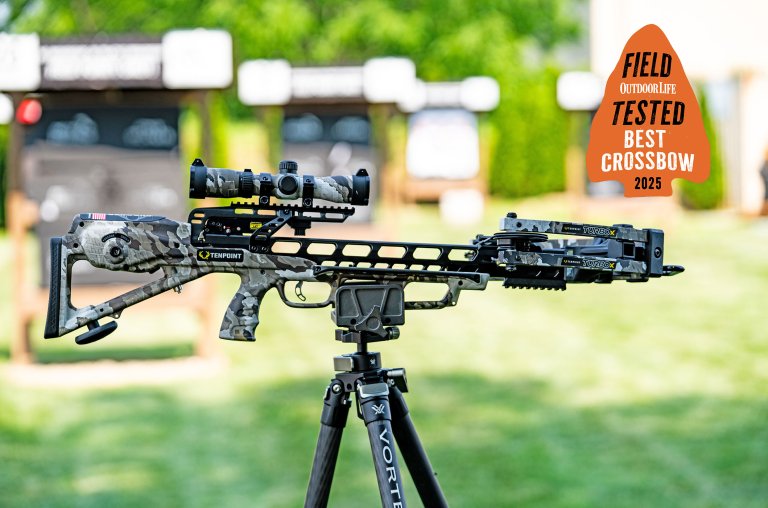
The TenPoint Turbo X was the most accurate crossbow we tested this year. It’s also $870 cheaper than the second most accurate crossbow and $1,200 less than the fastest crossbow. It was one of the easiest to cock and decock and it shot very well in all field positions. When you add up those factors and our score sheets, we couldn’t deny the Turbo X as the 2025 editor’s choice winner.
Turbo X shot a 1.23-inch group average out of four, three-shot groups at 50 yards. While the bench shooting was impressive, the crossbow was far from done showing off. Horner shot the crossbow off-hand extensively and printed several 3-inch groups at 50. He also stretched it out to 85 yards off-hand, and his group was under 8 inches.
Over the years of testing crossbows, I’ve learned that some are sensitive to shooter input. For example, if you pull the stock tightly into your shoulder on one shot and use a relaxed grip on the next, the arrows hit in different places. The Turbo X maintained the same point of impact for two shooters on the bench, offhand, and off a tripod.
What about broadheads? We tested that too. At 40 yards, a G5 DeadMeat hit perfectly with the field point. A Muzzy Trocar Crossbow Broadhead, hit about 3-inches low. We also shot a TenPoint Evo-X as well, and it landed more than 8 inches from the field point’s impact point. We were hoping the Turbo X would shoot any fixed blade given its relatively low speed and high-accuracy potential. But if you’re planning on shooting fixed heads, we recommend trying a few different designs to see what flies best.
The Turbo X uses TenPoint’s ACUslide cocking mechanism, it’s also used on the $2,650 Flatline 460. It’s a very easy system to use. You can go from unloaded to ready to fire in under 30 seconds. We think the cocking effort is low enough that a young hunter can crank it back on their own.
The Turbo X isn’t the fastest crossbow by any means. We chronographed it at 415 fps with a 400-grain arrow and measured its drop from 20 to 40 yards at 6.5 inches. So while it’s about 100 fps slower than the TenPoint TRX 515, it will still give you plenty of forgiveness in range estimation. One benefit of a slower crossbow is that the strings don’t wear out as quickly as their higher fps counterparts.
The main disadvantage of the Turbo X is that it’s a long crossbow. It won’t be easy to maneuver in a ground blind or through thick brush. Another con is the scope rail isn’t made of metal like we see on more expensive crossbows.
Best Value Crossbow: Wicked Ridge M1
Buy at The Real Grit
Key Features
-
Length: 32 inche -
Width Uncocked: 14 inche -
Weight: 5.8 pound -
Price: $90
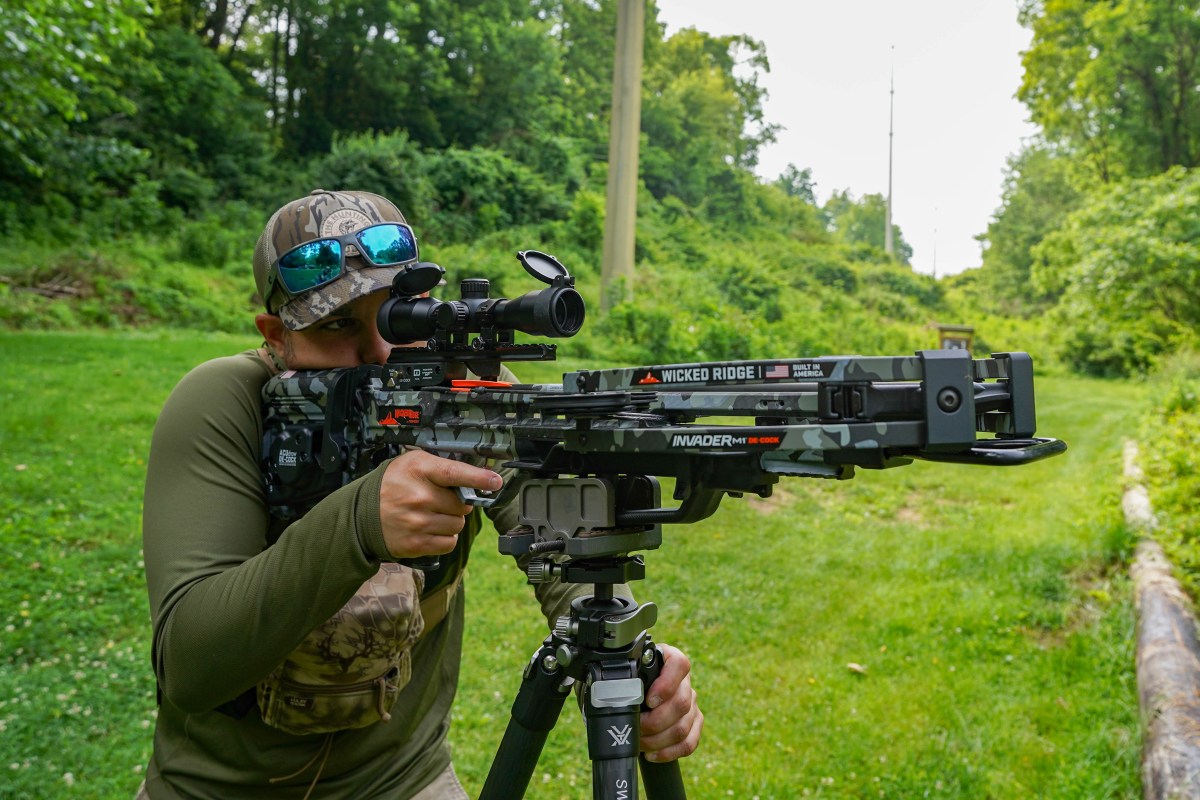
Throughout our many crossbow tests, we’ve reviewed a bunch of crossbows under $1,000 and usually the main differentiator is their ease of loading and build quality. This year was no different. The top two budget crossbows, the Barnett XP405 and the Wicked Ridge Invader M1, were equally accurate but the Invader M1 was far easier to cock due to its integrated cocking mechanism. The version of the Invader M1 we tested also has the new de-cock feature.
The Invader M1 De-Cock has TenPoint’s ACUdraw De-Cock built into it. It uses a sled, which is stored neatly on the butt stock, to hook onto the string. The cocking handle, stored alongside the forend, inserts into the stock and winds the string back. The bow’s draw weight is 190 pounds, but the force required to turn the handle is only 5 pounds. It was one of the easiest crossbows we tested in terms of cocking effort. Other than the safety clicking on, the whole operation is silent and can be done in a treestand with little movement. De-cocking the crossbow is just as easy and silent.
The Invader M1 De-Cock is an all-around great bow for the money. If you’re interested in picking one up though, you’ll have to navigate three variations of the Invader M1. The Invader M1 De-Cock with the ACUdraw 50 Sled De-Cock costs $700, but it’s a manual cocking crossbow. The mechanism is still integrated into the crossbow, but rather than cranking the string back you’ll pull it back with the two attached handles. You’ll also manually let the string down. The ACUdraw Crank De-Cock is the version we tested, which costs $900 and has the crank to pull the string back or forward. The standard Invader M1 costs $750 and is the same crossbow we tested minus the de-cocking feature.
More of the Best Archery Gear from Our Tests
Buy at The Real Grit
Buy at Outdoor America
Pros
- Ultralight
- Micro-diameter
- Unmatched consistency
- Has compatible components that allow for building lightweight, fast arrows, or high-FOC bone crunchers
Cons
- Not the very best option for shooting long distances
Key Features
-
.001 and .003 straightness versions -
Spines:
200, 250, 300, 340, 400, and 500 -
Compenents:
Halfouts or HIT inserts -
Made in USA -
Inside Diameter:
.204 inch -
Weight (340 spine):
7.4 grains per inch -
Price (.003):
$110 (6 fletched arrows), $170 (dozen shafts)
Easton finally built the ultimate arrow when they came out with the 5.0 late last year. Due to incredible demand, bowhunters are just starting to get them in their hands now.
The 5.0 is more than just an arrow – it’s an arrow system because you can build it the way you want. To start, it’s a 5mm arrow built using Easton’s Acu-Carbon process, which was made famous by the Axis series of arrows. Instead of rolling the carbon around a mandril to form the shaft, Easton weaves the carbon over the mandril in a continuous process.
This construction minimizes the effect of a “high spine,” which is a line of stiffer carbon running the length of the arrow commonly found when the carbon is rolled. Ideally, you want to identify that high spine and make sure it’s facing up when you load the arrow to shoot. Because of the 5.0’s construction, that orientation is less critical than it is with other shafts. Also, the continuous weave means the first arrow off the line will match the 387,000th arrow off the line, and every one in between. Buy a dozen this year, and the weights and straightness tolerances will match the dozen you buy three years from now.
Where Easton hit the 5.0 out of the park is in making the shaft super light. The 300-spine 5.0 weighs 8.4 grains per inch. That’s not the lightest arrow on the market, but it’s pretty light. So if you’re looking for a flat-shooting arrow, you can build the 5.0 to be super light. Put in the aluminum HIT inserts and some 2.5-inch fletchings, and you’ve got a real speed burner.
Easton has a series of components made for the 5.0 that allow you to add weight to the front to make the arrow hit like a sledgehammer while maintaining long-range accuracy. You can build a 5.0 arrow with 15 percent FOC that’s still a viable, long-range arrow, as opposed to one that weighs 700 grains.
Easton has a series of components that allow you to build the 5.0 arrow you want. There are inserts that weigh 16 grains, 25 grains, 50 grains, and 75 grains. You decide how much weight you want in the front of your arrow to get the performance you’re looking for.
Along with that, Easton offers the 5.0 in 200, 250, 300, 340, 400 and 500 spines. The varied spine offerings are critical for building high-FOC arrows that will still fly well. One of the common mistakes bowhunters make in building arrows with high FOC, is they don’t consider the effect that added weight has on the arrow spine.
The more weight you add to the front of an arrow, the weaker the spine gets. So a hunter shooting a 70-pound draw weight with a 29-inch arrow would want that arrow to be 300 spine with a 100-grain point. If the hunter adds 50-100 grains to the front of that arrow, the correct spine for solid arrow performance is going to change to 250 or even 200. But bowhunters don’t realize that, so they end up sticking with the now-weakened 300, which likely won’t always fly well – especially as the shooting distance increases.
Buy at The Real Grit
Buy at Outdoor America
Pros
- Great value
- Bright and easy to see
Key Features
-
Factory crested and fletched -
.244 diameter -
High-modulus carbon -
Six pack of arrows at $70
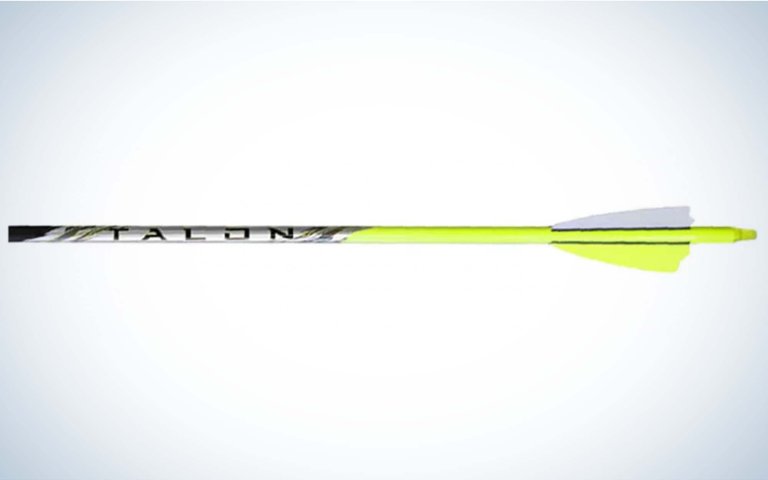
The Black Eagle Talon V2 Fletched .003 arrows represent the ultimate in convenience, simplicity, and affordability. This is a six pack of factory crested and pre-fletched arrows, so all the customer has to do upon buying a pack is to have the arrows cut to length and then glue in the included inserts. No arrow wraps are needed. No fletching required. And the pack sells for just $70. That’s a bargain.
Often times with these factory-fletched six packs, there is no cresting – a bright paint or sticker that serves the same purpose as a wrap – and the fletchings are kind of cheap. The Talon V2 Fletched .003 arrows include neon-yellow cresting and 2.5-inch Q2i shield cut fletchings. These are high-quality, durable fletchings that will work well for shooting field points or fixed-blade broadheads.
At the factory, Black Eagle “super sorts” these arrows to make sure that each arrow within a given pack weighs within 1 grain of all the others and that the spines and straightness tolerances are also equally precise. That’s the pinnacle of consistency, and it’s rare among lower-priced arrows.
We picked the Talons with .003 straightness, which isn’t the tightest tolerance, but it’s pretty good. Most bowhunters aren’t likely to notice an issue where straightness variances affect performance. And the .003 six pack of this arrow is $20 cheaper than the .001 version.
Made of high-modulus carbon, the .244-diameter Talons are available in 300, 350, 400 and 500 spines. That will cover a broad spectrum of draw lengths and weights.
Buy at The Real Grit
Buy at Outdoor America
Pros
- Ultralight and compact
- Comfortable and easy to use
- High visibility pins
- Solidly built
Cons
- Although it costs less than other sights in its class, it is still pricey
- New on the market this year, it seems to be difficult to find one to buy
Key Features
-
The main drive wheel is big and has a rubber exterior for good traction -
Scope houses bright pins with a rheostat cover that allows for dimming those pins in bright conditions -
Sight scale indicator(s) feature slots so they can be adjusted up and down to get them exactly where they’re needed -
Sight tape receiver is angled back toward the shooter for increased visibility -
Adjustable elevation stop can be set where needed so you can have a hard stop wherever you zero your sight
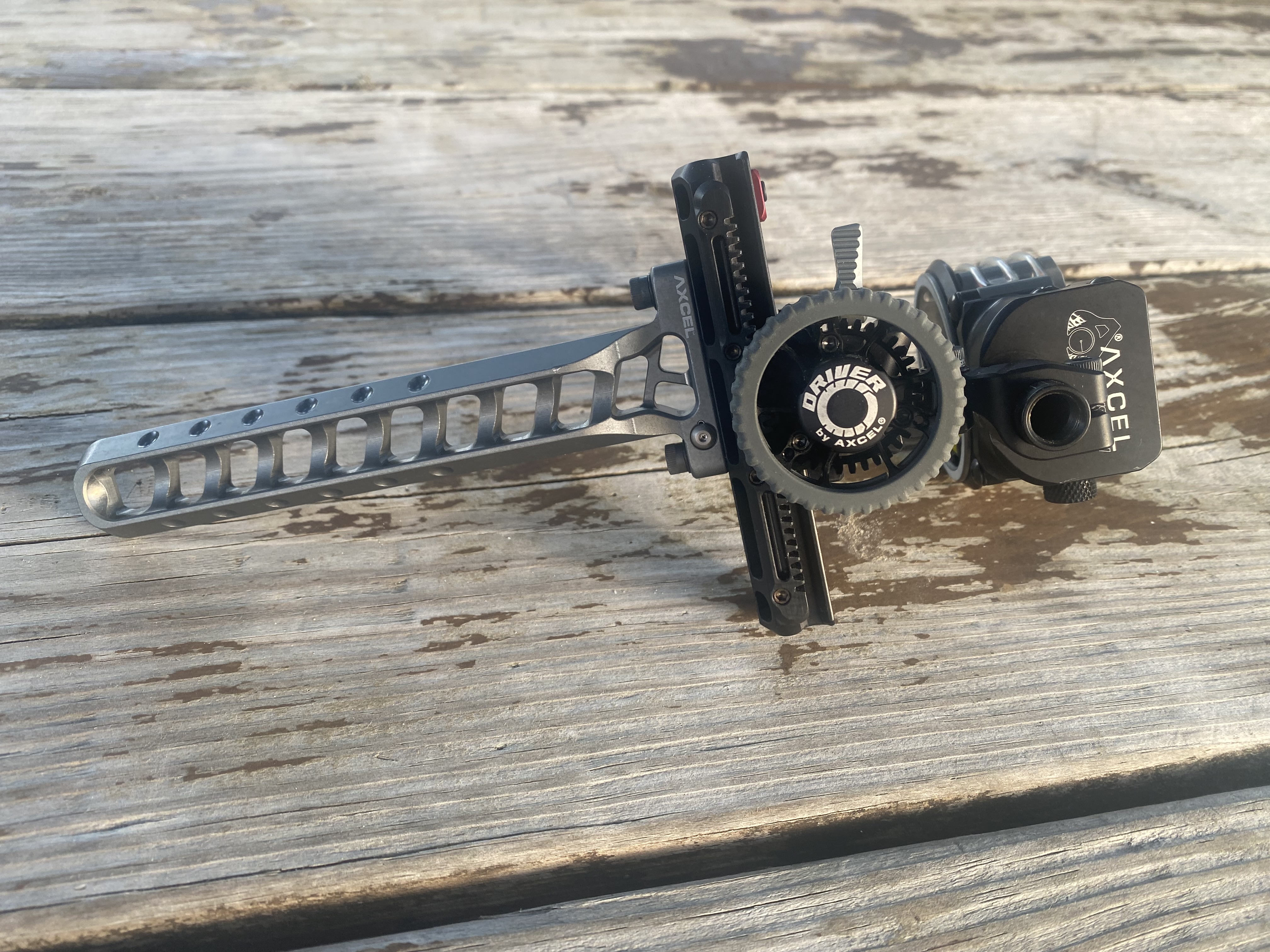
The Axcel Driver is the sight that feels like Axcel saw everything that was coming out on the market, so their engineers rolled up their sleeves, told everyone to stand back, and said, “Hold my beer.” The Landslyde Axcel introduced just a few years ago was a huge hit among bowhunters, and the Driver is basically an improved Landslyde.
The Driver is a slider that comes in just about any configuration you can imagine – dovetail, Bridge-Lock, Picatinny mounting options, single or double vertical pins, three or five horizontal pins, and three different scope options. You name it, they’ve got it.
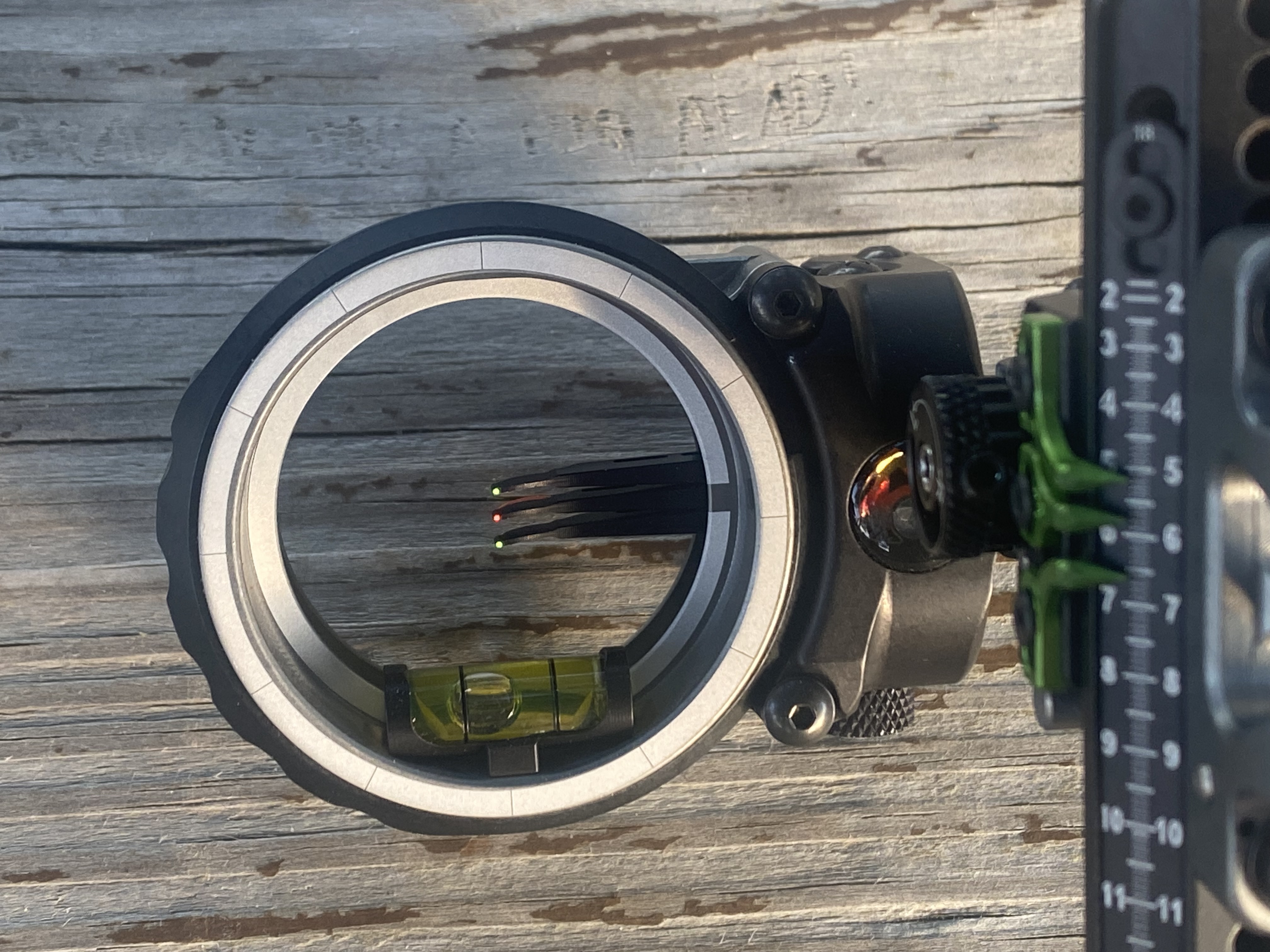
The wheel is bigger than it was on the Landslyde and it has a rubber “tire” on the outside that’s great for traction in your hand. The locking bar, which locks the scope in place, is conveniently located on top of the sight, right about where your index finger would be when you go to adjust the sight. And it is an absolute lock. When you lock it down, the scope does not move.
Axcel took out a lot of the guts from the Landslyde to lighten the Driver, without sacrificing features or stability. The Bridge-Lock version with a 3-pin Accustat scope weighed just 8.5 ounces. One of the features that was removed, but is offered back in another way, is the typical second axis adjustment was eliminated. The second axis adjustment typically is a set of two screws that hold a bar in place. Loosening the screws allows you to pivot the scope up and down to make sure that it’s level.
With the Driver, Axcel machined the scope receiver so that the scope is perfectly perpendicular to the vertical, elevation bar. By doing that, now the user can level both the first and second axes simply by adjusting the first axis. The first axis adjustment is a set of two screws connecting the vertical elevation bar to the sight’s mounting system – pic rail, dovetail, Bridge-Lock bar. That’s the most important one on a slider, because you need to know the elevation bar is moving straight up and down, or else you’ll have left-right issues as you adjust the sight for different yardages.
Each sight includes 1-3 sight scale indicators that can easily be adjusted to meet the calibration of your sight. And you’ll get some metal sight tapes and dozens of stick-on paper sight tapes with every sight.
Axcel employs some of the brightest fibers on the market for its pins. There is the option to mount a light on any of the scopes, but I’ve found that, except when I’m hunting from a blind, I’ve never needed a light to see the pins on an Axcel hunting sight. They gather light in ever the lowest-light situation. A blind is different because you’re sitting in the dark shooting into the light, which makes unlighted pins all look black.
Read the full article here