
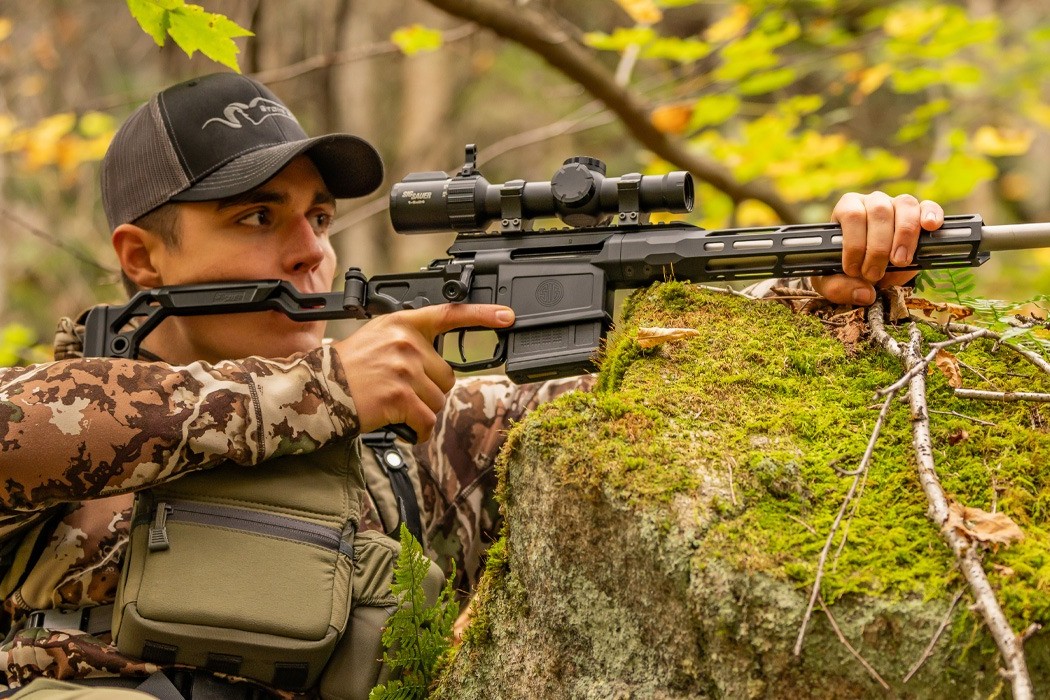
When Sig Sauer released the CROSS TRAX, I knew I had to get my hands on one. The promise was to build a practical hunting rifle you can actually hike with all day. I tested mine and here’s what I’ve learned about this Sig hunting rifle.
How the Sig Cross Trax is build
To build Cross Trax, Sig Sauer took its original Cross rifle and pulled out everything that wasn’t mission-critical for a pack rifle. The Trax sports a skeletonized 11.5″ handguard that wraps a 16″ barrel and boasts a minimalist stock that folds tight. A Rattler grip replaces the standard furniture.
As a result, you get a compact bolt action rifle that weighs just over 6 pounds in 308 Win (that’s about half a pound lighter than the original Cross).
The receiver is monolithic, meaning no bedding, no action screws and fewer places for accuracy to degrade under field conditions.
The 3 lug bolt throws just 60 degrees, which keeps scope mounting low and cycling fast.
The Trax is available in 308 Win and 243 Win calibers.
How it handles and best applications
The Cross Trax sure isn’t built for benchrest competitions or high-volume shooting on the range. If you plan to shoot 50 rounds prone off a bipod, you’re going to have a rough time. The minimalist stock, small contact patch at your shoulder, and light overall weight means 308 recoil gets your attention fast.
Who the rifle was purpose-built for are stalk hunters who might hike for several hours through backcountry. Carrying the Trax in hand or folded into a ruck is near effortless.
When you bring it up, the rifle mounts instinctively. From kneeling, standing or improvised positions, handling feels natural and quick.
The pistol grip gives you control options a traditional stock can’t match, especially when you’re bracing against a tree or shooting off trekking poles. Though not everyone likes the Rattler grip, many switch it for a standard AR style.
Accuracy and ammo selection
Testing with Sig’s own 308 match loads consistently produced sub-MOA groups at 100 yards. Best 3-shot clusters with SIG 168gr Match Grade OTM rounds landed in the 0.6″ – 0.75″ range. With SIG hunting ammo, you’re looking at groups between 1.0″ and 1.25″. That’s more than adequate for ethical shots on deer-sized game out to reasonable distances.
I also read that other reviewers had good results with Nosler 175gr BTHP and Black Hills 178gr ELDX.
So while it isn’t a half-MOA precision monster, the Sig Cross Trex shoots straight enough that shooter error, not rifle capability, becomes the limiting factor for hunting scenarios. And that’s exactly where the accuracy bar should sit for a mountain rifle.
A few words on recoil
If you’re used to heavier precision rigs with adjustable stocks and plush recoil pads, the Trax can feel brutal. This makes sense since – the minimalist chassis trades recoil management for packability. Definitely something to keep in mind when planning to burn through boxes of ammunition verifying your zero or practicing field positions.
So sure I’d want more gun extended prone sessions or high round counts. But for actual hunting, when I’m covering miles on foot and might fire three careful shots all day? To me, the trade-off makes sense.
Adding a suppressor will help with the recoil but will erode the core selling point – the light weight of the rig.
Value
At around $1,500 for the rifle, the Trax sits below boutique ultralights but above budget bolt guns. You’re paying for that folding chassis, monolithic receiver and Sig Sauer’s engineering. Whether that’s “worth it” depends heavily on whether you’ll actually use those features. All in all, the Trax isn’t trying to be an all-arounder; it’s purpose-built for hunters who require mobility for spot-and-stalking in mountains or hiking into remote areas. Know what you’re getting, accept the trade-offs and this rifle will reward you with performance few rifles can match out of the box.
Read the full article here