
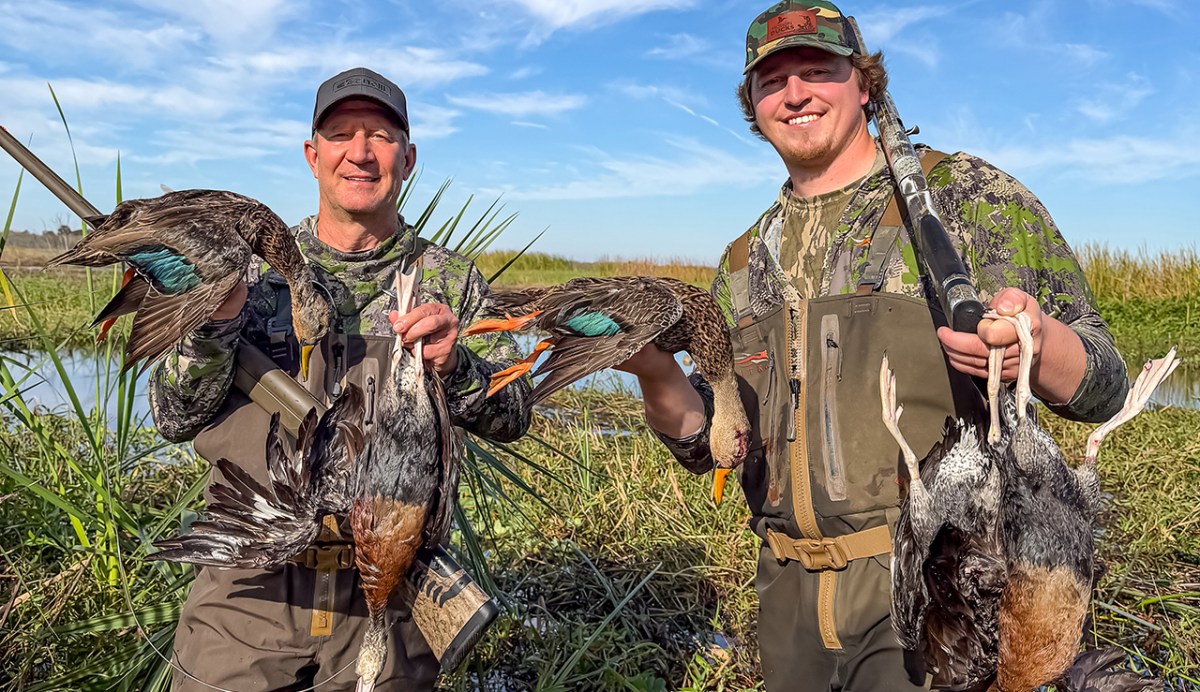
A flock of black-bellied whistling ducks circled the decoys, twice. They flared just as they were about to drop their long, lanky legs for a landing. My buddy Austin Crowson and I just watched as they banked away and faded into the Florida swamp.
Minutes later a flock of blue-winged teal landed in the decoys. A hawk chased them out, nearly plucking one from the sky. Another pair of teal landed, followed by a flock of more than 20 that turned hard into the small decoy spread. We didn’t fire a shot.
Four pairs of mottled ducks flew overhead, all within range. One pair locked up on the decoys. We could have shot our one bird limit with ease, but we didn’t. Crowson and I left the marsh later that morning, having not fired a shot. On this, the final morning of our three day hunt, we were looking for just one bird each, a fulvous whistling duck.
“These things are a real unicorn,” confirmed KC Leitner, owner and operator of River Oak Outfitters, based out of Okeechobee, Florida. “I know it can be frustrating, passing all those ducks, but on public land and with all the pressure we saw this weekend, you did the right thing. Shoot one of the species you already have and it could certainly spook a fulvous if it was near; I’ve seen that a lot. You guys approached this hunt for one duck like a deer hunt, and that’s what it takes to get these elusive birds.”
Leitner’s words were reassuring. That’s hunting. But still, I’m not normally one to pass up decoying ducks.
The 41
Three seasons ago I was hunting sandhill cranes in Texas with the crew of Spec Ops Waterfowl. It was my first crane hunt.
“So, how close are ya to the 41?” asked founder and owner, Luke Bledsoe.
“The 41?” I came back. Everyone in the blind laughed. I was serious.
“You know, the 41 species of waterfowl.”
“Uh, oh, yeah, that 41,” I replied in a cracking voice. I was glad it was dark and they couldn’t see my blushing face. But I started naming the birds I’d taken over the decades.
“Holy smokes, you only have six left,” Bledsoe said with excitement. “And you’re going to check off one of those today.”
I shot a limit of cranes pretty quickly, then sat back and enjoyed watching these pterodactyls of the sky drop into the decoys. It was a sight I’d yearned to see since I was a boy. It was more captivating than I imagined. Now I only needed five species of the 41. But I wasn’t set on hunting any of them, not at that point.
If you are like I was and are totally unaware of “the 41,” here’s the list of huntable North American Waterfowl species that are counted:
Puddle Ducks
- Mallard
- Pintail
- American Wigeon
- Gadwall
- Northern Shoveler
- Green-winged Teal
- Blue-winged Teal
- Cinnamon Teal
- Wood Duck
- Black Duck
- Mottled Duck
- Black Bellied Whistling Duck
- Fulvous Whistling Tree Duck
Diver Ducks and Mergansers
- Canvasback
- Redhead
- Greater Scaup
- Lesser Scaup
- Common Goldeneye
- Barrows Goldeneye
- Ruddy Duck
- Bufflehead
- Ring-necked Duck
- Hooded Merganser
- Common Merganser
- Red-breasted Merganser
Sea Ducks
- King Eider
- Common Eider
- Old Squaw (Long Tailed Duck)
- Harlequin Duck
- Common (Black) Scoter
- Surf Scoter
- White-winged Scoter
Geese, Swans and Cranes Division
- Tundra Swan
- Sandhill Crane
- Canada Goose
- Cackling Canada Goose
- Snow Goose
- Blue Goose
- Ross Goose
- White-fronted Goose (Specklebelly)
- Brant Goose
I’ve never been a slam guy, birds, big game or otherwise. But I do like having goals when hunting. Usually, when it comes to waterfowl hunting, the goal is to set decoys in a strategic way that fools birds. Or to see how few shots I can fire to secure a limit, or maybe just a brace. Sometimes the goal is to come away with two ducks, one for each of my dogs to retrieve. Other times the goal is to get my 85-year-old dad some good shooting. We love hunting together, and have our whole lives.
Chasing the Slam

Up to this point, the 38 species that I had taken had been simply through chance — and from hunting a lot all over the continent.
But once I had found out the slam existed, I have to admit that it became interesting to me. Not until last season when I traveled to North Carolina to hunt black ducks had I set out to specifically shoot a bird with the intent of ticking a species off the list of 41. I shot two black ducks in North Carolina, then a freak ice storm pushed birds out. That same storm resulted in canceled flights and also moved the whistling ducks out of Florida, so I cancelled the second leg of that trip where I’d hoped to shoot both whistlers. This season I returned to Florida with high hopes.
On the recent hunt in Florida, I had two goals. The first was to shoot a black-bellied whistling duck and a fulvous whistling duck.
As I sat for two and a half days in the Florida wetlands, I was struck by its beauty and unmatched birdlife. Parts of the marsh looked identical to where I’d hunted water buffalo in Australia’s Northern Territory. Other parts looked like where I’d photographed jaguar in Brazil’s Pantanal. Florida’s birdlife is unlike anything I’d ever seen in the world, and I’ve been to more than 40 countries. It was mesmerizing to sit back, watch, and listen to so many birds, some of which I’d never before encountered.
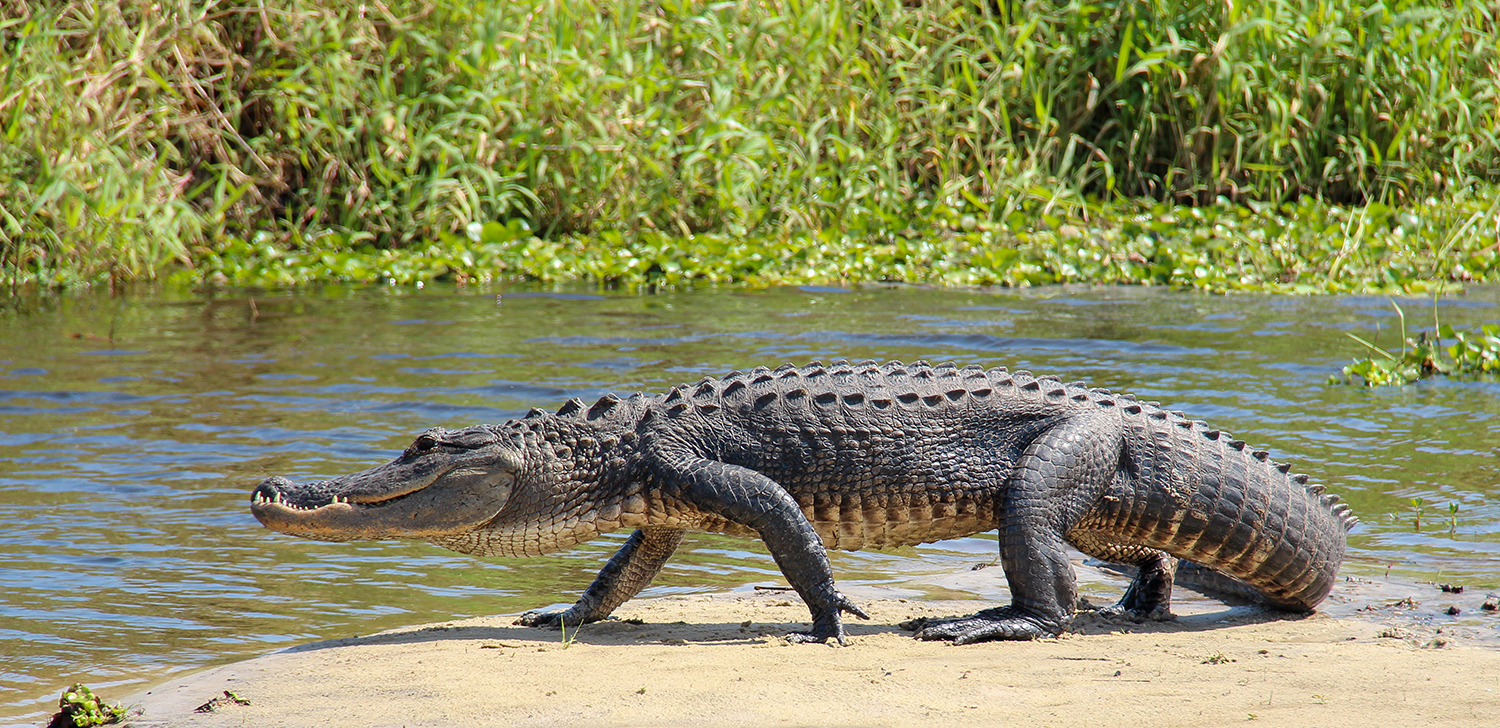
Two days before Florida, I was hunting in 33 degree temperatures at home. Florida’s weather was clear and sunny and in the low 80ºs. I had no dogs to manage. I could just relax and scan the sky for ducks, and watch the water for gators, which there was no shortage of. We were up at 3 each morning. We wrapped up the hunting at 5:30 p.m. Those long lazy days gave me time to reflect on many of the memorable duck hunts I’ve been blessed to enjoy over the decades.
Waterfowling Memories
As we get toward the end of our hunting careers, it’s natural to look back at the beginning. Some of my most memorable duck hunts happened when I was a kid, walking to the river behind our house after football practice. Here, I hunted wood ducks and mallards. Scoring on a prized bufflehead or ring-necked duck was a bonus back in the 1970s because they were something different. One time I came home with two redheads and felt like the luckiest kid in the world.
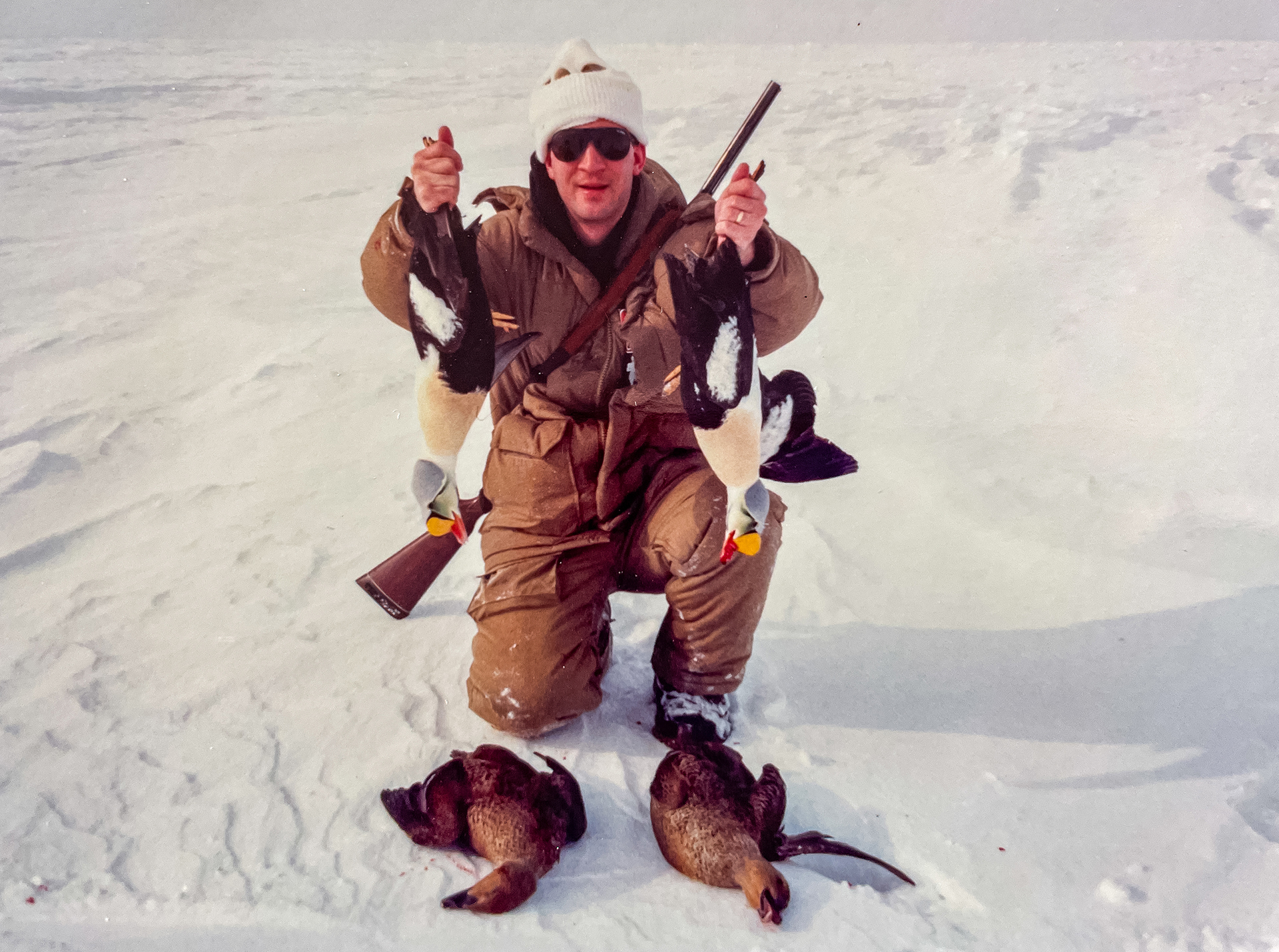
One of my favorite hunts took place in early September, 1991. I was a high school teacher in Point Lay, Alaska, far above the Arctic Circle. I was also the cross country coach of the K-12 school. We had a meet in Barrow, Alaska and I took my shotgun. A local man I had befriended a year prior loaned me his truck, told me to drive all the way out on Point Barrow — the farthest northern point in the United States.
“The wind will be good this afternoon, so go to where the spit narrows and sit there, the kings will fly right over you,” he said. It was my first king eider hunt. A single came right at me. I shot it and it splashed at my feet. It was a juvenile drake, ugly brown. I didn’t care. I’d dreamed of hunting these ducks my whole life. I had no idea when or how it would happen, but it certainly wasn’t how I’d envisioned. Little did I know I’d go on to shoot dozens of king and common eiders during my years of living in the high Arctic. We ate them, lots of them. I only had two birds mounted, a drake of each eider species.
Blue-Winged Teal
Three seasons ago I was hunting with some industry friends in Saskatchewan. I go on very few writer hunts as I prefer doing my own thing. But this was a good group and that was accentuated when I shot my first blue-winged teal, totally by chance.
“Nope, they’re all gone,” replied a guide when I asked if there were any blue wings still around, the minute we arrived in camp. Then, on the last day of the hunt we drove by a pond.
“What’s that!?” I hollered. (It wasn’t really a question, as I knew perfectly well they were blue-winged teal.) We were driving to set out a massive spread of snow goose decoys for an afternoon hunt, but I asked to sit and hunt the pond for blue-winged teal while everyone else chased snows. I didn’t want to shoot a teal then because it was part of some slam. It was simply a cool duck that I’d never had the chance to hunt before, and any sort of new hunting experience is exciting to me.
I’d never hunted blue-wings, never seen one during hunting season. It’s hard killing a species that’s nowhere near where you hunt (I live and do much of my hunting in Oregon). Before I knew it we were setting up a big A-frame blind for everyone to hunt the pond for ducks.
The first duck that came into the decoys was a lone blue-winged teal. Everyone called my name. Rafe Nielsen from Browning was sitting next to me and mumbled something about not missing. I shot. The little duck fell three feet from the blind. I beat the dog to it. Holding it, admiring its blue wings in the afternoon sun, I was beyond thrilled.
“Are you shaking?” Nielsen asked, smiling. “All the big game you’ve shot and you’re shaking over a teal. That’s awesome.”
Everyone cheered and congratulated me. It was a moment I’ll never forget, all thanks to a small, brown, hen teal.

Photo by Scott Haugen
Mottled Ducks
On day three of the crane hunt in Texas, we were done. The crew and hunters headed out. I stayed behind to help guide Drew Garcia round up decoys and the blind.
“Is that a flock of mallards going into that pond?” I pointed.
“Nope, mottled ducks,” Garcia responded. “Wait … you don’t have one do you?”
He smiled. Hurriedly, we tossed the crane decoys and panel blind into a trailer and took off walking across the field. Along the way, Garcia detailed the lay of the pond and where the ducks would likely be based on the wind direction.
“Once you reach the top edge, the birds will bunch up before they fly,” he whispered as we snuck closer. “Look for the biggest duck, that’ll be a drake, and make sure they’re separated before you shoot because you’re only allowed one mottled duck a day.”
The last 20-yards brought back so many boyhood memories of jumping ducks. My palms were sweaty. My heart raced. My finger was on the safety, ready to flick it off the moment I saw ducks. The birds were right where Garcia said they’d be. They flushed but took what seemed like forever to separate. When they did, I fired — and missed. The second shot folded a big bird.
“That’s a stud!” Garcia smiled as he pulled the striking duck from tall grass. “When was the last time you jump-shot a duck,” he asked. It had been 30 years or more, back in high school, since I felt the rush of a duck stalk. It felt good.
Geese
My first Ross’s and blue goose were birds to remember. Mostly because my dad was with me, as were my two dogs, Echo and Kona. We were in Saskatchewan on a spring snow goose hunt. Dad and I had shot lots of snows together over the years, but never a blue or a Ross’s goose. We each got both. Dad was in his late 70s at the time. It goes down as one of our most memorable father-son trips. We still talk about that one.
I’ve shot five cinnamon teal in my life, all in the valley near my home in Oregon’s Willamette Valley, where I hunt the most. All have come late in the season and all by surprise. The first two drakes were taken over 35 years ago. I didn’t shoot another one until two seasons ago. Last year I shot a drake and hen in one shot as they crossed into the decoys. Those unexpected moments are what keep us going to the marsh.
After the Texas hunt where a crane and mottled duck fell, my list went from six to four birds needed to complete the 41. The next year I drew a swan tag in Utah, where I hunted with good friends and tagged a dandy tundra bird. We also shot a lot of ducks on that trip, and I had the best green-winged teal hunt ever in the mud flats, laying in coffins. With the swan and black duck secured, the count dropped to two birds — the whistling ducks.
Trouble in the Swamp
At the suggestion of a friend, I gave KC Leitner a call. Leitner is a well-known outfitter and guide who was born and raised near Okeechobee. He’s hunted ducks his whole life. This was my second trip that targeted birds for the slam. I invited Crowson, my hunting partner from home. I hunt ducks with Crowson more than anyone. He’s pursuing the 41 too, but he’s not in a rush. He’s young. He was hoping to get four species with Leitner.
On opening morning, Leitner launched his airboat at 3:30 a.m. The fog was unusually thick and the going was slow. Leitner had planned on hunting a private pond on the late November season opener, but the birds had left the area. For the past few years they’d been using it like clockwork, but not this season. We went into the marsh with loads of other eager hunters. It was a typical public land opening morning that I’ve seen in other parts of the country.
By the end of the first hour, Crowson and I each had our first black-bellied duck. Crowson also shot his first mottled duck. We let the blue-wings pass, as our focus was on fulvous ducks.
That afternoon we relocated. “Fulvous come here to feed at night,” Leitner noted, as another guide, Colton, tossed out a couple dozen decoys and Crowson and I built a makeshift blind. “Since we’re early, you guys can shoot a blue wing or two, but after about 3, don’t fire a shot. You want it calm so the fulvous come in. We each shot a blue-winged teal. Not until 15 minutes after shooting light did the whistlers start pouring in. Black-bellies dominated, and there were more than enough fulvous to boost our spirits.
One the second morning, Colton took us to a distant marsh to hopefully intercept fulvous as they left a nighttime feeding area, for a roost site. We could have hunted another blind near where we were the day prior, but the amount of public pressure on opening weekend was high and intense. Leitner put a different group where we were going to hunt. They shot two fulvous. Crowson and I were quickly learning what fulvous hunting on public land was like, and it involved a lot of luck.
At 10:30 we joined Leitner. He dropped Crowson and I in a prime place where fulvous had been active during the day. Leitner never stops scouting. “If you guys are willing to sit, you have as good a chance here as any for a fulvous,” he told us.
The Sunday traffic was gone. You could hear every bird in the marsh. It was teeming with more varieties of birds than I’d ever seen. I loved it. Setting decoys, crafting a blind and getting ready to hunt together, Crowson and I were in our element. We agreed to not fire a shot unless a fulvous flew by. Two hours later, our plans unraveled.
In the distance we could hear an airboat running and shooting while clearly under power. They ended up coming our direction. We got video and photos of them, driving recklessly and shooting any birds they jumped. There were three of them: two women and one man. None of the birds they shot at were ducks. We contacted authorities. About that time, another airboat came roaring through our decoys, intent on catching the bad guys. They did. Words were exchanged. The airboat left after about 10 minutes. The bad guys’ airboat wouldn’t start. Three minutes later another group of hunters on a airboat caught up to them. More words were exchanged. I thought things might get ugly, but they didn’t.
The bad guys finally got their airboat started and as soon as they gained full power, they began shooting again. More than three boxes of shells were spent and more boats chased them, until finally then the authorities came. Four hours after the frustrating fiasco began, the marsh was once again calm. We figured we’d be lucky to see a duck, let alone a fulvous. An hour later, Crowson shot a stunning mottled duck. I fired one shot and dropped a drake blue-winged teal and a hen green-winged teal as they scissored into the decoys. No more ducks flew.
The End

On the third and final morning of the hunt, the marsh was silent when we arrived. Thirty minutes before shooting light, loads of fulvous ducks could be heard whistling overhead. Ten minutes before shooting light, they were gone. They were like ghosts, their black-whisped silhouettes smearing across the low-lit sky before vanishing.
Though we could have had a good morning shoot on teal and mottled ducks, Crowson and I restrained ourselves. We didn’t fire a shot for fear of botching an opportunity at a fulvous. That’s all we wanted, an opportunity. But it didn’t come.
For me, the Florida hunt was worth it just for the joy of riding in Leitner’s airboat and taking in the mind-boggling abundance of birdlife in strikingly beautiful wetlands. The experience felt more like a big game hunt. But at times, it wasn’t as enjoyable as I’d hoped, largely due to the pressure I put on myself. I often found myself getting caught up in checking the last box, rather than appreciating the beauty that was right in front of me.
Read Next: Tales of Spring Subsistence Hunting in the Arctic: Bot Fly Larva, Caribou Fetus, and Boiled Eiders
If anything, I learned that checking a final bird off a somewhat arbitrary list isn’t the driving reason behind why I duck hunt. But, I do like the travel and adventure that comes with chasing all variety of waterfowl species. Toss in an opportunity for fulvous ducks that sees my wife coming along for a post-hunt mini-vacation, or a hunt that offers the possibility of other birds or fish to be pursued, then yes, I would be in. For now, my joy lies in hunting with Dad, my two aging pudelpointers, Crowson and a few other friends. I covet each and every hunt and greatly appreciate the number and variety of ducks and geese we’re blessed to hunt near home, 30 species overall. When I die, I doubt the words, “He was one short!” will be etched into my tombstone. Not completing the list was a reminder to me that duck hunting isn’t about numbers. It’s about the joy of the hunt and spending time with friends, family, and good dogs.
Note: For signed copies of Scott Haugen’s many books, visit his website and follow his adventures on Instagram and Facebook.
Read the full article here