
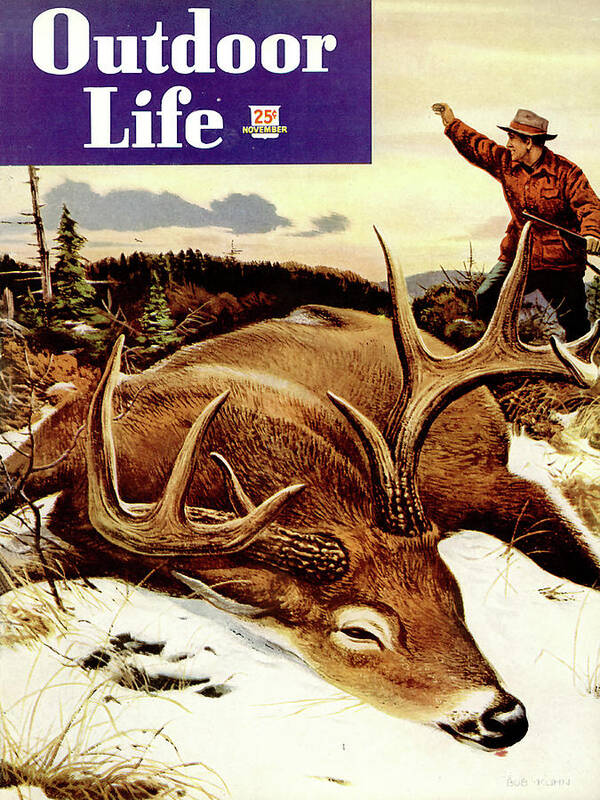
This story, “Luck of the Willeys,” appeared in the December 1967 issue of Outdoor Life.
Dawn of November 12, 1966, opening day of the Vermont deer season, found me hiking up the wooded side of Bigelow Mountain in northern Lamoille County. The usual anticipation and excitement of this red-letter day were fizzing around inside me but, as it turned out, what was in store for my companions and me was beyond my wildest hopes.
Deer hunting, among the Willey clan, is a family affair, and there are enough of us so that we had Bigelow Mountain pretty well surrounded that morning. My brother Don and my brother-in-law Bill Curtis Jr., along with his father, Bill Curtis Sr., were with me near Eden Lake. My father, Harold Willey Sr., and my brothers Dave and Dale were strung out to the south toward Wolcott.
To add a little background to our group, I’m 35 and married, and I have five children. I work on construction wherever there’s a bridge or a road to be built, so much of the time I’m only home on weekends to hunt and fish. My father, Harold Sr., 63, was a dairy farmer for many years. He’s retired now, but he works part-time at the fire tower on Belvidere Mountain.
My brother Dale, 27, drives a truck for the American Oil Company. He has two youngsters.
Brother Dave drives a truck for Redi-Mix Cement. He’s 24 and has one daughter. Don, 22, is unmarried. He works for United Aircraft in Hartford, Connecticut. Roger, my youngest brother, is 14 and a freshman at Newport High School.
Bill Curtis Sr., 63, is a mason, and Bill Curtis Jr., 31, is an electrician. Bill Jr. has a son and lives in Newport, Vermont. Dave lives in Hyde Park, Don lives in Newport, and Dale lives in St. Johnsbury. The rest of us call Lowell, Vermont, home.
On this opening morning of deer season, Don and the Curtises came to my house for breakfast. The rest of them met at my father’s place. Soon after stoking up on some rib-sticking grub, Don, Bill and his father, and I drove a few miles to the Boy Scout area near Lake Eden. The rest of the family drove on to the south where they crossed Wolcott Branch and headed up Bigelow Mountain from the other side.
We all know this area well because we spend most of our spare time in the woods — hunting, and fishing the backcountry streams and beaver ponds for trout.
We knew deer were plentiful here, too, because we’d seen lots of sign while we were bird and rabbit hunting earlier in the fall. Last year Lamoille County chalked up a kill of 627 bucks, and the biggest deer in the state come mostly from this northern section.
It’s too big a country for deer drives, and anyway we like still hunting best, with every man on his own. Don, the two Bills, and I split up and went our separate ways. The morning was cold and still as the first tints of sunrise colored the eastern skies.
I went right to the top of the mountain and headed south along the ridge, cradling my .308 caliber Savage 99 in the crook of my elbow. I have a lot of confidence in that shooting iron, and such confidence is half the battle in deer hunting. I’ve anchored both deer and woodchucks with the .308, and in 1962 it converted a black bear into a rug.
This morning, sounds of occasional distant gunfire rolled through the surrounding hills as I continued slowly along the mountain, pausing now and again to listen and to look all around. But I didn’t see anything until I’d almost come to the end of the ridge.
Then suddenly two deer jumped ahead of me. I heard them crash away in a crackle of branches, and I caught a glimpse of blurry gray movement in the brush. But I had no idea whether they were bucks or does, and in Vermont’s regular season you’d better be sure.
“Antlers not less than three inches in length,” the regulations say.
These deer headed down into Lamphear Basin, but I could see where they and other deer had been working in some beechnuts that lay thick beneath a stand of trees.
It looked like a promising spot, so I decided to spend a little time there. I sat on a blowdown overlooking the beeches, with my rifle ready across my knees.
The snap of a twig behind me made my muscles tense, but it was only a squirrel scampering across the forest floor. Then a woodpecker drummed a tattoo on a nearby tree.
I was about to move on because I get nervous sitting still, and then, above the sound of the woodpecker’s drumming, I heard a shuffling in the brush.
Gripping the rifle, I stood up cautiously and saw a sow bear and a yearling cub coming up the ridge about 100 yards away.
A light breeze was drifting from me toward them, but so far they hadn’t caught my scent. I eased away from the blowdown and sneaked quietly around the knoll to get the wind in my favor.
When I looked again, the cub stood in plain sight, but all I could see of the sow was her rear end. I didn’t want to shoot the little fellow, even though I knew he was plenty old enough to take care of himself. So I tried to maneuver into position for a shot at the old lady.
I must have spooked her, though, because suddenly she was gone as silently as a shadow. A moment later I glimpsed her and the cub as they disappeared on the trail down the mountainside.
After a while he sat down on log to have a smoke, and a moment later a nine-point buck came walking down the road right toward him. Stubbing his cigarette under his boot, and raising his .303 caliber Enfield in one quick motion, Bill blasted the buck in the skull, head-on, splitting its rack.
I wasn’t very happy as I started up another ridge, but I didn’t see how else I could have handled the situation, because the pair would surely have scented me if I’d stayed on the blowdown.
And then a moment later I forgot all about the bears as the pounding of hoofs through dry leaves came to my ears. Glancing up, I saw a six-point buck bounding straight toward me. Maybe the bears or another hunter had jumped him.
Startled at the suddenness of this unexpected development, I tossed the rifle to my shoulder and snapped off a quick shot that missed.
But it turned him, and — getting a rein on my jumpy nerves — I took a good bead behind the buck’s shoulder and fired again at a range of 30 yards. This time the 150-grain bullet tore through the deer’s lungs, dropping him in his tracks. And my hunt was over.
I dressed my buck and dragged it to Lamphear Basin on the other side of the mountain from where I’d started. Fortunately, I found Charlie Lamphear at his home, and he drove me and my deer back to the Boy Scout area. It was 1 p.m.
Meanwhile, when I’d left my brother Don that morning, he had gone up the mountain to my left. We were supposed to meet on the ridge, but somehow Don got turned around, bore too far to his right, and eventually found himself in Peters Swamp.
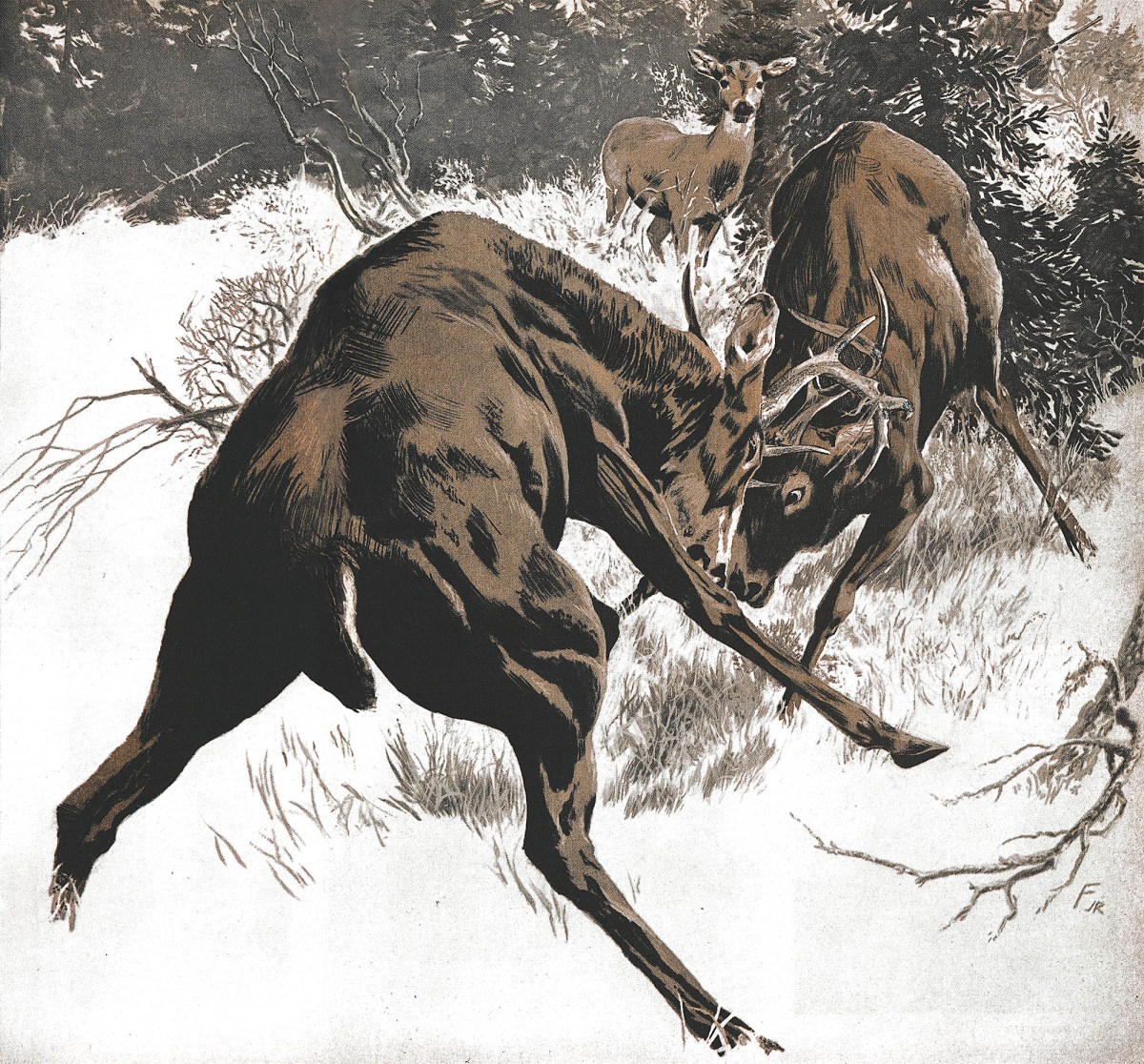
It turned out to be a fortunate error because, as he fought his way through the thick, boggy jungle, he heard a strange sound ahead, a sort of grunting, thudding, clashing noise “all mixed up together,” as he described it. Stealing cautiously forward, he came to a little clearing and found two bucks furiously battling for a doe that stood demurely watching from the edge of the evergreens. The sight completely unhinged Don, and all he could do was stand frozen and stare.
“They’d back off and charge at each other,” he said. “And when they hit, it sounded like a pile driver. Then they’d hook and prance and snort around the clearing, jabbing at each other until all at once they’d back away for another charge.”
Don watched them for several minutes, as he shook from a bad case of buck fever. One of the bucks was a 12-pointer; the other was smaller. Twice Don raised his .30/30 Winchester Model 94 and put its front bead on the larger deer but each time Don shook so much that the sight wobbled all over the clearing.
The third time, he took a deep breath, tensed his muscles, swung the bead along the big buck’s flank, and squeezed the trigger.
At the rifle’s blast, the 12-pointer fell kicking. The smaller buck stood a second, motionless, then whirled with a snort and bounded away behind the fleeing doe.
When Don got to his buck, it lay stone-dead, shot through the neck. It was his first deer. Don dressed it and started to drag it to the road, but he’d gone only a short distance when he realized that he was going to need help. He hid the buck in a thicket and piled some brush over it. Then he set out for the road, and he didn’t waste any time getting there. Three-quarters of an hour later he burst into my house where my wife, Avis, was getting lunch for the youngsters.
“Is anybody back yet?” he asked, panting.
“No,” Avis told him.
“Well, have you got a piece of rope?”
“What do you want to do, tie up a deer?” Avis quipped.
“That’s right,” Don said. “A twelve-point buck I just shot in Peters Swamp.”
“You’re kidding!” Avis said, but she got the chunk of rope.
Don went back and hitched the rope to his buck. Then he dragged it through the brush out to the Griggs place, which was nearer the swamp than the Boy Scout area.
A passing hunter gave him a lift to the Scout area, where he borrowed Bill Curtis’s car and drove back to get his buck. Don managed to boost it over a fender and drove back to the Boy Scout area just after Charlie Lamphear and I had arrived with my buck.
After congratulating each other, we loaded Don’s deer and mine onto my car and took them to George Wright’s weighing station at Eden Corners. My buck tipped the beam at 134 pounds and Don’s 12-pointer at 188.
When we finally arrived home in mid-afternoon, we found two other bucks hanging in the yard. David and Dale had both scored.
After Dad, Dave, and Dale had crossed the Wolcott Branch, they split. Dale had hardly entered the woods when he ran into a procession of deer that someone had spooked from the hollow. There were seven deer in the band, and they ran past Dale, practically in single file.
The first four were does. Then came a small buck, and Dale got his .30/30 Winchester 94 to his shoulder. While he was trying to decide whether to shoot, another doe came bounding out of the brush, and behind her — last of all — a seven-point buck.
Dale didn’t wait any longer. He got his front sight on this seven-pointer, and when it flashed past, he swung and shot. His bullet smashed through both the deer’s shoulders, and his buck sprawled in a heap.
Attracted by the shot, Dave over and helped Dale dress the deer and drag it the short distance out to the road.
By 7:30 a.m., they had Dale’s 175-pound buck loaded aboard my father’s station wagon.
Then they went back into the woods. Dale was through deer hunting, of course, but there’s always a chance for a shot at a bear. Dave figured there were more deer in the hollow where Dale’s band had come from.
“You circle around to the left,” he told dad. “I’ll work in from the other side. We might push something out.” They did. Slogging through the brush, dad jumped seven deer that scattered in all directions without giving him a chance for a shot.
He let out a yell to warn Dave, and soon one of the deer — a three-pointer — came dashing past Dave. As the buck streaked across an opening in the evergreens, Dave pulled up his .30/30 Marlin and squeezed off a quick shot that knocked the deer down.
But as Dave came up to finish it off, the three-pointer jumped up and took off again. Dave’s hurried second shot was a clean miss.
Then began a chase I’d like to have seen. The way Dave tells it, the buck was hit hard enough to leave a blood trail, and Dave followed it as fast as he could, straining his eyes through the brush for another glimpse of the deer. Finally he saw the buck and fired again. This was another miss, and it only made the deer move faster.
That made Dave move faster, and it must have been quite a sight to see him chasing that buck through the pucker brush.
About five minutes later Dave got another peek at the deer as it topped a little rise, and he sent another bullet blasting after it. This one connected and knocked the buck down again, but again the three-pointer was up and away before Dave reached him. Dave’s snap shot as the deer disappeared was another miss.
The two bullets that hit, though, had slowed the buck down considerably. And Dave was persistent. He kept following the blood trail until it finally led to a brook. The buck was sort of half-sitting on the bank beside a pool, and as Dave came up, it slumped and slid into the water.
“I’ve got you now, you old cuss!” Dave said, and fired a final bullet, which converted the 135-pound buck into venison.
That’s how Dave tells it, but my father has another version.
“The way Dave got that deer,” he avers, “is he drownded it!”
Anyway, with the season only a half a day old, we had four nice bucks hanging on the game pole. There was quite a lot of celebrating among the Willey tribe that night, and quite a lot of eating of deer hearts and livers.
Father had seen deer, but had no shots. Bill Curtis and his father had hunted all day without even seeing a deer.
The next morning the two Bills came back to hunt with my father. They parked their cars at the Boy Scout area and hunted the section of Bigelow Mountain where Don and I had been successful the day before.
Again they hunted separately. My father hunted slowly along the wooded slope until he came to an old logging road that he followed up onto the hardwood ridges. Here he stopped to rest. He glanced at his watch and saw that it was 9 a.m.
Just seconds later he heard a faint rustling and turned to see a spikehorn buck step into the woods road behind him.
The deer saw father at the same time. But, as the buck gathered his muscles to spring away, a bullet from dad’s Winchester .32 Special carbine drilled through both lungs and sent him somersaulting. Dad dressed him out, dragged him down to the road, and brought him home. The spikehorn weighed 136 pounds.
That left Bill Curtis Jr. and his father still wandering over the ridges. In the late morning, a little discouraged, Bill Jr. came down to the car and ate a sandwich. When he’d eaten and rested awhile he headed back into the woods, following the same old logging road where dad had shot his spikehorn earlier that morning.
After a while he sat down on a moss-covered log to have a smoke, and a moment later a nine-point buck came walking unconcernedly down the road right toward him.
Stubbing his cigarette under his boot, and raising his .303 caliber Enfield in one quick motion, Bill blasted the buck in the skull, head-on, splitting its rack. The deer dropped dead in its tracks. Shortly after noon Bill had his 213-pound buck dressed and draped over the fender of his car.
Meanwhile, back at the ranch, as they say, my kid brother, Roger, was planning to get into the act. He’d hurried through his barn chores. Then he’d grabbed his .22 caliber Model 66 Winchester and started down the road toward the Boy Scout area to see if he could find father and the Curtises.
His .22 wasn’t exactly a deer rifle, but that didn’t discourage Roger. He was out for venison.
He’d gone about a quarter of a mile down Route 100 when all at once he spied a four-point buck drinking in a beaver pond.
Roger’s first bullet knocked the deer flat, but it jumped up and ran toward the road. Roger knocked it down again. Again it got up and headed back toward the pond. This time a couple of well-placed bullets put it down for keeps.
Almost beside himself with excitement, Roger hid his deer in some brush and started for home on the run to get a knife and a rope.
A short distance up the road, a passing motorist gave him a lift home to break his momentous news. Roger’s buck, his first, weighed 124 pounds, field-dressed. Roger thinks deer hunting is easy now.
“I can’t wait,” he says confidently, “to get another buck next season.”
The rest of us had seven bucks with a total dressed weight of 1,105 pounds of venison for our winter meat supply.
He should talk to Bill Curtis Sr., who never saw a deer. Maybe Bill’s chance will come next year, although, as we tell him, the luck of the Willeys can’t be expected to extend too far beyond the immediate family.
Anyway, at this point the rest of us had seven bucks with a total dressed weight of 1,105 pounds of venison for our winter meat supply.
That should have been the end of the story, but there was one more bonus left for the Willey family.
The following Saturday, Avis wanted to go deer hunting, so I took her out in the late afternoon. I drove down the road toward the old asbestos mine in Eden.
I knew there were some deer down that way, but before we got there, as we passed an apple orchard, I saw a deer standing under a tree. It was too far for us to be sure of its sex, but when I broke out the binoculars I saw that it was a three-point buck.
Avis raised my .308 Savage to her shoulder and touched off a shot. The buck leaped once and landed in a heap beside the tree.
The bullet had struck an unfortunate part of his anatomy and didn’t improve some of the steaks, but anyway Avis had her first deer, a 105-pounder.
Read Next: ‘I Laughed, I Cried.’ After 36 Years, North Woods Hunter Finally Tags His First Deer
As I look back on this memorable hunt, I think it’s interesting that it brought four of our group — Donald, Bill Curtis Jr., Roger, and Avis — their first deer.
We don’t really expect that we’ll be able to duplicate this outstanding success again, but we’ll all be out there trying — including Bill Curtis Sr.
Read the full article here