
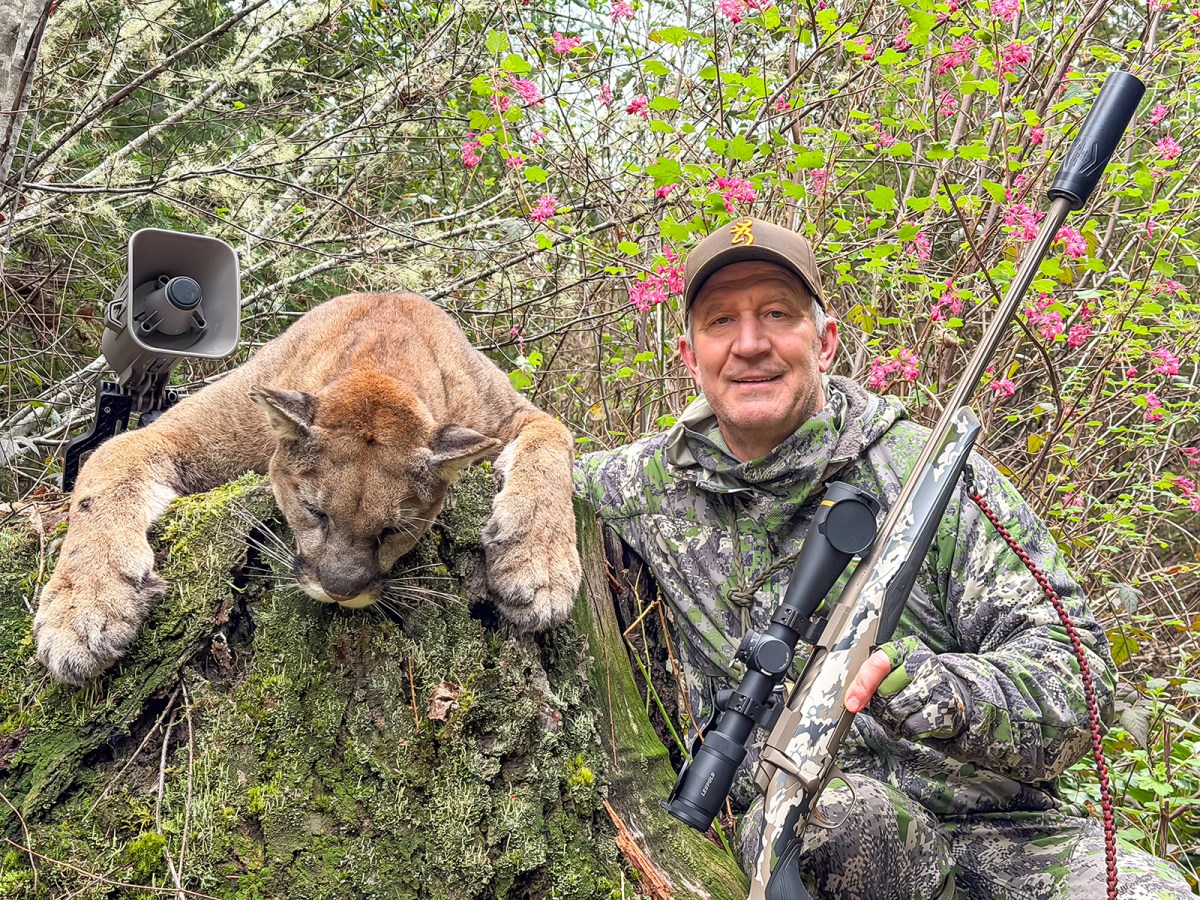
The wind was strong, rain sweeping sideways. I lit up the narrow trail with mating cougar sounds from an electronic call. My rifle in the shooting sticks, scope on 3X, safety off — I was ready.
In my lap lay a short-barreled 12 gauge shotgun with 3-inch payloads of TSS No. 2s. That barrel was pointed 45 degrees behind me, where two trails emerged from a thick grove of Douglas firs. Should a cat approach from behind, the shot would come inside 8 yards.
Eerie cat sounds resonated from the e-caller. After 15 minutes of off-and-on action, I switched to a yearling deer distress sound, the same one I used to call in and kill a cougar in this same area only four days prior.
Two hours of sitting, calling, and waiting in torrential rains and swirling winds, the only time my head left the riflescope was to glance behind to see if that was the cat’s angle of approach. The heavy rain put my every nerve on edge. I didn’t like it. I prefer dead calm conditions when calling big predators, because the slightest movement captures your attention.
The two-hour calling session was draining. Every swaying branch and moving leaf jolted my pulse. More than once fir boughs shifted in the wind, exposing dead maple leaves draped across tree limbs. At a fleeting glance, their horizontal lines looked like the back of a cougar, but each time it turned out to be only brown leaves — just 10 feet away. When calling apex predators in close quarters, your eyes and mind focus in an intense way. It’s unlike any other type of hunting, and that’s what I love about it.
As dark spots on the trail and in thick cover played tricks on my brain amid rapidly waning daylight, it was time to stop. Defeated, I gathered the soaking wet gear and headed home. I’m not a betting man but if I were, I would have put down a large sum on my killing a cat that afternoon. At 3 p.m., less than an hour before I started calling, a cougar was caught on one of my cellular trail cameras. The last time that happened here, I called barely more than two minutes before a tom came running full-speed at the sounds of my mouth calls. When I shot it in the chest, it collapsed seven paces from where I sat.
Mountain Lion Cell Cam Video
The Challenge
I hunt mountain lions only three minutes from my home, in the western foothills of Oregon’s Cascade Range. Over the previous five nights I captured five to seven different cougars each night on multiple trail cameras. All were at night — until now.
This isn’t hard, rugged country to navigate, it’s just very difficult to hunt due to the thick cover and lack of visibility. The mountain lions were showing up with regularity within 200 yards of multiple homes scattered around the edge of the forest. One property owner shared surveillance footage of a tom and female cougar walking between two parked cars in his driveway, 30 feet from his front door. Another home owner showed me a female with three yearlings walking down their driveway. I also caught those lions, and others, on trail cameras. These were the cougars I chased.
Here, amongst nearly one square mile of 18-year-old Douglas fir reprod, Columbia black-tailed deer thrive. So do gray fox, cottontails, opossums, skunks, gray squirrels, and birds — all of which cougars eat. For five years I’ve been lion hunting in this spot and calling them has been my only approach. Hounds are prohibited in Oregon. Bait is legal, but I’ve avoided that.
Two years ago, a few of the neighbors lost their house cats. I caught three cougars on film carrying house cats and found where one laid and ate a fluffy white house cat 150 yards from the doorstep it plucked it from.
What makes calling cougars in this setting so challenging is the density of the cover. Oftentimes when I set up and call I’m carrying only a shotgun. Using mouth calls, targeting cats where shots would come inside 20 yards, sometimes half that. I’ve called in cougars that have instantaneously appeared in the thick brush, but by the time I swung on them for a shot, they’d vanished.
Shooting lanes here are narrow and short. Step into thick cover of tangled branches and underbrush of the Douglas firs, and visibility quickly dwindles to feet, not yards. This is where the cougars are lurking. They come in waves. Sometimes they’re here a day or two, then gone for months. This time, they’d been lingering for over a week. I’d never seen anything like it. Neither have the local biologists or the state game officer I spoke with.
The Learning Curve
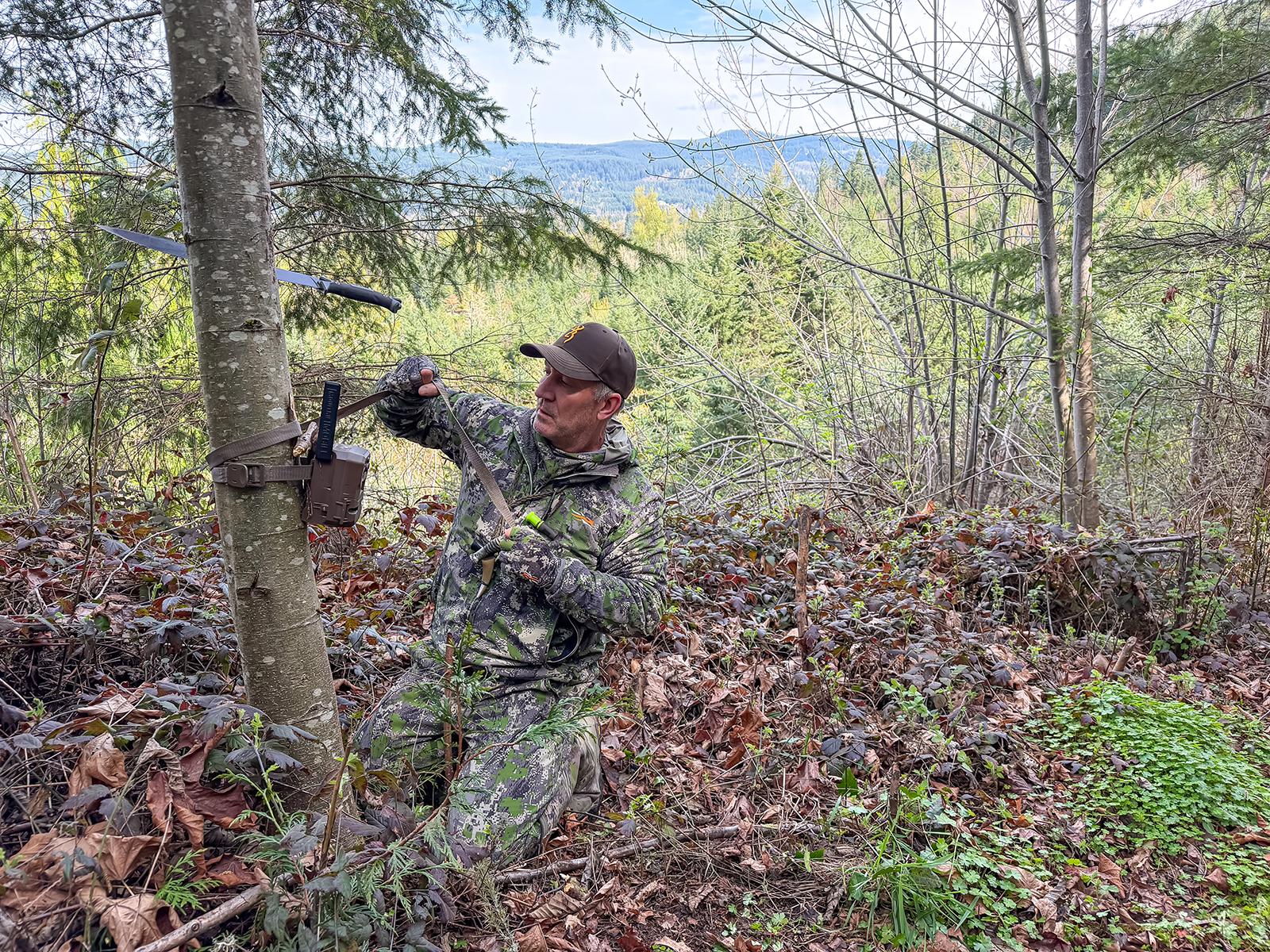
I have more than 25 trail cameras set in this area. Two-thirds are Moultrie cellular cameras. The rest are Stealth Cam DS4K trail cameras set in thick cover and wooded draws that lack cell coverage. I check those cards in the middle of every other day; these cats are used to human traffic. The non-cell trail cameras have caught some key cougar interactions I otherwise would not have seen.
Before I started using cell cameras, I was always behind the cougars, even when I checked cams twice a week. When I switched to cellular trail cameras, the game quickly changed.
I learned that timing is everything when it comes to killing a mountain lion here. I’ve accumulated hundreds of videos of cougars. As luck would have it, most of the daytime captures seem to come when I’m on the road. One time a cougar sat inches from a trail camera, purring, overlooking a house 125 yards away where kids and dogs could be heard playing in the middle of the day. Another time a big tom courted a female for several minutes in broad daylight. There are more. Lots more.
I set all trail cameras to video mode on the highest definition setting. A quality video clip reveals more than a still image ever will. I can’t count the number of times a single cat popped up on the thumbnail but when I played the video clip and I’d find two, sometimes three cats move through the frame. The sounds cougars make are intriguing. Not only are the video clips — and I download all of them — educational, but they’ve also allowed me to pattern cat movement across the wooded ridgeline, through a densely forested bowl, and into backyards. It’s the Moultrie cellular trail cameras that have upped my success rate, allowing me to get on cougars right when they show up.
Bringing It All Together
On March 27 a single adult female cougar showed up in the middle of the night. It appeared again on the 28. This time a tom was minutes behind it. The peak of the cougar rut appears to be late March through mid-April in this valley. I have over 75 trail cameras set throughout the hills and valleys of the area; they’ve been my leading source of information. But the cats on March 27 and 28 appeared on the very top of a timbered ridge just after midnight. They had too far of a head start for me to catch them.
On the morning of March 29, things changed. At 5:22 a.m. a female and two yearlings popped up on the same Moultrie cellular trail camera the previous cats were caught on. Two minutes behind them came another adult female. They all walked at a quickened pace down an ATV trail. I knew which direction they were headed.
At first light I was set up and ready, electronic call in place. I figured the cats were between a quarter-mile and a half-mile from where I called. Then again, they could be closer, or long gone. I set up on a main trail that offered the longest shooting distance on the property, just over 50 yards. It was only a few yards wide; a narrow window, as everything else surrounding me was brush and dense fir trees.
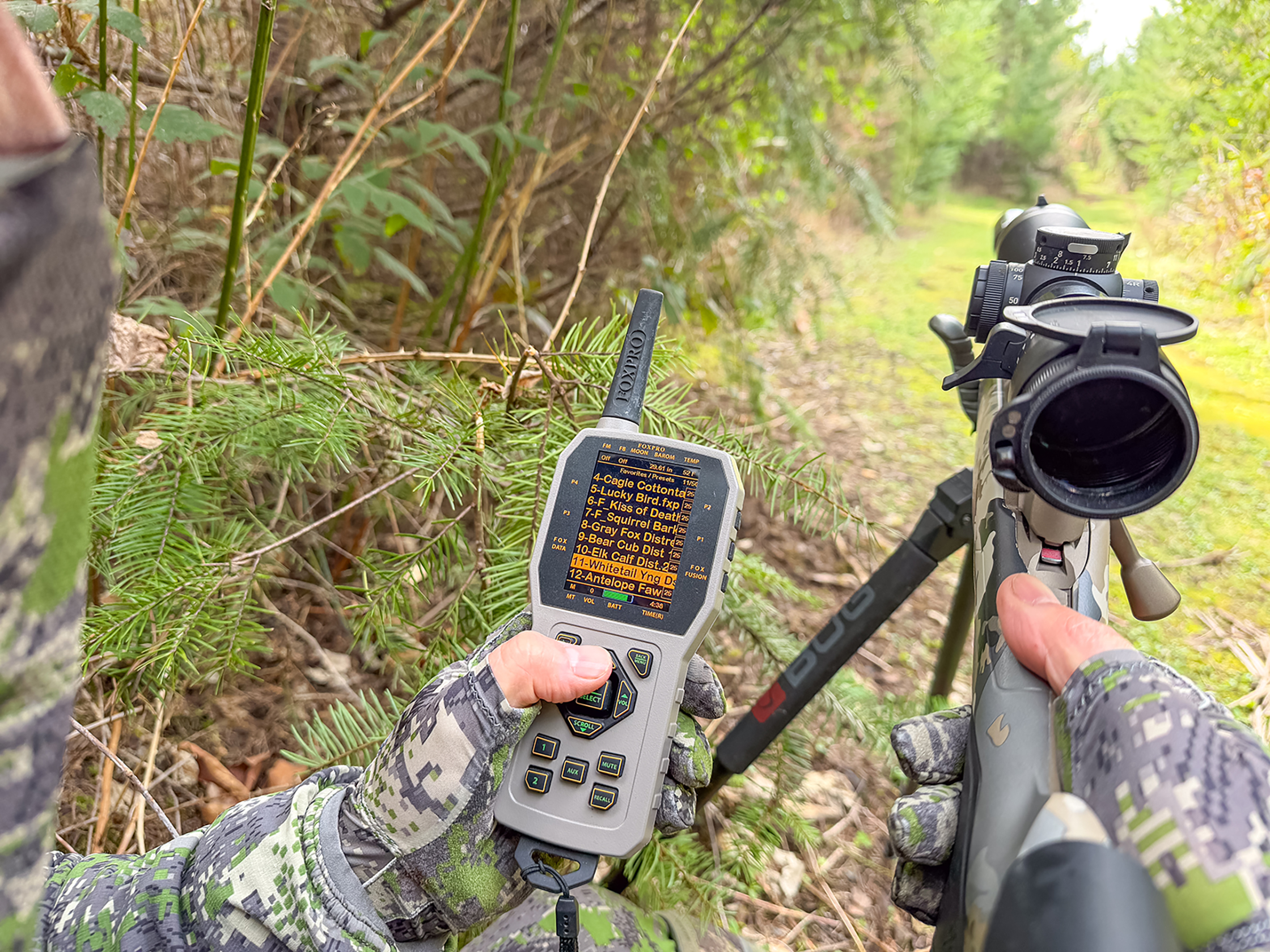
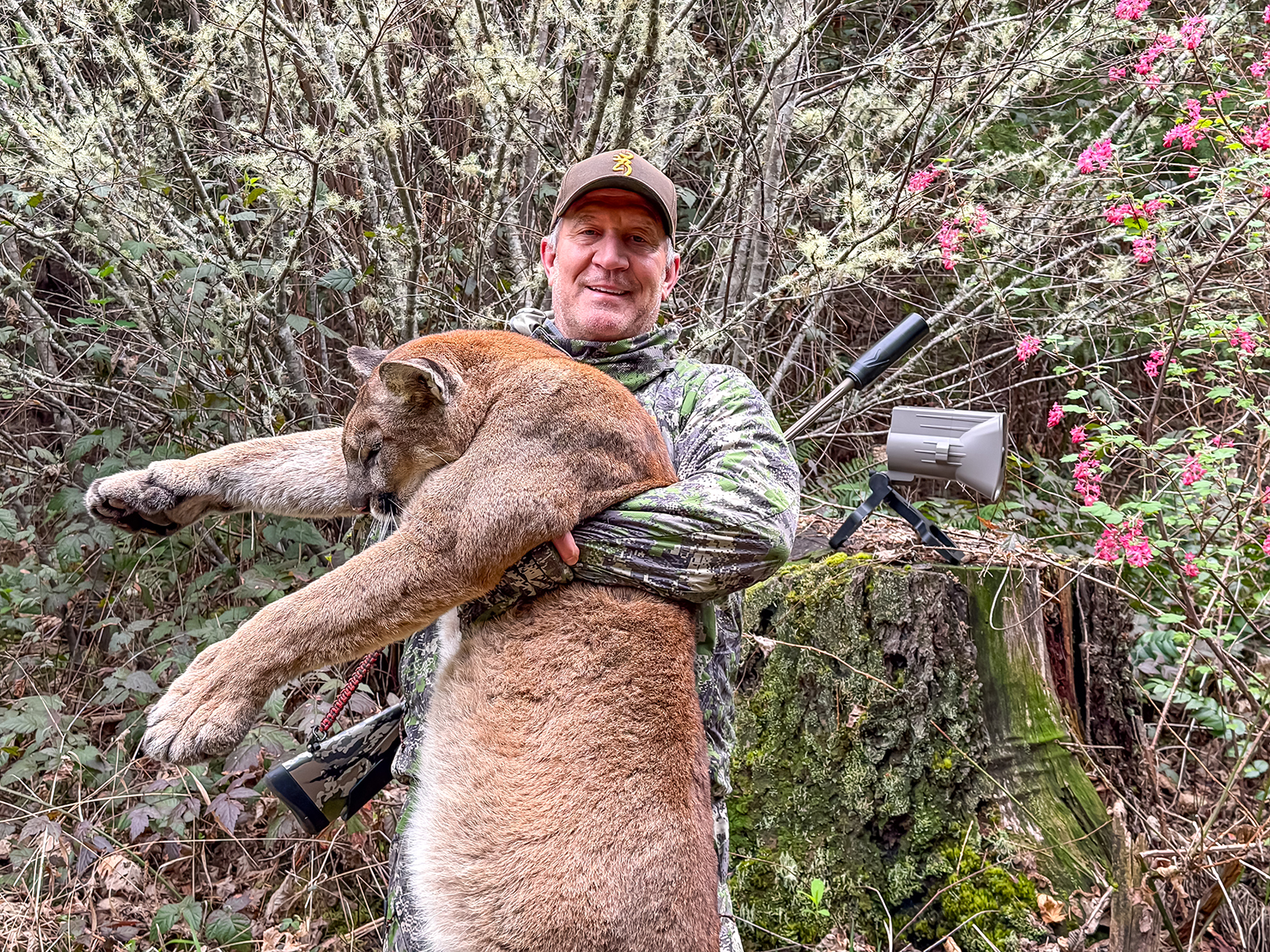
With a FoxPro X24 speaker on a stump 45 yards from where I sat, I played the first series of cottontail sounds at half-volume. The morning was calm and clear. Sounds carried well.
After about a minute, I paused the call, then resumed. The play and pause sequence lasted about 10 minutes, then I switched to a bird distress sound. I ran similar splits to the cottontail, but at full volume and for around 15 minutes. Bird distress sounds are a favorite of mine, it’s what I used to call in the last cougar I shot here and I’ve brought in many bears with it too. Twice I paused the call due to Steller’s jays frantically calling from the trees. Their elevated chatter often follows incoming predators, mainly coyotes and gray fox. I felt confident a cougar was closing in but nothing showed up.
Then I ran gray fox distress sounds for over 10 minutes, also at max volume. Gray fox are a favorite food of cougars in this area. The woods were silent during the pauses. More than once I got the feeling something was near.
Due to the high volume of blacktails in the area, and the fact this is what seems to initially draw cougars to this spot, the next call was a young deer distress. Over the years here I’ve caught several cougars on the prowl for deer, and I’ve found one deer kill. Given the amount of talkative lions I was catching on trail cameras, and the onset of the rut, I combined cougar whistles with the deer distress sounds.
Nearly 10 minutes into the mixed sequence, Steller’s jays again stirred. This time the ruckus came 150 yards directly in front of me, on the very trail I predicted the cats to be on. Jays flittered, swarmed, and squawked above the tree tops. I turned off the call for a couple minutes, watching and listening. I had that feeling you get when someone enters a room, but you don’t see or hear them. That sensation washed through my body.
When nothing showed, I filled the stillness of the woods with young deer distress sounds. The crispness and clarity of every sound at high volume is what I love about the X24. My rifle was rock solid, pointed at the trail two feet to the right of the speaker. The glowing red FireDot of the Leupold scope shined against the dark shadows.
After a bit, I’d had enough. Coming out of the gun, I raised the remote control to turn it off. Surely a cat should have appeared by now, I thought. Just then, it happened.
From the very spot I’d anticipated, a cougar materialized. Its body was dark in the narrow trail. It took two steps, looking up at the blaring speaker the whole time. Its head seemed small. It was a female. As it rounded a small bush, I placed the FireDot in the center of its chest and pulled the trigger. The 6.8 Western barely kicked, hardly making a sound with the suppressor on the end of the barrel. The cougar crumpled on the spot, twitched a few times, then went limp.
From the time I laid eyes on the cat until pulling the trigger, scarcely more than a second elapsed. But it was one of the best moments of my hunting life, as it always is when a cougar comes to a call. It’s simply a grand sight to witness, seeing a cougar moving in to kill something. Breathtaking, stunning, powerful, sometimes peaceful, all at once.
Scott Haugen
I’ve been fortunate to make a living as a full-time outdoor writer for over 25 years. Fourteen of those years were spent hosting hunting TV shows. I’ve been blessed to embark upon hundreds of big game hunts around the world. I rank calling in a cougar in this dense habitat to be among the most challenging of any hunting I’ve experienced. The hours and failed attempts I’ve amassed without seeing a cat are humbling. I still have so much to learn, but that’s what I love about the process. These cats are smart, brave and hard to predict. Only hunts I’ve undertaken for maneater lions, tigers, and bears eclipse the joys, challenges, and thrills of calling in a cougar.
When cougars show up, my life transforms. Chores go neglected, phone calls and emails are ignored. I give answers to my wife without knowing the questions. Even my dogs look at me differently. They know my mind is elsewhere.
As I write these words, it’s 5:30 a.m. I began working three hours ago; sleep eludes me when cougars are present. But I keep getting sidetracked. During this three-hour window, 19 thumbnails of five different cougars have appeared on my Moultrie App and all in the same area I just hunted. It’s the most cats I’ve ever caught on video, and for the longest time.
I have another cougar tag in my pocket. It will be time to hit the woods soon. This could be the day.
Read the full article here