

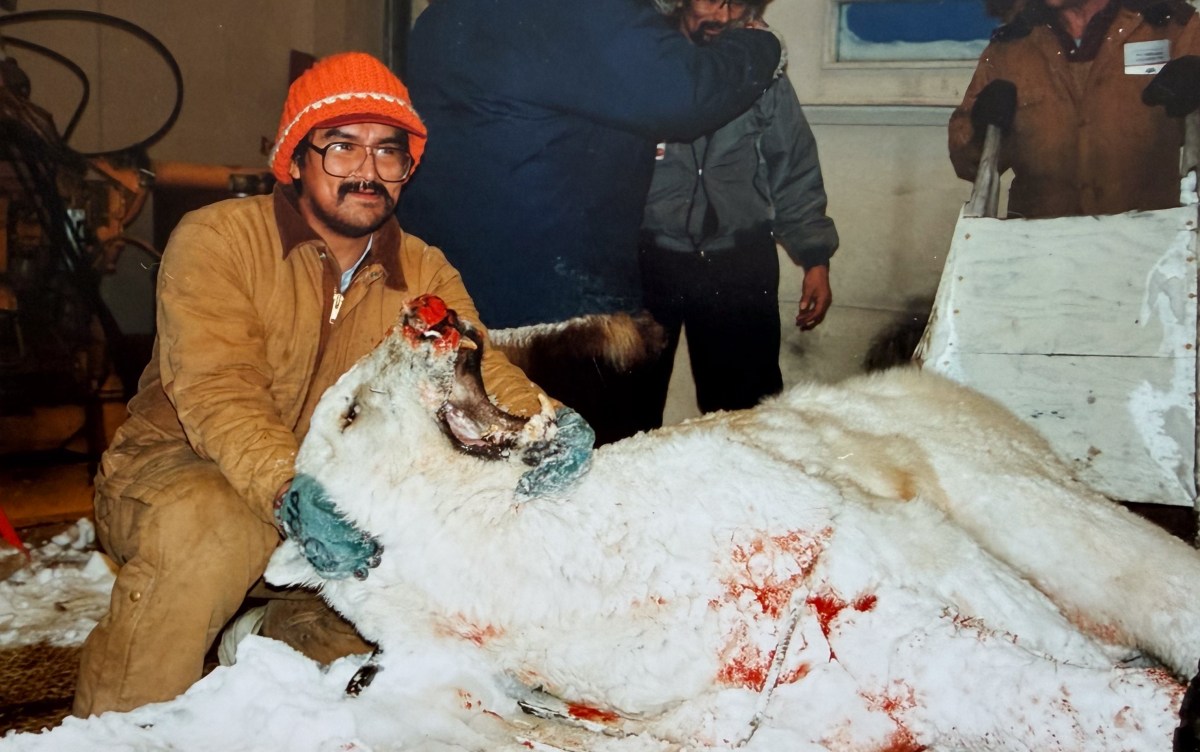
A gunshot rang out from next door. My wife, Tiffany, and I paused in the middle of our Christmas dinner. Seconds later a phone call broke the silence.
“I just shot a polar bear that’s been trying to get into our house,” said the village reverend. “I can’t get out the door because the bear broke it. Can you help?”
It was 1992 in the remote village of Point Lay, Alaska. The Inupiat community numbered less than 100 people back then. Located on the edge of the Chukchi Sea, 230 miles north of the Arctic Circle, Tiffany and I were two of four school teachers in the village.
I stuck my head outside to test the weather. Temperatures hung at 30 degrees below zero. There was only a slight breeze. We’d been locked in snow since early September. Twenty-four hours of darkness consumes the Far North this time of year.
Getting dressed, I filled Tiffany in on the details of where I was going. The reverend shot at the bear with a .45-70 through the front door. He was confident he hit it, as it let out a loud growl. But he had no idea, where he might have hit it. I planned on getting to the house, seeing if the bear was dead, and if not, tracking it down.
“You be careful,” Tiffany said as I headed out. I knew what was going through her mind. It weighed heavy on me, too. We didn’t bring it up. Two years prior I had tracked down and killed a man-eating polar bear here. It was a horrific ordeal. A story for another time.
I made it to the reverend’s house and saw polar bear tracks all around it. There was blood at the front door. No sign of the bear. The top hinge of the heavy, metal door was popped from the frame and the thick door was bent inward at a 45-degree angle. Wanting to get on the bear while it was fresh, I’d ask for the details later.
A crimson blood trail glowed on the white snow under the beam of my flashlight. I moved fast. A .220-grain soft point was already chambered in my .30-06 rifle. The blood flowed steady for 75 yards. I was hot and sweating under my down clothes. Flashbacks of the man-eater from years past loomed in my mind.
Along the way, two clear footprints caught my eye, one from the front paw, one from the back. They seemed oddly small. I didn’t stop.
The blood trail ascended a 20-foot pile of snow and ice, pushed there by a bulldozer that cleared a road in the village. I slowed down, searching crevasses for the bear. Clearing a rise, I held the flashlight under my barrel, lighting up the snow in front of me. Peeking over the rise, down toward the banks of a frozen Kasegaluk Lagoon, the light’s beam moved along the blood trail. Through the scope, a polar bear twitched on the ice, 25 yards in front of me.
“Whatchya got?” the reverend said, putting his hand on my shoulder. It startled me. I was so focused on the bear I failed to see or even hear the reverend by my side. I didn’t like that. When hunting wounded predators, your senses are heightened and your mind laser focused. Nerves are wound tight. Nothing in the world exists in that moment in time, other than the task at hand. One mistake or moment of hesitation could mean death. I prefer sorting out situations like this alone.
I pointed to the bear. The reverend had his .45-70 ready. We crept closer. The bear was on its side. From 10 yards we watched as it took a final breath. Steam rolled from its nostrils and bleeding mouth. Blood-stained snow surrounded the white bear.
The polar bear had been trying to make its way into the house for nearly half an hour, but the reverend and his wife kept it at bay. They first noticed it staring into the kitchen window, its black nose pressed against the glass — two feet from where the reverend’s wife stood over the sink. The woman screamed and hit the bear in the nose with a frying pan just as it broke through the window.
The bear moved to the back of the house, where it tried going through a door. It failed but kept circling the house, checking windows and doors as points of potential entry. Finally, the bear’s appetite got the best of it. That’s when it tried breaking down the front door. The man had no choice but to shoot the bear.
The small size of the bear surprised me. Maybe 125 pounds and a little over five feet from head to tail.
That winter in Point Lay, polar bears were thick. Children were escorted to school by parents toting guns. Adults patrolled the streets to keep bears away.
During the time we called Alaska’s North Slope home, from 1990 to 1997, Native hunters killed approximately 110 polar bears annually in Alaska, with most being taken in the dark winter months. Male polar bears are active throughout the winter, unlike pregnant females that seek dens to enter their deep winter sleep and give birth. That year in Point Lay, the pack ice created an open lead very near shore. Seals hauled out on the edges of the open water. During winter in the Arctic, where there are seals, polar bears will be nearby.
Alaska’s polar bears are divided into two populations. During our time, the Beaufort Sea population was estimated at between 1,800-2,000 polar bears while the Chukchi Sea population was estimated between 3,000-5,000. With so many boars competing for food, younger and weaker bears are displaced. Those bears sought out easy food sources in the village.
A few weeks prior to the Christmas bear encounter, a gunshot blast from one of my neighbors surprised me. A quick second shot followed, then a third.
I looked out the front door to see Charles, a local man, pointing his rifle barrel between his feet. He fired one more shot. Houses in the Arctic are built on stilts to keep the foundation from melting the permafrost, and the house from sinking. Many of the locals put their dog houses under their homes to protect them from the wind and to keep polar bears from getting them.
Charles’ pack of dogs incessantly barked blood curdling screams. Then, under the glow of a streetlight, I saw what Charles was shooting at. A polar bear was after a dog, trying to force his way beneath the staircase to kill it. Elevated four feet at the highest point, the steps tapered to the ground and left enough space for the dog to retreat. The bear was too big to maneuver into the small cubby to make the kill. When Charles saw what was happening, he darted inside his house, grabbed a rifle and shot the bear through the gaps in his porch before it dug its way to the dog.
After the shooting was over, I tried helping Charles pull the bruin from under the steps. The bear’s back feet were enormous, its hair long, the pads like rough abrasive paper. We couldn’t budge it.
A crew loaded the polar bear onto a sled and took it to the firehouse where the skinning commenced. Though squaring over nine feet, the boar was thin. It should have easily carried another 200 pounds of fat. This was common among problem polar bears.
Twelve days later, an Inupiat man drove his snowmachine across the frozen lagoon to get some whale blubber from an ice cellar located on a spit, about two miles from the village. This ice cellar was dug by hand, decades prior. It was still used to store whale meat and blubber for the villagers.
When the man reached the entrance to the ice cellar, a large male polar bear was there. It ran off, but came back. It got aggressive and approached the man. He shot and killed it. I helped skin that massive bear. It squared over 10 feet and weighed well over 1,000 pounds.
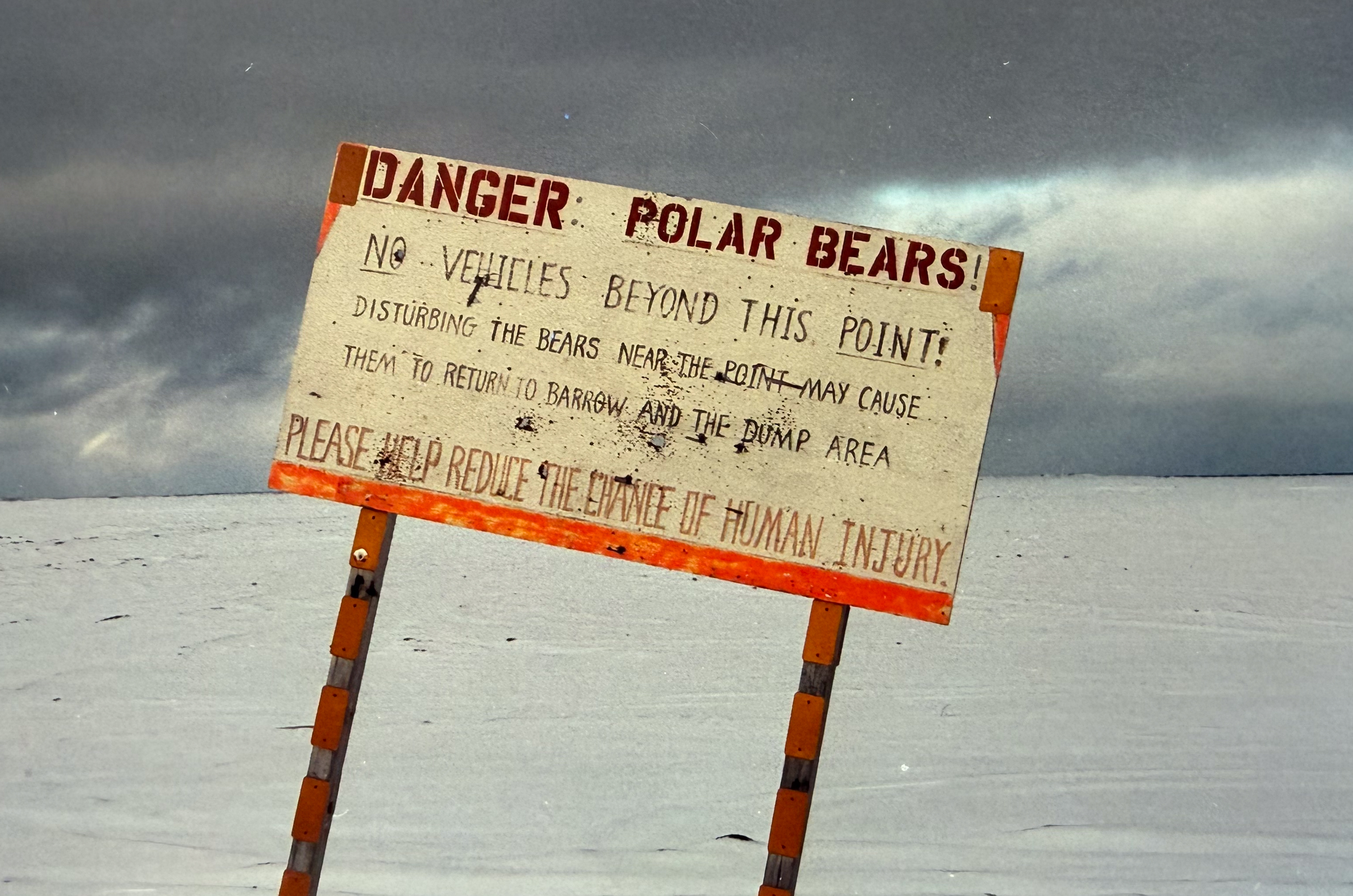
One year in Point Lay, the decision was made to change the runway lights. With the incessant storms that year, bush pilots said red lights would be easier to see than the current blue ones. Soon after the change was made, a polar bear walked down both sides of the runway and swatted every red light. They were replaced. Again the bear broke every red light. Blue lights were reinstalled. The bear never touched them.
When in Barrow — known as Utqiaġvik, today — for a basketball tournament with the high school team I coached, I visited with a local man. It was December, 1993, and the man had shot two polar bears the day of our arrival. He shot both bears on the frigid pack-ice, only a few miles off the coastline. Driving along the ice in search of tracks, the hunter found fresh sign on the outskirts of the village. Following the tracks for over two miles he finally caught a glimpse of a bear’s yellowish hide reflecting in the headlights of his snowmachine. The bear was oblivious to the man’s intrusion as he crept closer. Stepping from his machine, the man shouldered his rifle and found the bear in his iron sights. A high shoulder shot dropped the nanuq at 60 yards.
Pulling his snow machine next to the large beast, the man worked its heavy, blubber-laden body onto his sled and headed home. Since he was only minutes away from the village, he could make it back quickly and commence skinning the bear before it froze.
Traveling a short distance, the man encountered another polar bear. It was walking his freshly made snowmachine trail. It was walking right at him, head held high, nose probing the cold air.
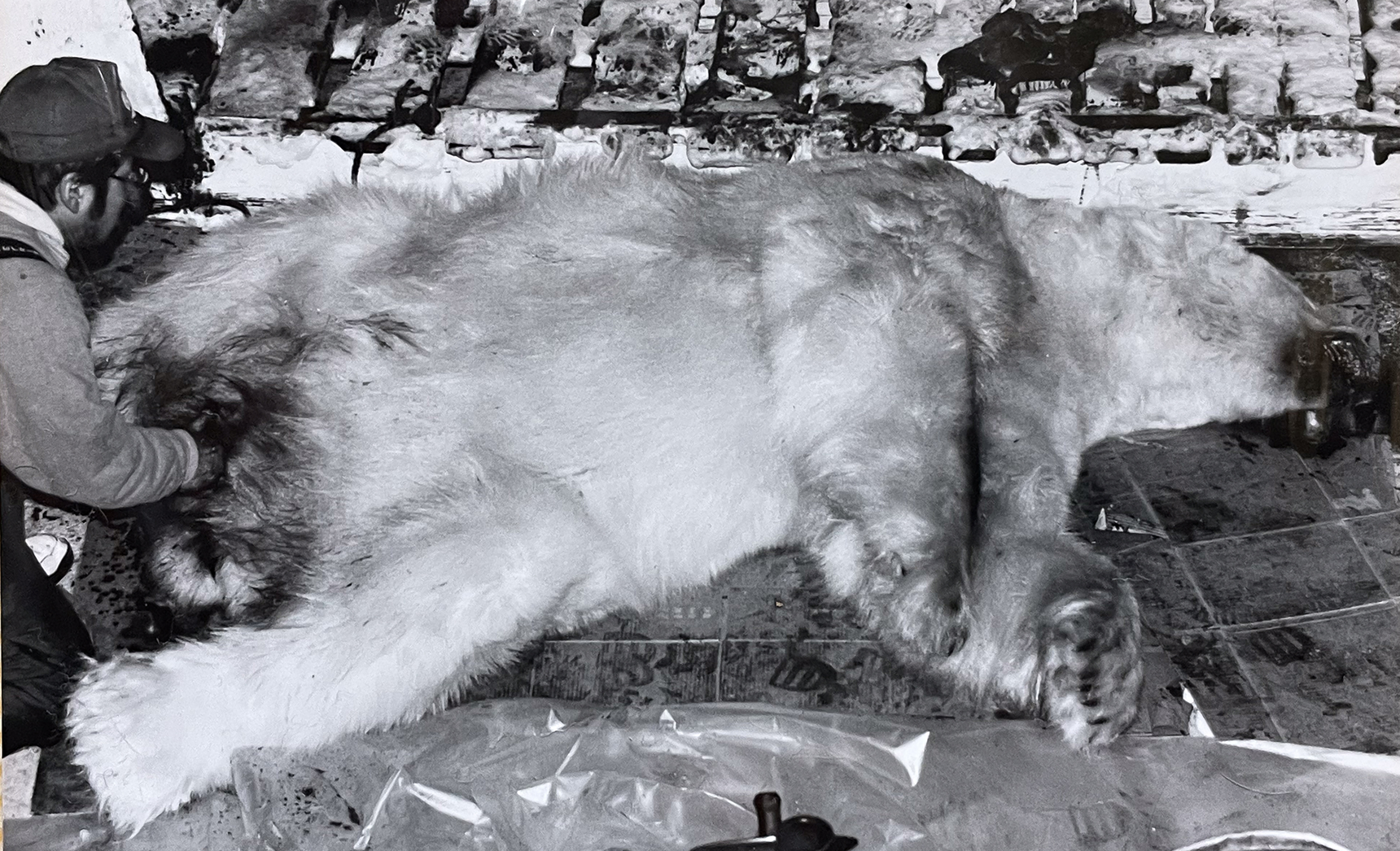
Stopping, the man dismounted and shot that big bear square in the chest. The second polar bear was the biggest the man had ever killed, and one of the biggest he had ever seen taken during his more than 50 years living in Barrow. With an estimated weight of over 1,300 pounds, I measured the hide of the great ice bear. Sprawled out on the snow by his front doorstep, the frozen hide taped out at 10 feet, 11 inches. Had it been thawed and relaxed, the hide would have easily gone over 11 feet. The lesser bear squared out at nine feet, six inches.
Two days later the man found me in the high school gym. Following our game he couldn’t wait to tell me the news. He’d just shot two more polar bears on the edge of town. I walked out with him to take a look. One squared over 10 feet. Four polar bears in four days, two of which squared over 10 feet. All the meat was consumed by family members, the hides used as blankets for camping. That was a special time in a special place.
I also coached high-school cross country. Village kids practiced for one month, then everyone flew to Barrow in mid-September for a single race. That was the season. A few days prior to the meet, several of Barrow’s whaling teams found success. Six bowhead whales lay on the beach. Bowheads are big, measuring 60 feet in length, and they weigh about one ton per linear foot. Villagers pitched in to butcher the whales. Then a storm hit. Heavy snow, extreme winds and rough seas kept the whales from being butchered in a timely fashion.
When the cross country teams arrived in Barrow, everyone gathered for a meeting. With the storm and dead whales came polar bears. Dozens of them. Rather than have the race around the outskirts of the northernmost town in the United States, as usual, it would be confined to one city block. The course was roped off. The road was cleared by a bulldozer. Residents lined the course. Most held rifles and shotguns. The kids ran the square for the entire race. It was snowing hard and blowing over 40 mph. The wind chill was close to 0 degrees. Visibility was less than 30 feet most of the race. But those kids never complained. They were the toughest kids I ever coached — or met.
In the summer of 1997, Tiffany I and moved from the Arctic. We took jobs as teachers at an international school in Sumatra, Indonesia, a half-mile from the equator. In the spring of 1998 I received an email from a former Point Lay student, Bill Junior. Junior and I hunted and trapped a lot together. He was a great kid, a hard-working student and athlete. We shared moments in the field I’ll never forget.
Junior said that he and his girlfriend were heading home on a snowmachine after they’d spent the day ice fishing 11 miles north of Point Lay. The wind began to blow, making it hard to differentiate between the ground and the sky. They traveled along the edge of the Chukchi Sea. Daylight was waning. With his vision limited, Junior battled to keep the snow machine on the trail.
Halfway home, movement caught Junior’s eye, 60 feet away. Stopping the machine, the distraction looked to be an Arctic fox, its white fur and black nose difficult to decipher in the dimly lit conditions. Junior grabbed his .243 and went after the white fox. Approaching within 30 feet of the mound the fox had been on, Junior saw nothing.
Then, in a powerful flurry of snow and ice, a polar bear erupted from a hole in the snow. The big polar bear lurched forward, hitting top speed in two strides. With no time to shoulder his rifle, Junior shot from the hip. The polar bear crumpled three steps from Junior’s feet. The tiny bullet hit the charging bruin in the center of its left eye, penetrating to the brain. Instant death. Junior’s miraculous shot saved his own life.
Read Next: Miracle on the Tundra: How One Caribou Hunter Survived a 5-Day Blizzard
As the bear lay motionless in the snow, Junior stared at it, thinking about what could have been. A few seconds later a cub emerged from the den. Following the scent trail, the cub made its way to the sow. Junior tied a rope around the cub for his girlfriend to hold, so he could load the sow onto the sled. Junior, being Native, had taken other polar bears in his young life.
Upon their arrival in Point Lay, residents gathered to hear the story, see the cub, and give thanks for the safe return of two of their children.
Both bears were in top physical shape, the sow still carrying fat left over from its long winter nap.
What he thought had been an Arctic fox was actually the head of the sow poking out of the den for the first time. People had been traveling that same trail for three weeks and no one had any clue a polar bear den was near.
Before leaving the scene, Junior stuck his head inside the dark, stale smelling den to make sure there were no other cubs. It was empty. As for the cub, a little sow, it was flown to Anchorage. The Anchorage Zoo did not have a polar bear and welcomed it. Junior named her Ahpun, one of the Inupiaq words for snow. Ahpun adjusted well to zoo life. I visited her many times over the years. It was fascinating to watch the bear grow from a cub to a massive female bear — it lived to be 20 years old.
More than any other wildlife I encountered while living in the Arctic, the polar bear commanded respect and awe. Their sheer power, lighting speed, ability to swim over 100 miles in the icy ocean, and the ease at which they endured temperatures that would kill a human in minutes, are still remarkable to me today.
Editor’s Note: For personally signed copies of Scott Haugen’s best selling book, Hunting The Alaskan High Arctic, visit scotthaugen.com
Read the full article here