
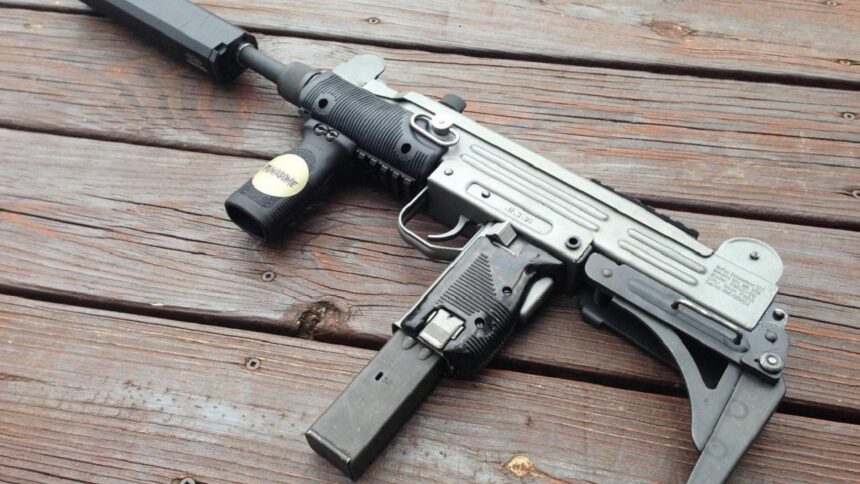
Summary and Key Points: Major Uziel Gal designed the Uzi for Israel Military Industries in 1950 after a British Mandate prison term. Adopted by the Israel Defense Forces in 1955, the 7.7-pound submachine gun borrowed its telescoping bolt and grip-fed magazine from the Czech Sa vz. 23, fired 600 rounds per minute, and saw action at Suez, in the Six-Day War, and during the Yom Kippur War. IMI built 1.5 million for 90 nations, the Secret Service carried it, and the MP5 replaced it.
Meet the Uzi
Some weapons are famous because of what they did on the battlefield.
The Uzi is famous for that and for much more.
It armed a brand-new nation, guarded an American president, and became Hollywood’s go-to bad-guy gun for two decades.
Not bad for a stubby piece of stamped steel designed by a young Israeli officer who didn’t want his name on it.
The Uzi submachine gun (SMG)/machine pistol is an iconic firearms design, with a silhouette possibly as recognizable as that of the AK-47.
It emerged at a perfect time and place in post-World War II history.
In 1948, the newborn State of Israel, surrounded on all borders by active enemies, recognized the need to rationalize and update its chaotic weapons inventory.
Israel Military Industries (IMI), the official state arms manufacturer, commissioned two engineering officers to design a new SMG for the Israel Defense Forces (IDF).
Designed in 1950 by Major Uziel “Uzi” Gal of the Israel Defense Forces (IDF), the gun proved itself in the Suez Crisis of 1956, the Six-Day War of 1967, the Yom Kippur War in 1973, and more.
Who Was Uziel Gal, Designer of the Uzi?
The man who designed the iconic SMG was born Gothard Glas and grew up in Munich. His boyhood home was full of swords, pistols, and rifles. He began designing weapons at age ten.
Uzi Submachine Gun.
He took a long rifle and tried to shorten it into a carbine by sawing off the barrel.
His family emigrated to what is now Israel after Hitler and the Nazis came to power in 1933, and he kept at it, although it was illegal under the British Mandate of Palestine.
His family settled in Kibbutz Yagur in the Land of Israel; his great passion for guns returned.
The young man joined the Palmach, the elite fighting force of the underground Haganah organization; he found the perfect occupation: weapons development.
However, he was caught – and sentenced to 7 years in prison by the British Mandate authorities for his work with illegal weaponry.
He was pardoned after just over two years in Acre Prison.
Behind bars, the young Gotthard passed the time designing a new submachine gun.
After Israel gained independence, Glas changed his name to Uziel Glas, later to Uziel Gal, and became an officer in the Israel Defense Forces (IDF).
His submachine gun was adopted in 1955, and although he didn’t want his SMG named after him, the Israeli government overruled him, and the Uzi was born.
Borrowed Ideas, Better Execution
The Uzi wasn’t built in a vacuum.
Gal borrowed the two best ideas from the Czech Sa vz. 23: a telescoping bolt that wraps around the rear of the barrel, and a magazine that feeds through the pistol grip.
However, Gal simplified the package and built it from stamped sheet metal so it could be mass-produced.
The telescoping bolt is the key.
Because the bolt wraps around the barrel, the receiver could be short without cutting barrel length.
The result was a 10.2-inch barrel in a gun that measured just 18.5 inches with the stock folded and 25.2 inches extended.
Unloaded, it weighed about 7.7 pounds and fired 9mm Parabellum at roughly 1,300 feet per second.
The heavy bolt kept the cyclic rate manageable at 600 rounds per minute.
That’s slow for a submachine gun, and that’s a good thing.
It meant a soldier could actually keep rounds on target while firing in full auto.
The magazine in the grip gave you something called “hand-finds-hand” reloading.
In the dark, under stress, your support hand goes straight to your firing hand, and the magazine goes home.
No fumbling.
The stamped receiver also had grooves that gave sand and grit somewhere to go, which mattered in the Negev and the Sinai.
Proven In The Desert
IDF paratroopers first fielded the Uzi in 1956 in the Sinai during the Suez Crisis.
In the 1967 Six-Day War, it earned its reputation in close-quarters fighting in trenches and urban areas.
One Israeli veteran called it “an outstanding weapon which could be fired one-handed and almost never jammed.”
Other countries took notice. West Germany adopted it as the MP2 in 1959. FN in Belgium built it under license.
The Dutch fielded it too.
Eventually, more than 90 nations used some version of it, and IMI built over 1.5 million of them, bringing in more than $2 billion in export earnings.
The Uzi Was A Great Weapon, But Had Its Flaws
None of that made it perfect.
The Uzi fires from an open bolt, which keeps it simple and helps with cooling.
However, it also had a nasty habit of firing when dropped or struck.
Its practical accuracy was limited to about 50 yards.
When the IDF formally stopped training soldiers on it in 2003, an army spokesman flatly called it “antiquated.”
The compact variants pushed the limits.
The Mini Uzi cycled at about 950 rounds per minute, and the 1986 Micro Uzi at roughly 1,250. Fun on a range day. A real handful anywhere else.
It takes some getting used to when firing it, but it is a blast to shoot and very manageable.
The iconic weapon’s reputation is well-deserved.
If you are ever out in Vegas and want to shoot one, then you are in luck.
However, be prepared to spend some money on ammo; it empties a magazine in about three seconds, and you’ll want to keep shooting.
From The Battlefield To The Washington Hilton
The Uzi’s most famous moment didn’t come in a war. On March 30, 1981, John Hinckley Jr. shot President Ronald Reagan outside the Washington Hilton.
Seconds later, Secret Service agent Robert Wanko was photographed with an Uzi drawn from a briefcase, scanning the crowd.
That image went around the world.
After that, Hollywood couldn’t get enough. Action heroes, drug dealers, terrorists, and cops all carried one on screen throughout the 1980s.
For a generation of Americans, the Uzi became the visual shorthand for automatic weapons, period.
Gal retired from IMI, moved to Philadelphia in 1976, and died there in September 2002 at 79.
Its Place In History
The Uzi was the right gun at the right time for a country that badly needed it. It was cheap to build, easy to maintain, and reliable in conditions that choked other weapons.
In my opinion, its biggest contribution was proving that a small nation with limited industry could design and mass-produce a world-class weapon and then sell it to everyone else.
The modern submachine gun has largely given way to short-barreled rifles and personal defense weapons. However, the Uzi is still in service in plenty of places, and IWI still sells versions of it today.
The man who designed it never wanted his name on it. The world put it there anyway.
Best Ever? For Its Time…Yes
Many have said that the Uzi was the best submachine gun ever. While it is arguably the best-known submachine gun ever, later weapons supplanted it, as with many.
For its time, however, the Uzi was the best submachine gun for a long time, as evidenced by its widespread international use by elite Special Forces units and law enforcement units, such as the US Secret Service.
However, the advent of the H&K MP5 changed the landscape, becoming the workhorse of submachine gun units.
It replaced the Uzi and was used by more than 40 countries.
But the Uzi remains an icon; its name alone is instantly recognizable. It was a prime example of brilliant design and engineering.
About the Author: Steve Balestrieri
Steve Balestrieri is a National Security Columnist. He served as a US Army Special Forces NCO and Warrant Officer. In addition to writing on defense, he covers the NFL for PatsFans.com and is a member of the Pro Football Writers of America (PFWA). His work was regularly featured in many military publications.